IBM sub-1nm nanostack chip technology
TECH

IBM sub-1nm nanostack chip technology

29+
Signals

Strategic Overview

  • 01.
    On June 25, 2026, IBM Research unveiled what it calls the world's first sub-1-nanometer chip technology, demonstrated at a 0.7 nm (7 angstrom) node and presented at VLSI 2026.
  • 02.
    The centerpiece is a 3D transistor architecture called nanostack that vertically stacks and staggers transistors, bonding separate wafers with different silicon crystal orientations to optimize each transistor type independently.
  • 03.
    The chip packs nearly 100 billion transistors on a fingernail-sized die, roughly twice the density of IBM's 2021 2 nm chip, with claimed gains of up to 50% more performance or 70% greater energy efficiency.
  • 04.
    IBM targets production within five years, aims the node at AI data centers, and projects the platform can extend silicon scaling for at least a decade.

Deep Analysis

Going up, not smaller: the wafer-bonding trick that makes nanostack work

The conceptual heart of IBM's announcement is a shift in axis. Conventional scaling crams more transistors into the x-y plane until features approach the size of individual atoms and the physics breaks down. The nanostack design instead adds the z-axis, vertically stacking and staggering transistors using 3D sequential integration so that different material combinations can sit on different layers [2]. IBM describes it as the industry's first 3D nanosheet-based architecture, a direct descendant of the gate-all-around nanosheet transistor the company first demonstrated in 2015 [2].

What distinguishes IBM's flavor of stacking from a textbook CFET (complementary field-effect transistor) is the bonding step. Rather than building both transistor types on one monolithic wafer, IBM bonds two separate wafers with different silicon crystal orientations - (110) for the PFETs and (001) for the NFETs - so each transistor type can be tuned independently before they are fused together [3]. This staggered sequential approach is the source of the density and efficiency gains: nearly 100 billion transistors on a fingernail-sized chip, roughly double the density of the 2021 2 nm part, with IBM claiming up to 50% more performance or 70% better energy efficiency against that baseline [1][2]. IBM says it experimentally validated the scheme through ultra-thin dielectric wafer bonding, dual-channel engineering, and a working CMOS inverter, with results presented at VLSI 2026 [1].

The '0.7nm' number is a label, not a ruler

The single most useful thing to understand about this announcement is that '0.7 nm' is not a physical measurement of anything on the chip. A silicon atom is roughly 0.2 nm wide, so a transistor literally 0.7 nm across would be a few atoms - physically impossible to build as described. Node names like '7 angstrom' have for years been marketing-flavored generation labels that track density scaling rather than the width of any single feature, and the technical community immediately zeroed in on this distinction, treating the 'sub-1nm' framing as a density milestone rather than a dimensional one. The genuine innovation, the same readers note, is the vertical stacking - the chip earns its transistor count by going up, not by shrinking past the atom.

This reframing matters because it changes what 'sub-1nm' should make you expect. The real engineering claim is a 40% improvement in SRAM scaling at the 7 angstrom design, which IBM bills as the largest such leap in over a decade [2][4]. Analyst Ian Cutress reinforces that the headline density figure is legitimate transistor-level scaling rather than a renaming exercise, even as he cautions that the marketing gloss can obscure how much of the gain comes from architecture versus lithography [3]. The takeaway: judge nanostack by transistors-per-area and joules-per-operation, not by pretending 0.7 nm is a width you could measure with a ruler.

The lab-to-fab gap and IBM's no-fab problem

IBM is a research organization, not a high-volume chip manufacturer, and that is the crux of the skepticism. What was demonstrated is a set of test structures, and reaching production requires developing the device, process, inspection, design tools, and supply chain simultaneously over roughly five years [3][6]. Ian Cutress calls that five-year timeline reasonable rather than conservative, but flags the large distance between a lab demonstration and shippable silicon, and predicts the first commercial product will be a smartphone processor or a small, expensive AI chiplet rather than a general-purpose CPU or GPU [3][6].

The stacking also moves the hard problems around rather than eliminating them. Cutress notes the engineering difficulty shifts from electrical toward mechanical and thermal challenges, and that the dielectric used to bond wafers carries a real parasitic-capacitance penalty - by his estimate, 10 nm of bonding oxide adds about 2.5% to cell-level effective capacitance, which is why the design needs sub-30nm bonding oxide to stay competitive [3]. Heat density is the recurring worry: stacking active transistors on top of one another concentrates power in a smaller volume, and skeptics argue that tradeoff was downplayed in the announcement. A reasonable historical proxy for IBM's path to volume is Japan's Rapidus, which licensed IBM's earlier 2 nm technology and is targeting mass production around 2027 - a reminder that IBM's research wins reach the market through licensees, not its own fabs.

Why AI data centers are the whole point

Why AI data centers are the whole point
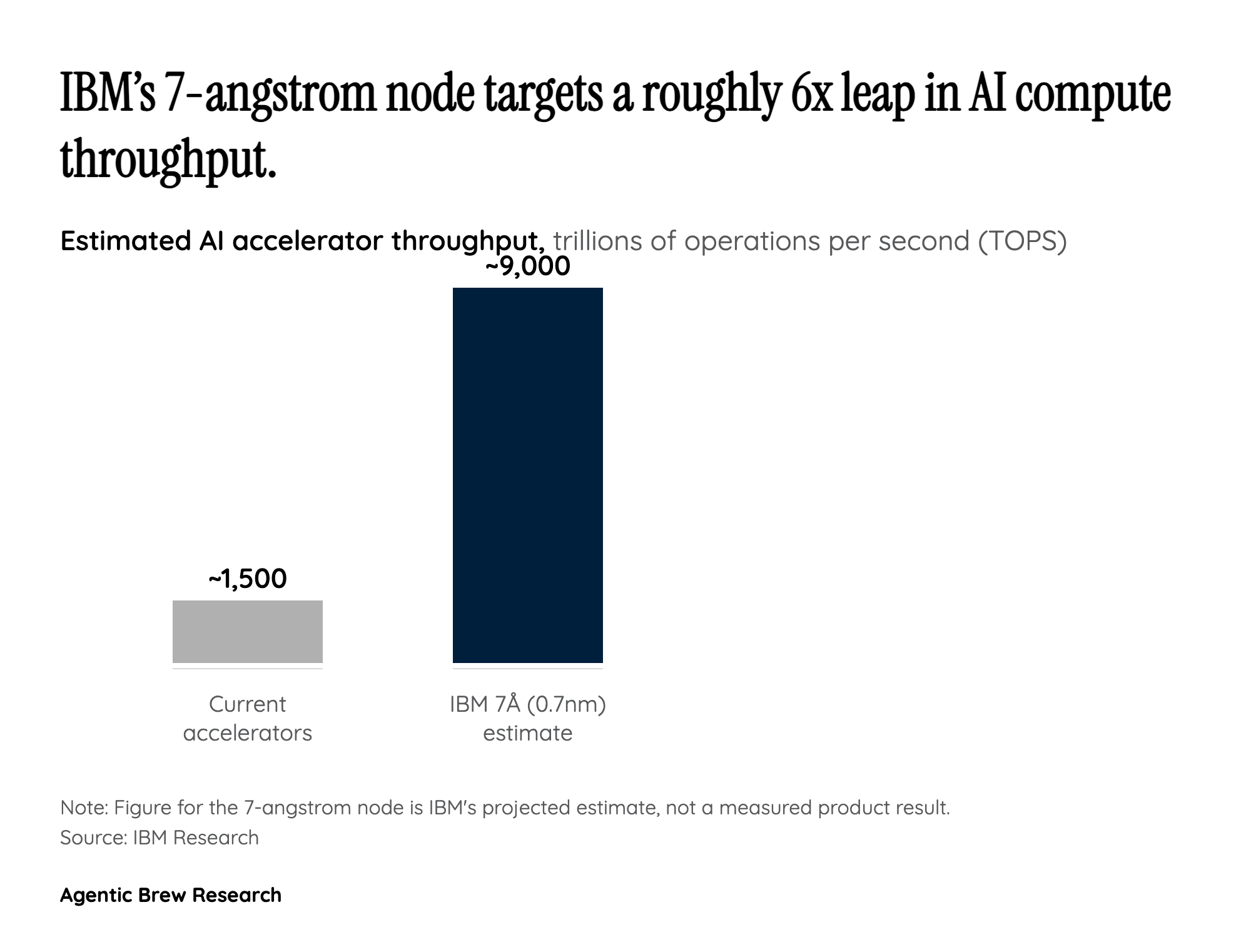
IBM estimates its 7-angstrom node could reach about 9,000 TOPS versus roughly 1,500 for current AI accelerators - a projected, not measured, figure.

IBM is not pitching nanostack at phones or laptops first; it is pitching it at the economics of training large models. The company estimates a 7 angstrom chip could reach roughly 9,000 TOPS (trillions of operations per second) versus about 1,500 TOPS for current accelerators - close to a 6x jump - and frames the payoff in wall-clock terms, suggesting a typical LLM training run could compress from around three months to a couple of weeks [2]. Paired with the 70% energy-efficiency claim, the value proposition is aimed directly at the power and cost ceilings now constraining frontier AI build-outs [1].

That strategic framing also explains the market reaction and its limits. IBM stock surged about 6% premarket on the announcement before relinquishing the gains as investors weighed the five-year horizon between a lab result and revenue [5]. The architectural story is real - extending scaling past 2D limits by exploiting the z-axis, with a roadmap IBM says can run for at least a decade [1][2]. But for a technology whose payoff is denominated in data-center training runs that do not yet have silicon, the honest read is that nanostack is a credible bet on the next decade of AI compute, not a product anyone can buy this year.

Historical Context

2015
IBM unveiled the nanosheet (gate-all-around) transistor architecture, the predecessor to the nanostack design.
2021
IBM unveiled its 2 nm chip, the baseline against which the new sub-1nm density and performance gains are measured.
2026-06-25
IBM debuted the world's first sub-1 nm (0.7 nm / 7 angstrom) chip technology with the nanostack architecture, presented at VLSI 2026.

Power Map

Key Players
Subject

IBM sub-1nm nanostack chip technology

IB

IBM Research (Albany, New York)

Developer of the nanostack architecture and the sub-1nm node; presented the work and owns the roadmap.

AS

ASML

Equipment partner and supplier of High-NA EUV lithography tooling relevant to the node, though IBM built its test structures without High-NA.

LA

Lam Research, Tokyo Electron, SCREEN Semiconductor Solutions

Named equipment and process ecosystem partners in IBM's announcement.

FU

Future foundry partners (unnamed)

Needed to develop the device, process, inspection, design tools, and supply chain simultaneously to reach production; IBM is a research org, not a high-volume manufacturer.

IB

IBM investors / equity market

Reacted to the announcement; stock moved on the news but gains faded over commercialization-timeline concerns.

Fact Check

6 cited
  1. [1] IBM Debuts World's First Sub-1 Nanometer Chip Technology
  2. [2] IBM unveils the world's first sub-1nm node chips
  3. [3] IBM Announces 0.7nm Process Node with NanoStack
  4. [4] IBM Research details first sub-1-nm chip, unveils nanostack architecture
  5. [5] IBM Stock Surges 6% on Revolutionary Sub-Nanometer Chip Technology
  6. [6] IBM Shows Sub-1-nm Chips, Targeting Production in 5 Years

Source Articles

Top 5

THE SIGNAL.

Analysts

"Frames the breakthrough as a landmark that pushes computing beyond the nanometer era and reinvents how chips are built for dramatically more power and energy efficiency."

Jay Gambetta
Director, IBM Research / IBM Fellow

"Considers the five-year timeline reasonable rather than conservative but warns of a large gap between lab test structures and commercial silicon; expects the first product to be a smartphone processor or small AI chiplet, not a CPU or GPU, and notes the density claim is legitimate transistor-level scaling."

Dr. Ian Cutress
Semiconductor analyst, More Than Moore

"Emphasizes that the engineering challenge shifts toward mechanical and thermal problems and that the bonding oxide carries a parasitic-capacitance cost."

Dr. Ian Cutress
Semiconductor analyst, More Than Moore
The Crowd

"The world’s first sub‑1 nanometer node chip is here. Delivering 70% greater energy efficiency, this breakthrough powers a new era of computing that’s more capable while using less energy. Dig into this next-gen tech: https://t.co/NkzAahH49S"

@@IBMNews1363

"BREAKING: $IBM surged +8% premarket after unveiling its most advanced chip ever made. IBM just unveiled a new chip design called "0.7nm," the densest one ever built. It packs nearly 100 billion transistors onto something the size of a fingernail, almost double the density of"

@@BullTheoryio666

"IBM has a fun interactive demo for their 7A announcement. You can zoom in from a tennis ball all the way down to a single atom, with 5nm, 3nm, 2nm, and their new 7A chip shown to scale. https://t.co/wGr6LSo5lX"

@@lithos_graphein29

"IBM Debuts World's First Sub-1 Nanometer Chip Technology"

@u/truecakesnake95
Broadcast
IBM, 세계 최초 0.7나노 AI 칩 공개! 엔비디아도 긴장할 반도체 혁명 시작되나?

IBM, 세계 최초 0.7나노 AI 칩 공개! 엔비디아도 긴장할 반도체 혁명 시작되나?

IBM and Lam Research: Sub-1nm High-NA EUV Collaboration for Future AI Computing

IBM and Lam Research: Sub-1nm High-NA EUV Collaboration for Future AI Computing

Black hole merger direct waves & IBM sub-1nm chip prototype - News (Jun 25, 2026)

Black hole merger direct waves & IBM sub-1nm chip prototype - News (Jun 25, 2026)