Google DeepMind's SynthID Bio watermarks AI-designed proteins for biosecurity
TECH

Google DeepMind's SynthID Bio watermarks AI-designed proteins for biosecurity

25+
Signals

Strategic Overview

  • 01.
    Google DeepMind announced SynthID Bio on September 30, 2026, a watermarking technology for synthetic biology that embeds imperceptible signatures into both protein sequences and predicted 3D structures.
  • 02.
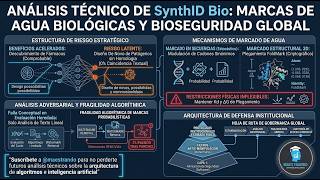
    The method uses two distinct mechanisms: nudging amino acid selection with a cryptographic key for sequences, and fine-tuning part of AlphaFold 3's diffusion network so the watermark is embedded directly in model weights for structures.
  • 03.
    Wet-lab testing on three protein binder targets (VEGF-A, SARS-CoV-2 spike RBD, and PD-L1) showed watermarked designs matched unwatermarked versions on hit rate, binding affinity, and sequence diversity.
  • 04.
    DeepMind published a methods paper in Nature and open-sourced the code, in vitro validation data, and model weights for the research community.

Deep Analysis

Two Watermarks, One Protein: How DeepMind Hid a Signature Inside Both Sequence and Shape

Most watermarking lives on the surface of a file - a few altered pixels, a biased token in a sentence. SynthID Bio marks a physical molecule instead, using two separate mechanisms stacked on top of each other. For sequences, the system nudges which amino acid gets chosen at each position using a cryptographic key, while a tool called ProteinMPNN rejects any substitution that would break the fold; for structures, DeepMind fine-tuned part of AlphaFold 3's own diffusion network so the watermark is baked directly into the model's weights rather than added after the fact [1]. The method, and the validation behind it, was published as a peer-reviewed methods paper in Nature, with code and model weights open-sourced alongside it [2].

What makes this more than a lab curiosity is that DeepMind tested it on physically synthesized proteins, not simulations alone. Across three different binder targets - VEGF-A, the SARS-CoV-2 spike protein's receptor-binding domain, and PD-L1 - watermarked designs matched the hit rate, binding affinity, and natural sequence diversity of unwatermarked versions in wet-lab testing [3]. That result extends a watermarking program DeepMind has been building since 2023, when SynthID first shipped for AI-generated images before expanding into video and, by late 2024, open-sourced text watermarking [4]. The broader SynthID family has already watermarked more than 100 billion images and videos and over 60,000 years of audio, with partners including OpenAI, NVIDIA, and Kakao [5]- scale that made biology, with its much harder physics-constrained 'file format,' the obvious next target.

The Watermark's Blind Spot: A Missing Signature Proves Nothing

DeepMind is unusually candid that SynthID Bio solves a narrower problem than the launch framing suggests. The company itself lists resistance to deliberate tampering as an open challenge: very short proteins may carry too few marked amino acids to detect reliably, fusing a marked protein onto an unmarked one can dilute the signal below the detection threshold, and because detection is inherently statistical, wherever the threshold gets set, it trades false positives against false negatives [6].

The bigger structural issue is what a missing watermark actually tells a screener - which is nothing definitive. An unmarked sequence could be a naturally occurring protein, the output of a model that was simply never watermarked, or a watermarked design that's since had its signal stripped or diluted; screening software has no way to distinguish between those three cases [6]. That's why both DeepMind and outside commentary frame this explicitly as one layer in a defense-in-depth stack rather than a standalone fix - 'no single biosecurity intervention is a silver bullet,' as one outlet covering the launch put it [1]. It also doesn't touch the threat model that worries biosecurity researchers most: someone designing a harmful sequence that looks nothing like any known toxin in sequence space while still folding into something dangerous. A watermark on that design would only tell a screener an AI made it - not that it's dangerous - and only if the model that made it chose to embed one in the first place.

Why DeepMind Needs an Industry It Doesn't Control to Say Yes

A watermark nobody checks for is just an invisible pattern. SynthID Bio's actual value depends on two adoption decisions DeepMind can't make unilaterally: model developers have to choose to embed the watermark when they release a protein-design tool, and DNA synthesis companies have to adopt detection and agree to exchange cryptographic keys with whatever central verification service ends up running the checks. DeepMind doesn't operate a protein-ordering service itself, so it's positioning itself here as a catalyst for an industry standard rather than the standard-setter.

There are early signs of buy-in. James Diggans, VP of Policy and Biosecurity at Twist Bioscience - a DNA synthesis company - publicly called the approach 'a promising new addition to the biosecurity toolbox that could strengthen screening, focus resources on sequences that warrant closer review and make biosecurity more efficient as AI-designed biology continues to advance' [1]. Biosecurity policy expert Sarah Carter, of Science Policy Consulting, framed it in similar terms as 'an important piece of the puzzle for tracking the provenance of biological designs' [7]- notably, both experts reach for additive, hedged language ('a piece of the puzzle,' 'an addition to the toolbox') rather than declaring the screening gap closed. The same logic extends to research collaborators: DeepMind worked with Stanford's Hie Lab and the Arc Institute to integrate the watermark into the Evo 2 model and mark the genome of an Evo-2-designed bacteriophage, with early testing in bacterial cultures confirming the phages stayed functional [6]- a genome-scale extension beyond the original protein-binder use case, and a sign DeepMind is trying to seed adoption across the wider research ecosystem, not just lock the technique to its own models.

The Skeptics' Case: An Old Trick in a New, High-Stakes Wrapper

The reception outside DeepMind's own channels has been more mixed than the launch announcement implies. On the largest public discussion thread, celebratory reaction (and no shortage of replicant jokes) sat alongside real technical pushback. One recurring objection is that hiding a signal in synonymous codon choices is a well-understood idea in DNA steganography circles, not a novel invention - the achievement, on this reading, is making it work end-to-end with a verified detector and open weights, not the underlying trick itself.

A second line of skepticism goes after the 'function fully preserved' framing directly. Commenters pushed back on the idea that you can meaningfully watermark a single molecule the way you watermark a block of text or an image, arguing that any sequence change risks some effect on three-dimensional structure or function that a handful of test cases won't surface. A working biologist in the discussion zeroed in on DeepMind's own bacteriophage result, noting that the announcement's language - that 'some' of the watermarked phages remained functional - implies the rest did not, which would suggest the wet-lab validation holds up best for simple, structurally forgiving protein binders and gets shakier for more biologically complex designs.

A third thread read the whole announcement more cynically: as a way for Google to fingerprint its own models' outputs and make it easier to spot (and potentially exclude) competitors' AI-generated sequences from clean training data and public databases - a data-moat argument that echoes similar suspicions aimed at other companies sitting on large proprietary genetic datasets. None of this contradicts DeepMind's technical claims so much as it questions how far those claims actually reach, and who benefits most if the industry standardizes around DeepMind's specific implementation.

Historical Context

2023-08
Launched the first version of SynthID for watermarking AI-generated images, released to select Vertex AI customers using the Imagen text-to-image model.
2024-10-23
Made its AI text watermarking tool open source, following earlier expansion of SynthID into video and audio watermarking.
2026-09-30
Announced SynthID Bio, extending the SynthID watermarking family into synthetic biology and protein design for the first time, alongside a Nature publication.

Power Map

Key Players
Subject

Google DeepMind's SynthID Bio watermarks AI-designed proteins for biosecurity

GO

Google DeepMind

Developer of SynthID Bio; controls whether and how watermarking gets embedded into its own protein-design and structure-prediction models, and who it shares code and weights with.

TW

Twist Bioscience

A DNA synthesis company whose screening pipeline is the practical chokepoint for whether watermark detection ever gets used at the point an AI-designed sequence is ordered; its public endorsement signals openness from a major synthesis vendor.

SC

Science Policy Consulting (Sarah Carter)

Independent biosecurity policy voice whose endorsement lends outside credibility to the provenance-tracking framing, separate from DeepMind's own messaging.

HI

Hie Lab (Stanford University) & Arc Institute

Academic collaborators who extended SynthID Bio beyond single proteins to genome-level watermarking of an Evo-2-designed bacteriophage, testing whether the approach generalizes past DeepMind's own models.

AD

Adaptyv Bio

Partner providing the in vitro validation that watermarked protein binders actually fold and bind as designed - the evidence that turns this from a computational claim into a physically demonstrated one.

Fact Check

7 cited
  1. [1] Google DeepMind's SynthID Bio can watermark AI-designed proteins without breaking them
  2. [2] SynthID Bio: watermarking methods for AI-designed proteins
  3. [3] Google DeepMind Embeds Watermarks in AI Proteins, Raising Biosecurity Questions
  4. [4] Google DeepMind is making its AI text watermark open source
  5. [5] SynthID Bio: Google DeepMind's AI Protein Watermark
  6. [6] Google's SynthID Bio can watermark AI-designed protein binders without breaking them
  7. [7] Introducing SynthID Bio

Source Articles

Top 5

THE SIGNAL.

Analysts

“Supportive but measured, framing SynthID Bio as one useful tool among several for tracking provenance rather than a complete solution: 'SynthID Bio is an important piece of the puzzle for tracking the provenance of biological designs.'”

Sarah Carter
Biosecurity policy expert, Science Policy Consulting

“Welcomes the approach as additive to existing screening rather than a replacement for it: 'a promising new addition to the biosecurity toolbox that could strengthen screening, focus resources on sequences that warrant closer review and make biosecurity more efficient as AI-designed biology continues to advance.'”

James Diggans
VP of Policy and Biosecurity, Twist Bioscience
The Crowd

“SynthID Bio is our new family of watermarking methods made for AI-generated biological designs. In a world first, we can now embed an imperceptible signature directly into protein sequences without affecting their biological function. 🧵”

@@GoogleDeepMind548

“Today, we announced SynthID Bio, a method to watermark and detect AI-designed proteins, the building blocks of life. We believe this is the first time humanity has successfully synthesised AI-designed proteins that are both functional and watermarked.”

@@pushmeet527

“Today in @Nature, we introduce SynthID Bio, a family of watermarking methods for protein sequences and structures, that we believe will contribute to responsible development of AI for biology.”

@@davidstutz9272

“Google DeepMind today announced SynthID Bio to watermark and detect AI-designed proteins”

@u/TorturedPoet30325
Broadcast
From deepfakes to DNA: the science of watermarking AI

From deepfakes to DNA: the science of watermarking AI

SynthID Bio: The Invisible Signature Inside AI Generated Proteins

SynthID Bio: The Invisible Signature Inside AI Generated Proteins

20261001 Análisis de SynthID Bio y Bioseguridad en IA

20261001 Análisis de SynthID Bio y Bioseguridad en IA