The mechanism, and where the signal gets weak
Claude's watermark is a version of Google DeepMind's SynthID-Text approach, published in Nature in 2024, and Anthropic has applied it automatically to every Claude model released after August 2, 2025 [1][11]. Anthropic says watermarking has no effect on output quality, creativity, or readability, and a watermarked response reads as indistinguishable from an unwatermarked one [3].
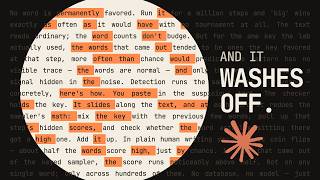
Under the hood, the method works by nudging which word gets picked at each generation step rather than altering anything a reader can see: a secret key, run against the recent context, effectively holds a knockout tournament among the plausible next-words at every step, and which words win reshuffles continuously so no single word or phrase is ever permanently favored. A detector that holds the same key can rerun that same scoring process over a piece of text and recover the statistical pattern it left behind. Google's own testing of this approach at scale, across roughly 20 million live Gemini responses, found only about a hundredth of a percentage point difference in thumbs-up rate and a roughly 0.5% increase in latency versus unwatermarked generation - a data point that helps explain why Anthropic can claim the watermark doesn't touch output quality.
The signal isn't uniform, though: short or fact-heavy text gives the model very few alternative word choices to encode the pattern into, so detection is weaker on that kind of output [3]. Editing resilience follows a related logic - the watermark travels with text that's copied and pasted, and light editing probably won't remove it, but a complete rewrite in which every word is replaced will strip it entirely [3]. TechCrunch frames the light-editing case directly: if content has only been lightly edited, nearly all the words are the human author's own, and there's very little, if anything, for the watermark to attach to [3].