
General Intuition's $6B robotics funding round
TECH

General Intuition's $6B robotics funding round

23+
Signals

Strategic Overview

  • 01.
    General Intuition is in talks to raise a new funding round at a $6 billion pre-money valuation, with new investors Valor Equity Partners, Point72 Ventures, and Seven Seven Six joining existing backers Khosla Ventures and General Catalyst.
  • 02.
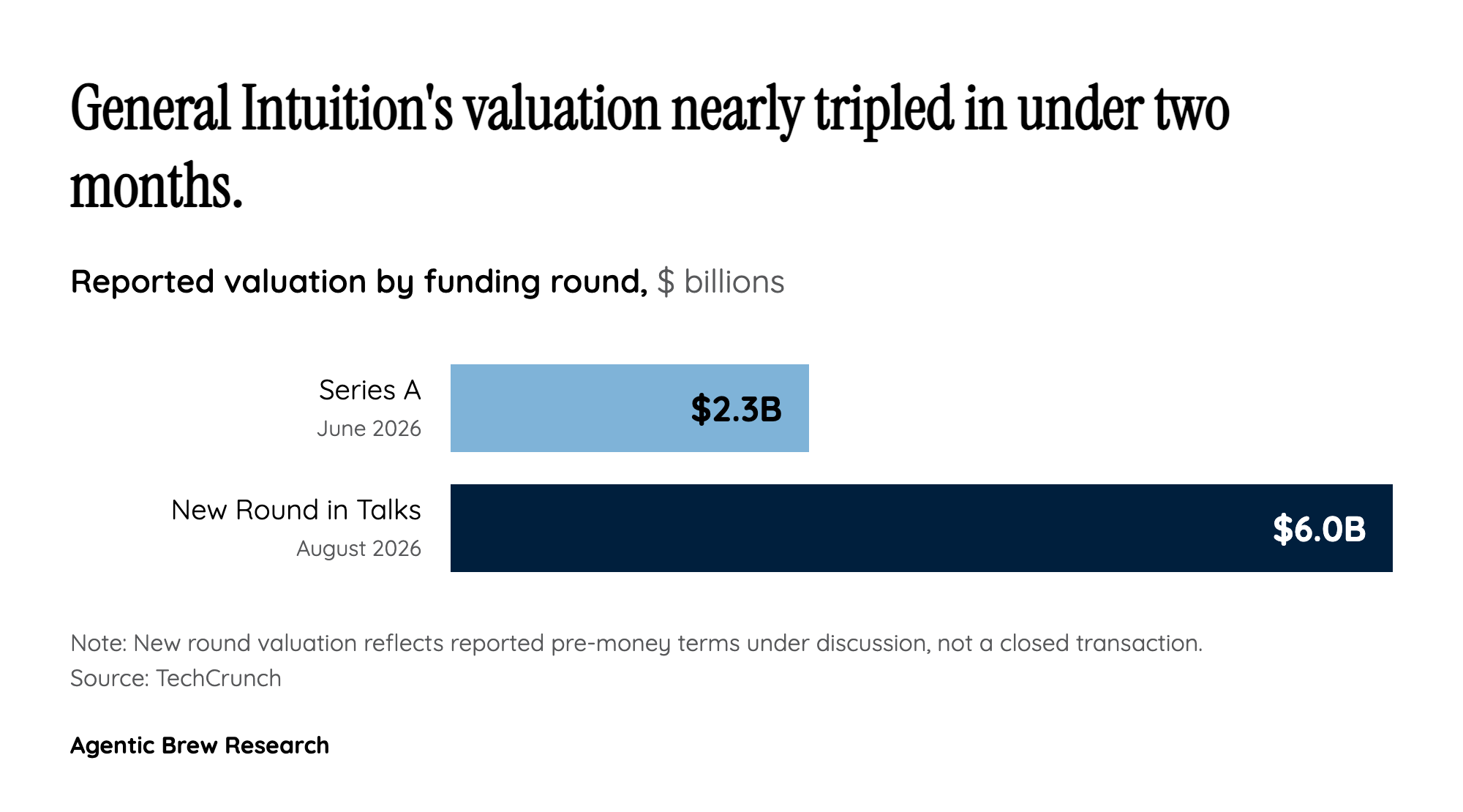
    The new round comes just weeks after the company raised $320 million at a $2.3 billion valuation in June 2026, and the new round is reportedly oversubscribed.
  • 03.
    The company plans to use the new funds to improve its general model with a focus on robotic embodiments, more compute infrastructure, and hiring.
  • 04.
    CEO Pim de Witte spun General Intuition out of Medal, his video-game clip-sharing platform, in October 2025, using its gameplay and 'action label' data as an initial training dataset.

Deep Analysis

The $6 Billion Bet on a Company With No Shipped Product

What stands out about this round isn't the size, it's the pace. General Intuition closed a $320 million Series A at a $2.3 billion valuation in June 2026, and by August a new syndicate led by Valor Equity Partners - reportedly making its first-ever investment in an AI lab - was discussing pricing the company at a $6 billion pre-money valuation [1]. That's not a company that shipped a breakout product and got repriced on revenue; it's a company that hasn't shipped a commercial robotics product at all. The round is reportedly oversubscribed [1], and the money is earmarked for compute infrastructure, hiring, and pushing the general model further into robotic embodiments [1].

One piece of outside commentary put the dynamic bluntly: 'The pace of fundraising reflects something investors don't often say out loud: they backed the research trajectory, not a commercial product' [4]. Khosla Ventures has now written checks into General Intuition three times in under a year - seed, Series A, and now this round - making it the most consistent believer in a thesis that still has to prove out commercially [4]. When repricing this aggressive happens ahead of revenue, it's a signal that a small number of investors think the underlying research problem - general-purpose world models for physical action - is closer to being solved than the market currently prices, and they're willing to pay up to not miss it.

Eight Minutes of Robot Data, Two Billion Clips a Year

The technical bet behind the valuation is sample efficiency. General Intuition's quadruped robot needed only eight minutes of real-world data to fine-tune after being pre-trained on game footage [2]- a strikingly small number next to the vast real-world datasets typically assumed necessary for robot learning. De Witte's explanation is that the model isn't just predicting the next frame the way a video generator would; it's trained on 'action labels' - what a player actually did and what happened next - across hundreds of millions of hours of gameplay pulled from Medal, the clip-sharing platform de Witte also founded, which sees roughly 2 billion videos uploaded per year from 10 million monthly active users [3]. That's the raw material for a model that, in de Witte's words, 'can respond to Fortnite information on the screen and take action, but also to real-world dynamics in a way that an LLM could never' [2].

The premise is that action-and-consequence data, regardless of whether it comes from a game engine or a physical sensor, teaches the same underlying skill: predicting what happens next given an action, then choosing a good one. If that premise holds, games become an almost absurdly cheap way to pre-train a robotics model, and eight minutes of real-world fine-tuning is the payoff. If it doesn't fully hold, the eight-minute number becomes a best case rather than a general one - which is exactly where the skepticism below starts to bite.

Your Gameplay Clips Are the Training Set - and OpenAI Wanted Them

The data provenance story here is easy to miss and worth pulling forward. Medal is a consumer product - people upload gameplay clips to share highlights, not to train robots - and its 'action label' exhaust has become the seed corpus for a company now being valued at $6 billion. Before General Intuition existed as a separate entity, OpenAI reportedly tried to acquire Medal outright for $500 million in late 2024 [3]; de Witte instead spun the data operation into its own frontier-lab bet. That decision looks prescient in hindsight given the valuation trajectory since, but it also means the underlying data pipeline - gamers' clips, harvested at platform scale - now sits at the center of a physical-AI company's commercial thesis without those gamers necessarily having signed up for that outcome.

De Witte has been explicit that General Intuition itself doesn't intend to build vertical products - 'We're not gonna build a self-driving car company. We're gonna make it 10 times easier for the next person to build a self-driving car company' - and frames the restraint partly in safety terms: 'We don't want to be an escalatory part of the system' [2]. That's a notable hedge from a company whose entire pitch is turning passive entertainment data into action-taking physical-world models.

The Skeptics Aren't in the Term Sheet

Khosla's framing - that game-action data produces a 'quantum leap' equivalent to the emergence of reasoning in LLMs, a kind of 'human intuition-like capability' [2]- is the story venture capital is telling itself right now. It is not the only read available. Community discussion around the company's earlier funding round surfaced pointed pushback on two separate fronts: whether game-engine physics actually transfers to useful real-world robot actions at all, since game engines don't model physics or consequences with real-world fidelity and the resulting skills may not generalize much past navigation, and whether the 'intuition' framing itself is doing rhetorical work to paper over a thesis that hasn't been proven commercially - one characterization was that this is 'classic VC talk when the numbers don't quite add up yet.'

Both critiques land on the same underlying question the deep-dive above raises: is the eight-minute fine-tuning result a demonstration of a genuinely general skill, or a narrow success on a task (quadruped locomotion) that happens to transfer unusually well from game navigation? Nothing in the public record settles that yet - which is itself notable, given the size of the check being written on the answer.

By the Numbers: A Valuation That Outran the Product

By the Numbers: A Valuation That Outran the Product
General Intuition's reported valuation climbed from $2.3 billion at its June 2026 Series A to a $6 billion pre-money figure under discussion by August 2026.

Three fundraising events in roughly ten months tell the trajectory plainly: a $134 million seed in October 2025 [3], a $320 million Series A at a $2.3 billion valuation in June 2026 [2], and talks for a new round at a $6 billion pre-money valuation by August 2026 [1]. The valuation move alone - from $2.3 billion to a reported $6 billion - happened in a matter of weeks, not the year-plus cadence typical of growth-stage repricing.

Historical Context

2025-10
Raised a $134 million seed round led by Khosla Ventures and General Catalyst with Raine Group participation, spinning the company out of Medal.
2026-06
Raised $320 million in a Series A at a $2.3 billion valuation, led by Khosla Ventures with General Catalyst and other participants, bringing total disclosed funding to $454 million.
2026-08
Entered talks for a new funding round at a $6 billion pre-money valuation, roughly weeks after the Series A closed.

Power Map

Key Players
Subject

General Intuition's $6B robotics funding round

PI

Pim de Witte

Founder/CEO of General Intuition (and of Medal); sets the strategy of training a single world model on game and real-world dynamics and controls how the company positions itself relative to vertical robotics products.

ME

Medal

Sister video-game clip-sharing platform also run by de Witte; supplies the gameplay and action-label data that seeds General Intuition's training set, making it the company's core data supply chain.

VA

Valor Equity Partners

New lead-tier investor reportedly making its first investment in an AI lab with this round, a signal that generalist growth investors are now pricing physical-AI research trajectories.

KH

Khosla Ventures

Led the seed and Series A rounds and is participating again, making it the most consistent financial backer across all three fundraising events in under a year.

GE

General Catalyst

Existing investor participating in the new round after backing the seed and Series A, reinforcing continuity of conviction across the company's rapid valuation climb.

PO

Point72 Ventures and Seven Seven Six

New investors joining the round alongside Valor, widening the syndicate of capital willing to price the company at nearly triple its two-month-old valuation.

Fact Check

4 cited
  1. [1] Valor, Point72 back General Intuition at $6B valuation as AI startup pushes into robotics
  2. [2] General Intuition's $2.3B bet that video games can train AI agents for the real world
  3. [3] General Intuition lands $134M seed to teach agents spatial reasoning using video game clips
  4. [4] Khosla wrote two cheques in three months, now General Intuition wants a third

Source Articles

Top 5

THE SIGNAL.

Analysts

Describes the company's approach as pre-training a single model that can act on both game and real-world dynamics: 'We have a single model that can respond to Fortnite information on the screen and take action, but also to real-world dynamics in a way that an LLM could never.'

Pim de Witte
Founder/CEO, General Intuition

Says the company won't build vertical robotics products itself - 'We're not gonna build a self-driving car company. We're gonna make it 10 times easier for the next person to build a self-driving car company' - and frames this restraint partly around safety: 'We don't want to be an escalatory part of the system.'

Pim de Witte
Founder/CEO, General Intuition

Compares the emergence of game-trained 'intuition' in world models to the emergence of reasoning in LLMs: 'In world models, I think the quantum leap is the emergence of intuition in the AI, a human intuition-like capability. The human action data and reaction data you have in games is the key part to the emergence of intuition.'

Vinod Khosla
Founder, Khosla Ventures
The Crowd

General Intuition, the startup building a foundation model that trains generalized AI agents how to move through space and time, is in talks to raise at a $6 billion pre-money valuation from new investors including Valor Ventures, Point72 Ventures, Seven

@@TechCrunch132

A startup was worth $2.3B. Weeks later, investors price it at $6B. General Intuition trains AI to move through space and time, is pushing into robotics, and reportedly landed a $10B AI contract. Physical AI is where the money went.

@@Shobhit0

General Intuition, the New York-based physical AI startup founded and led by CEO Pim de Witte, is in talks to raise new funding at a $6 billion pre-money valuation from Valor Equity Partners, Point72 Ventures and Seven Seven Six, with existing backers Khosla Ventures and General

@@TradedVC0

Valor, Point72 back General Intuition at $6B valuation as AI startup pushes into robotics

@RamsinJacobRealty1
Broadcast
World Models & General Intuition: Khosla's largest bet since LLMs & OpenAI

World Models & General Intuition: Khosla's largest bet since LLMs & OpenAI

Ep. 39: Pim de Witte, General Intuition CEO

Ep. 39: Pim de Witte, General Intuition CEO

Pim De Witte on Turning Down $500 Million from OpenAI... Then Raising $134M.

Pim De Witte on Turning Down $500 Million from OpenAI... Then Raising $134M.

General Intuition's $6B robotics funding round — AI News | Agentic Brew