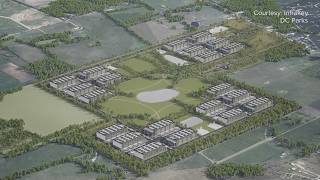
Community opposition to AI data centers
TECH

Community opposition to AI data centers

34+
Signals

Strategic Overview

  • 01.
    More than 75 data center projects worth roughly $130 billion were blocked or delayed by local opposition in the first quarter of 2026, according to Data Center Watch.
  • 02.
    More than 70 cities and counties nationwide have enacted temporary or permanent bans on new data centers, including Denver, New Orleans, and Minneapolis.
  • 03.
    New York's legislature passed a one-year statewide data center moratorium on June 4, 2026, which would make New York the first US state with such a measure if Governor Hochul signs it.
  • 04.
    Opposition to data center development is bipartisan, cutting across party lines among both politicians and grassroots groups.

Deep Analysis

2026 Is the Inflection Point: Opposition Crossed From Nuisance to Structural Risk
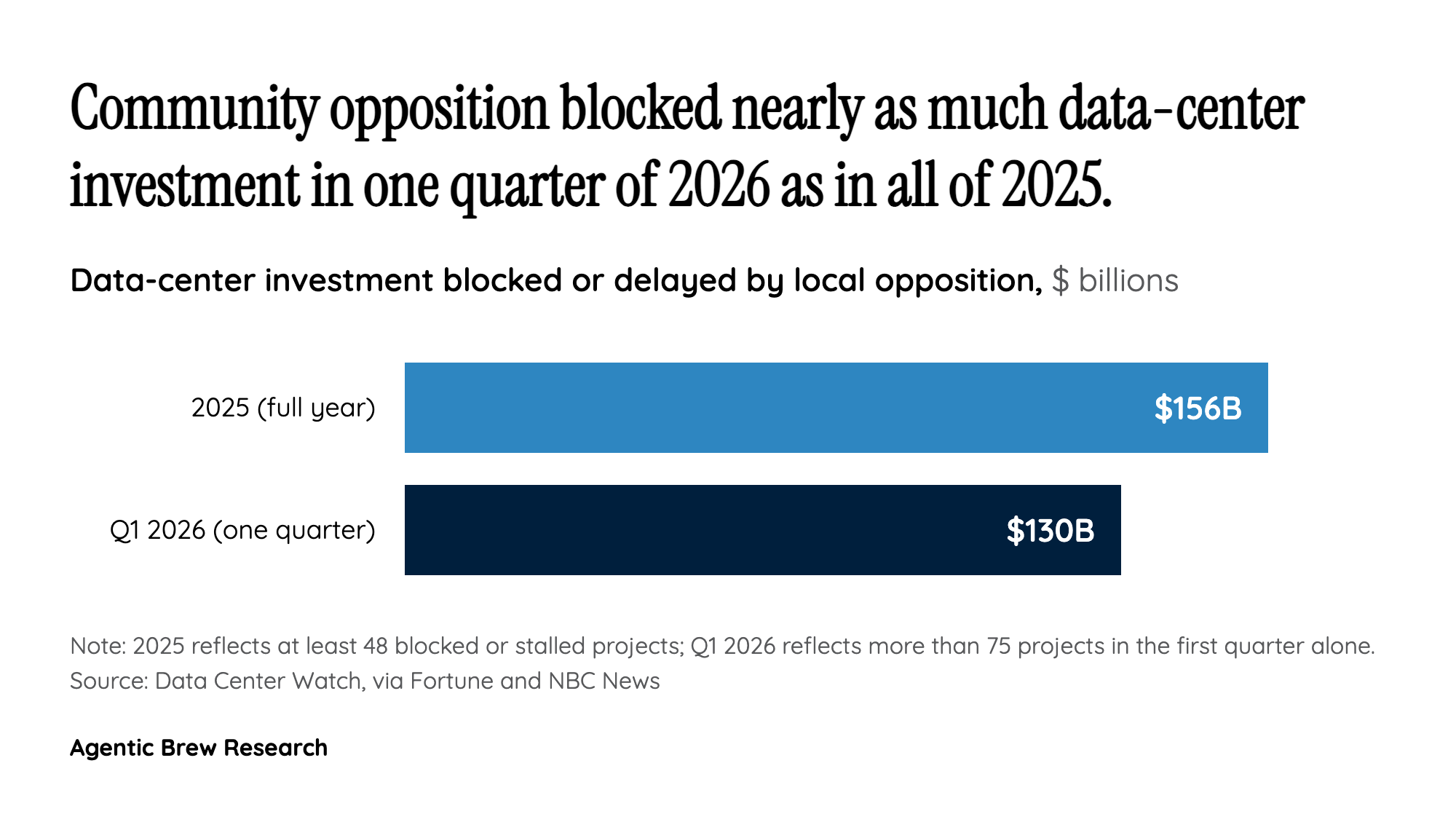
2026 Is the Inflection Point: Opposition Crossed From Nuisance to Structural Risk
Data-center investment blocked or delayed by local opposition: 2025 full year ($156B) vs Q1 2026 alone ($130B). Source: Data Center Watch via Fortune, NBC News.

The numbers mark a phase change. More than 75 projects worth roughly $130 billion were blocked or delayed in the first quarter of 2026 alone [1], with over 20 projects outright killed in Q1 — a record quarterly pace after cancellations rose from 6 in 2024 to 25 in 2025 [2]. Since 2023, roughly $162 billion in developments have been blocked or delayed [3]. Grassroots opposition groups doubled from about 396 at the end of 2025 to 833 by March 2026 [1]. The velocity is what reframes the story: Data Center Watch's lead analyst Miquel Vila attributes the surge in blocked projects directly to community backlash [3], and Fortune now frames that backlash as a structural — not public-relations — risk weighed against Moody's projection of roughly $785 billion in hyperscaler capital spending in 2026 and nearly $1 trillion in 2027 [2]. When a single quarter erases nine figures of planned investment, opposition stops being a messaging problem and becomes a line item. The supply-side echo is already audible on developer and policy YouTube, where organizers describe near-universal local resistance and argue some hyperscalers would now rather walk away from a contested site than fight through it.

Follow the Power Bill: Ratepayers Subsidizing Big Tech, and the Incentive-to-Oversight Flip

The most durable grievance is economic. Carnegie Mellon's Paulina Jaramillo calls the data-center electricity demand surge "unprecedented," projecting national bills up 8% and regional increases as high as 25% by 2030 [3]. On grids like PJM, data-center load is outpacing supply and lifting wholesale prices, with politicians citing increases as steep as 267% over five years in heavy-buildout regions [3]. A federal watchdog flagged a 76% electricity price spike in the largest US grid region and demanded that tech giants fund their own power infrastructure [4]. That demand echoes the federal posture: in March 2026 the Trump administration gathered hyperscalers at the White House and pressed them to 'pay their own way' for infrastructure costs [5]. The policy consequence is a clean reversal — states that once dangled generous tax incentives are now reassessing, shifting 'from incentive-focused policies toward regulatory oversight' [6]as construction costs soar. Marc Einstein of Counterpoint Research notes the squeeze cuts the other way too: with the AI industry not yet profitable, absorbing rising energy costs only adds pressure [3].

Strange Bedfellows: A Cross-Ideological Revolt the Political System Can't Categorize

What makes this movement hard to defeat is that it scrambles normal alignments. Data Center Watch found opposing politicians split 55% Republican and 45% Democrat [7], and the opposition cuts cleanly across party lines among both officials and grassroots groups [1]. At the federal level, Sen. Bernie Sanders and Rep. Alexandria Ocasio-Cortez introduced a national moratorium [1], while community organizing online describes anarchists, union activists, Indigenous organizers, and disgruntled Trump supporters standing side by side — a coalition observers say is unusually hard to scapegoat or splinter. Public opinion supplies the fuel: a Gallup poll found 71% of Americans oppose AI data center construction in their area, with 48% strongly opposed and only 25% in favor [8]. The unity has produced its own backlash-to-the-backlash: in widely shared social threads, some GOP lawmakers have floated that the anti-data-center movement is a Chinese influence operation and called for an FBI investigation — a framing that opponents across the spectrum have largely mocked rather than feared. The civic energy is plainly visible in the feeds: a single petition against a Nashville facility drew hundreds of thousands of signatures, and small-town councils such as La Pine, Oregon have unanimously turned projects away — momentum that reads as neighborly rather than partisan.

The Skeptics' Case vs. the Grid-Strain Evidence

Industry-aligned voices push back that the opposition runs on misinformation. In online policy debates, a self-identified data-center worker argued the movement is a 'motte and bailey' — defensible headline concerns masking weaker underlying claims. But the counter-evidence is concrete and physical. Roughly 517 of 809 planned U.S. data centers sit in areas that experienced drought over the past year [9], and in Gallup's breakdown half of opponents cite excessive resource use, with 18% each naming water and energy and 16% naming pollution [8]. Community-side technical commenters point to reliability notices and interconnection-approval delays showing that high-power GPU clusters strain grids differently than legacy load — a reliability argument, not a vibes argument. The result is a debate where the industry's 'it's all FUD' framing collides with hard siting math, and where even a sympathetic regulator has to weigh demands that operators self-generate power and pay for grid upgrades rather than socialize them [4].

Historical Context

2020-01-01
Residents formed an opposition group after Headwaters proposed a data center complex, an early flashpoint in the movement.
2023-01-01
Filed a lawsuit to stop an Amazon data center, marking escalation to legal challenges.
2024-09-01
Unanimously rejected a Diode Ventures data center proposal amid local 'Peaceful Peculiar' opposition.
2025-01-01
At least 48 projects representing $156 billion in investment were blocked or stalled in 2025, with cancellations rising from 6 (2024) to 25 (2025).
2026-04-08
Voters approved a first-in-nation ballot referendum limiting data center construction.
2026-04-24
Vetoed a first-in-nation legislative moratorium on 20MW+ data center permitting, but separately signed a law barring data centers from state tax incentives.
2026-06-04
Passed a one-year statewide data center moratorium, sending it to Governor Hochul.

Power Map

Key Players
Subject

Community opposition to AI data centers

DA

Data Center Watch (10a Labs)

Research initiative tracking opposition; its quarterly reports (authored/maintained by analyst Miquel Vila) are the primary data source quantifying blocked/delayed projects and opposition groups, shaping media and policy narratives.

HY

Hyperscalers (Microsoft, Amazon Web Services, Meta, Alphabet/Google, Oracle, OpenAI, Anthropic, CoreWeave)

Developers with ~$785B in 2026 and ~$1T in 2027 projected capital spending at risk from delays and cancellations.

ST

State and local governments

Primary check on development; over 300 state bills filed in early 2026 and dozens of municipal moratoriums/bans shift power away from incentives toward regulatory oversight.

PR

President Trump and federal administration

Pushing AI buildout and accelerated permitting; in March 2026 gathered hyperscalers at the White House and pressed them to 'pay their own way' for infrastructure costs.

SE

Sen. Bernie Sanders (I-VT) and Rep. Alexandria Ocasio-Cortez (D-NY)

Introduced a federal version of a data center moratorium, signaling national-level legislative pushback.

GR

Grassroots opposition groups (e.g., Protect Catlett, Citizens for Fauquier County)

Local activist organizations driving petitions, lawsuits, and zoning fights; counted at 188 groups across 40 states (Fortune) and doubling from ~396 to 833 (NBC, by March 2026).

Fact Check

9 cited
  1. [1] Data center opposition sharply rising in 2026, study finds
  2. [2] Communities are blocking billions in data centers; Big Tech has wagered $1 trillion otherwise
  3. [3] AI data centers, electricity prices, backlash and ratepayer protection
  4. [4] AI data centers trigger 76 percent electricity price spike in largest US region; federal watchdog demands tech giants pay for their own power infrastructure
  5. [5] Trump, data centers and the consumer impact
  6. [6] States reconsider data center incentives and permitting: energy, water and fiscal
  7. [7] Data Center Watch report
  8. [8] Americans oppose data centers in their area
  9. [9] AI data center boom is running into America's water problem

Source Articles

Top 3

THE SIGNAL.

Analysts

"This is directly a response to growing backlash."

Miquel Vila
Supply Chain and Political Risk Analyst at 10a Labs / lead analyst, Data Center Watch

"Carnegie Mellon's Paulina Jaramillo calls the demand surge "unprecedented," projecting national bills up 8% and regional hits to 25% by 2030."

Paulina Jaramillo
Carnegie Mellon University

"the industry's not making money, so that puts even more pressure on them."

Marc Einstein
Counterpoint Research

"If it doesn't benefit all of us, we don't need that technology"

Eddie Lin
Seattle City Council Member
The Crowd

"🚨 The Nashville Zoo is asking for the public's help fighting a new 69,000-sq-ft data center that could disrupt endangered species' breeding programs with constant noise, lights, & 24/7 industrial activity. 397K+ people have already signed the petition."

@@JasonBassler18249

"🦔 Community protests have blocked $130 billion in data center projects so far this year. Q1 2026 produced the most blocked and delayed projects on record. Nashville collected 180,000 petition signatures in days. Charlotte voted on a moratorium. My Take These companies committed"

@@HedgieMarkets344

"In a significant victory for local residents, the La Pine City Council in Central Oregon has unanimously voted to reject a proposed 20-megawatt data center. When developer Boxminer pitched the large facility to the small town of just 3,200 people, it promised jobs, tax revenue,"

@@Rainmaker1973252

"Republicans Claim Anti-Data Center Movement Is a Chinese Psy-Op"

@u/MarvelsGrantMan13618000
Broadcast
Data centres cancelled: 'Every data centre has local opposition' | Karen Feraden

Data centres cancelled: 'Every data centre has local opposition' | Karen Feraden

Americans oppose data centers. We went to find out why | America, Actually

Americans oppose data centers. We went to find out why | America, Actually

"Texas is already strained": Data center opposition builds in Waco

"Texas is already strained": Data center opposition builds in Waco