Google's Gemini 3.7 Flash launch
TECH

Google's Gemini 3.7 Flash launch

93+
Signals

Strategic Overview

  • 01.
    Google launched Gemini 3.7 Flash on August 13, 2026, calling it its most intelligent workhorse model yet for coding and agents.
  • 02.
    The release came just three weeks after Gemini 3.6 Flash shipped on July 21, 2026, continuing Google's accelerated release cadence.
  • 03.
    Introductory pricing is $0.75 per million input tokens and $3.75 per million output tokens through December 31, 2026 - half of Gemini 3.6 Flash's launch price - before rising to $1.50/$7.50 per million tokens on January 1, 2027.
  • 04.
    Gemini 3.7 Flash is available through Google AI Studio, Android Studio, Google Antigravity, the Gemini Enterprise Agent Platform, and Spark, as well as third-party platforms including OpenRouter and Devin.

A Three-Week Sprint, Not a Coincidence

Gemini 3.7 Flash arrived on August 13, 2026, just 23 days after Gemini 3.6 Flash shipped on July 21 - an unusually tight turnaround even by Google's own recent standards, and reporting frames it as a continuation of an already-accelerated release cadence [1]. Google's own explanation for the jump is telling: the company says the gains come from developer feedback and algorithmic innovations, not a new pretraining run [1]. That distinction matters. Training a new base model from scratch takes months of compute and planning; tuning how an existing model reasons is comparatively cheap and fast - exactly the kind of lever a company under competitive pressure would pull first.

That pressure is not subtle. The launch landed the same week as reports of an AI leadership shakeup and staff departures inside Google, and analysts read the release explicitly as a product-execution response aimed at Anthropic and OpenAI rather than a routine model refresh [2]. Coverage comparing 3.7 Flash's coding evals directly against Claude Sonnet 5 and GPT-5.6 Terra reinforced that framing [3]. On X, the speed itself became the marketing message: Google DeepMind research lead Koray Kavukcuoglu framed the jump from Gemini 3.5 to 3.7 in just three months as evidence of accelerating internal iteration, a message Google's official and AI Studio accounts also promoted. Whether that cadence is sustainable for the teams and platforms that have to keep re-integrating a new default model every few weeks is a separate question.

Half Price Now, Double by January

The economics are as aggressive as the release schedule. Gemini 3.7 Flash launched at $0.75 per million input tokens and $3.75 per million output tokens - half of what 3.6 Flash cost when it launched just three weeks earlier [4]. On OpenRouter, an extra promotional discount of 50 percent pushed the effective price down to $0.375/$1.875 per million tokens through August 27, on top of a 1,048,576-token context window [5]. Multiple outlets described the move as Google escalating an industry-wide price war that already includes OpenAI's 'Ultrafast' and DeepSeek's V4-Pro models [6].

But the discount has an expiration date. Pricing doubles to $1.50/$7.50 per million tokens on January 1, 2027 [7], meaning any team building cost assumptions into a product roadmap today is planning around a rate that will not exist in five months. That tension - cheap now, pricier later - fuels a strategic read that surfaced repeatedly in developer discussion online: Flash-tier models may exist less to win intelligence leaderboards than to make Google's own highest-volume, lowest-margin surfaces - AI Overviews in Search and the free tier of the Gemini app - affordable to run at the scale Google needs. Under that lens, beating Claude Sonnet 5 on a benchmark is a nice headline, but the real job of Gemini 3.7 Flash may be staying cheap and fast enough to sit under an enormous volume of queries without losing money.

What the Benchmarks Actually Show

What the Benchmarks Actually Show
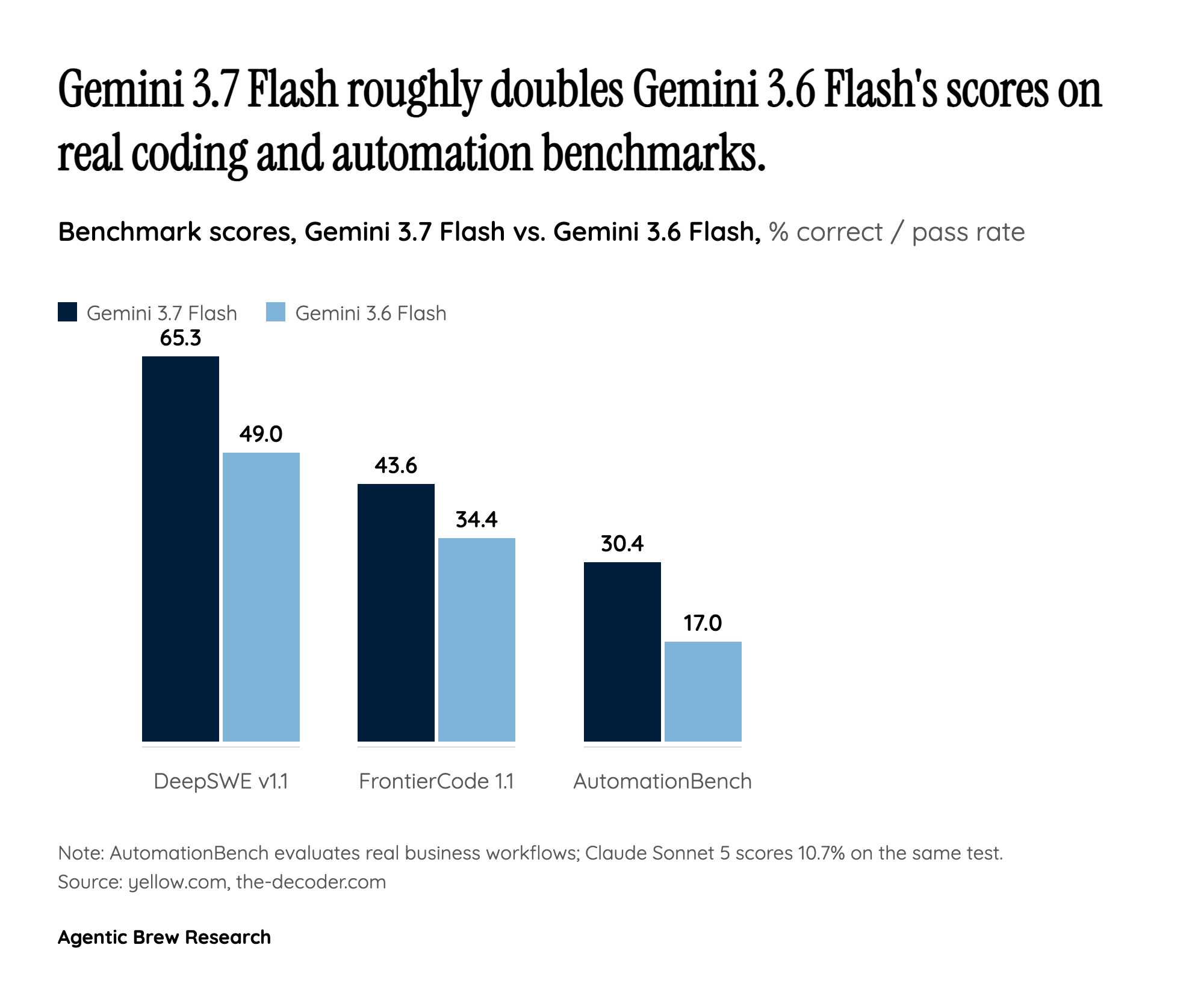
Gemini 3.7 Flash posts sharp gains over Gemini 3.6 Flash on DeepSWE, FrontierCode, and AutomationBench.

The jump in raw scores is real. On the DeepSWE v1.1 coding benchmark, Gemini 3.7 Flash scores 65.3 percent versus 49.0 percent for Gemini 3.6 Flash [8]; on FrontierCode 1.1, it improves from 34.4 to 43.6 percent [4]; and on AutomationBench, a suite built around real business workflows, it jumps from 17.0 to 30.4 percent - nearly three times where Claude Sonnet 5 lands on the same test, at 10.7 percent [8]. On WebDev Arena, Gemini 3.7 Flash's Elo score of 1588 edges out Claude Sonnet 5 (1541) and GPT-5.6 Terra (1523) [8].

None of that makes 3.7 Flash a universal winner, and the coverage is careful to say so. On OSWorld-2.0, a harder test of agentic computer use where a model has to operate a desktop environment rather than just write code, Gemini 3.7 Flash trails GPT-5.6 Terra [9], and broader knowledge-work evaluations still favor Claude Sonnet 5 in places [10]. The honest summary is narrower than 'Google's Flash model beats the frontier': it means Gemini 3.7 Flash has closed most of the gap on coding and agentic-workflow tasks specifically, at a fraction of the cost, while still losing ground on some of the hardest, most open-ended agentic benchmarks.

The Skeptics Have a Point, and So Do the Early Adopters

Reddit's reaction split along a predictable line. The celebratory read - '3.7 Flash is so fast... almost twice as fast and much cheaper too' than larger models, with one user citing a DeepSWE jump from 37 percent for 3.5 Flash to 65 percent for 3.7 Flash - sits alongside a more skeptical minority. 'Assume benchmaxxed until proven otherwise' was a recurring rebuttal, alongside pointed comparisons noting that by Google's own published numbers, 3.7 Flash still trails several Chinese open models. A separate strand of complaints has nothing to do with benchmarks at all: some users reported the model losing coherence past roughly 2,000 lines of code, and argued that Gemini models scale poorly once deployed in real agentic workflows rather than single-turn evals - with one comment going as far as to say that unless latency is sub-second, a model is useless for agentic work regardless of leaderboard position.

Early enterprise adopters tell a more concrete story than either camp. Harvey, the legal-AI company, benchmarked 3.7 Flash on its own Legal Agent Bench and reported a 90.7 percent score, a 2.6-point all-pass improvement over 3.6 Flash on real legal-workflow tasks [8]. Nunu.ai co-founder Kyrill Hux tested the model on Figma-to-code porting and said it delivered visual parity 'that other frontier models struggle with,' at roughly half the cost of GPT-5.6 Terra [8]. Cognition's Devin, meanwhile, integrated the model and found it performs best on tightly scoped refactors with minimal diffs that match existing repo conventions - a narrower, more specific endorsement than 'beats the frontier,' and one that lines up with the benchmark data better than either the hype or the skepticism does on its own [11].

Historical Context

2026-07-21
Gemini 3.6 Flash launched as the prior-generation 'workhorse' model at $1.50/$7.50 per million input/output tokens, alongside Gemini 3.5 Flash-Lite and Gemini 3.5 Flash Cyber.
2026-08-13
Gemini 3.7 Flash launched only 23 days after Gemini 3.6 Flash, marking an accelerated release cadence for the Flash model family.
2026-08-13
The launch occurred amid reported AI leadership shakeup and talent departures at Google, with analysts framing the release as a product-execution response to competitive pressure from Anthropic and OpenAI.

Power Map

Key Players
Subject

Google's Gemini 3.7 Flash launch

GO

Google DeepMind / Google

Developer and publisher of Gemini 3.7 Flash; positioned the model as its primary agentic 'workhorse' to compete on coding and agent workloads while cutting price 50 percent.

CO

Cognition (Devin)

Coding-agent maker whose FrontierCode 1.1 benchmark Google cited (43.6% vs 34.4% for 3.6 Flash); Devin integrated the model, which performs well on tightly scoped refactors with minimal diffs matching repo conventions.

OP

OpenRouter

Third-party model marketplace offering Gemini 3.7 Flash with an exclusive extra 50 percent promotional discount through August 27, 2026, expanding distribution beyond Google's own platforms.

HA

Harvey (legal AI)

Enterprise customer that benchmarked the model on its Legal Agent Bench (LAB-AA), reporting a 90.7% score and a 2.6-point all-pass improvement over 3.6 Flash, illustrating vertical enterprise adoption.

NU

Nunu.ai

AI startup that evaluated the model for Figma-to-code porting tasks, calling it on par with GPT-5.6 Terra at roughly half the cost.

AN

Anthropic (Claude) / OpenAI (GPT)

Primary competitors; Gemini 3.7 Flash is positioned against Claude Sonnet 5 and GPT-5.6 Terra on coding and agent benchmarks, with Google claiming to beat both on several evals amid broader competitive and talent pressure.

Fact Check

12 cited
  1. [1] Gemini 3.7 Flash launch: Google's accelerated cadence continues
  2. [2] Google launches Gemini 3.7 Flash amid AI leadership shakeup
  3. [3] Google launches Gemini 3.7 Flash, which beat Sonnet 5 and GPT-5.6 in coding evals
  4. [4] Gemini 3.7 Flash lands with coding gains and undercuts its three-week-old predecessor's price by 50%
  5. [5] Gemini 3.7 Flash on OpenRouter
  6. [6] Google joins the AI model price war with the new Gemini 3.7 Flash
  7. [7] Gemini 3.7 Flash brings coding-agent gains and a price cut
  8. [8] Gemini 3.7 Flash launches at half price with major DeepSWE gains
  9. [9] AI Models: Google Gemini 3.7 Flash, OpenAI Ultrafast, DeepSeek V4 Pro
  10. [10] Google cuts Gemini 3.7 Flash price in half, claims it tops Claude in business workflows
  11. [11] Gemini 3.7 Flash review
  12. [12] Introducing Gemini 3.7 Flash

Source Articles

Top 5

THE SIGNAL.

Analysts

Reported that Gemini 3.7 Flash improved all-pass performance by 2.6 points over Gemini 3.6 Flash on Harvey's Legal Agent Bench, indicating measurable gains on real legal-workflow tasks.

Niko Grupen
Head of Applied Research, Harvey

Said the model's benchmarks put it near mid-sized frontier models at about half the cost, and specifically praised its efficiency and accuracy porting Figma designs into code with precise visual parity that other frontier models struggle with.

Kyrill Hux
Co-founder, Nunu.ai

Assessed the release as elevating Google's Flash line from a budget fallback to a primary work model given the coding and agent gains at the price point.

Kingy AI
Industry review outlet
The Crowd

Today we're introducing Gemini 3.7 Flash, our most intelligent workhorse model yet for coding and agents. This model brings substantial gains across software engineering, web development, and complex knowledge work. Now through the end of the year, Gemini 3.7 Flash is available

@@Google6138

introducing Gemini 3.7 Flash: our most intelligent workhorse model yet for coding and agents this release comes just three weeks after Gemini 3.6 Flash, and is a direct result of developer feedback and algorithmic innovations that we look forward to bringing to future models

@@GoogleAIStudio5036

Today we're launching Gemini 3.7 Flash - our latest workhorse model for coding and agentic workflows, with an introductory price at half the original cost of 3.6 Flash. ⚡️ We have been iterating rapidly with the Flash series, going from 3.5 to 3.7 in just 3 months, making it

@@koraykv2306

3.7 flash passed the ultimate test

@u/Grand-Bit-72971100
Broadcast
Introducing Gemini 3.7 Flash

Introducing Gemini 3.7 Flash

Autonomous Web Optimization with Gemini 3.7 Flash

Autonomous Web Optimization with Gemini 3.7 Flash

Gemini 3.7 Flash - Benchmark and Pricing | How to Use Online

Gemini 3.7 Flash - Benchmark and Pricing | How to Use Online

Google's Gemini 3.7 Flash launch — AI News | Agentic Brew