Stanford free lecture on LLM architecture (ChatGPT, Claude)
TECH

Stanford free lecture on LLM architecture (ChatGPT, Claude)

22+
Signals

Strategic Overview

  • 01.
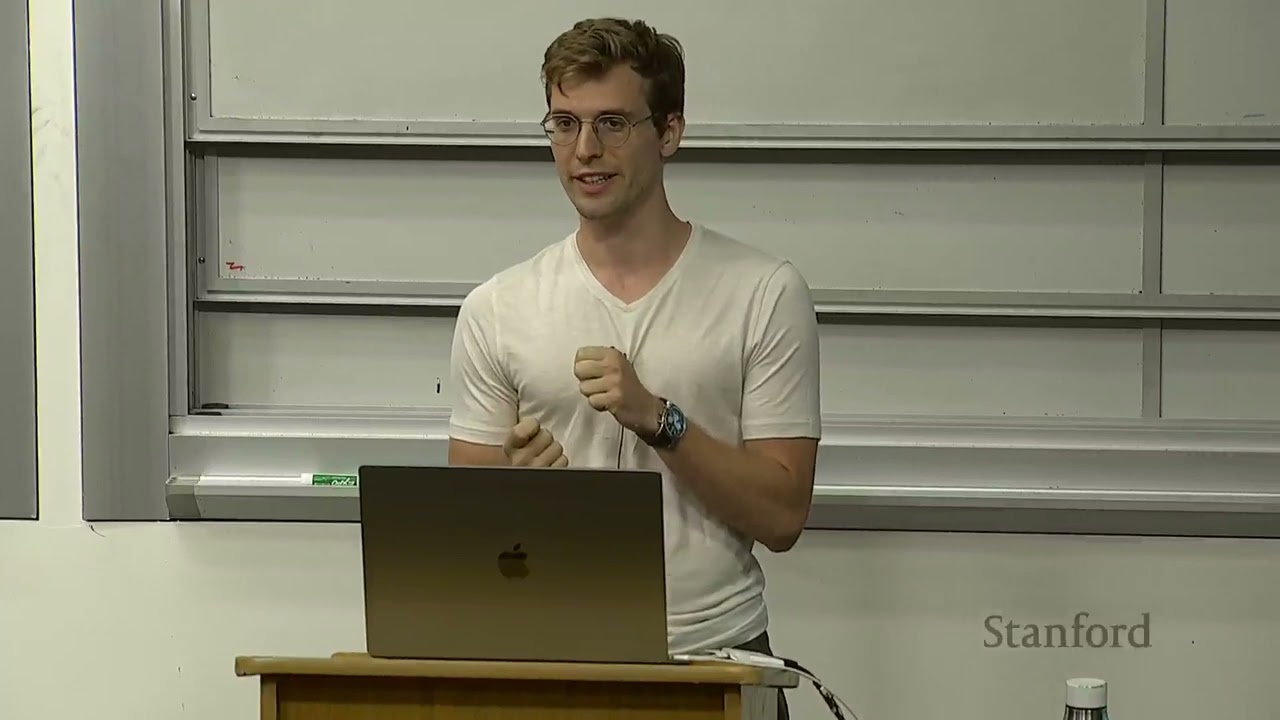
    The viral 'free Stanford LLM lecture' is Yann Dubois' CS229 guest talk 'Building Large Language Models', posted free on Stanford Online's YouTube channel and framed as an introductory pass over the engineering choices that production LLMs actually live or die on.
  • 02.
    Dubois deliberately skips deep transformer mechanics — already saturated online — and concentrates on evaluation, cost, compute, data curation, tokenizer design, scaling laws (including Chinchilla), and post-training alignment via SFT, RLHF, and DPO.
  • 03.
    Stanford pairs that one-shot lecture with a deeper full-semester course, CS336 'Language Modeling from Scratch' taught by Tatsunori Hashimoto and Percy Liang, which walks students through tokenizer, architecture, optimizer, GPU kernels, parallelism, data pipeline, and alignment end-to-end.
  • 04.
    A separate Stanford seminar, CS25 'Transformers United' (now in its sixth iteration), runs free livestreams open to the public with guest speakers including Geoffrey Hinton, Ashish Vaswani, and Andrej Karpathy.

The Lecture Is Not About Transformers — That's The Whole Point

The 'free Stanford LLM lecture' currently bouncing around social feeds is Yann Dubois' CS229 guest talk 'Building Large Language Models' on Stanford Online's YouTube channel. Read the syllabus and you'll notice what isn't there: there is almost no time spent re-deriving self-attention or sketching transformer block diagrams. Dubois says so explicitly — because transformer videos already saturate YouTube, his lecture intentionally emphasizes evaluation, cost, compute, data, and tokenizer choices instead [1].

The content that does make it in is the unglamorous middle of an LLM project. Pretraining is covered as autoregressive language modeling with cross-entropy loss, BPE tokenization, and the scaling-law literature including Chinchilla. Then the talk pivots to post-training: supervised fine-tuning, RLHF, and Direct Preference Optimization. Dubois treats SFT as behavioral shaping rather than knowledge injection, and presents DPO as the pragmatic alternative when teams don't want to maintain a separate reward model [2]. The thesis under all of this — 'in industry it's data, evaluation, and systems that make or break a model' [1]— is the actual reason the lecture is worth watching, and it's the part that gets lost in the viral hook.

For a builder, the implication is concrete. If you've spent twenty hours on transformer-from-scratch tutorials and still feel lost about how labs decide what to train, this lecture is the missing layer.

Three Stanford Courses, Three Different Jobs

The viral tweets compress everything into 'Stanford released a lecture.' What Stanford actually has free on YouTube right now is closer to a full curriculum stack — and the three pieces are aimed at very different readers. Treating them as interchangeable wastes a lot of time.

CS229's Dubois guest lecture is roughly a one-hour orientation. It's the right starting point if you want a vocabulary and a mental model for how a modern LLM is built, but it does not ask you to write code. CS336 'Language Modeling from Scratch' — taught by Tatsunori Hashimoto and Percy Liang, currently in its third offering for Spring 2026 — is the opposite: a full-semester systems course that has students implement the tokenizer, architecture, optimizer, GPU kernels, parallelism, data pipeline, and post-training/alignment, explicitly modeled after operating-systems classes that build entire systems from the ground up [3]. CS25 'Transformers United' is a third thing again — a public-facing research seminar with guest speakers like Geoffrey Hinton, Ashish Vaswani, and Andrej Karpathy, open to anyone via Zoom or livestream with no Stanford affiliation required [4].

Writer-syllabuses on Medium summarizing CS229 are useful but they aren't substitutes for any of the three [2]. The honest mapping: CS229-Dubois if you want the map, CS336 if you want the muscle memory, CS25 if you want to track where the research frontier is heading.

The 'Anthropic Pays A Premium' Hook, Examined

The reason this lecture went from niche to mass-share is the second half of the hook: that understanding LLM internals is what Anthropic-tier employers pay for. The compensation numbers behind that claim are real — and also more specific than the tweets imply.

Levels.fyi currently lists Anthropic Software Engineer median total compensation at roughly $710K, with senior engineers averaging around $563K and lead engineers reaching about $785K, and a reported high near $920K [5]. Anthropic's own job board pegs Research Scientist, Interpretability base salary at $315,000–$560,000 [6]. Compensation-tracking writeups put Research Engineer (Pre-training / Tokens) base in the $315K–$340K range, with total comp at senior or staff levels reaching $350K–$550K once equity and a 15–25% bonus are layered in [7][8].

The nuance the viral framing flattens: those numbers attach overwhelmingly to research-engineer, research-scientist, and interpretability roles whose listings ask for mechanistic-interpretability or large-scale ML-systems backgrounds. The Anthropic Interpretability team's own pitch is that mechanistic understanding of trained models is the most robust route to safe advanced AI [6]— which is the bar a candidate has to clear, not just 'I watched the CS229 lecture.' Treat the Dubois talk as the cheapest possible on-ramp to that body of work, not as a credential. The realistic next step after CS229 is CS336's full semester of code, then reading the interpretability and post-training papers those roles actually cite.

Why A 2024 Lecture Is A 2026 Story

Most 'breaking news in AI' has a half-life measured in days. This one is unusual: the underlying lecture was uploaded in 2024 and is virally re-discovered in 2026, with developer Reddit treating it as gold-tier intro material and frequently cross-referencing it against Sebastian Raschka's textbook and Manning's 'Build a Large Language Model from Scratch.' That's a distribution pattern, not a news event.

Two things keep the flywheel spinning. First, Stanford Online's posture: lectures from CS229, CS336, and CS25 are posted free on YouTube and stay free, so any aggregator who finds them can effectively re-release them with a new hook attached. CS25 alone reports millions of YouTube views and a public Discord of more than 5,000 members [4]. Second, the LinkedIn and X 'free resource' economy rewards reposting the same artifact with new scarcity framing — 'Anthropic pays $X for this skill' being the current dominant template. The same lecture has now been packaged at least three different ways inside a single week of social posts.

The practical read for anyone tired of being told to 'just watch the lecture': the actual asset isn't a single video, it's an open Stanford LLM curriculum that quietly grew over the last two years. The viral moments are just the surface layer that drags new people in. The compounding value sits in the syllabi and lecture playlists Stanford keeps re-publishing each spring [3].

Historical Context

2024-08
Dubois announced the CS229 'Building Large Language Models' guest lecture publicly, with Stanford Online uploading the recording to YouTube shortly after.
2024
Hashimoto and Liang debuted CS336 'Language Modeling from Scratch' as a build-an-LLM-end-to-end course, modeled after operating-systems classes that construct entire systems from the ground up.
2025
Second offering of CS336; the Spring 2025 lecture playlist became one of the most-watched free 'build an LLM' curricula online.
2026
Third CS336 offering is currently in progress, with new 2026 lectures on architectures, GPU kernels (Triton/XLA), parallelism, and inference being uploaded to YouTube as the term runs.

Power Map

Key Players
Subject

Stanford free lecture on LLM architecture (ChatGPT, Claude)

YA

Yann Dubois

Delivered the viral CS229 lecture while a Stanford CS PhD student co-advised by Percy Liang and Tatsu Hashimoto, and a co-author on Alpaca/AlpacaFarm; now a Research Scientist at OpenAI leading the Post-training Frontiers team, which gives his framing of 'data, evaluation, systems beats architecture' real industry weight.

TA

Tatsunori Hashimoto & Percy Liang

Stanford NLP faculty who teach CS336 'Language Modeling from Scratch' and were Dubois' PhD co-advisors; they anchor Stanford's strategy of releasing entire LLM-building curricula on YouTube for free, which is what keeps these talks viral months after upload.

ST

Stanford Online / Stanford Engineering

The distribution channel that posts CS229, CS336, and CS25 lectures publicly on YouTube; without their open-courseware posture, a one-off guest lecture from 2024 wouldn't be re-igniting on social media in 2026.

AN

Anthropic

Cited in the viral framing as the trophy employer paying premium compensation for engineers who understand LLM internals; the job listings and salary disclosures are what create the financial 'why bother' that drives the lecture's reach.

Fact Check

9 cited
  1. [1] Building Large Language Models (LLMs): Lessons from Stanford CS229
  2. [2] Building and Training Large Language Models (LLMs): A Stanford Lecture Summary
  3. [3] Stanford CS336 — Language Modeling from Scratch
  4. [4] Stanford CS25 — Transformers United
  5. [5] Anthropic Software Engineer Salaries
  6. [6] Research Scientist, Interpretability — Anthropic Careers
  7. [7] Anthropic Compensation 2026: Detailed Salary Breakdown
  8. [8] Anthropic Salary Overview: How Much Do Employees Get Paid
  9. [9] The Art and Science of Building Large Language Models: Insights from Stanford's CS229 Lecture

Source Articles

Top 1

THE SIGNAL.

Analysts

"Argues the practical bottlenecks of building production LLMs are data, evaluation, and systems — not the transformer architecture itself."

Yann Dubois
Lecturer, Stanford CS229; Research Scientist, OpenAI

"Pushes back on the 'overfitting' intuition imported from traditional ML, noting that at LLM scale 'larger models tend not to overfit in the traditional sense.'"

Yann Dubois
Lecturer, Stanford CS229

"Frames supervised fine-tuning as behavioral shaping rather than knowledge injection: 'The goal of SFT is not to teach the model new knowledge but to fine-tune it to produce outputs that align with expected behavior.'"

Yann Dubois
Lecturer, Stanford CS229

"Presents DPO as a lighter alternative to full RLHF reward-model pipelines: 'DPO is a simplified approach that directly uses labeled preference data without needing a separate reward model.'"

Yann Dubois
Lecturer, Stanford CS229

"Frames mechanistic understanding of trained models as the most robust path to safe advanced AI, which is the stated justification for the team's premium hiring posture."

Anthropic Interpretability team
Research team, Anthropic
The Crowd

"This 2 hour Stanford lecture will teach you more about how LLMs like ChatGPT & Claude are built than most people working at top AI companies learn in their entire careers. Bookmark this & give 2 hours today, no matter what. It'll be the most productive thing you do this week."

@@RohOnChain19391

"Instead of watching an hour of Netflix, watch this 2 hour hour Stanford lecture will teach you more about how LLMs like ChatGPT and Claude are built than most people working at top AI companies learn in their entire careers."

@@Ai_Tech_tool6112

"Instead of watching an hour of Netflix, watch this 2-hour Stanford lecture. It will teach you more about how LLMs like ChatGPT and Claude are actually built than most people in top AI companies learn across their entire careers. Save this."

@@Tabbu_ai1448

"Stanford just dropped 5.5hrs worth of lectures on foundational LLM knowledge"

@u/igorwarzocha2800
Broadcast
Stanford CS229 I Machine Learning I Building Large Language Models (LLMs)

Stanford CS229 I Machine Learning I Building Large Language Models (LLMs)

Stanford CME295 Transformers & LLMs | Autumn 2025 | Lecture 1 - Transformer

Stanford CME295 Transformers & LLMs | Autumn 2025 | Lecture 1 - Transformer

Stanford CS336 Language Modeling from Scratch | Spring 2025 | Lecture 1: Overview and Tokenization

Stanford CS336 Language Modeling from Scratch | Spring 2025 | Lecture 1: Overview and Tokenization