OpenAI's proposed 5% equity stake to the US government
TECH

OpenAI's proposed 5% equity stake to the US government

37+
Signals

Strategic Overview

  • 01.
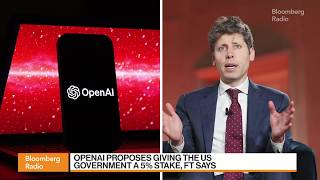
    OpenAI proposed giving the US government a roughly 5% equity stake, held through a US sovereign wealth fund vehicle, to share AI's upside and address political blowback.
  • 02.
    The proposed fund is modeled after the 1976 Alaska Permanent Fund, with returns distributed to US citizens, and the proposal envisions other leading US AI developers granting matching 5% stakes.
  • 03.
    The talks remain preliminary and conceptual, and any formal equity transfer would likely require congressional approval.
  • 04.
    A 5% stake is worth roughly $42.6 billion at OpenAI's approximately $852 billion post-money valuation, and OpenAI reportedly hopes an IPO would lift its valuation toward $1 trillion.

Deep Analysis

The $42.6 Billion Regulatory Put

Strip away the language of shared prosperity and OpenAI's offer reads as a transaction, not a gift. The company floated giving the US government a roughly 5% stake - worth about $42.6 billion at its approximately $852 billion post-money valuation [6]- explicitly to secure good relations with the administration and address political blowback [1]. In plain terms, existing shareholders would absorb tens of billions in dilution as a form of political insurance, buying regulatory goodwill ahead of a public offering.

The timing is the tell. OpenAI reportedly hopes an IPO would lift its valuation toward $1 trillion [2], and a company heading for public markets has every incentive to defuse the risk that Washington intervenes on safety, antitrust, or data policy first. Analysts have described the arrangement as a regulatory put - a term borrowed from finance for a downside hedge - where shareholders trade a slice of equity today to insure against a far costlier regulatory or political shock tomorrow [6]. That framing dominated the sharpest social commentary too: rather than reading the pitch as generosity, community discussion overwhelmingly cast it as a maneuver, with the recurring line that this is a bribe dressed up as policy.
When the Referee Owns the Team

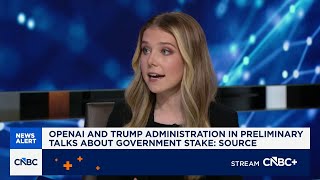
The core objection is structural, not partisan. If the federal government holds equity in OpenAI, it becomes a shareholder and a regulator at the same time - a dual role that Washington watchdog Public Knowledge warns creates substantial conflicts of interest and could make the government less willing to enforce safety rules that reduce the value of its own investment [3]. A regulator that profits when the company it polices does well has a built-in reason to look the other way.

Critics pushed the point further in community discussion: the government already has two levers over AI firms - taxation, which captures financial upside, and regulation, which shapes behavior - so bolting on equity is at best redundant and at worst corrupting. A related and darker read framed the stake as bailout insurance: once the state owns a piece of OpenAI, it acquires a direct incentive to prop the company up if an AI investment bubble bursts, socializing the downside while the founders keep the upside. There is also an international dimension - Public Knowledge cautioned that once the US takes an equity cut, other jurisdictions could demand analogous arrangements, turning a one-off deal into a global template for governments taking stakes in AI labs [3].

5% Is the Middle of a Much Wider Fight

OpenAI's offer only makes sense against the spectrum of alternatives already on the table. At the low end sits real precedent: in August 2025 the US government took a roughly 9.9% stake in Intel through CHIPS Act funding, but as a passive investor with no board seat [5], and Congress had earlier authorized the Development Finance Corporation to make minority equity investments back in 2018 [5]. So a federal minority stake in a private firm is neither unprecedented nor inherently radical.

At the high end sits Senator Bernie Sanders, who on June 18, 2026 unveiled the American AI Sovereign Wealth Fund Act - a one-time 50% stock tax on AI companies with more than $200 million in annual sales, funding annual dividends of roughly $1,000 per person [4]. Sanders' argument is about accountability, not just money: he contends the decisions these companies make will be accountable to the public, which we do not have right now [4]. Read against that backdrop, OpenAI's voluntary 5% looks less like largesse and more like a preemptive counteroffer - a modest, self-designed stake that heads off a far more aggressive, mandatory 50% grab. Even the populist 'share the wealth' framing drew skepticism in community discussion, where commenters noted the distributed payout would amount to only around $120 per US citizen, small enough to make the wealth-sharing pitch feel more like messaging than material redistribution.

The Structural-Finance Angle Everyone Underrates

Beyond the ethics debate, one strand of analytical commentary focused on what the government actually gains as an equity holder - and it is not just a dividend. On X, the sharpest structural read drew an Intel parallel and argued the arrangement could quietly turn the government into a soft backstop for OpenAI's enormous future capital expenditure, the kind of trillion-dollar buildout an AI-infrastructure company faces. A state that owns 5% and wants its stake to appreciate has reason to smooth OpenAI's access to capital, energy, and favorable policy - an implicit support that is worth far more than the headline percentage.

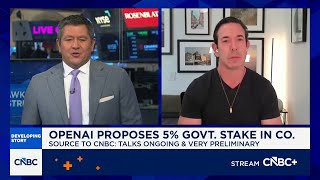
That is precisely why the conflict-of-interest critique and the finance critique are two sides of the same coin. The same alignment of incentives that worries safety advocates - a government that profits when OpenAI wins - is what could make the stake commercially valuable to OpenAI in the first place. It is also why uptake is far from certain. Any transfer would likely require congressional approval [1], the proposal assumes rival labs would grant matching 5% stakes even though Anthropic has declined and prefers a tax-funded digital dividend [1], and broadcast coverage carried openly skeptical expert voices questioning whether the structure makes sense at all. The offer is on the table; whether it survives contact with Congress, competitors, and its own critics is another question entirely.

Historical Context

1976
The Alaska Permanent Fund was established to channel state oil and resource revenues into resident dividends, the explicit model for OpenAI's proposed public wealth fund.
2018
Congress authorized the DFC to make equity investments as a minority investor, a statutory precedent for federal minority equity stakes in private firms.
2025-08-22
The US government took a roughly 9.9% equity stake in Intel via CHIPS Act funding as a passive investor with no board seat.
2026-06-18
Sanders unveiled the American AI Sovereign Wealth Fund Act, proposing a one-time 50% stock tax on AI companies with more than $200M in annual sales.

Power Map

Key Players
Subject

OpenAI's proposed 5% equity stake to the US government

SA

Sam Altman / OpenAI

Proposer. Pitched the 5% stake to top officials, effectively trading equity for regulatory goodwill ahead of a planned IPO. Whether the offer materializes shapes the entire debate.

TR

Trump administration

Recipient and counterparty. Officials including Commerce Secretary Howard Lutnick and Treasury Secretary Scott Bessent would hold the stake via a government sovereign wealth fund vehicle; their acceptance determines feasibility.

AN

Anthropic, Google, Meta

Other leading AI developers the proposal envisions ceding matching 5% stakes; it is unclear whether they would agree. Anthropic is not participating and favors a tax-funded digital dividend.

SE

Senator Bernie Sanders

Rival policymaker. Introduced the American AI Sovereign Wealth Fund Act proposing a one-time 50% stock tax on large AI firms, a far more aggressive alternative that reframes OpenAI's 5% offer as modest.

PU

Public Knowledge

Washington nonprofit watchdog and lead critic. Warns that a government acting as both shareholder and regulator creates conflicts of interest, a framing that anchors the opposition case.

US

US Congress

Gatekeeper. Any equity transfer of this scale would likely require congressional approval, so the proposal's fate ultimately rests outside the White House and OpenAI.

Fact Check

6 cited
  1. [1] OpenAI proposed donating 5% of its equity to a US sovereign wealth fund
  2. [2] OpenAI Reportedly Pitches Granting US Government 5% Stake
  3. [3] OpenAI Proposes 5% Federal Government Stake to Defuse Regulatory Pressure
  4. [4] Sovereign wealth fund tax on AI companies unveiled by Sanders
  5. [5] The Legal Bases for Government Stakes in Private Firms
  6. [6] OpenAI Offers Washington $42.6 Billion Stake, Experts Warn Safety Rules Face Conflict Risk

Source Articles

Top 5

THE SIGNAL.

Analysts

"Argues the government would be a shareholder and a regulator at the same time, which creates substantial conflicts of interest and could make it less willing to enforce safety rules that reduce the value of its investment."

Public Knowledge
Washington nonprofit advocacy group

"Favors a far larger public stake via a stock tax and argues AI decisions should be accountable to the public, saying the decisions AI companies make will be accountable to the public, which we do not have right now."

Senator Bernie Sanders
US Senator (I-VT), sponsor of the American AI Sovereign Wealth Fund Act
The Crowd

"I feel like Trump is probably going to like this idea: OpenAI discussed giving the US gov a 5% stake in its company per FT. If this turns into an $INTC type situation, would be interesting if the US government becomes a soft backstop for their $1T+ in future capex/obligations."

@@aleabitoreddit880

"Imagine what has been happening behind the scenes if OpenAI is proactively offering the US government a 5% stake in the company."

@@APompliano603

"Sam Altman and OpenAI are reportedly in talks to give the U.S. government a 5% stake in the company."

@@StockSavvyShay508

"OpenAI reportedly proposed giving the Trump administration 5% stake in the company"

@u/Outside-Iron-8242495
Broadcast
Here's why OpenAI could want the U.S. government to take a stake in AI firms

Here's why OpenAI could want the U.S. government to take a stake in AI firms

OpenAI Proposes Giving the US Government a 5% Stake, FT Says

OpenAI Proposes Giving the US Government a 5% Stake, FT Says

Tusk Ventures CEO on OpenAI proposing a 5% stake to the government: 'It makes zero sense'

Tusk Ventures CEO on OpenAI proposing a 5% stake to the government: 'It makes zero sense'