Micron's record AI-memory earnings drive stock surge
TECH

Micron's record AI-memory earnings drive stock surge

29+
Signals

Strategic Overview

  • 01.
    Micron reported record fiscal Q3 2026 revenue of $41.46 billion, nearly four times the year-ago $9.3 billion, a 346% jump driven by AI memory demand.
  • 02.
    GAAP gross margin reached a company-record 84.6% (84.9% non-GAAP), up from roughly 39% a year earlier, with Q4 guided to about 86% and revenue guidance of $50.0 billion plus or minus $1 billion versus the roughly $36 billion analyst consensus.
  • 03.
    Shares rose 18.4% to $1,236 the next day, briefly giving Micron a $1.398 trillion market cap that topped Meta's $1.392 trillion and nearly matched Tesla for the first time in its history.
  • 04.
    Micron disclosed 16 multi-year, non-cancelable take-or-pay Strategic Customer Agreements locking in roughly $100 billion in minimum contracted revenue and $22 billion in upfront customer cash, with HBM3E and HBM4 fully booked through calendar 2027.

Deep Analysis

The Contract That Tries to Break the Cycle

Memory has always been a commodity business with a punishing rhythm: glut, price collapse, losses, recovery, repeat. The single most consequential thing in Micron's report is not the revenue number - it is the legal structure underneath it. Micron disclosed 16 multi-year Strategic Customer Agreements that lock in roughly $100 billion in minimum contracted revenue, backed by $22 billion in upfront customer cash [1]. These are take-or-pay deals: the buyer must pay for the committed volume whether or not it actually takes delivery, the contracts cannot be canceled, and they carry floor pricing and upfront deposits [2].

That is a different animal from how memory has historically been sold. In a normal cycle, demand softens, customers walk, spot prices crater, and the manufacturer eats the downside. Here, HBM3E and HBM4 are already fully booked through calendar 2027 with demand pushing into 2028, and a large slice of that revenue is contractually floored rather than exposed to the spot market [2]. The bull thesis is that this converts Micron from a price-taker into something closer to an infrastructure utility with visibility years out. Tech Times framed the contracts explicitly as a signal that the AI memory cycle is breaking from its old pattern [1]. Whether the floors hold under stress is the whole debate - but the structure itself is the news.
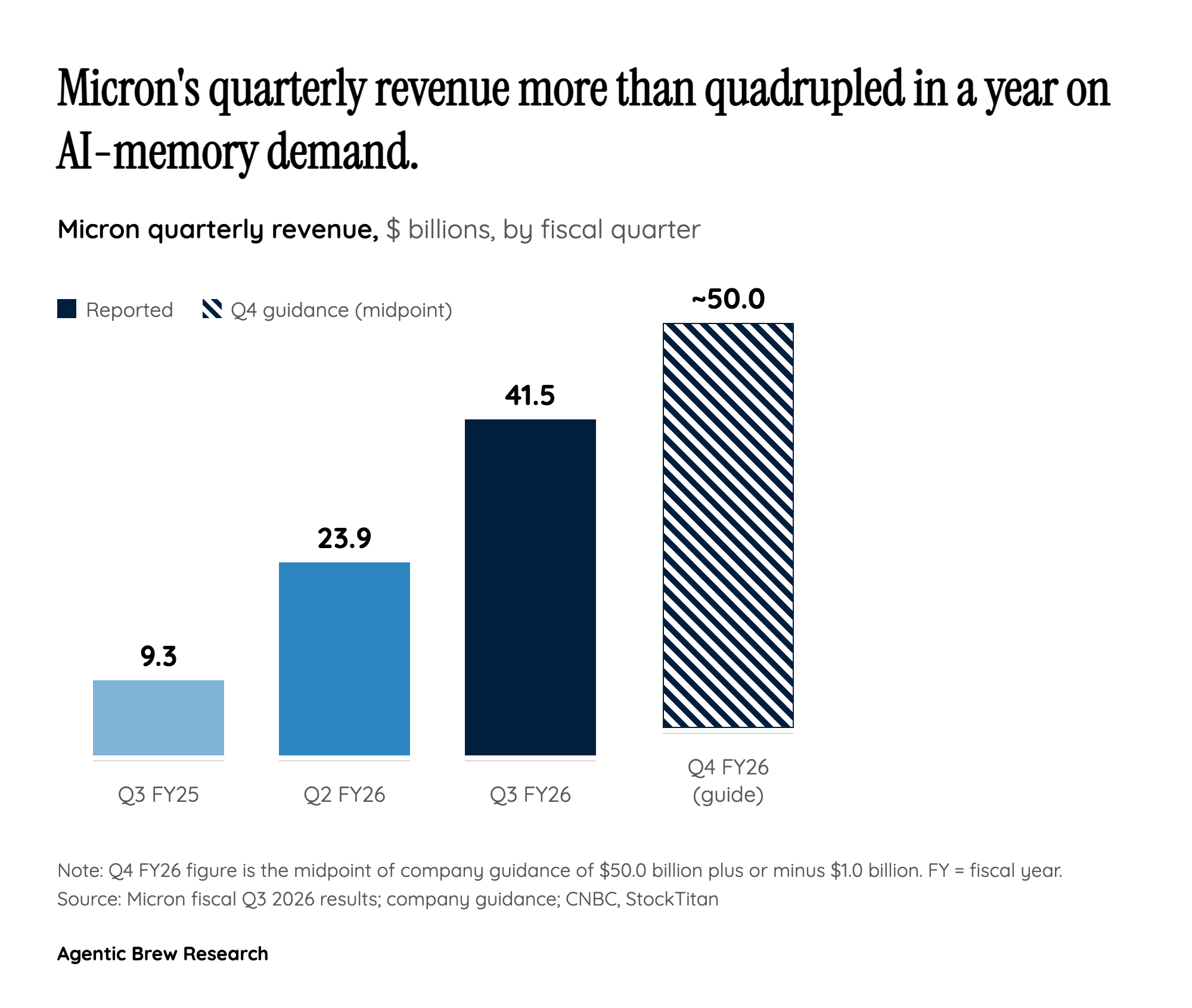

Tech's New Margin King

Tech's New Margin King
Micron quarterly revenue jumped from $9.3B a year ago to a record $41.46B, with Q4 guidance near $50B.

The number that made analysts blink was the margin. Micron posted a GAAP gross margin of 84.6% (84.9% non-GAAP), up from roughly 39% a year earlier, and guided next quarter to about 86% [3]. At that level, a memory maker is now more profitable per dollar of revenue than Nvidia, which runs near 75%, and Meta, near 82% - prompting CNBC to crown Micron tech's new "margin king" [4]. The revenue trajectory is just as steep: $41.46 billion in the quarter against $9.3 billion a year earlier, with Q4 guidance of roughly $50 billion versus a $36 billion consensus, and data center revenue alone surging more than sevenfold to $11.5 billion [5].

The striking part is the valuation disconnect this opens up. Micron briefly carried a $1.398 trillion market cap, topping Meta's $1.392 trillion [6], yet it is throwing off margins that exceed Nvidia's while trading at a fraction of Nvidia's multiple. Bulls read that as a re-rating still in early innings; skeptics read peak margins as a classic late-cycle tell. Either way, a memory company out-earning the two companies it just passed in market value is the kind of statistic that forces a second look at how the market prices the AI supply chain.

Why Memory Became the Bottleneck

To understand why customers are signing non-cancelable checks, look at what the next generation of AI hardware actually requires. Nvidia's Vera Rubin racks are specified for up to 400TB of memory capacity and up to 300TB/s of aggregate bandwidth each [7]. Feeding that takes enormous volumes of HBM4 and DRAM, and Micron's 12-high HBM4 delivers over 2.8 TB/s of bandwidth - a 2.3x jump over the prior HBM3E generation [7]. In other words, every new Rubin system is a memory-hungry machine, and the amount of high-bandwidth memory per accelerator keeps climbing.

This is the mechanism behind the "memory wall" that Susquehanna's Mehdi Hosseini described, where customers have no choice but to pay a premium [2]. Compute has outrun the ability to feed it data, so the scarce input shifts from GPUs to the memory stacked next to them. Micron's own CEO said the company does not yet have line of sight on when supply will catch up to demand [5]. Crucially, the same physical scarcity that lets Micron charge record prices also constrains its rivals: SK Hynix and Samsung are certified for Rubin too, but all three are fighting over limited fab capacity, which is why the supply-side discipline analysts cite isn't just a promise - it is a manufacturing reality.

The Cyclical Mirage Case

Not everyone buys the structural story, and the skeptics make a specific, mechanical argument rather than vague caution. Memory cycles have historically ended the same way - revenue declines of 25-40% and stock drops of 50-60% - and record margins have often marked the late innings, not the early ones [8]. As recently as fiscal 2023, Micron's revenue roughly halved and the company posted a net loss near $5.8 billion [9]. The contrarian read is that take-or-pay floors look durable on paper until the cash to honor them has to actually exist.

That is where community sentiment splits sharply from the headline euphoria. On the bullish side, investors are framing the print as a structural AI-infrastructure re-rating and circulating the guidance gap - roughly $50 billion in next-quarter revenue - as proof the market mispriced memory as merely cyclical. The harder-edged skepticism lives on Reddit, where the load-bearing worry is financial plumbing rather than demand: a take-or-pay obligation is only as good as the counterparty's balance sheet, and several voices argue the money to pay for all that booked HBM does not yet exist, with one blunt formulation that bankrupt AI companies don't honor purchasing contracts. A second strand worries about spillover - rising memory prices pushing up RAM costs and forcing consumer-hardware price hikes - which would make the same boom that lifts Micron a tax on everyone downstream. Bank of America's Vivek Arya splits the difference, crediting genuine supply-side discipline for a "more durable cycle" without declaring the cycle dead [2]. The unresolved question is whether floor pricing survives a real downturn in AI capex, or whether it is the most elegant version yet of the same trap memory always springs.

Historical Context

2023
Revenue roughly halved in fiscal 2023 amid a post-pandemic memory glut, swinging Micron to a net loss of about $5.8 billion - a reminder of how brutal the memory cycle has historically been.
2026-03-27
Micron began mass production of 36GB 12-high HBM4 for Nvidia's Vera Rubin, delivering bandwidth over 2.8 TB/s, a 2.3x gain over HBM3E.
2026-05-26
Micron crossed $1 trillion in market value for the first time, then added nearly $400 billion more in under a month.
2026-06-25
After the blowout Q3 report, Micron briefly overtook Meta and nearly matched Tesla in market capitalization.

Power Map

Key Players
Subject

Micron's record AI-memory earnings drive stock surge

MI

Micron Technology (MU)

The memory maker at the center of the story; it is leveraging structurally short HBM supply and take-or-pay contracts to lock in record margins and revenue visibility through 2027.

NV

Nvidia

The primary HBM demand driver; its Vera Rubin racks demand up to 400TB of memory each, and Micron is now in high-volume production of 12-high HBM4 for those systems.

SK

SK Hynix and Samsung

Competing certified HBM4 suppliers for Nvidia's Rubin platform; all three are confirmed suppliers fighting over constrained manufacturing capacity, which keeps supply tight and pricing firm.

DA

Data center operators and automakers

Counterparties to the 16 take-or-pay deals; they are obligated to buy committed volumes over three to five years regardless of pricing, having put $22 billion upfront to secure supply.

PE

Peer memory and storage stocks (Sandisk, Western Digital, Seagate)

Read-through beneficiaries of the rally, rising roughly 22%, 5%, and 3.2% respectively as investors extended the AI-memory thesis across the sector.

Fact Check

9 cited
  1. [1] Micron Q3 2026 Earnings: $100B Contracts Signal AI Memory Cycle Break
  2. [2] Micron reported strong earnings; Street sees more momentum on deals
  3. [3] Micron Technology, Inc. Reports Record Results for the Third Quarter
  4. [4] Micron is tech's margin king as memory crisis pushes it past Nvidia, Meta
  5. [5] Micron tops earnings estimates as AI drives memory demand
  6. [6] Micron beats Meta in market cap
  7. [7] Micron enters high-volume production of HBM4 for Nvidia Vera Rubin
  8. [8] Every Memory Cycle Ends the Same
  9. [9] Memory Supercycle or Cyclical Mirage? Micron Earnings in a Historical Lens

Source Articles

Top 5

THE SIGNAL.

Analysts

""Micron's record fiscal Q3 financial results and even stronger outlook for Q4 reflect the strategic value of memory in the AI era." On the earnings call he added that Micron currently does not have line of sight as to when memory supply will be able to catch up with increasing demand."

Sanjay Mehrotra
Chairman, President and CEO, Micron

""Nvidia realised their AI moment a few years ago [with its graphics processing units] . . . now, memory has never been such a valuable part of the computing stack.""

Manish Bhatia
EVP Global Operations, Micron

""MU delivered another strong quarter, reinforcing our constructive view on memory's role in AI and the increasing supply-side discipline supporting a more durable cycle.""

Vivek Arya
Analyst, Bank of America

"With "the memory wall playing out, customers have no choice but to pay a premium.""

Mehdi Hosseini
Analyst, Susquehanna
The Crowd

"Everyone is focused on Micron's $MU earnings beat. I think the biggest takeaway is something few are talking about. Next quarter Micron guided for $50B in rev and $35B profit. For perspective, 1yr ago $NVDA reported $35B rev and $20B profit for the quarter. I break down"

@@MikeEdward_TTG306

"Micron will be a $4,000 stock and here is why (Save this). As Sanjay Mehrotra puts it "We are only in the early innings of the significant innovation and productivity that can be unleashed in every part of the global economy over time." That is a roadmap and the math behind it"

@@MelvinInvests263

"$MU Micron Technology just turned memory into the hottest AI toll road on the tape. $41.46B revenue, $25.11 EPS, 84.9% gross margin. The market spent years calling this cyclical. The filing just called that bluff. #StockNewsroom #Micron #MicronEarnings 1/2"

@@S_NewsRoomCOM0

"Micron stock jumps 9% as soaring prices from memory crunch lead to quadrupling of revenue"

@u/app1310949
Broadcast
Micron Sales Forecast Shatters Estimates on AI Demand

Micron Sales Forecast Shatters Estimates on AI Demand

Micron Earnings Take on New Gravity With Market on Edge Over AI

Micron Earnings Take on New Gravity With Market on Edge Over AI

AI Demand in Full Force: MU Earnings Show Memory's Critical Role

AI Demand in Full Force: MU Earnings Show Memory's Critical Role