Intel Joins Musk's Terafab AI Chip Megafactory in Austin
TECH

Intel Joins Musk's Terafab AI Chip Megafactory in Austin

28+
Signals

Strategic Overview

  • 01.
    Intel announced on April 7, 2026 that it is joining Elon Musk's Terafab project alongside SpaceX, xAI, and Tesla to help design and manufacture semiconductors at a massive vertically integrated facility in Austin, Texas.
  • 02.
    Terafab targets 2-nanometer process technology with initial capacity of 100,000 wafer starts per month, scaling to 1 million per month, and aims to produce 100-200 billion custom AI and memory chips annually at full scale.
  • 03.
    Approximately 80% of chip production is allocated for space-based applications including SpaceX systems, with only 20% for Earth-based use. Two advanced fabs will serve automotive/humanoid robotics and AI data center infrastructure respectively.
  • 04.
    Intel's stock rose approximately 2.8% to $52.21 following the announcement, approaching its 52-week high of $54.60.

Deep Analysis

The $10 Billion Hole That Made Intel Say Yes to Musk
The $10 Billion Hole That Made Intel Say Yes to Musk
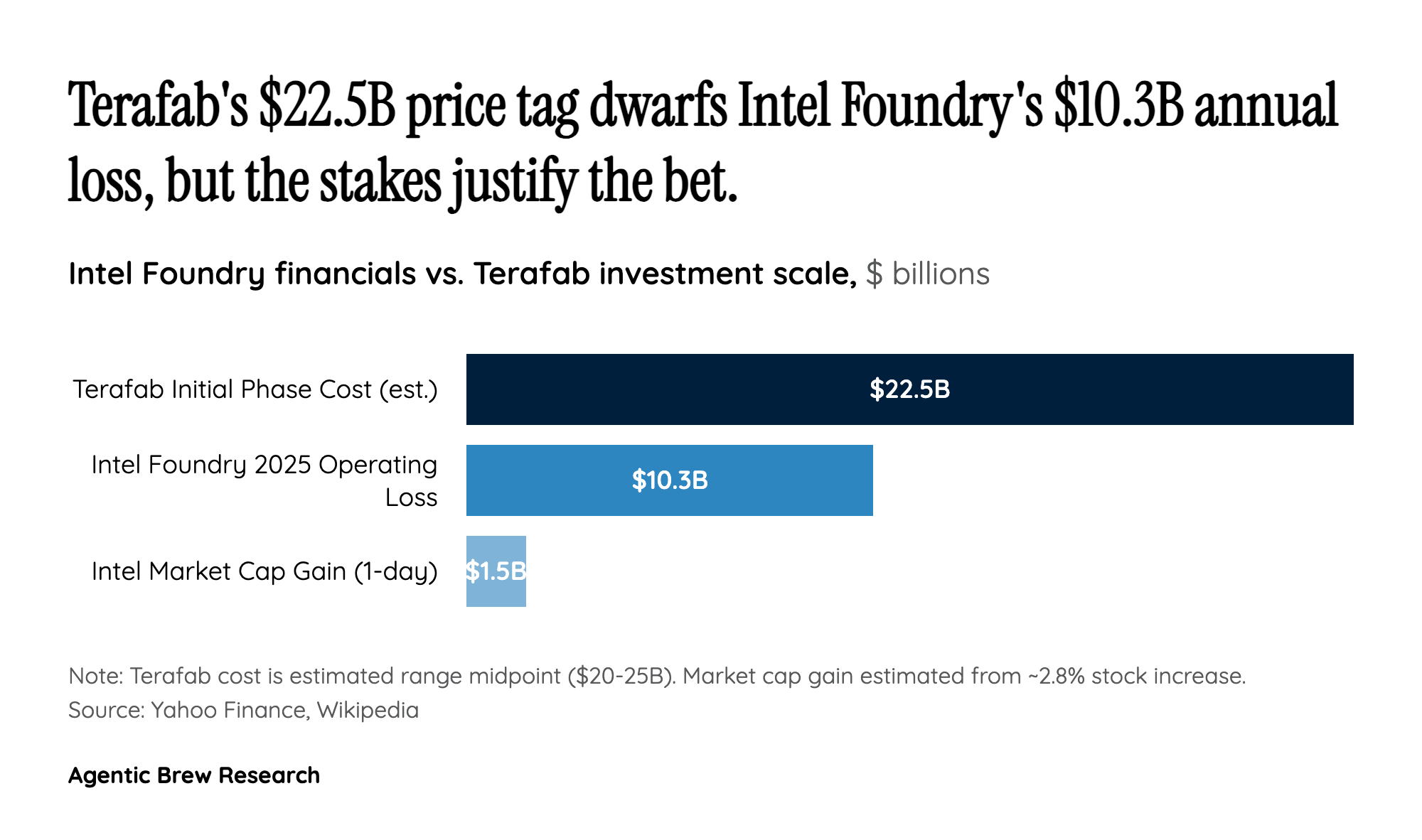
Chart comparing Terafab's estimated $22.5B initial investment against Intel Foundry's $10.3B annual operating loss and one-day market cap gain

Intel's decision to join Terafab cannot be understood without grasping the dire state of its foundry business. In 2025, Intel Foundry posted a staggering $10.32 billion operating loss while managing only 3% revenue growth. For a company attempting the unprecedented feat of simultaneously designing its own chips and manufacturing them for outside customers, the math has been brutal. CEO Lip-Bu Tan, who took the helm with a mandate to revive Intel's manufacturing credibility, needed a flagship customer that would signal to the market that Intel Foundry is a serious contender against TSMC and Samsung.

Musk's Terafab provides exactly that signal. The partnership gives Intel a marquee customer with enormous volume potential — the facility targets 100,000 wafer starts per month initially, scaling to 1 million. Even if Intel captures a fraction of that volume, it represents a meaningful revenue stream for a foundry business desperately seeking anchor clients. The stock market's immediate response — Intel shares rising 2.8% to approach their 52-week high — suggests investors see this as validation of the foundry pivot strategy. Analyst Gil Luria of D.A. Davidson captured the sentiment precisely: Intel needs to prove it can support the largest customers with their most important projects. Whether the economics actually work remains an open question, but the optics alone may have been worth the handshake.

A Space Computing Empire Disguised as a Chip Factory

The most underreported dimension of Terafab is its allocation: approximately 80% of chip production is designated for space-based applications, with only 20% for Earth-based use. This is not primarily an automotive play or even an AI data center play — it is fundamentally a space computing infrastructure project. SpaceX's D3 chip is among the first products slated for production alongside Tesla's AI5, and one of the two Austin fabs is explicitly dedicated to space-based AI systems.

This allocation reveals Musk's broader strategic calculus. SpaceX's Starlink constellation, its Mars ambitions, and the growing demand for edge computing in orbit require a reliable domestic supply of radiation-hardened, high-performance processors. Currently, space-grade chip production is a niche market dominated by legacy processes and long lead times. By vertically integrating semiconductor manufacturing with his space operations, Musk could dramatically reduce costs and turnaround times for the thousands of satellites SpaceX launches annually. The Earth-based 20% — serving Tesla's self-driving and robotics needs — almost functions as a side benefit that helps subsidize the economics of the space-focused production lines.

150 Fabs and 300,000 Workers: Vision Versus Reality

Terafab's full vision, as detailed in Tom's Hardware's analysis, calls for more than 150 fabs, over 12,600 lithography tools, and a workforce exceeding 300,000 people. What Musk is describing would represent an order of magnitude beyond anything the semiconductor industry has ever attempted.

Tom's Hardware analyst Anton Shilov's skepticism deserves serious weight here. The barriers to entry in leading-edge semiconductor manufacturing are not merely financial — they involve decades of accumulated process knowledge, relationships with equipment suppliers like ASML (which has multi-year backlogs for its most advanced EUV lithography machines), and a talent pool that takes years to develop. The initial plan — two fabs in Austin targeting 2-nanometer technology — is ambitious but plausible with Intel's existing expertise. The leap from two fabs to 150 is where the vision enters uncharted territory. At $20-25 billion for the initial phase alone, the full vision would require capital investment potentially exceeding $1 trillion, rivaling the GDP of many nations.

The Weekend That Rewired U.S. Semiconductor Strategy

Intel CEO Lip-Bu Tan hosting Musk at Intel's campus over the weekend before the Monday announcement carries significance beyond corporate hospitality. This was a personal, high-stakes negotiation between two leaders who each need what the other has. Musk needs Intel's manufacturing expertise and existing fab infrastructure to make Terafab viable in the near term. Tan needs Musk's volume commitments and brand association to convince Wall Street that Intel Foundry has a future.

The broader geopolitical context adds another layer. The U.S. government is a major Intel shareholder and has invested heavily in domestic semiconductor sovereignty through the CHIPS Act. A Musk-Intel partnership that produces chips for both commercial and space applications on American soil aligns neatly with national security priorities. The fact that Musk first floated this partnership approximately five months earlier, around November 2025, suggests this was not an impulsive decision but a carefully negotiated arrangement. The timing of the public announcement — coming just weeks after Terafab's March 21 unveiling — was likely orchestrated to maximize market impact while Intel's stock was already trending upward. With analyst price targets ranging from D.A. Davidson's $45 to KeyBanc's $70, and UBS at $52 against a consensus hold rating at $44.67, the partnership gives bulls a compelling narrative even as the market waits for execution proof.

Tesla's AI5 Chip: The First Real Test of Vertical Integration

Among the first products Terafab aims to produce is Tesla's AI5 chip, with small-batch production targeted for 2026 and volume production in 2027. This chip, designed for Tesla's Autopilot self-driving system and Optimus humanoid robots, will serve as the critical proof of concept for the entire Terafab model. If Intel can deliver competitive 2-nanometer AI5 chips on schedule, it validates both Terafab's viability and Intel's foundry capabilities at the leading edge.

The stakes are particularly high because the broader industry watches closely when major customers commit manufacturing volumes to a new foundry partnership. A successful AI5 production run would demonstrate that the Terafab model — consolidating chip design, lithography, fabrication, memory production, advanced packaging, and testing under one roof — can deliver the integration benefits Musk is betting on. Failure or significant delays, on the other hand, would reinforce skeptics' concerns about the feasibility of building world-class semiconductor manufacturing capability from a standing start, even with Intel's participation. The 2027 volume production target leaves remarkably little runway for the kind of yield optimization and process refinement that typically takes years at a new fab.

Social Media Erupts: The X.com Reaction as Market Sentiment Barometer

The announcement's reception on X.com provided a real-time window into market and public sentiment that reinforced the bullish stock reaction. Intel's official post — "Intel is proud to join the Terafab project" — drew 9,700 likes and 1,900 retweets, an unusually strong engagement level for a corporate semiconductor announcement. SpaceX's post calling Terafab the "most epic chip-building effort ever" outperformed even Intel's, garnering 10,000 likes and 1,600 retweets, signaling that Musk's audience views this as a signature moonshot on par with SpaceX's rocket reusability achievements.

Beyond the official accounts, independent analysis on X.com added nuance. User @XFreeze's thread, which accumulated 454 likes, highlighted Samsung's involvement alongside Intel in the Terafab ecosystem — a detail that underscores the project is attracting multiple foundry partners rather than relying solely on Intel. The overwhelmingly positive sentiment across these posts coalesced around two dominant themes: the sheer scale of Musk's ambition and the narrative of Intel's comeback as a manufacturing powerhouse. Notably, the social discourse leaned heavily toward "skeptics proven wrong" framing, with many commenters citing Intel's foundry losses as precisely the kind of pressure that produces bold strategic pivots. This enthusiasm, while genuine, also carries risk — elevated expectations make any execution stumble more painful for Intel's stock, which analysts already view with mixed conviction given the wide spread between D.A. Davidson's $45 target and KeyBanc's $70.

Historical Context

2025-11
Musk first floated the idea of partnering with Intel on semiconductor manufacturing approximately five months before the formal announcement.
2025-12-31
Intel Foundry recorded a $10.32 billion operating loss for the full year 2025, with only 3% revenue growth, underscoring the financial pressure behind the Terafab partnership.
2026-03-21
Musk publicly announced the Terafab project as a vertically integrated large-scale semiconductor facility targeting more than 1 terawatt of AI compute per year.
2026-04-07
Intel officially joined the Terafab project, confirming its role in chip design, fabrication, and advanced packaging for Tesla, SpaceX, and xAI.

Power Map

Key Players
Subject

Intel Joins Musk's Terafab AI Chip Megafactory in Austin

IN

Intel

Manufacturing partner providing chip design, fabrication, and advanced packaging capabilities. The deal strengthens Intel's foundry business, which recorded a $10.32 billion operating loss in 2025.

TE

Tesla

Co-developer and primary customer. Tesla's AI5 chip for Autopilot and Optimus humanoid robots is among the first products targeted for production.

SP

SpaceX

Co-developer with one fab dedicated to space-based AI systems, including the D3 chip. Approximately 80% of production capacity is allocated for space applications.

XA

xAI

Co-developer and consumer of AI compute capacity produced at the Terafab facility.

LI

Lip-Bu Tan

Intel CEO who led the decision to join Terafab and personally hosted Musk at Intel's campus over the weekend before the announcement.

THE SIGNAL.

Analysts

""Elon has a proven track record of re-imagining entire industries. This is exactly what is needed in semiconductor manufacturing today. Terafab represents a step change in how silicon logic, memory and packaging will get built in the future.""

Lip-Bu Tan
CEO, Intel

""Intel needs to show it can support the largest customers with their most important projects, and that seems to be the case with the Tesla partnership.""

Gil Luria
Analyst, D.A. Davidson

"Raised feasibility concerns, noting that "barriers to entry in the semiconductor industry are so high that launching a new player capable of manufacturing chips in high volumes on leading-edge process technologies is nearly impossible, from both a capital investment and an expertise point of view.""

Anton Shilov
Journalist, Tom's Hardware
The Crowd

"Intel is proud to join the Terafab project with @SpaceX @xAI, and @Tesla to help refactor silicon fab technology. Our ability to design, fabricate, and package ultra-high-performance chips at scale will help accelerate Terafab's aim to produce 1 TW/year of compute to power"

@@intel9700

"Intel is joining Terafab! SpaceX, @xAI, and @Tesla are launching the most epic chip-building effort ever - combining logic, memory, and advanced packaging under one roof"

@@SpaceX10000

"Again, many doubted Elon Musk's new Terafab project because of the astronomical numbers, not realizing he was playing a much bigger game all along. Elon officially partnered with the US's biggest chip manufacturer, Intel, alongside massive max-capacity orders from Samsung"

@@XFreeze454
Broadcast