
AI Coding Agents Are Causing Mental Exhaustion for Engineers
TECH

AI Coding Agents Are Causing Mental Exhaustion for Engineers

29+
Signals

Strategic Overview

  • 01.
    Simon Willison, Django co-creator, reports that running multiple AI coding agents in parallel draws on all his 25 years of experience and leaves him mentally exhausted by 11 AM, describing the shift from writing code to maintaining mental models as the new bottleneck.
  • 02.
    A BCG and UC Riverside study of 1,488 US workers found that 14% experienced 'AI brain fry' — mental fatigue from excessive oversight of AI tools — leading to 33% more decision fatigue, 39% higher error rates, and 39% increased intent to quit.
  • 03.
    Willison identifies a growing problem of 'cognitive debt' where agent-generated code evolves faster than engineers can reason about it, causing them to lose their mental model of their own projects.
  • 04.
    The emergence of 'dark factories' — Level 5 AI-assisted programming where code must not be written or reviewed by humans — represents a radical new paradigm pioneered by companies like StrongDM, spending roughly $1,000 per day per engineer in token costs.

Deep Analysis

Why This Matters

The promise of AI coding agents has always been rooted in productivity — the idea that developers could accomplish more in less time. Simon Willison's candid account shatters the simplistic narrative. Here is one of the most experienced and technically accomplished developers in the world, someone with 25 years of professional experience, admitting he is "wiped out" by 11 AM from the cognitive demands of managing four parallel coding agents. If Willison struggles, the implications for the broader engineering workforce are severe.

This matters because the software industry is moving toward a future where AI agents write the majority of code, yet the human infrastructure to support this transition — the cognitive frameworks, the management practices, the organizational support systems — barely exists. The BCG/UC Riverside finding that 39% of workers experiencing AI brain fry intend to quit signals a looming talent crisis that could undermine the very productivity gains AI tools promise to deliver.

The social media response underscores the resonance of this message. Willison's X.com post on cognitive debt garnered 2,300 likes and 282 retweets, while his post linking to the HBR research on AI burnout received 1,600 likes and 273 retweets. The Latent.Space podcast's post on Willison's dark factory analysis drew 756 likes and 144 retweets. On YouTube, his Lenny's Podcast interview has accumulated 24,602 views and 757 likes, his Pragmatic Summit talk reached 30,115 views and 807 likes, and his earlier Pragmatic Engineer appearance drew 80,935 views and 1,982 likes. The scale and consistency of engagement across platforms — particularly among technical audiences — suggests this is not a niche concern but a widespread industry anxiety. Notably, no significant Reddit discussions were found on the topic, likely because the most recent Lenny's Podcast episode was published just one day prior.
How It Works: The Mechanics of Cognitive Overload

The exhaustion Willison describes is not physical but cognitive. When an engineer runs multiple AI coding agents in parallel, their role shifts from writing code to supervising code generation. Each agent produces output that must be evaluated for correctness, consistency with the existing codebase, security implications, and alignment with architectural intent. The engineer becomes an air traffic controller, maintaining simultaneous mental models of multiple evolving workstreams.

Willison identifies a particularly insidious mechanism he calls 'cognitive debt.' As agents generate code faster than a human can fully internalize, the developer's mental model of their own project degrades. He warns: "I no longer have a firm mental model of what they can do and how they work..." — capturing how the codebase grows while comprehension shrinks, creating a widening gap that compounds with every agent-driven change. This connects to a broader observation he made: "It's so easy to let the codebase evolve outside of our abilities to reason clearly about it. Cognitive debt is real."

The addiction-like patterns Willison observes add another dimension. He describes how engineers stay up late launching agent tasks and wake at 4 AM to check results: "I've talked to a lot of people who are losing sleep because they're like, my coding agents could be doing work for me. I'm just going to stay up an extra half hour and set off a bunch of extra things... and then waking up at four in the morning. That's obviously unsustainable." The variable-reward nature of AI output — sometimes brilliant, sometimes flawed — mirrors the psychological mechanics of slot machines. As Willison puts it: "There's an element of sort of gambling and addiction to how we're using some of these tools."

By The Numbers

The quantitative evidence paints a stark picture. The BCG/UC Riverside study surveyed 1,488 US workers and found that 14% reported experiencing 'AI brain fry' — defined as "mental fatigue from excessive use or oversight of AI tools beyond one's cognitive capacity." Among those affected, decision fatigue increased by 33%, major errors increased by 39%, and intent to quit rose by 39%. The impact varies significantly by profession: 26% of marketing roles reported brain fry compared to just 6% in legal roles, suggesting that the intensity and nature of AI tool interaction matters enormously.

There is a notable bright spot in the data: when AI replaces genuinely repetitive tasks rather than augmenting complex ones, burnout decreases by 15%. This suggests the problem is not AI tools per se, but the specific pattern of using AI agents for complex, judgment-intensive work like software development where human oversight cannot be eliminated but is cognitively crushing.

On the economic side, StrongDM's dark factory model consumes approximately $1,000 per day per engineer in token costs — a figure that reflects the sheer volume of AI computation required when agents handle the majority of code generation. Willison's personal database of 1,228 documented AI hallucination cases underscores why human oversight remains necessary despite the cost it imposes on mental health.

The Dark Factory and the Future of Engineering

The 'dark factory' concept, as analyzed by Willison, represents the most extreme vision of AI-assisted development. At Level 5, "Code must not be written by humans... Code must not be reviewed by humans." This is manufacturing logic applied to software: lights-out factories where no human presence is needed on the production floor.

The November 2025 inflection point made this conceivable. When GPT 5.1 and Claude Opus 4.5 demonstrated that "long-horizon agentic coding workflows began to compound correctness rather than error," the theoretical ceiling for autonomous code generation rose dramatically. StrongDM's founding of a dedicated AI team in July 2025 positioned them to exploit this shift early.

Yet the dark factory model raises profound questions about the engineering profession. If code is neither written nor reviewed by humans, what is the engineer's role? Willison's experience suggests the answer is cognitive architecture — maintaining the high-level intent, strategic direction, and system understanding that agents cannot self-generate. But this is precisely the role that causes the most exhaustion, because it requires holding an ever-expanding system in mind without the grounding that comes from having written the code yourself.

Impacts and What Comes Next

The research from UC Berkeley Haas is particularly sobering for organizational leaders. Ranganathan's 8-month ethnographic study found that workers using AI tools "although they felt more productive, they did not feel less busy, and in some cases felt busier than before." This productivity-busyness paradox suggests that organizations adopting AI tools may be optimizing for output while inadvertently degrading the human experience of work. In the Lenny's Podcast discussion, Willison also raised concerns about mid-career engineers being particularly vulnerable — developers with enough skill to run complex multi-agent workflows but facing the greatest cognitive strain in reconciling agent output with their existing mental models.

Several developments are worth watching. First, the emergence of tooling and practices to manage cognitive load — Willison's own work on documenting agentic engineering practices points in this direction. Second, organizational responses to the 39% quit-intent figure among brain-fry-affected workers; companies that fail to address cognitive overload risk losing exactly the experienced engineers they need most. Third, the evolution of the dark factory model: if fully autonomous code generation matures, it could paradoxically reduce cognitive burden by eliminating the supervisory role entirely — or it could create new, higher-order cognitive demands around system design and verification.

The broader lesson is that AI's impact on knowledge work is not a simple story of labor replacement or augmentation. It is a fundamental restructuring of cognitive demands, and the engineering profession is experiencing it first and most intensely. The cross-platform engagement — from X.com discussions with thousands of likes to YouTube videos approaching six-figure view counts — confirms this is resonating deeply with the developer community. How this community adapts will set precedents for every profession that follows.

Historical Context

2025-07
StrongDM founded its AI development team to pursue fully autonomous code generation workflows in the 'dark factory' model.
2025-11
The release of GPT 5.1 and Claude Opus 4.5 marked an inflection point where long-horizon agentic coding workflows began to compound correctness rather than error.
2026-02-07
Published detailed analysis of StrongDM's dark factory approach and the implications of fully autonomous AI software development.
2026-02
Published Ranganathan and Ye's research showing AI doesn't reduce work but intensifies it, based on 8-month study of approximately 200 employees.
2026-03
Harvard Business Review published BCG/UC Riverside study coining 'AI brain fry' after surveying 1,488 US workers.
2026-04-02
Appeared on Lenny's Podcast discussing mental exhaustion from AI agents, cognitive debt, addiction-like behavioral patterns, and the dark factory model.

Power Map

Key Players
Subject

AI Coding Agents Are Causing Mental Exhaustion for Engineers

SI

Simon Willison

Django co-creator, independent developer, and prominent voice on agentic engineering who has been documenting AI's impact on software development through his blog and podcast appearances.

ST

StrongDM

Pioneer of the 'dark factory' model of AI-powered software development, founded its AI team in July 2025 and operates at approximately $1,000/day per engineer in token costs.

BC

BCG and UC Riverside

Research team that published the 'AI brain fry' study quantifying the cognitive toll of AI tool oversight across 1,488 US workers, finding 14% affected with significant increases in errors and quit intent.

AR

Aruna Ranganathan and Xingqi Maggie Ye (UC Berkeley Haas)

Researchers who conducted an 8-month ethnographic study of approximately 200 employees finding that AI tools consistently intensify work rather than reducing it.

THE SIGNAL.

Analysts

"States that "using coding agents well is taking every inch of my 25 years of experience as a software engineer, and it is mentally exhausting," and warns of addiction-like patterns: "There's an element of sort of gambling and addiction to how we're using some of these tools." He also identifies cognitive debt as a systemic risk: "It's so easy to let the codebase evolve outside of our abilities to reason clearly about it. Cognitive debt is real.""

Simon Willison
Django Co-Creator, Independent Developer

"Captures the shifted nature of engineering fatigue: "I end each day exhausted — not from the work itself, but from the managing of the work.""

Francesco Bonacci
Cua AI (as cited in HBR)

"Based on an 8-month ethnographic study, found that workers "although they felt more productive, they did not feel less busy, and in some cases felt busier than before," concluding that AI tools consistently intensified work rather than reducing it."

Aruna Ranganathan
Professor, UC Berkeley Haas School of Business

"Identified 'AI brain fry' — defined as "mental fatigue from excessive use or oversight of AI tools beyond one's cognitive capacity" — affecting 14% of 1,488 surveyed workers, correlating with 33% more decision fatigue, 39% higher major error frequency, and 39% increased intent to quit."

BCG/UC Riverside Research Team
Researchers, BCG and UC Riverside
The Crowd

"Short musings on 'cognitive debt' - I'm seeing this in my own work, where excessive unreviewed AI-generated code leads me to lose a firm mental model of what I've built, which then makes it harder to confidently make future decisions"

@@simonw2300

"Interesting research in HBR today about how the productivity boost you can get from AI tools can lead to burnout or general mental exhaustion, something I've noticed in my own work"

@@simonw1600

"How to Kill The Code Review @simonw called out StrongDM's 'Dark Factory' last month: no human code, but *also* no human review (!?) in this week's guest post, @ankitxg makes a 5 step layered playbook for..."

@@latentspacepod756
Broadcast
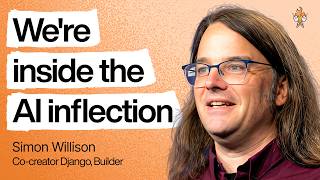
An AI state of the union: We've passed the inflection point & dark factories are coming

An AI state of the union: We've passed the inflection point & dark factories are coming

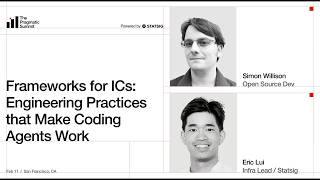
Simon Willison: Engineering practices that make coding agents work - The Pragmatic Summit

Simon Willison: Engineering practices that make coding agents work - The Pragmatic Summit

AI tools for software engineers, but without the hype - with Simon Willison (Co-Creator of Django)

AI tools for software engineers, but without the hype - with Simon Willison (Co-Creator of Django)