AI Agent Architecture and Context Engineering
TECH

AI Agent Architecture and Context Engineering

42+
Signals

Strategic Overview

  • 01.
    Context engineering has emerged as the successor to prompt engineering, defined as the discipline of curating the entire information environment fed to an LLM during inference -- including system prompts, tools, MCP connections, external data, and message history.
  • 02.
    According to the LangChain State of Agent Engineering survey of 1,340 respondents, 57% of organizations now have AI agents in production, with 32% citing quality as the top barrier to further deployment.
  • 03.
    Most agent failures are context failures rather than model failures, meaning improving what information reaches the model matters more than improving the model itself.
  • 04.
    The Model Context Protocol (MCP), created by Anthropic, has become a universal open standard for AI-to-tool communication, described as 'HTTP for agents,' with enterprise adopters including Pinterest deploying production-scale MCP ecosystems.

Most Agent Failures Are Context Failures, Not Model Failures

The most consequential insight reshaping how the industry builds AI agents is deceptively simple: when agents fail, the problem is almost always what information they were given, not the model's reasoning capability. This finding, echoed across multiple independent sources, inverts the dominant narrative that better models automatically produce better agents. Instead, the bottleneck is the information architecture surrounding the model -- what Andrej Karpathy calls "the delicate art and science of filling the context window with just the right information for the next step."

This reframing has practical implications that cascade through every layer of agent development. If context is the binding constraint, then the highest-leverage engineering work is not fine-tuning models or waiting for the next capability jump, but designing systems that select, compress, and sequence information correctly. Phil Schmid's breakdown identifies seven distinct components of context engineering -- system prompt, user prompt, short-term memory, long-term memory, RAG, tools, and structured output -- each representing a surface area where context can go wrong. The LangChain survey corroborates this: among organizations that have agents in production, 32% cite quality (not capability) as the top barrier, and a striking 67% failure rate afflicts agents without persistent memory. The message is clear: the model is rarely the weakest link.
The KV-Cache Economy: Where a 10x Cost Gap Reshapes Agent Design

Manus co-founder Yichao 'Peak' Ji offered what may be the most actionable insight for anyone running agents in production: "the KV-cache hit rate is the single most important metric for a production-stage AI agent." The economics are stark -- cached tokens cost $0.30 per million while uncached tokens cost $3.00 per million, a 10x difference. For a system like Manus that averages approximately 50 tool calls per task with a 100:1 input-to-output token ratio, KV-cache optimization is not a nice-to-have; it is the difference between a viable business and an unsustainable one.

This metric reframes context engineering as an economic discipline, not just a technical one. Every architectural decision -- how prompts are structured, whether context is appended or prepended, how tool results are formatted -- has a direct cost implication through its effect on cache hit rates. Anthropic's own Applied AI team revealed a complementary pattern: sub-agents typically return summaries of 1,000-2,000 tokens despite exploring tens of thousands of tokens or more. This compression ratio is not incidental; it is a deliberate architectural choice that keeps parent agent context windows lean and cacheable. The takeaway for practitioners is that agent architecture should be designed cache-first, treating token economics as a primary constraint rather than an afterthought.

Semantic Collapse: The Hidden Ceiling That Breaks RAG at Scale

While the January 2026 debate over whether RAG is 'dead' generated substantial noise, a more specific and technically grounded concern has emerged: semantic collapse. This failure mode, documented by AI Competence, describes how RAG systems progressively lose the ability to reason with meaning as document collections grow, with degradation beginning around 10,000 documents and outright collapse at approximately 50,000 documents.

The mechanism is subtle and pernicious. As the document corpus grows, the embedding space becomes increasingly crowded, and the semantic distance between genuinely relevant and merely similar documents shrinks. The retrieval system starts returning results that are topically adjacent but contextually wrong, and the LLM -- which, as Neo4j's Alyssa Di Pasqualucci notes, "only reasons over the information present in the context window" -- dutifully reasons over garbage. The model does not know the context is wrong; it fills gaps with guesses that sound authoritative. This is not a model failure. It is a context failure at the retrieval layer, exactly the kind of problem context engineering is designed to address. Solutions being explored include graph-based retrieval (Neo4j's approach), skill graphs that let agents navigate to relevant knowledge rather than loading everything into context (as highlighted by Shubham Saboo on X), and hybrid architectures that combine multiple retrieval strategies with aggressive reranking.

MCP as 'HTTP for Agents': The Infrastructure Bet That Could Define the Stack

Anthropic's Model Context Protocol has moved from an internal experiment to what Vendia describes as a potential 'HTTP for agents' -- a universal protocol layer for AI-to-tool communication. The analogy is deliberately ambitious: just as HTTP standardized how browsers talk to servers, MCP aims to standardize how agents talk to tools. Pinterest's April 2026 deployment of a production-scale MCP ecosystem with cloud-hosted MCP servers for specific domains provides the strongest enterprise validation to date.

Vendia's proposed 'LAMP stack' for AI agents -- LLM, Agent Framework, MCP Gateway, Persistence -- positions MCP as the middleware layer, analogous to Apache in the original LAMP stack. The framing is compelling: "Getting hundreds of millions of trusted AI agents into production requires getting millions of developers fluent in agentic architecture." The adoption of MCP by multiple major players lends credibility to MCP as a cross-vendor standard rather than an Anthropic-only play. However, the analogy also carries a warning. HTTP succeeded because it was simple, stateless, and vendor-neutral from inception. MCP, born from a single company's ecosystem, faces the challenge of maintaining neutrality as it scales. The protocol's trajectory over the next twelve months -- whether it remains truly open or gravitates toward Anthropic's orbit -- will likely determine whether this 'new LAMP stack' becomes the dominant paradigm or fragments into competing standards.

The 70% Tax: System Prompts and Tool Definitions Crowd Out Actual Work

A finding from the YouTube research signals surfaces a constraint that many practitioners may not have quantified: approximately 70% of the context window is consumed by system prompts and tool definitions before any task-specific context is even loaded. This 'context tax' means that agents operating with, say, a 128K token window effectively have only ~38K tokens for the actual work -- retrieved documents, conversation history, intermediate reasoning, and task instructions.

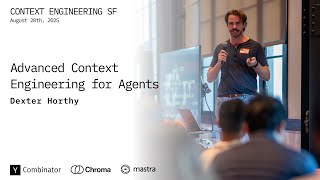
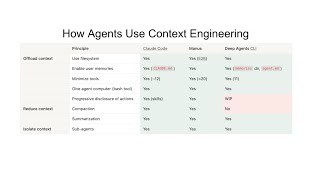
This constraint explains why the three principles identified by LangChain's analysis -- Offload (move data to file systems), Reduce (compact and summarize), and Isolate (delegate to sub-agents) -- are not optimization tips but architectural necessities. When your tool definitions alone consume a significant share of available context, every additional token of task context must earn its place. Manus's 100:1 input-to-output token ratio reflects this reality: the vast majority of tokens flowing through their system are context, not generation. The YC Root Access talk by Dexter Horthy of HumanLayer reinforces this with the concept of 'spec-first development' for agents -- designing the context architecture before writing agent logic, because the context constraints will dictate what the agent can actually do. As X user elvis/DAIR.AI observed, "AI agents with a human touch are way better than general agentic systems. The human touch happens at phases like prompt design, context engineering, agent architecture, and evaluation." The implication is that human expertise is most valuable not in the loop during execution, but upstream in designing what context the agent receives.

Historical Context

2025-06
The term 'context engineering' entered mainstream AI discourse, popularized by influential figures framing it as the successor to prompt engineering.
2025-11
Documented the industry-wide shift from 'vibe coding' to context engineering as the defining software development trend of 2025.
2025-12
Published the State of Agent Engineering survey revealing 57% of organizations had agents in production and 89% had implemented observability.
2026-01
Debate over whether RAG was 'dead' reached its peak, with consensus emerging that RAG remains a component within the broader context engineering framework.
2026-04
Deployed a production-scale MCP ecosystem with cloud-hosted MCP servers for specific domains, marking one of the first major enterprise MCP deployments.

Power Map

Key Players
Subject

AI Agent Architecture and Context Engineering

AN

Anthropic

Creator of MCP and Claude. Published foundational engineering guides on context engineering for agents. MCP has become the de facto standard for agent-to-tool communication.

MA

Manus

AI agent startup that open-sourced key production lessons on context engineering, particularly KV-cache optimization. Processes ~50 tool calls per task with a 100:1 input-to-output token ratio.

LA

LangChain

Provider of LangGraph and publisher of the State of Agent Engineering report (1,340 respondents), which benchmarked industry adoption of agents in production.

PI

Pinterest

Early enterprise deployer of production-scale MCP ecosystem with cloud-hosted MCP servers for specific domains, validating MCP as a viable enterprise integration pattern.

VE

Vendia

Proposed the new 'LAMP stack' architecture model for AI agents (LLM, Agent Framework, MCP Gateway, Persistence), framing context engineering as the new full-stack discipline.

THE SIGNAL.

Analysts

"Described context engineering as "the art of providing all the context for the task to be plausibly solvable by the LLM," a definition that has become widely cited as the canonical framing of the discipline."

Tobi Lutke
CEO, Shopify

""In every industrial-strength LLM app, context engineering is the delicate art and science of filling the context window with just the right information for the next step.""

Andrej Karpathy
Founding Member, OpenAI

""The KV-cache hit rate is the single most important metric for a production-stage AI agent," citing the 10x cost difference between cached and uncached tokens as the key optimization target."

Yichao 'Peak' Ji
Co-founder, Manus

""Sub-agents typically return summaries of 1,000-2,000 tokens despite exploring tens of thousands of tokens or more," describing the compression pattern that makes multi-agent architectures viable."

Anthropic Applied AI Team
Applied AI, Anthropic

""LLMs only reason over the information present in the context window. If that information is incomplete, outdated, or noisy, the model fills the gaps with guesses," arguing for graph-based approaches to context engineering."

Alyssa Di Pasqualucci
Developer Advocate, Neo4j
The Crowd

"SKILL graphs take context engineering to its logical conclusion. Skill graphs are interconnected knowledge the agent can traverse. Instead of loading everything into context, the agent navigates to exactly what the current task needs."

@@Saboo_Shubham_484

"AI agents with a human touch are way better than general agentic systems that try to automate everything. The human touch happens at phases like prompt design, context engineering, agent architecture, and, more importantly, evaluation. Domain expertise matters so much."

@@omarsar0216

"Congrats to our friends at @manusAI! Manus has built one of the most disruptive agents of 2025. We recently hosted a discussion with Manus co-founder Yichao Peak Ji on their context engineering approach."

@@LangChain578
Broadcast
Advanced Context Engineering for Agents

Advanced Context Engineering for Agents

How Agents Use Context Engineering

How Agents Use Context Engineering

3 New Context Engineering Skills for Agents

3 New Context Engineering Skills for Agents