Anthropic autonomous AI agent development frameworks
TECH

Anthropic autonomous AI agent development frameworks

26+
Signals

Strategic Overview

  • 01.
    Anthropic designed a three-agent harness architecture separating planning, generation, and evaluation for long-running full-stack AI development. The Planner converts brief prompts into comprehensive product specs, the Generator implements features in structured sprints, and the Evaluator uses Playwright MCP to interact with running applications like a human QA engineer.
  • 02.
    Anthropic published research on measuring AI agent autonomy in practice, analyzing millions of human-agent interactions and finding that the 99.9th percentile turn duration in Claude Code nearly doubled from under 25 minutes to over 45 minutes between October 2025 and January 2026, signaling a rapid increase in agent autonomy.
  • 03.
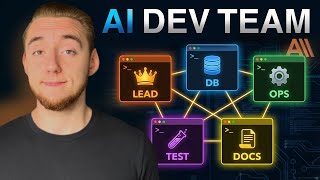
    Claude Code's Agent Teams feature enables multiple Claude Code instances to work on different parts of a problem simultaneously, coordinated by a lead agent that assigns subtasks and merges results, each operating in isolated git worktrees to eliminate edit collisions.
  • 04.
    Anthropic launched enterprise agent plugins in February 2026 for finance, engineering, and design sectors, and released Claude Cowork with Dispatch enabling computer-use agent capabilities accessible from mobile devices.

Why This Matters

Anthropic's agent development frameworks represent a fundamental shift in how software is built with AI. Rather than treating AI as a code-completion tool, these frameworks position AI agents as autonomous development teams capable of planning, implementing, and quality-checking entire applications over multi-hour sessions. The three-agent harness in particular demonstrates that structured multi-agent orchestration can produce substantially better results than single-agent approaches, even at significantly higher cost.

The broader significance lies in the convergence of several Anthropic initiatives: the harness architecture for development quality, the autonomy research for safety measurement, and the enterprise plugins for commercial deployment. Together, these signal that autonomous AI agents are moving from experimental demos to production-grade infrastructure. As Kranthi Manchikanti noted, model capability is no longer the bottleneck — governance is. The question has shifted from whether agents can do the work to how organizations safely manage agents that increasingly operate with minimal human oversight.

Social media signals confirm the intensity of community engagement around these developments. On X, Matthew Berman's post analyzing the Claude Code harness leak and breakdown drew 973 likes and 155 retweets (1,179 total engagement), while CG's post highlighting Anthropic's certified architect exam with 13 free courses garnered 800 likes and 55 retweets (879 engagement), indicating strong developer interest in both the technical architecture and the emerging professional ecosystem. On YouTube, Anthropic's own "Tips for building AI agents" video reached 564K views with 11,901 likes, while The AI Automators' "Anthropic Just Dropped the New Blueprint for Long-Running AI Agents" pulled 149K views and Cole Medin's "Claude Code's Agent Teams Are Insane" reached 107K views — demonstrating that agent framework content is commanding attention well beyond the typical developer audience. Sentiment across these channels is mixed: enthusiasm for capabilities sits alongside serious concern about control and safety.
How It Works

The three-agent harness separates long-running development into three distinct roles. The Planner converts brief user prompts into comprehensive product specifications. The Generator implements features in structured sprints using standard web stacks like React, Vite, and FastAPI. The Evaluator uses Playwright MCP to interact with the running application like a human QA engineer, testing functionality and reporting defects back for iteration. As Prithvi Rajasekaran explained, "separating the agent doing the work from the agent judging it proves to be a strong lever."

A critical design element is the use of context resets with structured handoff artifacts between agents. Rather than trying to maintain a single context window across hours of work, each agent receives a well-defined state artifact from the previous phase, enabling it to continue coherently without accumulated context degradation. This approach acknowledges a core limitation of current language models — that every new context window is effectively amnesia — and turns it into an architectural feature rather than a bug.

The Agent Teams feature in Claude Code takes a different but complementary approach to multi-agent coordination. A lead agent decomposes problems into subtasks and assigns them to parallel worker agents, each operating in isolated git worktrees to prevent edit collisions. This enables simultaneous work on different parts of a codebase while maintaining merge safety.

By The Numbers

Anthropic's research and product data reveal the scale and cost profile of autonomous agent development. A solo agent run in the three-agent harness takes approximately 20 minutes and costs $9, while the full harness run for a complex application like a game maker takes 6 hours and costs $200 — a 20x cost increase that delivers substantially improved output quality. This cost-quality tradeoff will be central to enterprise adoption decisions.

The agent autonomy research, based on millions of human-agent interactions, found that the 99.9th percentile Claude Code turn duration nearly doubled from under 25 minutes in October 2025 to over 45 minutes by January 2026. Despite this increase in autonomy, safety guardrails remain prevalent: 80% of tool calls come from agents with at least one safeguard in place, 73% have human involvement, and only 0.8% of actions appear irreversible. Software engineering dominates agentic tool usage at 49.7% of all calls, followed by back-office automation at 9.1%.

User behavior patterns reveal a nuanced governance dynamic that challenges simple assumptions about human oversight. New users employ full auto-approval roughly 20% of the time, but this rises to over 40% among experienced users with around 750 sessions. Crucially, interrupt rates also rise with experience, from 5% to 9% — experienced users don't simply step back from oversight but develop more strategic intervention patterns, trusting agents with routine operations while intervening more precisely at critical decision points. This suggests that effective agent governance is not a binary choice between full human control and full autonomy, but an evolving skill that users develop over time. Internal Anthropic agent success rates reinforced this trajectory, doubling from August to December while interventions dropped from 5.4 to 3.3 per session — agents are getting more reliable, and humans are getting better at supervising them.

Impacts & What's Next

The most immediate commercial impact targets the SaaS industry directly. Anthropic's enterprise agent plugins for finance, engineering, and design constitute what TechCrunch described as "a major opportunity to grow Anthropic's enterprise client base — and a significant threat to SaaS products currently performing those functions." This is not speculative disruption — with pre-built agents capable of handling common enterprise workflows like financial reporting, design iteration, and engineering task management, Anthropic is positioning autonomous agents as replacements for specialized software tools. The threat is particularly acute in areas where tasks are well-structured and repetitive, precisely the domains where current SaaS products have built their value propositions. Anthropic's own Economic Index estimates that AI could increase US labor productivity growth by 1.0 to 1.8 percentage points annually over the next decade — a macroeconomic shift that will flow partly through the displacement of existing software workflows.

On the labor market front, Anthropic's own Economic Index research found that removing AI-covered tasks would leave less-skilled work behind for most occupations. The engineering workforce is already experiencing a role transformation, with the 2026 Agentic Coding Trends Report documenting the transition from code-writing to agent-orchestration.

Safety and security concerns are also escalating. Reports of Anthropic's upcoming Mythos model, which reportedly allows agents to work autonomously with high sophistication, have raised concerns about large-scale cyberattack potential. Social media signals reflect this tension: X user @elder_plinius (Pliny the Liberator) reported an incident of a multi-agent system causing a cascading replication storm that could not be easily stopped (427 likes, 46 retweets, 511 total engagement), underscoring that multi-agent safety is not a theoretical concern but an active operational risk as these systems scale.

The Bigger Picture

Anthropic's agent frameworks sit at the intersection of three converging trends: the maturation of multi-agent architectures, the enterprise push for AI ROI, and the emerging governance challenge of autonomous systems. The three-agent harness design is notable not just for its technical architecture but for what it implies about the future trajectory — as Rajasekaran argues, "the space of interesting harness combinations doesn't shrink as models improve," suggesting that orchestration patterns will remain essential even as underlying models become more capable.

The competitive landscape is intensifying. With OpenAI and Google also investing heavily in agentic capabilities, 2026 is shaping up as the year enterprises demand concrete returns from agent investments. Anthropic's strategy of combining open research publication (the autonomy measurement paper), developer tools (Claude Code Agent Teams), and enterprise products (plugins and Cowork) positions it as both a thought leader and a commercial platform in the agent space.

The partnership with Infosys targeting regulated industries highlights what may be the decisive battleground: governance and compliance. While the three-agent harness addresses code quality through its Evaluator agent, it does not inherently handle authorization, compliance, and operational risk. Bridging this gap — between agent capability and enterprise governance — will likely determine which frameworks achieve large-scale production adoption. Anthropic's own research provides some reassurance: 80% of agent tool calls already include at least one safeguard, 73% maintain human involvement, and only 0.8% of actions appear irreversible — but whether these ratios hold as autonomy increases remains the central open question. The social signals around the topic reveal a community that is simultaneously excited about agent capabilities and concerned about control, a tension that will define the next phase of autonomous AI development.

Historical Context

2025-10-01
Claude Code Skills feature launched, beginning the shift toward structured agent orchestration capabilities.
2025-12
Internal agent success rate doubled from August to December while human interventions dropped from 5.4 to 3.3 per session, demonstrating rapid improvement in agent reliability.
2026-01-21
Released the 2026 Agentic Coding Trends Report documenting the transition from code-writing to agent-orchestration in software development.
2026-02-18
Published agent autonomy measurement research analyzing millions of human-agent interactions from October 2025 to January 2026.
2026-02-24
Launched enterprise agent plugins for finance, engineering, and design verticals.
2026-03-24
Released Claude Cowork with Dispatch feature enabling computer-use agent capabilities accessible from mobile devices, and upgraded Claude Code with Agent Teams for multi-agent coordination.
2026-04-04
Published the three-agent harness design for long-running autonomous full-stack development, detailing the Planner-Generator-Evaluator architecture.

Power Map

Key Players
Subject

Anthropic autonomous AI agent development frameworks

AN

Anthropic

Primary developer of the three-agent harness framework, Claude Code multi-agent capabilities, agent autonomy research, and enterprise agent plugins driving commercial adoption.

IN

Infosys

Collaboration partner integrating Anthropic's Claude models with Infosys Topaz for enterprise AI solutions, targeting regulated industries requiring governance.

EN

Enterprise SaaS Companies

Potentially disrupted by Anthropic's enterprise agent plugins for finance, engineering, and design which threaten existing SaaS workflows.

OP

OpenAI / Google

Key competitors in the agentic AI space, with 2026 shaping up as the year enterprises demand ROI from agent investments across all major AI providers.

THE SIGNAL.

Analysts

"Architect of the three-agent harness. Argues that separating generation from evaluation is a key lever for quality in long-running agent workflows, and that the space of interesting harness combinations does not shrink as models improve."

Prithvi Rajasekaran
Engineer, Anthropic

"Argues that Anthropic's harness evaluates the product but enterprise governance must evaluate the process. States that model capability is no longer the bottleneck — governance is."

Kranthi Manchikanti
Editor, AI Engineer Weekly

"Lead authors of the agent autonomy measurement research, concluding that effective oversight of agents will require new forms of post-deployment monitoring infrastructure and new human-AI interaction paradigms."

Anthropic Research Team
Anthropic
The Crowd

"Claude Code's source files just leaked. We can finally see what makes the harness so good. Full breakdown:"

@@MatthewBerman973

"Anthropic just dropped a claude certified architect exam. 13 free courses, learn to build ai agents, build simple, practical and real skills"

@@cgtwts800

"AGENT CHAOS - was messing around with a particularly liberated multi agent harness when one of them caused a cascading replication storm that I couldn't figure out how to stop"

@@elder_plinius427
Broadcast
Anthropic Just Dropped the New Blueprint for Long-Running AI Agents.

Anthropic Just Dropped the New Blueprint for Long-Running AI Agents.

Tips for building AI agents

Tips for building AI agents

Claude Code's Agent Teams Are Insane - Multiple AI Agents Coding Together in Real Time

Claude Code's Agent Teams Are Insane - Multiple AI Agents Coding Together in Real Time