Global AI Data Center Investment Surge
TECH

Global AI Data Center Investment Surge

43+
Signals

Strategic Overview

  • 01.
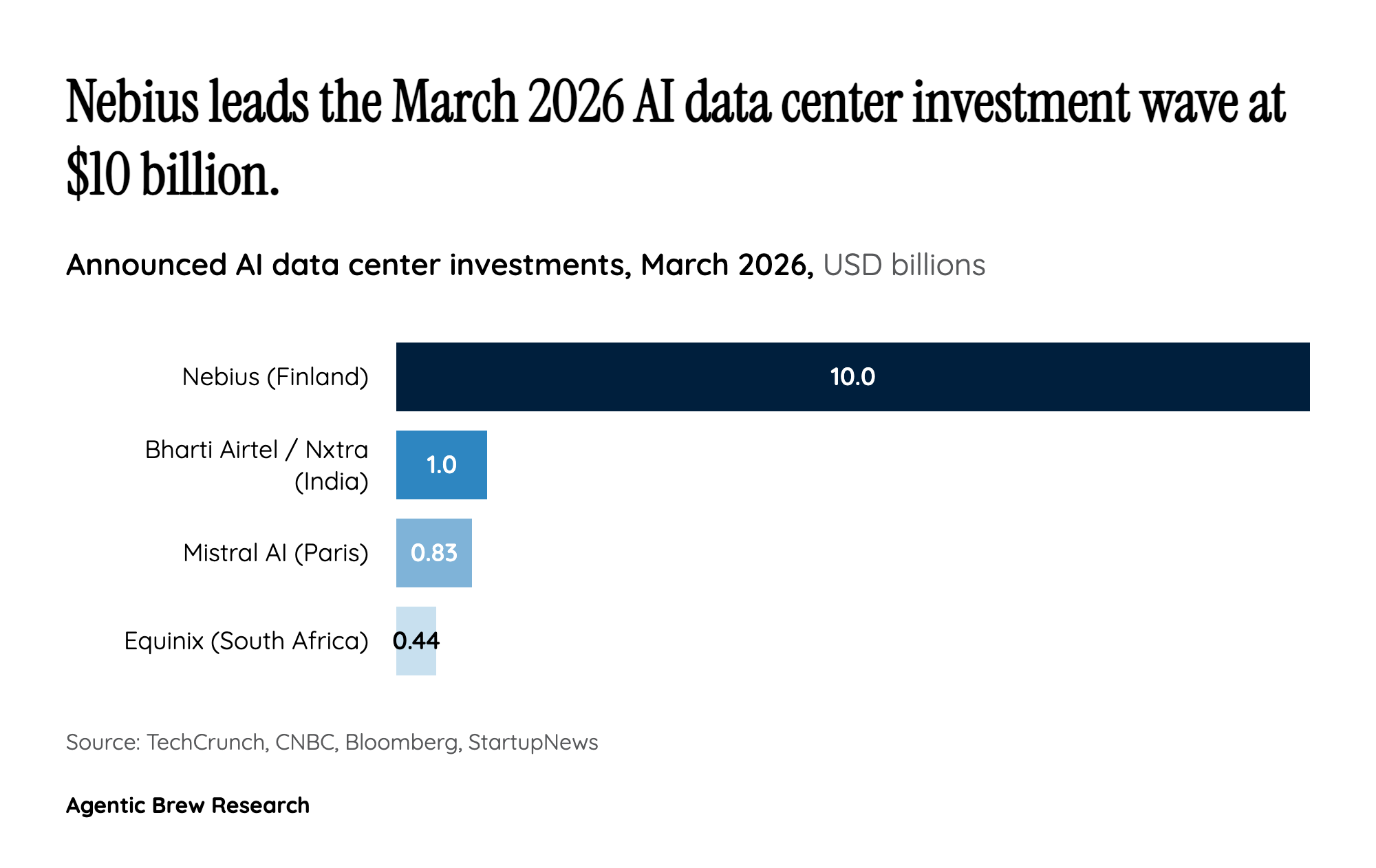
    Nebius announced a $10B, 310 MW AI factory in Lappeenranta, Finland -- one of Europe's largest -- with first capacity expected in 2027.
  • 02.
    Mistral AI raised $830M (EUR 750M) in debt from seven banks to build a data center near Paris housing over 13,000 NVIDIA GB300 GPUs with 44 MW capacity, operational Q2 2026.
  • 03.
    Bharti Airtel raised $1B for Nxtra Data from Alpha Wave ($435M), Carlyle ($240M), and Anchorage ($35M), valuing Nxtra at approximately $3.1B, to scale from 300 MW to 1 GW.
  • 04.
    Equinix committed $438M to expand data center operations in South Africa as local AI demand booms.
  • 05.
    Global hyperscaler capex is projected at $660-690B for 2026, with Meta alone boosting its West Texas data center investment to $10B targeting 1 GW by 2028.

Deep Analysis

Why This Matters

The simultaneous announcement of over $12 billion in AI data center investments across four continents in a single week marks a turning point in the global AI infrastructure race. These are not speculative bets -- they are responses to concrete, immediate demand for AI compute that existing facilities cannot satisfy. As Futurum Group analysts noted, "AI capacity is being monetized as quickly as it is installed," meaning every megawatt brought online finds paying customers almost instantly.

What makes this wave distinctive is its geographic breadth. Previous data center buildouts were heavily concentrated in the United States, which still hosts roughly 75% of the 23+ GW currently under construction. But the March 2026 announcements signal a decisive shift: Nebius in Finland, Mistral in France, Airtel in India, and Equinix in South Africa represent a global redistribution of AI compute. Nations and companies are increasingly unwilling to depend on US hyperscalers for their AI workloads, driven by data sovereignty concerns, latency requirements, and the strategic importance of controlling compute infrastructure.
How It Works

Each of these four deals follows a different financing and operational model, reflecting the diversity of approaches to building AI compute at scale. Mistral AI used debt financing -- $830M from seven banks -- to build a single facility near Paris equipped with over 13,000 NVIDIA GB300 GPUs. This debt-funded approach allows the AI startup to maintain equity while rapidly scaling its infrastructure. Nebius, by contrast, is funding its $10B Finland facility through revenue from $40B+ in supply contracts with Microsoft and Meta, essentially building infrastructure pre-sold to hyperscaler customers.

Bharti Airtel took the private equity route, raising $1B from Alpha Wave, Carlyle, and Anchorage Capital to fund Nxtra Data's expansion from 300 MW to 1 GW. This values Nxtra at approximately $3.1B and reflects strong PE appetite for AI infrastructure assets in high-growth markets. Equinix, as a publicly traded REIT, is deploying corporate capital -- $438M -- to expand in South Africa, building on its established global network of data centers. These varied funding mechanisms all point to the same conclusion: capital is flowing to AI infrastructure through every available channel.

By The Numbers

By The Numbers
Nebius leads the March 2026 AI data center investment wave at $10 billion.

The scale of the global AI data center buildout is staggering by any measure. Hyperscaler capital expenditure is projected to reach $660-690B in 2026, up from approximately $580B spent globally in 2025. Cumulative AI data center capex is expected to hit $5.2 trillion by 2030. Sovereign AI compute capacity alone is projected to nearly triple from 1.3 GW in 2026 to 3.1 GW by 2031, driven by government programs including the EU's EUR 200B AI action plan, Saudi Arabia's $15B+ commitment, the UAE's planned 5 GW facility, and Japan's commitment of 1 trillion yen per year.

The energy footprint is equally dramatic. Data centers consumed approximately 415 TWh globally in 2024, up 73% from 2023. Goldman Sachs projects that by 2030, overall power consumption from AI data centers will jump 175% from 2023 levels. AI workloads are growing at a 28.3% compound annual rate through 2030, ensuring demand will continue to outpace even the most aggressive buildout schedules.

Impacts & What's Next

The infrastructure surge carries significant consequences for energy systems and consumers. In the United States, PJM -- the grid operator serving 13 states -- projects a 6 GW power shortfall by 2027, and AEP Ohio has already paused new data center interconnections. Areas with heavy data center concentration have seen electricity prices jump 267% over five years, and US household bills could rise $15-25 per month as utilities pass through infrastructure upgrade costs. Roughly 40% of the additional energy powering these facilities by 2030 is expected to come from fossil fuels, undermining corporate climate pledges.

The regulatory response is accelerating in parallel. Over 30 US states have introduced more than 300 data center-related bills in 2026, addressing everything from tax incentives to energy consumption limits. Senator Bernie Sanders has proposed an AI data center moratorium, a measure that has attracted significant public attention. On the social front, investor sentiment remains bullish, but a growing counter-narrative focuses on grid strain and environmental impact. The next phase of this buildout will be defined not just by capital deployment but by the ability to secure power, navigate regulation, and manage community opposition.

The Bigger Picture

The March 2026 investment wave is best understood as the physical manifestation of a geopolitical shift. AI compute is becoming a strategic asset on par with energy reserves or semiconductor manufacturing capacity. Nations that lack domestic AI infrastructure face the prospect of relying on foreign-controlled compute for their most sensitive workloads -- a dependency that is increasingly viewed as unacceptable. The EU's EUR 200B AI action plan, India's embrace of PE-funded data center expansion, and South Africa's courting of Equinix all reflect this sovereignty imperative.

The question is whether the current pace of buildout is sustainable. The industry faces a trilemma: it needs more power (straining grids), more chips (straining NVIDIA's supply chain), and more capital (straining financial markets) simultaneously. Yet the economics remain compelling -- as Futurum Group observed, every megawatt of AI capacity is finding customers as fast as it can be deployed. The companies and countries that successfully navigate the energy, regulatory, and supply chain constraints of the next two to three years will control the physical layer of the AI economy for the decade that follows.

Historical Context

2019-2024
The number of hyperscale data centers doubled, with over 135 new facilities added in 2024 alone, setting the stage for the current investment surge.
2024-10
Equinix opened its first South African data center (JN1) in Johannesburg, establishing the company's African footprint ahead of its $438M expansion commitment.
2024-12
Microsoft and Amazon pledged more than $50B toward India's cloud and AI infrastructure within 24 hours of each other, signaling the beginning of the sovereign AI compute race in Asia.
2025
Up to $580B was spent globally on AI data center infrastructure, establishing a new baseline for annual investment.
2026-02
Nebius announced a 240 MW facility near Lille, France, while Mistral committed $1.4B to data center development in Sweden, expanding the European sovereign compute footprint.
2026-03
Four headline AI data center deals spanning Europe, India, and Africa were announced within days, collectively representing over $12B in committed investment.

Power Map

Key Players
Subject

Global AI Data Center Investment Surge

NE

Nebius Group

Amsterdam-based AI infrastructure company building Europe's largest AI factories, having secured $40B+ in supply contracts with Microsoft and Meta. Its 310 MW Finland facility positions it as a key non-US compute provider.

MI

Mistral AI

French AI startup building sovereign European compute infrastructure. Plans to scale from 44 MW (Q2 2026) to 200 MW by 2027 and 1.4 GW across France by 2030, reducing European dependence on US hyperscalers.

BH

Bharti Airtel / Nxtra Data

India's second-largest telecom operator, using $1B in private equity funding to scale Nxtra's data center capacity from 300 MW to 1 GW, positioning India as a sovereign AI compute hub.

EQ

Equinix

Global data center operator expanding into the African continent, committing $438M to South Africa following the opening of its first Johannesburg facility (JN1) in October 2024.

NV

NVIDIA

Critical GPU supplier powering the buildout wave. Mistral's Paris facility alone will house 13,800 GB300 GPUs, underscoring NVIDIA's central role in every major AI data center project.

ME

Meta

US hyperscaler with $10B+ committed to a single West Texas data center targeting 1 GW by 2028, and $115-135B in total 2026 capex, representing the scale of US-based AI infrastructure spending.

THE SIGNAL.

Analysts

""We have been building in Finland for many years and are pleased to be expanding our presence here." Volozh's statement signals Nebius's long-term commitment to Finland as a strategic location for European AI compute."

Arkady Volozh
CEO, Nebius Group

""The new data center will position our city at the forefront of Finland's AI ecosystem." The mayor's endorsement reflects the economic opportunity municipalities see in hosting large-scale AI infrastructure."

Tuomo Sallinen
Mayor, Lappeenranta

""AI capacity is being monetized as quickly as it is installed." This assessment underscores why companies are racing to build despite the enormous capital outlays -- demand continues to outstrip supply."

Futurum Group analysts
Analysts, Futurum Group

"Goldman Sachs projects that "by 2030, overall power consumption from AI data centers will jump 175% from 2023 levels," highlighting the enormous energy infrastructure challenge accompanying the AI buildout."

Goldman Sachs Research
Analysts, Goldman Sachs
The Crowd

"TERAFAB unveiled. $20-25B. Not a side project. A trillion watts of compute per year. Yes, trillion. Matching the U.S. electricity grid output. AI data centers in orbit. Robotaxis. Optimus. When the grid caps out, you go to space."

@@MarioNawfal192

"JUST IN: MISTRAL AI SECURES $830M DEBT TO BUILD NVIDIA-POWERED DATA CENTERS. French AI firm Mistral has secured $830M in major debt financing to build Nvidia powered data centers across Europe, per Silicon Republic. The deal is backed by a consortium of global banks."

@@BSCNews17

"Reuters: Nebius $NBIS is building a $10B, 310 MW AI data center in Lappeenranta, Finland, with developer Polarnode. Capacity is set to come online in phases starting in 2027."

@@wallstengine16
Broadcast
How data centers work and why AI is driving their growth

How data centers work and why AI is driving their growth

AI Spending Worry: Meta, Microsoft Shares Fall on Data Center Investment Plans

AI Spending Worry: Meta, Microsoft Shares Fall on Data Center Investment Plans

Billionaire Gautam Adani Earmarks $100 Billion To Develop AI Data Centers Across India

Billionaire Gautam Adani Earmarks $100 Billion To Develop AI Data Centers Across India