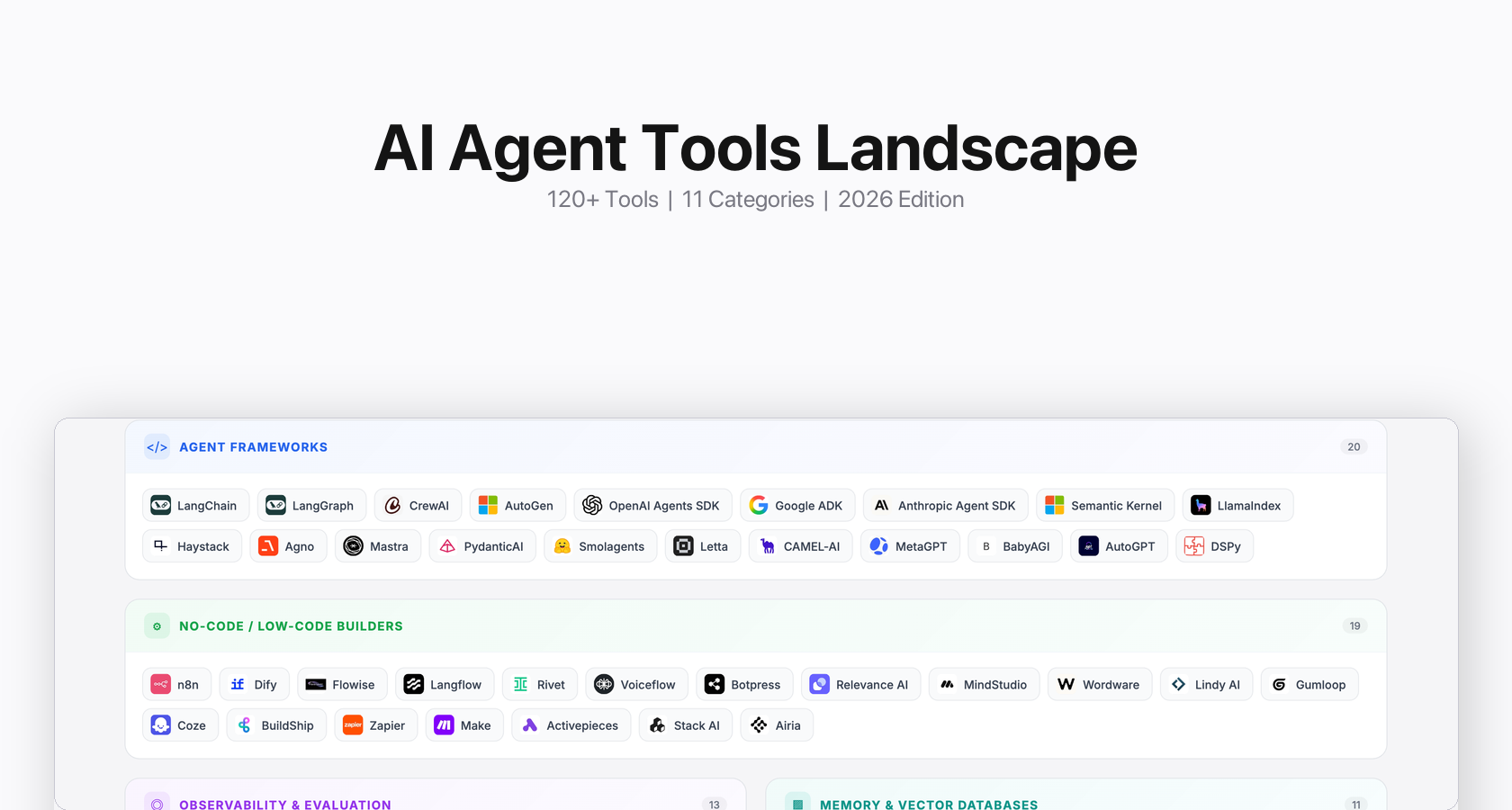
AI Agent Infrastructure, Tooling, and Autonomous Capabilities in 2026
TECH

AI Agent Infrastructure, Tooling, and Autonomous Capabilities in 2026

70+
Signals

Strategic Overview

  • 01.
    The AI agent market is projected to grow from $7.84B in 2025 to $52.62B by 2030 (CAGR 46.3%), with 120+ production-ready agentic tools mapped across 11 categories in Q1 2026.
  • 02.
    Major platform launches in March 2026 include NVIDIA's open-source Agent Toolkit with OpenShell runtime, OpenAI's Frontier enterprise platform, and Microsoft's Copilot Wave 3 with Agent 365 governance layer.
  • 03.
    Inter-agent communication standards are consolidating around Anthropic's MCP (donated to Linux Foundation, 75+ connectors), Google's A2A protocol (150+ supporting organizations), and CopilotKit's AG-UI, with Deloitte expecting convergence to 2-3 leading standards.
  • 04.
    AI coding agents are reaching massive scale: Claude Code accounts for 4% of all GitHub public commits, Cursor crossed one million paying developers, and Salesforce Agentforce reached $540M+ ARR with 18,500 customers.

Deep Analysis

Why This Matters

The AI agent infrastructure landscape is undergoing a rapid transition from experimental prototypes to production-grade enterprise platforms. With the market projected to grow from $7.84B in 2025 to $52.62B by 2030, every major technology company is racing to establish its agent platform as the default. NVIDIA, OpenAI, Microsoft, Anthropic, Google, and Salesforce have all launched or expanded dedicated agent infrastructure in Q1 2026 alone, signaling that AI agents are no longer a research curiosity but a core enterprise capability.

This matters because the infrastructure layer being built now will determine how autonomous AI systems operate for years to come. The competing protocol standards — MCP, A2A, and AG-UI — represent a critical juncture similar to the browser wars or mobile OS battles. Whichever standards win will shape the interoperability of AI agents across organizations and ecosystems. Deloitte's warning that over 40% of agentic AI projects could be cancelled by 2027 highlights the gap between ambition and execution, making the choice of tooling and infrastructure a high-stakes decision for enterprises.

How It Works

The modern AI agent stack has crystallized into roughly 11 categories: frameworks (LangChain, CrewAI, AutoGen), no-code builders, observability platforms, memory and vector databases, tool integrations, browser automation, communication protocols (MCP and A2A), coding agents (Claude Code, Cursor, Devin), enterprise platforms (Salesforce Agentforce, OpenAI Frontier), AI cloud infrastructure, and foundation models. Each layer addresses a distinct need in the lifecycle of building, deploying, and managing autonomous agents.

NVIDIA's Agent Toolkit exemplifies the full-stack approach: OpenShell provides a secure execution runtime, Nemotron offers open foundation models, AI-Q supplies an agentic search blueprint that combines frontier and open models to reduce costs by over 50%, and cuOpt provides a pre-built skills library. Microsoft's approach layers governance on top via Agent 365, addressing the security and management challenges that emerge when organizations deploy fleets of agents. The protocol layer — particularly Anthropic's MCP with 75+ connectors and Google's A2A with 150+ supporting organizations — provides the connective tissue allowing agents to communicate with tools and with each other.

By The Numbers

The scale of AI agent adoption is striking across multiple dimensions. The overall market is projected to grow from $7.84B in 2025 to $52.62B by 2030 with a 46.3% CAGR, according to MarketsandMarkets. Salesforce Agentforce has reached $540M+ ARR with 18,500 customers. Devin AI ($73M ARR) and Lovable ($75M ARR) demonstrate that standalone agent products can generate significant revenue. Anthropic has surpassed $2.5B in annualized revenue, with Claude Code contributing 4% of all GitHub public commits. Cursor has crossed one million paying developers.

On the adoption side, 88% of senior executives plan to increase AI budgets and 79% are already adopting AI agents. Gartner projects that 40% of enterprise applications will embed AI agents by end of 2026, up from less than 5% in 2025 — an eightfold increase in a single year. Separately, Gartner forecasts that by 2028, 33% of enterprise software will include agentic AI, a broader measure covering the full enterprise software category. The open-source ecosystem reflects this momentum: LangChain has 126k GitHub stars, n8n has 150k+ stars, Firecrawl has 82k+ stars, and Browser Use has 78k+ stars with an 89% success rate on the WebVoyager benchmark. METR research shows AI task duration doubling every 7 months, suggesting agents are rapidly expanding the complexity of work they can handle autonomously.

Impacts & What's Next

The immediate impact is a consolidation of the agent tooling landscape around major platform plays. Enterprises face a build-versus-buy decision: assemble custom stacks from open-source components (LangChain, CrewAI, Browser Use) or adopt integrated enterprise platforms (NVIDIA Agent Toolkit, OpenAI Frontier, Salesforce Agentforce, Microsoft Copilot). The protocol wars between MCP and A2A will determine interoperability, and Deloitte's expectation of convergence to 2-3 standards suggests some bets will prove wrong.

Looking ahead, the governance layer is emerging as a critical differentiator. Microsoft's Agent 365, launching May 2026, addresses the reality that managing fleets of autonomous agents requires security, compliance, and oversight tooling that does not yet exist at scale. Deloitte reports that only 12% of organizations expect AI agent automation ROI within 3 years, compared to 45% for basic automation, suggesting that while the infrastructure is maturing rapidly, practical deployment at scale remains challenging. The Reddit community sentiment of favoring 'controlled self-organization' — where agents propose actions and an orchestrator enforces constraints — reflects the pragmatic middle ground that production deployments are likely to occupy.

The Bigger Picture

The shift captured by Adaline Labs — from 'how big can we go' to 'how smart can we be efficiently' — reflects a maturation of the entire AI field. The agent infrastructure being built in 2026 is not merely about making AI more autonomous; it is about creating the operational backbone for a new kind of enterprise computing where humans and AI agents collaborate as teams. Jensen Huang's vision of employees 'supercharged by teams of frontier, specialized and custom-built agents' is being realized through the infrastructure layers now being deployed.

The social signals tell a nuanced story. While enthusiasts celebrate the evolution from simple RAG pipelines to autonomous agentic systems that can plan, critique, and self-correct, practitioners express healthy skepticism about scaling, cost, and non-deterministic behavior. The Stanford webinar framing of agentic AI as a 'progression of language model usage' — from simple prompting through reflection and planning to full tool usage — provides a useful mental model. The market is moving along this progression at different speeds in different domains, with coding agents (Claude Code, Cursor, Devin) furthest ahead and more complex multi-agent enterprise workflows still in early stages. The landscape of 120+ tools across 11 categories in Q1 2026 is both a sign of vibrant innovation and a warning of fragmentation that will inevitably consolidate.

Historical Context

March 2025
AI agent market map identified approximately 300 players; by early 2026 the landscape expanded to thousands of companies.
November 2025
At Ignite 2025, Microsoft unveiled an end-to-end platform for deploying fleets of production-ready AI agents.
January 2025
Research showed AI task duration (the length of tasks AI can handle autonomously) is doubling every 7 months.
February 2026
Launched its agent management platform, later followed by the Frontier enterprise platform for building and deploying AI agents.
March 16, 2026
Released the Agent Toolkit — an open-source platform featuring OpenShell runtime, Nemotron models, AI-Q agentic search blueprint, and cuOpt skills library.
March 9, 2026
Introduced Copilot Wave 3 with delegated multi-step task automation and announced Agent 365 governance layer for managing agents across organizations.

Power Map

Key Players
Subject

AI Agent Infrastructure, Tooling, and Autonomous Capabilities in 2026

NV

NVIDIA

Released open-source Agent Toolkit and OpenShell runtime (March 2026) with AI-Q hybrid architecture that can reduce query costs by over 50%. Partners include Adobe, Atlassian, Cisco, CrowdStrike, Salesforce, ServiceNow, and Synopsys.

AN

Anthropic

Created MCP protocol (donated to Linux Foundation), Claude Code accounts for 4% of GitHub commits, surpassed $2.5B+ annualized revenue.

MI

Microsoft

Operating 100+ AI agents in its supply chain, launched Copilot Wave 3 with delegated multi-step task automation and announced Agent 365 governance layer launching May 2026.

OP

OpenAI

Launched Frontier enterprise platform for building, deploying, and managing AI agents. Early adopters include HP, Intuit, Oracle, State Farm, Thermo Fisher, and Uber.

GO

Google

Developed A2A (Agent-to-Agent) protocol with 150+ supporting organizations, competing with Anthropic's MCP as a leading inter-agent communication standard.

SA

Salesforce

Agentforce platform reached $540M+ ARR with 18,500 customers, establishing itself as a leading enterprise agent deployment platform.

THE SIGNAL.

Analysts

"Employees will be supercharged by teams of frontier, specialized and custom-built agents they deploy and manage."

Jensen Huang
CEO, NVIDIA

"Agent orchestration will be the key differentiator in 2026, but warns that more than 40% of today's agentic AI projects could be cancelled by 2027. Projects the agent orchestration market at $8.5B by 2026 and $35B by 2030."

Deloitte TMT Predictions Team
Technology, Media & Telecom Predictions

"2026 may be remembered as the year AI research shifted from 'how big can we go' to 'how smart can we be efficiently.'"

Adaline Labs Research
AI Research Lab

"Predicts 40% of enterprise applications will embed AI agents by end of 2026, up from less than 5% in 2025. Separately, projects that by 2028, 33% of enterprise software will include agentic AI — a distinct measure covering the broader enterprise software category rather than just applications embedding agents."

Gartner
Technology Research & Advisory

"Effective agents favor simplicity over complexity — a key design principle highlighted in Anthropic's approach to building production-grade agent systems."

Barry Zhang
Anthropic
The Crowd

"Anthropic ships Claude Code as an npm package, someone runs ls on the source map, entire codebase just sitting there unobfuscated. plugins, skills, tools, hooks, commands - everything."

@@k1rallik3400

"Full Stack Agentic AI Tools to learn in 2026!! We are moving from simple RAG pipelines to autonomous Agentic Systems that can plan, critique, and self-correct."

@@Python_Dv13000

"SOMEONE OPEN SOURCED A SMALL MODEL TRAINED SPECIFICALLY AS A PERSONAL AGENT ROUTER. DECIDES WHAT RUNS LOCAL VS CLOUD AUTOMATICALLY."

@@RoundtableSpace999

"Seriously, can LLM agents REALLY work in production?"

@u/unknown0
Broadcast
Stanford Webinar - Agentic AI: A Progression of Language Model Usage

Stanford Webinar - Agentic AI: A Progression of Language Model Usage

How We Build Effective Agents: Barry Zhang, Anthropic

How We Build Effective Agents: Barry Zhang, Anthropic

Building Agents with Model Context Protocol - Full Workshop with Mahesh Murag of Anthropic

Building Agents with Model Context Protocol - Full Workshop with Mahesh Murag of Anthropic