AI Startups 9fin, Qodo, and ScaleOps Close Major Late-Stage Rounds
TECH

AI Startups 9fin, Qodo, and ScaleOps Close Major Late-Stage Rounds

28+
Signals

Strategic Overview

  • 01.
    9fin raised $170M in Series C funding at a $1.3B valuation to scale its AI-powered debt intelligence platform serving over 300 banks, asset managers, and law firms.
  • 02.
    Qodo raised $70M in Series B funding to build AI code verification and governance tools, positioning against unchecked AI-generated code from tools like Claude Code and OpenClaw.
  • 03.
    ScaleOps raised $130M in Series C funding at over $800M valuation for its autonomous Kubernetes and GPU resource optimization platform, reporting 350% year-over-year growth.
  • 04.
    AI startups accounted for 41% of the $128 billion in venture dollars raised on Carta last year, a record-high annual share, reflecting the broader momentum behind these funding rounds.

Deep Analysis

Why This Matters

Three AI startups collectively raising $370M in a single day signals that late-stage venture capital is flowing aggressively into AI companies that have demonstrated clear enterprise traction and revenue growth. This is not speculative early-stage betting -- 9fin has delivered multiple consecutive years of 100% ARR growth, ScaleOps reports 350% year-over-year growth, and Qodo serves marquee enterprise clients including Walmart, NVIDIA, and Red Hat. The pattern suggests investors are increasingly confident that AI-native companies solving specific enterprise pain points can build durable, high-margin businesses.

The broader context reinforces this: AI startups accounted for 41% of the $128 billion in venture dollars raised on Carta last year, a record-high annual share. But what distinguishes these three rounds is their focus on the infrastructure and tooling layers around AI rather than AI model development itself. 9fin applies AI to a $145 trillion debt market, Qodo verifies the code that AI generates, and ScaleOps optimizes the compute infrastructure AI runs on. This represents a maturation of the AI funding landscape, where investors are backing the picks-and-shovels companies that make AI deployments practical and reliable for enterprises.
How It Works

Each company addresses a distinct bottleneck in the AI-driven enterprise stack. 9fin combines proprietary credit market data with AI-driven workflows to help over 300 banks, asset managers, law firms, and advisory firms source deals, analyze risk, and monitor global debt markets. As CEO Steven Hunter puts it, AI in credit markets is only effective "if powered by proprietary data" -- generic large language models lack the specialized, real-time financial data needed for professional debt market workflows.

Qodo tackles the emerging problem of 'software slop' -- the proliferation of low-quality AI-generated code. With 95% of 500 surveyed developers saying they change their review approach when code is AI-generated, Qodo builds AI agents for code review, testing, and compliance. The company ranked among top performers on Martian's Code Review Bench with an F1 score of 50.3%, and positions itself as a 'system of record' for code quality. ScaleOps takes a different approach, using autonomous optimization to manage Kubernetes clusters and GPU resources. Rather than requiring enterprises to buy more compute, ScaleOps claims to reduce cloud and AI infrastructure costs by up to 80% through intelligent resource allocation, addressing what CEO Yodar Shafrir calls a management problem built for 'a world that no longer exists.'

By The Numbers

By The Numbers
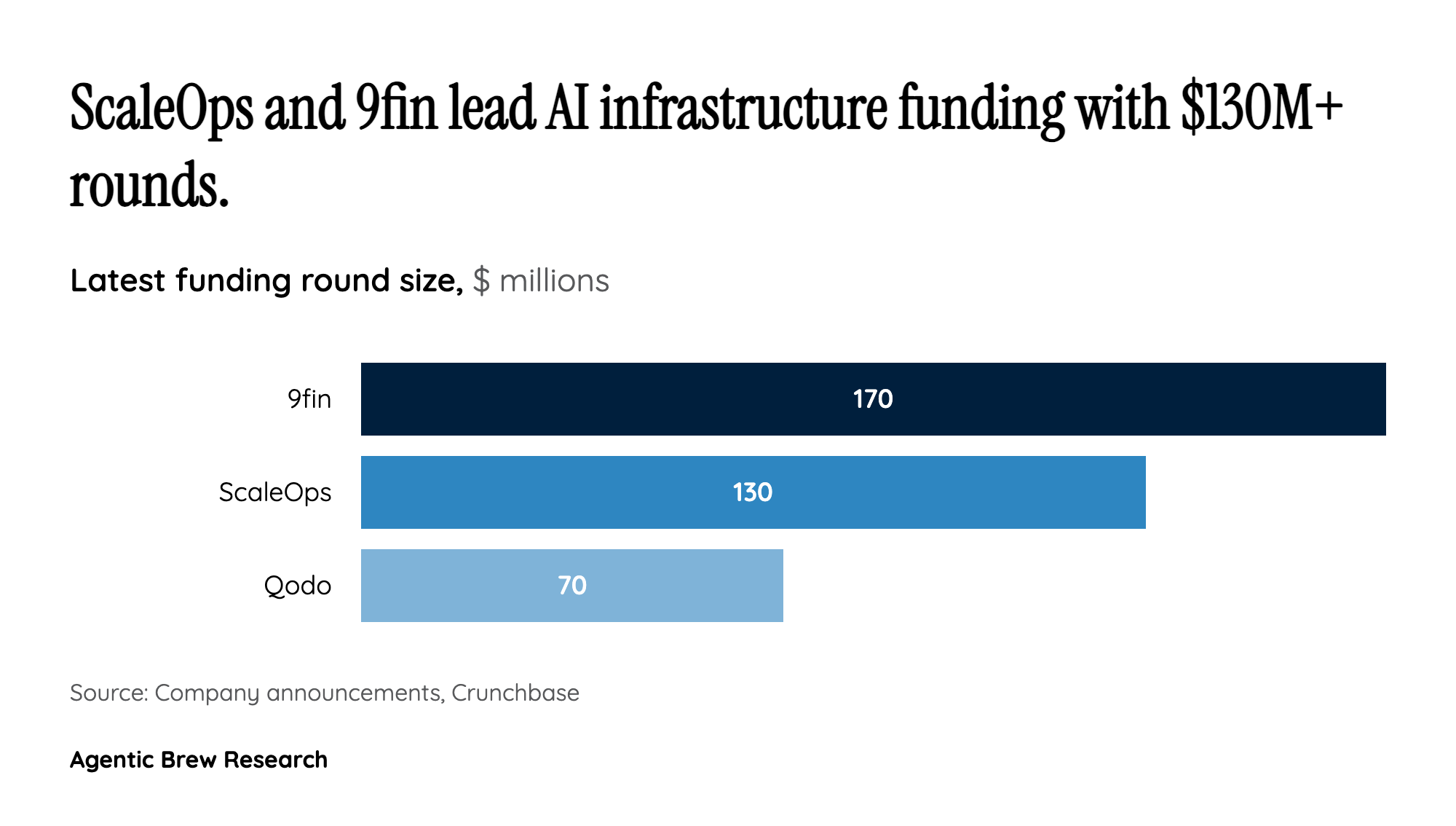
ScaleOps and 9fin lead AI infrastructure funding with $130M+ rounds.

The funding metrics across all three companies are substantial. 9fin raised $170M at a $1.3B valuation, bringing total funding to over $250M. The company serves more than 300 enterprise clients and has achieved multiple consecutive years of 100% annual recurring revenue growth. ScaleOps raised $130M at over $800M valuation, with total funding now exceeding $210M. The company reports 350% year-over-year growth and has tripled its team in 12 months. Qodo raised $70M in Series B, bringing total funding to $120M, with a client roster including Walmart, NVIDIA, Red Hat, Box, Intuit, Ford Motors, and Monday.com.

The investor rosters reflect institutional conviction. 9fin's round was led by HarbourVest with participation from CPP Investments (Canada Pension Plan Investment Board), a sovereign wealth-class investor. ScaleOps drew Insight Partners as lead alongside Lightspeed Venture Partners. Qodo attracted not only institutional investors like Qumra Capital and Square Peg but also angel investors from OpenAI, Meta, Shopify, and Snyk -- a notable signal that insiders across the AI and developer tools ecosystem see code verification as a critical emerging category.

Impacts & What's Next

These rounds point to several near-term market shifts. First, AI infrastructure tooling is crystallizing as a distinct, well-funded category. ScaleOps' $800M valuation validates that autonomous compute optimization is not a niche concern but a primary enterprise need as AI workloads scale. The company's rapid growth trajectory -- from $21.5M in late 2023 to $210M+ total funding in just over two years -- suggests the market is expanding faster than most anticipated.

Second, code quality and governance are emerging as a mandatory enterprise layer. As Qumra Capital partner Boaz Morris noted, "AI has made code cheap to generate and the scarce resource is now trust." With AI coding tools generating billions of lines of code monthly, the verification and compliance layer that Qodo is building could become as essential as CI/CD pipelines are today. Third, the digitization of traditionally analog financial markets continues to attract significant capital, with 9fin's unicorn status demonstrating that vertical AI applications in underserved sectors like debt markets can command premium valuations when backed by proprietary data advantages.

The Bigger Picture

These three funding rounds, announced on the same day, collectively illustrate the second-order effects of the AI revolution. The initial wave of AI investment focused on foundation models and general-purpose chatbots. The current wave is funding the companies that solve the problems AI itself creates: compute costs spiraling as enterprises deploy AI workloads (ScaleOps), unchecked AI-generated code threatening software quality (Qodo), and massive traditional markets still lacking AI-native tooling (9fin).

The social media reception reinforces this framing. On X, commentary highlighted AI infrastructure as a 'new gold rush,' AI code quality as a distinct investment category, and AI's deepening penetration into traditional finance. The participation of sovereign wealth-class investors like CPP Investments alongside traditional venture firms suggests that the AI infrastructure buildout is being treated as a generational investment opportunity, not a cyclical trend. As enterprises move from AI experimentation to production deployment, the companies providing the critical middleware -- optimization, verification, and domain-specific intelligence -- are positioning themselves as indispensable layers of the enterprise AI stack.

Historical Context

2016
Founded by Steven Hunter and Hussam EL-Sheikh out of frustration with inefficiencies in debt markets.
2017-10-10
Closed seed round with Seedcamp as earliest investor.
2018
Founded by Itamar Friedman, who previously co-founded Visualead and led machine vision at Alibaba.
2022
Co-founded by Yodar Shafrir, former engineer at Run:ai, a GPU orchestration startup later acquired by Nvidia.
2023-12-19
Raised $21.5M via seed and Series A rounds led by Lightspeed Venture Partners, NFX, and Glilot Capital Partners.
2024-11-12
Raised $58M Series B, bringing total funding to $80M at that time.
2024-12-02
Closed $50M Series B led by Highland Europe with Spark Capital, Redalpine, Seedcamp, 500 Startups, and Ilavska Vuillermoz Capital.
2026-03-30
All three companies announced major late-stage funding rounds on the same day: 9fin ($170M Series C), Qodo ($70M Series B), and ScaleOps ($130M Series C), totaling $370M in combined AI startup funding.

Power Map

Key Players
Subject

AI Startups 9fin, Qodo, and ScaleOps Close Major Late-Stage Rounds

9F

9fin

AI-native debt intelligence platform serving the $145T global debt market, founded by Steven Hunter (ex-J.P. Morgan) and Hussam EL-Sheikh (ex-Deutsche Bank), headquartered in London

QO

Qodo

AI code verification and governance startup founded in 2018 by Itamar Friedman, serving enterprise clients including Walmart, NVIDIA, Red Hat, and Intuit

SC

ScaleOps

Autonomous cloud and AI infrastructure resource management company co-founded in 2022 by Yodar Shafrir, serving Adobe, Wiz, DocuSign, Coupa, and Fortune 500 companies

HA

HarbourVest

Led 9fin's $170M Series C round, with principal Michael Guiness citing 9fin's combination of proprietary data with AI-driven workflows

IN

Insight Partners

Led ScaleOps' $130M Series C, with Managing Director Jeff Horing highlighting the urgency of managing cloud and AI workloads at scale

CP

CPP Investments

Canada Pension Plan Investment Board participated in 9fin's Series C, signaling sovereign wealth-class institutional confidence in AI-powered fintech

THE SIGNAL.

Analysts

""AI will redefine credit markets, but only if powered by proprietary data." Hunter argues that effective AI in debt markets requires proprietary data embedded into professional workflows, not generic models."

Steven Hunter
CEO & Co-founder, 9fin

""The era of unverified AI software development is over. At Qodo, we are building a 'system of record' for code quality and trust." Friedman positions Qodo as the necessary verification layer as AI code generation scales across enterprises."

Itamar Friedman
CEO, Qodo

""Compute is the defining bottleneck of the AI era, and the way most enterprises manage compute was built for a world that no longer exists." Shafrir frames ScaleOps as solving an infrastructure management problem rather than a supply constraint."

Yodar Shafrir
Co-Founder & CEO, ScaleOps

""AI has made code cheap to generate and the scarce resource is now trust." Morris highlights the fundamental shift in software economics where code production is commoditized but code quality verification becomes the bottleneck."

Boaz Morris
Partner, Qumra Capital

""ScaleOps is addressing the urgent challenge of managing cloud and AI workloads, helping enterprises unlock performance, efficiency, and innovation at scale." Horing sees infrastructure optimization as a critical enabler for enterprise AI adoption."

Jeff Horing
Managing Director, Insight Partners
The Crowd

"9fin, the debt intelligence provider founded by two former investment banking analysts, has raised fresh funds at a $1.3 billion valuation"

@@business0

"ScaleOps raises $130M to improve computing efficiency amid AI demand"

@@TechCrunch0

"Qodo, a US-based startup, just raised $70M to verify AI-generated code. Backed by Qumra Capital, Square Peg, Susa Ventures & others. We let AI write the code, Now we need systems to make sure it actually works."

@@adxtyahq12
Broadcast