WeRide's dual-launch strategy reveals a deliberate effort to establish the company as the global standard for robotaxi technology outside of the United States. While Waymo dominates in select American cities and Baidu's Apollo Go leads in China, WeRide is carving out a distinctive position as the autonomous vehicle partner of choice for international markets. The partnership model -- technology provider to ride-hailing platforms rather than a direct-to-consumer operator -- allows WeRide to scale without building local brand recognition or consumer apps, leveraging the existing user bases of Uber and Grab.
This approach also hedges against geopolitical risk. As a Chinese company listed on NASDAQ, WeRide operates in a complex environment where U.S.-China technology tensions could impact its business. By establishing operational footholds in politically neutral markets like the UAE and Singapore, the company creates revenue streams that are less vulnerable to bilateral trade disputes. The Middle East, in particular, has emerged as a haven for Chinese technology companies seeking international expansion without the regulatory friction encountered in the U.S. or Europe.
The competitive dynamics are shifting as well. Uber's decision to invest in WeRide rather than build its own autonomous technology validates the asset-light approach to autonomous mobility. Meanwhile, Grab's willingness to be the first Southeast Asian platform to deploy robotaxis positions it ahead of regional competitors in the autonomous race. The question is no longer whether robotaxis will become a global phenomenon, but which companies and which regulatory frameworks will define the rules of the road.
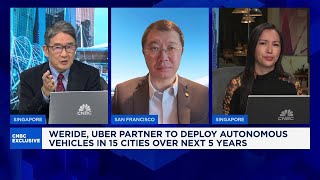
Early social media and online reactions reflect genuine excitement tempered by the niche awareness typical of a story still only one to two days old. On X.com, @techsnif's post breaking the Grab/Singapore launch news garnered 37 likes, while finance-focused accounts moved quickly to frame the investment implications -- @MikeLongTerm's post discussing $GRAB and the WeRide Singapore partnership received 30 likes, and @meetblossomapp's coverage of the Uber/WeRide Dubai launch attracted 23 likes, with commentary centered on what the news means for $GRAB and $UBER shareholders. On YouTube, a CNBC interview with CEO Tony Han discussing the 15-city, five-year expansion plan through Uber accumulated 3,311 views, while WeRide's official Abu Dhabi launch video reached 3,321 views and the Grab Singapore launch video had 87 views. Notably, Reddit had no discussions of either launch at the time of analysis, consistent with the extreme recency of the news and the tendency for Reddit threads on niche technology topics to emerge several days after initial reporting. The overall pattern suggests that awareness is currently concentrated among financial and technology audiences rather than the general public, but the stock-focused framing on social platforms points to growing investor attention that could amplify as the story matures.