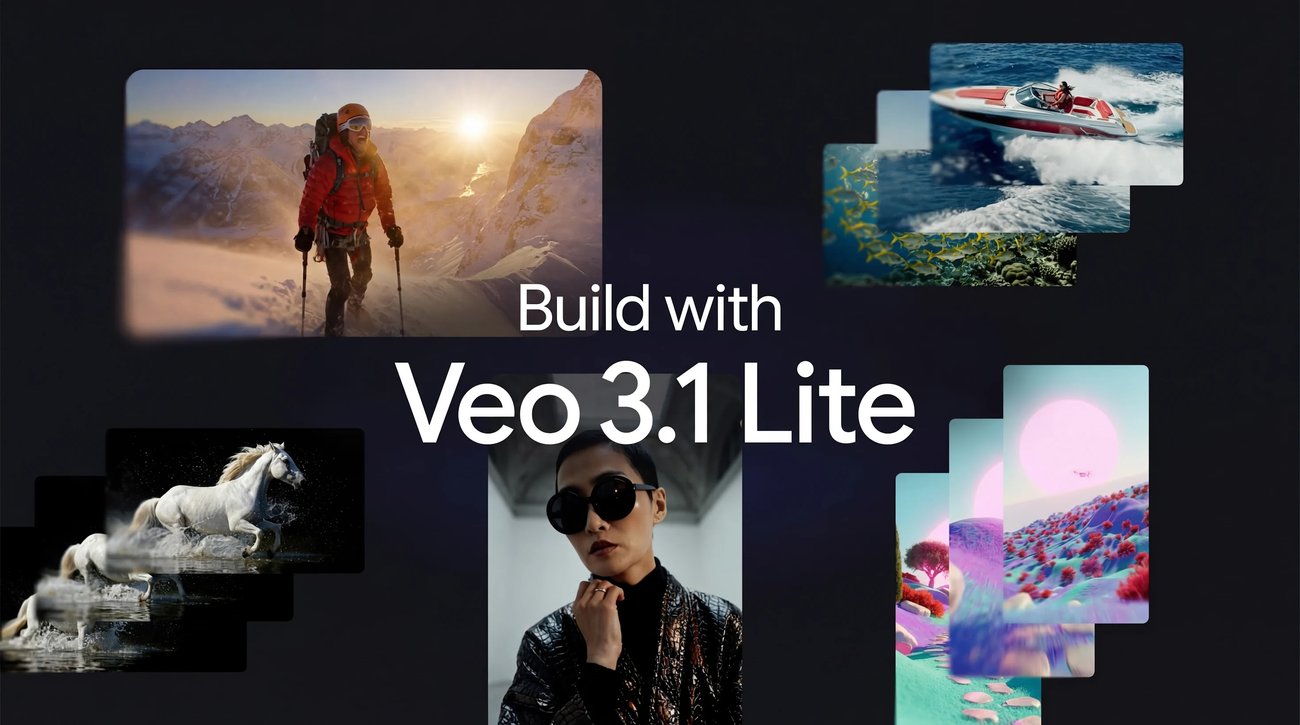
Google Launches Veo 3.1 Lite, Its Most Affordable Video Generation Model
TECH

Google Launches Veo 3.1 Lite, Its Most Affordable Video Generation Model

32+
Signals

Strategic Overview

  • 01.
    Google launched Veo 3.1 Lite on March 31, 2026, its most cost-effective video generation model, available via the Gemini API in paid preview and Google AI Studio.
  • 02.
    Veo 3.1 Lite costs less than half the price of Veo 3.1 Fast while matching its generation speed, with pricing starting at $0.05 per second for 720p and $0.08 per second for 1080p.
  • 03.
    The model supports Text-to-Video and Image-to-Video at 720p and 1080p resolutions in landscape (16:9) and portrait (9:16) formats, with clip durations of 4, 6, or 8 seconds.
  • 04.
    Veo 3.1 Lite does not support 4K video generation, unlike Veo 3.1 Fast and the full Veo 3.1 model.
  • 05.
    The model is exclusive to paid Google AI Studio users and is not available in the Gemini consumer app.
  • 06.
    Google will also reduce Veo 3.1 Fast pricing effective April 7, 2026, with 720p dropping from $0.15 to $0.10/sec, 1080p from $0.15 to $0.12/sec, and 4K from $0.35 to $0.30/sec.
  • 07.
    The launch comes just one week after OpenAI announced the shutdown of its Sora AI video app due to massive financial losses.

Why This Matters

Google's launch of Veo 3.1 Lite represents a significant strategic shift in the AI video generation market -- from a quality race to a developer adoption race. By offering video generation at $0.05 per second for 720p, Google is making AI-powered video creation economically viable for high-volume applications like e-commerce product videos, social media content, and marketing materials. This is a price point that opens the door for developers to build video generation directly into their applications without prohibitive per-unit costs.

The timing is equally significant. Just one week before this launch, OpenAI announced the shutdown of its Sora AI video app on March 24, 2026, citing massive financial losses. Sora had peaked at approximately 4.2 million monthly active users in January 2026 before declining 38%. With its primary Western competitor exiting the market, Google is moving aggressively to capture developer mindshare with an affordable, API-first approach. The simultaneous announcement of April 7 price cuts for Veo 3.1 Fast further signals Google's intent to use pricing as a competitive weapon to lock in developer adoption.

The announcement generated significant engagement on X.com, with Google AI Developers' official post (@googleaidevs) and community voices like Rohan Paul (@rohanpaul_ai, over 5,600 engagement) amplifying the pricing message, underscoring strong developer interest in cost-efficient video generation.
How It Works

Veo 3.1 Lite is available through the Gemini API in paid preview and through Google AI Studio for paid users. It is not available in the Gemini consumer app. The model supports two primary modes: Text-to-Video, where developers provide a text prompt and receive a generated video clip, and Image-to-Video, where a reference image serves as the starting point for video generation.

The model generates clips at 720p or 1080p resolution in either landscape (16:9) or portrait (9:16) format, with configurable durations of 4, 6, or 8 seconds. The 720p tier includes audio generation at $0.05 per second. Notably, Veo 3.1 Lite does not support 4K video generation -- that capability remains exclusive to the higher-tier Veo 3.1 Fast and Full models. According to analysis from The Decoder, the 'Lite' designation refers to an optimized parameter set that reduces cost without sacrificing generation speed, meaning developers get the same turnaround time as Veo 3.1 Fast at less than half the price.

By The Numbers

By The Numbers
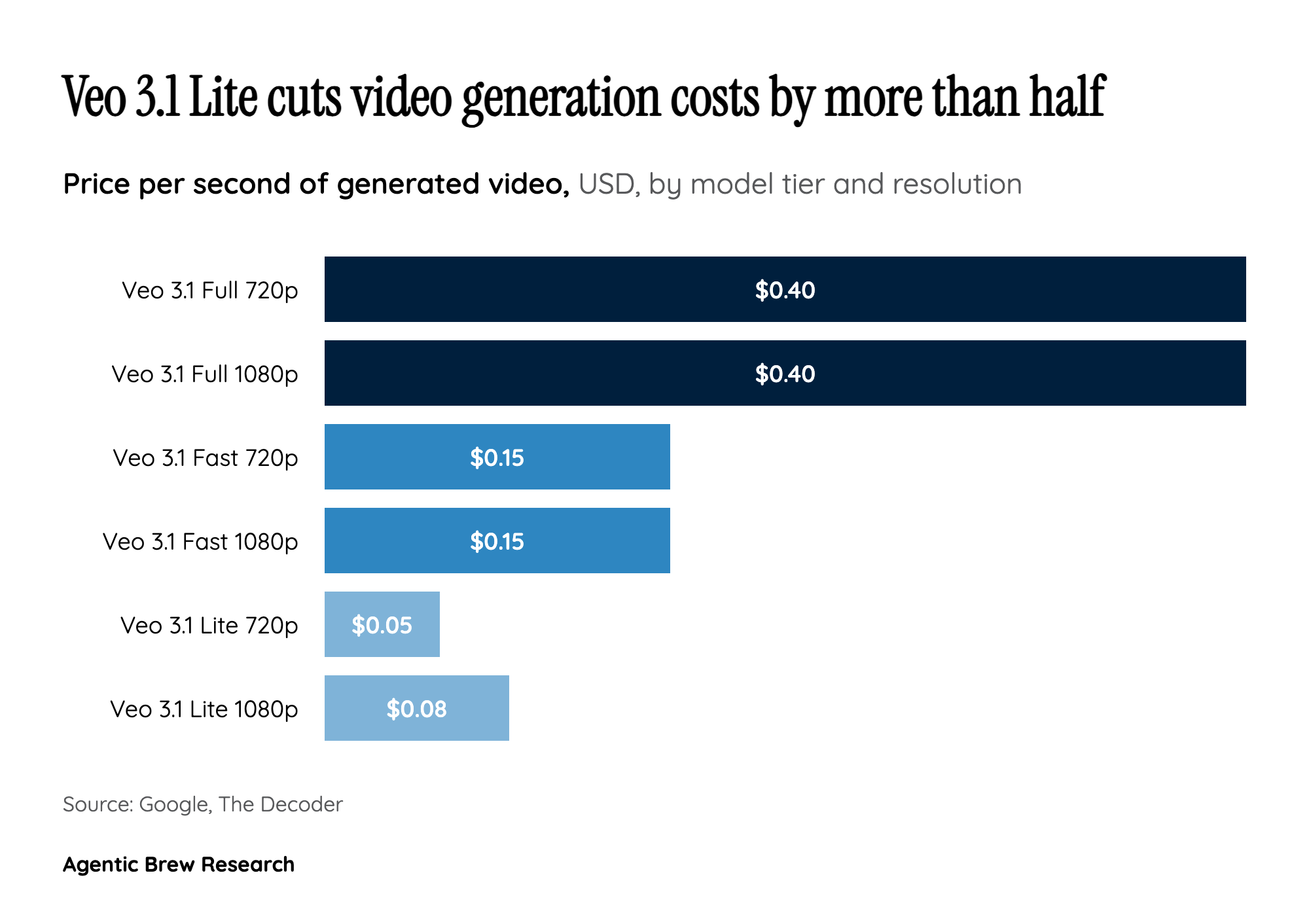
Veo 3.1 Lite cuts video generation costs by more than half compared to Fast and Full tiers

The pricing structure across Google's Veo 3.1 model family reveals the aggressive cost optimization:

- Veo 3.1 Lite: $0.05/sec (720p), $0.08/sec (1080p) -- no 4K support

- Veo 3.1 Fast (current): $0.15/sec (720p), $0.15/sec (1080p), $0.35/sec (4K)

- Veo 3.1 Fast (after April 7): $0.10/sec (720p), $0.12/sec (1080p), $0.30/sec (4K)

- Veo 3.1 Full: $0.40/sec (720p), $0.40/sec (1080p), $0.60/sec (4K)

Veo 3.1 Lite represents more than a 50% cost reduction compared to Veo 3.1 Fast, and an 87.5% reduction compared to the Full model at 720p. Supported clip durations are 4, 6, or 8 seconds, meaning a single 8-second 720p clip costs just $0.40 to generate.

Impacts & What's Next

The immediate impact is a democratization of AI video generation for developers. At $0.05 per second, building video generation into applications becomes viable for use cases that were previously cost-prohibitive: automated product demo videos for e-commerce catalogs, dynamic social media content generation, and personalized marketing videos at scale. TechBuzz AI described Veo 3.1 Lite as potentially 'the good enough solution that unlocks a whole new category of video-first applications.'

The competitive landscape is rapidly shifting. With OpenAI's Sora out of the picture, Google's primary Western competition now comes from Runway, which is focusing on the higher-end creative market with a $100M AI film fund. Chinese competitors, particularly Alibaba's Seedance 2.0, deliver higher quality output but face copyright concerns limiting global distribution. Google also teased Veo 4 just days before this launch, suggesting the next generation is imminent. The company has explicitly committed to continued investment: 'Our commitment to making video generation more available to developers doesn't stop with the release of Veo 3.1 Lite. Stay tuned for more updates soon!'

The Bigger Picture

Google's Veo 3.1 Lite launch fits into a broader pattern of AI model commoditization. Just as large language models have seen rapid price declines, video generation models are now entering their own price war phase. Google is deliberately choosing to sacrifice per-unit margin in exchange for platform adoption, a strategy it has successfully deployed across cloud services, maps, and other developer-facing products.

This also signals a maturation of the AI video generation market. The failure of OpenAI's Sora -- which peaked at 4.2M users but could not sustain itself financially -- demonstrates that consumer-facing AI video apps face brutal unit economics. Google's API-first, developer-focused approach with tiered pricing (Lite/Fast/Full) suggests a more sustainable business model where customers self-select into price-performance tiers based on their actual needs. The market is bifurcating: high-end creative production (where Runway and Alibaba compete) versus high-volume developer tooling (where Google is now the dominant Western provider).

Historical Context

2026-01-13
Released major Veo 3.1 update introducing true 4K video generation and native 9:16 vertical video support.
2026-03-24
Announced shutdown of the Sora AI video app due to massive losses, after peaking at approximately 4.2 million MAUs before declining 38%.
2026-03-28
Signals emerged that Veo 4 is imminent.
2026-03-31
Launched Veo 3.1 Lite at $0.05/sec for 720p.
2026-04-07
Scheduled date for Veo 3.1 Fast price reductions.

Power Map

Key Players
Subject

Google Launches Veo 3.1 Lite, Its Most Affordable Video Generation Model

GO

Google DeepMind

Developer and launcher of Veo 3.1 Lite. Drives the entire Veo model family and is positioning Google as the dominant Western AI video generation provider.

OP

OpenAI (Sora)

Former competitor whose Sora AI video app was shut down on March 24, 2026 due to massive losses after peaking at 4.2M MAUs.

AL

Alibaba (Seedance 2.0)

Key Chinese competitor delivering higher quality output but facing copyright concerns limiting global distribution.

RU

Runway

Competitor focusing on higher-end creative market with a $100M AI film fund.

AL

Alisa Fortin

Product Manager at Google DeepMind who authored the official blog post announcing Veo 3.1 Lite.

LO

Logan Kilpatrick

Head of Google AI Developer Relations who announced Veo 3.1 Lite on X.com, garnering 2,823 engagement. Also announced upcoming April 7 price cuts for Veo 3.1 Fast.

THE SIGNAL.

Analysts

"Analyzed that the 'Lite' designation refers to an optimized parameter set for lower cost, not reduced speed. Notes that Google now competes primarily with Chinese alternatives, particularly Alibaba's Seedance 2.0."

Matthias Bastian
Author, The Decoder

"Sees the launch as targeting the 'good enough' developer market, calling Veo 3.1 Lite potentially 'the good enough solution that unlocks a whole new category of video-first applications.'"

TechBuzz AI
Tech publication

"Highlighted the cost efficiency as the key differentiator, noting Veo 3.1 Lite is 'under half the price of Veo 3.1 Fast' at '$0.05 per second for 720p,' with the summary garnering over 5,600 likes — indicating strong developer community interest."

Rohan Paul
AI/ML community voice, X.com
The Crowd

"Video's here to stay - introducing Veo 3.1 Lite, our most cost efficient video generation model to date, and on April 7th we are also reducing the price for Veo 3.1 Fast : )"

@@OfficialLoganK2400

"Introducing Veo 3.1 Lite, now available via the Gemini API and @GoogleAIStudio. Veo 3.1 Lite supports both Text-to-Video and Image-to-Video, and is less than half the cost of Veo 3.1 Fast."

@@googleaidevs722

"Veo 3.1 Lite just launched by Google as its most cost-efficient video generation model to date. Under half the price of Veo 3.1 Fast. Beginning at $0.05 per second for 720p. Supports clip lengths of 4 sec/6 sec and 8 seconds."

@@rohanpaul_ai5600
Broadcast