
Anthropic Launches Claude Managed Agents in Public Beta
TECH

Anthropic Launches Claude Managed Agents in Public Beta

33+
Signals

Strategic Overview

  • 01.
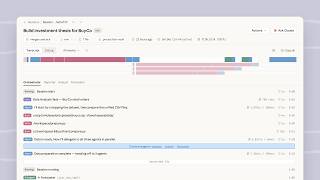
    Anthropic launched Claude Managed Agents in public beta on April 8, 2026, providing a fully managed cloud-hosted platform with sandboxed code execution, authentication, checkpointing, scoped permissions, and persistent long-running sessions for building production-grade AI agents.
  • 02.
    The platform supports multi-agent coordination (in research preview) where a master agent delegates subtasks to specialized workers, and agents can be defined in natural language or YAML with configurable guardrails.
  • 03.
    Early adopters including Notion, Rakuten, Asana, Sentry, and Vibecode are already deploying agents, with Rakuten standing up agents across five departments within a week per deployment.
  • 04.
    Pricing follows a hybrid model: standard API token usage plus $0.08 per session-hour for active runtime and $10 per 1,000 web searches.

Separating Brain from Hands: The OS Architecture That Makes Long-Running Agents Viable

The most technically significant aspect of Managed Agents is not what they do but how they are structured. Anthropic's engineering team published a detailed architecture breakdown that decouples agents into three layers: the brain (Claude model doing reasoning), the hands (tool execution in sandboxed environments), and the session (persistent state and checkpointing). This mirrors decades-old operating system design -- processes, syscalls, and process state -- applied to AI agents for the first time at platform scale.

This separation solves the fundamental reliability problem that has plagued every agent framework to date. When an agent's reasoning and its execution environment are tightly coupled, a single tool failure can crash the entire agent. By isolating execution into sandboxed containers with scoped permissions, Managed Agents can recover from tool failures without losing reasoning context. The engineering blog reports ~60% reduction in median time-to-first-token (p50 TTFT) and over 90% reduction at the 95th percentile -- gains that come not from a faster model but from better systems architecture around the model. The self-evaluation capability, still in research preview, adds another layer: developers define success criteria and Claude iterates autonomously toward meeting them, which internal testing showed improves structured file generation success rates by up to 10 percentage points over standard prompting.

For developers, the practical implication is that agents can now be defined in natural language or YAML configuration files rather than imperative code. This is a deliberate design choice that lowers the barrier from "you need an ML engineer" to "you need someone who can write a clear prompt and a config file." The multi-agent coordination preview takes this further, enabling a master agent to delegate subtasks to specialized workers -- a pattern that mirrors microservices architecture and suggests Anthropic is thinking about agents as composable infrastructure, not monolithic applications.

The $0.08/Hour Gambit: Session-Based Pricing and the Build-vs-Buy Calculus

Anthropic's pricing model for Managed Agents introduces a fundamentally new billing paradigm for AI: $0.08 per session-hour on top of standard token costs, plus $10 per 1,000 web searches. This is not just a new line item -- it is a strategic signal about how Anthropic wants enterprises to think about agent costs. By charging for runtime rather than just inference, Anthropic is pricing agents like compute infrastructure (think EC2 instances) rather than API calls. This reframes the value proposition from "how many tokens did my agent use" to "how long was my agent working on the task."

The build-vs-buy math becomes stark when you consider what the $0.08/hour replaces. Building the equivalent scaffolding in-house -- sandboxed execution, authentication, checkpointing, state management, monitoring -- requires months of engineering time, as SiliconANGLE noted. At $0.08/hour, an agent running 8 hours a day costs roughly $0.64/day or about $19/month in session fees. For an enterprise paying even a single engineer $150K+/year to build and maintain agent infrastructure, the economics are overwhelming. Rakuten's ability to deploy across five departments within a week per deployment illustrates this: the platform cost is trivial compared to the engineering time saved.

The $10 per 1,000 web searches pricing reveals another strategic layer. By bundling web search as a managed capability rather than requiring developers to integrate third-party search APIs, Anthropic captures more of the agent value chain. Each bundled capability -- search, code execution, file handling -- makes the platform stickier and the vendor lock-in deeper. This is the classic platform playbook: price individual components cheaply enough that building your own never makes sense, then become the infrastructure layer that is too expensive to leave.

Who Loses When Agent Infrastructure Becomes a Commodity

The social media reaction to Managed Agents was telling. Felipe Demartini's viral tweet -- "Anthropic just killed the agent infrastructure market. And no one noticed" -- garnered 625 likes and captured a sentiment echoed across developer communities. On YouTube, Nick Saraev's video titled "Claude Managed Agents Just Dropped, And It Kills n8n" pulled 48,594 views and 2,121 likes, directly naming a casualty. The framing was consistent: Managed Agents is not just a product launch, it is an infrastructure commoditization event.

The companies most exposed are those that built businesses on the scaffolding gap -- the orchestration frameworks, agent hosting platforms, and workflow automation tools that existed precisely because deploying a production agent was hard. When Anthropic bundles sandboxed execution, state management, multi-agent coordination, and monitoring into a single API call, the value proposition of standalone orchestration layers shrinks dramatically. This is analogous to AWS launching managed Kubernetes: it did not kill Kubernetes tooling overnight, but it permanently compressed margins for companies whose primary value was making Kubernetes easier to run.

The competitive dynamics extend beyond startups. TechBuzz analysts noted that Managed Agents positions Anthropic directly against Microsoft Azure AI and Google Vertex AI Agent Builder. But the more interesting competition may be with traditional enterprise automation platforms -- the RPAs, workflow engines, and integration platforms that handle the structured, repetitive work that AI agents are increasingly capable of performing. Anthropic's official announcement explicitly frames the product as enabling teams to "focus on the user experience, not the operational overhead," which is precisely the pitch that automation platforms have made for years. The difference is that Managed Agents can handle unstructured tasks that rule-based automation cannot, while the $0.08/hour pricing undercuts the per-bot licensing model of traditional RPA vendors. The AI agent market is projected to reach $50 billion by 2028, and Managed Agents is Anthropic's bid to own the platform layer of that market rather than just supplying the models that power it.

Historical Context

2024
Estimated only 20% of enterprises had incorporated AI agents, setting the baseline for projected rapid growth.
2025-01
Predicted 70% of enterprises will incorporate AI agents by 2027, signaling a massive adoption wave ahead.
2026-04-08
Launched Claude Managed Agents in public beta with sandboxed execution, multi-agent coordination, and self-evaluation capabilities.
2026-04-08
Published technical blog detailing the brain/hands/session architecture, drawing from OS design patterns, with ~60% reduction in p50 TTFT and >90% reduction in p95 TTFT.

Power Map

Key Players
Subject

Anthropic Launches Claude Managed Agents in Public Beta

AN

Anthropic

Platform provider executing a strategic pivot from model-only API to full enterprise AI deployment platform, directly competing with Microsoft Azure and Google Vertex AI Agent Builder.

NO

Notion

Early adopter deploying Claude directly into workspaces for engineers and knowledge workers, signaling ecosystem validation from a major productivity platform.

RA

Rakuten

Enterprise early adopter that deployed agents across product, sales, marketing, finance, and HR within a week per deployment, integrating with Slack and Teams.

AS

Asana

Early adopter deploying 'AI Teammates' within project management workflows, extending agent capabilities into task coordination.

VI

Vibecode

Early adopter reporting 10x faster prototype-to-deployed-app workflows using Managed Agents.

THE SIGNAL.

Analysts

"The platform is designed to eliminate the technical complexity preventing businesses from deploying AI agents at scale: "focus on the user experience, not the operational overhead.""

Anthropic
Platform Provider

""Claude's reputation for safety and reliability will resonate with enterprises nervous about putting AI into mission-critical workflows." Over 70% of companies experimenting with AI cite deployment challenges, not model performance, as their biggest barrier."

TechBuzz
Industry Analyst

""Deploying a production-grade agent requires software teams to build not only the agent itself but also a significant amount of scaffolding." Anthropic's governance tools address what has held back enterprise adoption."

SiliconANGLE
Tech Media Analysis

""Anthropic just turned long-running agents into a cleaner systems problem... separates the model brain from its execution hands." His post garnered 5,500 likes, reflecting strong developer enthusiasm for the architectural approach."

Rohan Paul (@rohanpaul_ai)
AI Developer & Commentator
The Crowd

"Introducing Claude Managed Agents: everything you need to build and deploy agents at scale. It pairs an agent harness tuned for performance with production infrastructure, so you can go from prototype to launch in days. Now in public beta on the Claude Platform."

@@claudeai36000

"Anthropic just killed the agent infrastructure market. And no one noticed. While you were scrolling the feed, the company behind Claude launched Managed Agents. Silently, it declared: That infrastructure you spent months building? Now it is a commodity. We will run it for you."

@@namcios625

"Anthropic just turned long-running agents into a cleaner systems problem by launching Managed Agents. A hosted service in the Claude Platform that separates the model brain from its execution hands. It runs long-horizon agents on your behalf through a small set of interfaces."

@@rohanpaul_ai5500
Broadcast
Introducing Claude Managed Agents

Introducing Claude Managed Agents

Claude Managed Agents Just Dropped, And It Kills n8n

Claude Managed Agents Just Dropped, And It Kills n8n

How Notion built with Claude Managed Agents

How Notion built with Claude Managed Agents