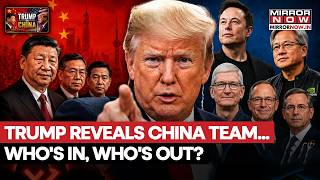
Jensen Huang joins Trump's China delegation for Xi summit
TECH

Jensen Huang joins Trump's China delegation for Xi summit

36+
Signals

Strategic Overview

  • 01.
    Nvidia CEO Jensen Huang was a last-minute addition to President Trump's Beijing delegation after the White House's original 17-CEO roster, circulated Monday, conspicuously omitted him.
  • 02.
    Trump personally phoned Huang on Tuesday after seeing reports about his absence; Huang then flew to Anchorage and boarded Air Force One during a refueling stop.
  • 03.
    Nvidia confirmed Huang is attending at President Trump's invitation, joining Musk, Cook, Fink, Solomon, Schwarzman, Mehrotra, and others for the May 14-15 Beijing summit.
  • 04.
    Nvidia stock rose roughly 2.4% in premarket trading after Trump confirmed Huang would join, while Chinese AI-linked stocks rallied on bets that the visit could unlock more H200 supply for Chinese buyers.

Deep Analysis

The Phone Call That Rewrote the Trip's Optics

The most striking thing about Jensen Huang's appearance on Air Force One isn't that Nvidia's CEO is going to Beijing. It's the 24-hour reversal that put him there. On Monday, the White House circulated a delegation list of 17 chief executives — Musk, Cook, Fink, Solomon, Mehrotra, Amon — and Huang's name simply wasn't on it. Reporting from Semafor framed the omission as deliberate: an effort to keep Nvidia's H200 chip lobbying from becoming the visible center of the summit and to spare the administration 'awkward conversations' with Republican China hawks like Rep. Brian Mast [1].

That plan didn't survive the news cycle. After media coverage flagged the absence, Trump personally phoned Huang on Tuesday and asked him to join. Huang flew to Anchorage to intercept Air Force One during its refueling stop, and Nvidia confirmed he was attending at the invitation of President Trump to support the administration's goals [2]. The mechanics matter because they expose the gravitational pull of one specific company: the U.S. government cannot stage a high-level economic engagement with China without it looking incomplete unless Nvidia's CEO is in the room.
The $50 Billion Conversation Beijing Doesn't Want to Have

Huang frames China as a roughly $50 billion AI-chip opportunity that Nvidia is currently locked out of [3]. But the contrarian reading — and the part most market commentary is missing — is that the gating constraint right now isn't Washington. It's Beijing. After Trump approved H200 sales in December 2025 in exchange for a 25% revenue cut to the U.S. Treasury [4], the chips didn't move. Commerce Secretary Howard Lutnick has since confirmed that zero H200 GPUs have actually been sold into China because Chinese customs has been directed to block imports, with purchases restricted to universities and R&D labs to channel demand toward domestic alternatives [5].

That means even a fresh policy concession from the U.S. side won't automatically translate into Nvidia revenue. China analyst Rui Ma argues the dynamic reflects a disconnect between Washington's confidence in Nvidia as leverage and China's willingness to endure pain for semiconductor self-reliance [6]. The summit's real test isn't whether Trump will trade something for chip-export relief — it's whether Xi is willing to let H200s ship at scale at all. The upside on the table is contingent on Beijing reversing an industrial policy decision, not just on Washington signing a license.

Why China Hawks Lost a Round Without Casting a Vote

The internal coalition politics of this trip are at least as consequential as the bilateral diplomacy. Huang's exclusion was, by multiple accounts, a concession to Republican China hawks who oppose any deal that increases Nvidia's flow of chips into China. Rep. Brian Mast (R-FL) has been blunt — accusing Huang of asking Americans to trust the CCP and calling the position laughable [1]. Derek Scissors of the American Enterprise Institute described the original absence as 'odd,' implying it could only be explained by political optics rather than substance [7].

The reversal — under media pressure rather than after policy negotiation — is a quiet defeat for that hawkish bloc. By the time the GOP foreign-policy critique becomes operative, the optics question has already been answered: the CEO of the world's most strategically important chipmaker is on Air Force One headed to meet Xi. Jason Hsu of the Hudson Institute reads the late inclusion as making 'a deal between U.S. and China on AI chip sales and export controls' possible [7], but with a caveat — the administration won't want to be seen as letting one company drive American export policy. Outside Washington, the public mood reflected the same fault line. Finance commentary on X and trading subreddits treated the reversal as a tradable, almost-comic event — proof that the H200-to-China question is now driven by direct White House interventions rather than working-level export policy, with the hawkish 'don't trust Beijing' frame barely surfacing in the retail conversation. That tension between the political need to constrain Nvidia and the economic incentive to deploy it as a bargaining asset is what Beijing will probe over the next 48 hours.

From 95% to Zero, and the Market's Bet on a Bounce

The numerical picture explains why investors moved on the news. Huang has stated Nvidia's AI-accelerator market share in China collapsed from roughly 95% to effectively zero under successive rounds of U.S. export controls [8]. That collapse is the backdrop for two market signals that hit within hours of Trump's confirmation: Nvidia rose about 2.4% in U.S. premarket trading [9], and Chinese AI-linked stocks rallied on Bloomberg's reporting that traders are betting Huang's visit unlocks more H200 supply [10].

The timing concentrates the stakes. Nvidia reports fiscal Q1 results on May 20, one week after the Beijing summit ends, and management's China commentary on that call will land directly against whatever deliverables — or non-deliverables — emerge from the Xi meeting [11]. Two paths diverge from here. If concrete licensing or customs movement emerges from Beijing, Nvidia gets a credible runway back to a multi-billion-dollar quarterly China revenue line, and the broader semiconductor complex (Micron and Qualcomm CEOs are also in the delegation) follows. If the summit produces only optics and Beijing keeps blocking imports, the H200-to-China trade remains a structural overhang heading into Nvidia's print. The premarket pop says the market is pricing the first scenario; Lutnick's data says the second is the actual baseline.

Historical Context

2021-2025
Successive Biden and Trump administrations imposed and tightened export controls on Nvidia's most advanced AI chips destined for China, citing military and AI-race concerns.
2025-12-08
Announced approval for Nvidia to sell its H200 chip to China in exchange for a 25% cut of those sales going to the U.S. Treasury.
2026
Publicly reaffirmed his stance against U.S. export controls, calling the surrender-the-market posture a 'loser's mentality' and defending Nvidia's right to sell into China.
2026
Despite U.S. approval, Beijing directed customs to block H200 imports and restricted purchases to universities and R&D labs, channeling demand toward domestic chip development.
2026-05-11
Released the initial list of 17 CEOs traveling to Beijing with Trump; Huang was conspicuously absent, which reporting attributed to a desire to avoid 'awkward conversations' about chip exports.
2026-05-12
Trump phoned Huang Tuesday after seeing the media coverage; Huang departed for Alaska to board Air Force One during the Anchorage refueling stop.

Power Map

Key Players
Subject

Jensen Huang joins Trump's China delegation for Xi summit

JE

Jensen Huang / Nvidia

CEO of the world's leading AI-chip company and the most active corporate advocate for loosening U.S. export controls; his presence on Air Force One reframes the trip's center of gravity around semiconductors.

DO

Donald Trump

Reversed Huang's exclusion overnight after media coverage; using the CEO roster as economic firepower to demand Xi 'open up' China to U.S. firms.

XI

Xi Jinping

Host of the two-day Beijing summit; weighing whether semiconductor concessions outweigh China's longer-term push for domestic chip self-reliance.

U.

U.S. Commerce Department (Sec. Howard Lutnick)

Administers export licensing; recently confirmed that no Nvidia H200 GPUs have actually been sold into China since approvals because Beijing is blocking imports at customs.

RE

Republican China hawks (Rep. Brian Mast, R-FL)

Opposed to Huang's lobbying for chip-market access; cited by reporters as a reason the White House initially tried to avoid 'awkward conversations' by omitting him.

OT

Other delegation CEOs (Musk, Cook, Fink, Schwarzman, Solomon, Fraser, Ortberg, Amon, Mehrotra)

Anchor the delegation as a cross-sector bargaining unit covering AI, smartphones, capital markets, aerospace, mobile chips, and memory.

Fact Check

11 cited
  1. [1] Nvidia snubbed from Trump China trip to avoid 'awkward conversations'
  2. [2] Nvidia says CEO Jensen Huang is joining Trump's China trip
  3. [3] Nvidia CEO Left Off Trump's China Delegation Despite $50 Billion Opportunity
  4. [4] Nvidia prepares H200 shipments to China as chip war lines blur
  5. [5] U.S. Commerce Secretary says Nvidia still hasn't sold any H200 AI GPUs to China
  6. [6] Jensen Huang's exclusion from Trump's China trip reveals a strategic disconnect
  7. [7] Jensen Huang joins Trump on China trip, raising questions about chip export controls
  8. [8] Jensen Huang says Nvidia China market share has fallen to zero
  9. [9] Nvidia CEO Huang to join Trump on China trip - reports
  10. [10] China AI Stocks Surge as Huang's Visit Boosts H200 Supply Bets
  11. [11] Nvidia stock rises as Jensen Huang joins Trump's China trip ahead of Q1 earnings

Source Articles

Top 5

THE SIGNAL.

Analysts

"Reads Huang's late inclusion as a signal of an emerging U.S.-China deal on AI chip sales and export controls, though the administration likely wants to avoid letting one company drive policy."

Jason Hsu
Senior Fellow, Hudson Institute

"Called it 'odd' that Huang was initially excluded and suggested Trump invited him only after press coverage exposed the omission."

Derek Scissors
Scholar, American Enterprise Institute

"Argues the initial absence revealed a strategic disconnect between Washington's confidence in Nvidia as leverage and China's willingness to endure pain for semiconductor self-reliance."

Rui Ma
China tech analyst

"Sharply skeptical of Huang's lobbying, framing it as Nvidia asking Americans to trust the CCP and calling the position laughable."

Rep. Brian Mast
U.S. Representative (R-FL)

"Has publicly characterized export-control surrender as a 'loser's mentality' that will accelerate China's domestic chip ecosystem and erode U.S. tech leadership."

Jensen Huang
CEO, Nvidia
The Crowd

"This is absolutely insane. President Trump is currently flying to China with all of the following people to request "deals" with China's President Xi: 1. Elon Musk, Tesla and SpaceX CEO 2. Jensen Huang, Nvidia CEO 3. Tim Cook, Apple CEO 4. Larry Fink, BlackRock CEO 5. Stephen…"

@@KobeissiLetter34000

"Panda Express was served on Air Force One tonight as the boys are headed to China"

@@greg1667693542020000

"President Trump, Secretary of State Marco Rubio, Elon Musk, Tim Cook, and Jensen Huang (who joined in Alaska) are all aboard Air Force One en route to China. This is history in the making. (Video: AI)"

@@Bubblebathgirl12000

"Trump will bring 5 billionaires worth a combined $870 billion on his China trip"

@u/InterestingCat3083700
Broadcast
Nvidia's Jensen Huang Joins Trump's China Trip | The China Show 5/13/2026

Nvidia's Jensen Huang Joins Trump's China Trip | The China Show 5/13/2026

Trump-Xi Summit: Nvidia CEO Joins Air Force One to China | Daybreak Europe 5/13/2026

Trump-Xi Summit: Nvidia CEO Joins Air Force One to China | Daybreak Europe 5/13/2026

Trump-Xi China Summit: POTUS' Beijing Team Packed With Wall Street Titans; Who's In & Who's Out

Trump-Xi China Summit: POTUS' Beijing Team Packed With Wall Street Titans; Who's In & Who's Out