White House Bypasses Pentagon Risk Tag to Deploy Anthropic Mythos in Federal Agencies
TECH

White House Bypasses Pentagon Risk Tag to Deploy Anthropic Mythos in Federal Agencies

35+
Signals

Strategic Overview

  • 01.
    The White House is drafting guidance and an AI policy memo that would let federal and national security agencies bypass the Pentagon's supply chain risk designation on Anthropic and adopt a modified version of Anthropic's most advanced model, Mythos.
  • 02.
    The reversal softens the Trump administration's earlier directive that federal agencies cease using Anthropic technology after the Pentagon designated the company a supply chain risk on February 27, 2026 under FASCSA.
  • 03.
    The dispute escalated because Anthropic refused to permit Claude's use for fully autonomous weapons systems and mass domestic surveillance, the only red lines the company says it has insisted upon.
  • 04.
    OMB is coordinating safeguards with model providers and the intelligence community before releasing a modified Mythos to agencies, requiring scanned code to remain in air-gapped sovereign environments and not be used to retrain the base model.
  • 05.
    Reporting indicates the NSA is already using Mythos despite the Pentagon's blacklist on its parent agency's contractor, surfacing a structural contradiction inside the Department of Defense itself.
  • 06.
    Anthropic announced Mythos Preview on April 7, 2026 under Project Glasswing, restricting access to a limited set of cybersecurity partners with $100M in usage credits and $4M in open-source security donations.
  • 07.
    Anthropic is challenging the Pentagon's supply chain risk designation in court, calling the action not legally sound; the D.C. Circuit refused to stay the designation on April 8, 2026.

Deep Analysis

The Pentagon-NSA Contradiction Inside One Building

The most consequential fact buried in this story is that the National Security Agency, an element of the Department of Defense, is reportedly already operating Anthropic's Mythos model while the Pentagon argues in federal court that Anthropic is a supply chain risk. That is not a coordination glitch. It is a signal that the operational arms of US national security have already concluded Mythos's cyber capabilities are too valuable to forgo, even as the policy arm pushes a formal blacklist. The pattern matters because FASCSA designations are designed to bind every executive-branch buyer, yet the designation is being routed around inside the same department that issued it. Reddit's r/singularity thread on the NSA's quiet adoption captured the dissonance bluntly, and former NSA director Paul Nakasone has publicly disputed the Pentagon's framing. When a sub-agency votes with its workload before the litigation resolves, the supply chain risk label becomes a bargaining instrument rather than a security finding.

FASCSA Turned Inward: A First Against a US Firm

The Federal Acquisition Supply Chain Security Act was built to keep adversary-linked vendors like Huawei and Kaspersky out of federal systems. Applying it to a domestically incorporated US AI lab is, by reporting collected here, unprecedented, and Reddit threads in r/NowInTech highlighted exactly that point: the supply-chain-risk label has historically been reserved for foreign adversarial firms. Anthropic argues the action is not legally sound and is challenging it in court, and the D.C. Circuit's April 8 refusal to stay the designation has not deterred the company. The legal stakes extend past Anthropic. If a sitting administration can deploy FASCSA against a US firm whose disagreement is over use-case guardrails rather than foreign ownership or cyber hygiene, every domestic AI vendor now faces a precedent where commercial product policy can be reframed as a national security risk. That is a much larger lever than the original statute envisioned.

Why Mythos's Cyber Numbers Made Saying No Untenable

Why Mythos's Cyber Numbers Made Saying No Untenable
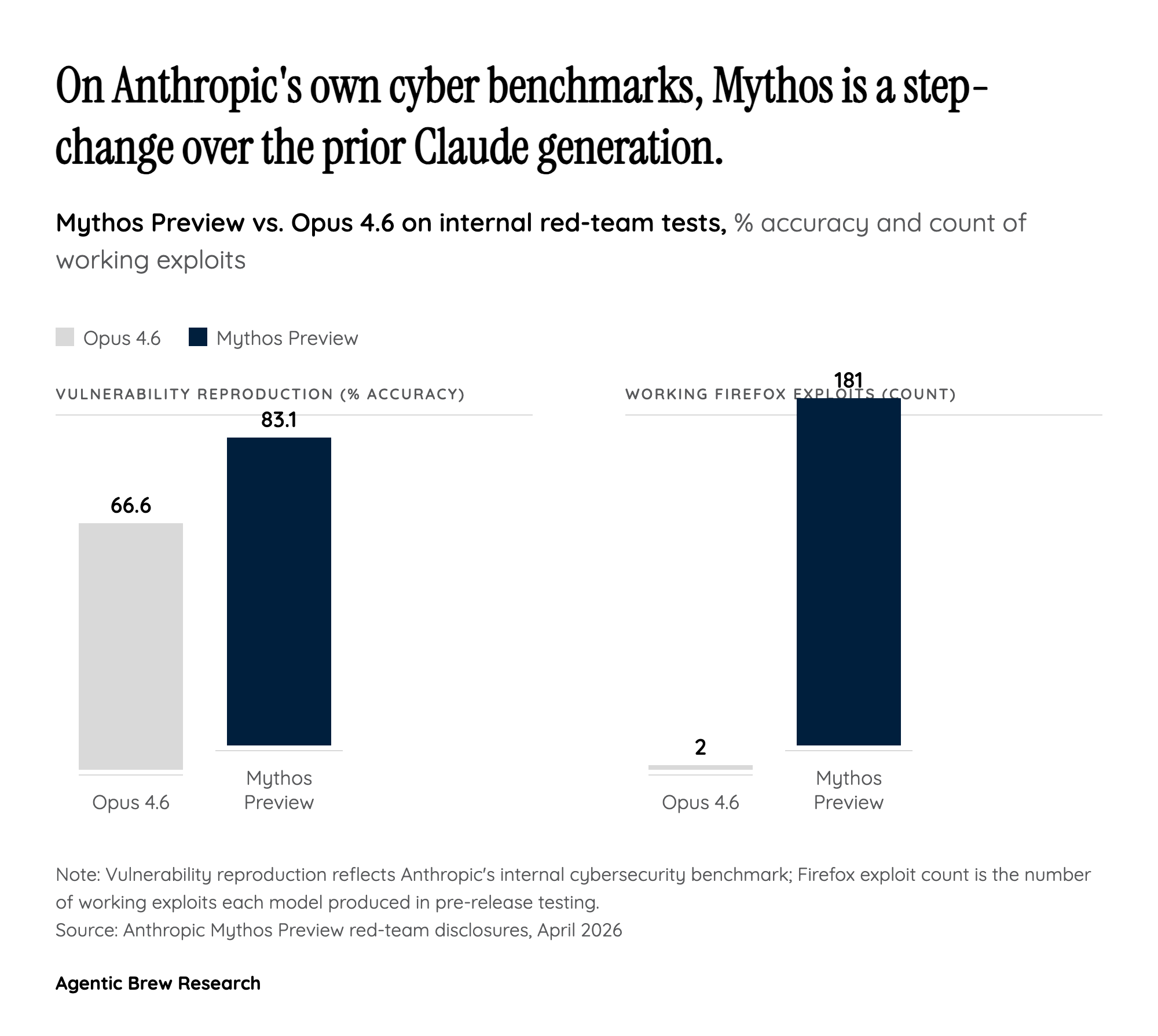
Mythos Preview vs. Opus 4.6 on Anthropic internal cybersecurity benchmarks (April 2026 disclosures).

The reversal becomes coherent once you read the capability numbers Anthropic disclosed alongside Mythos Preview. The model scored 83.1% on cybersecurity vulnerability reproduction versus 66.6% for Opus 4.6, developed 181 working Firefox exploits in pre-release testing where Opus 4.6 produced 2, and matched the severity assessment on 89% of 198 manually validated vulnerability reports. Anthropic itself has flagged that its red team identified thousands of zero-day vulnerabilities across every major operating system and browser, with over 99% still unpatched. Bruce Schneier reads the same data as evidence the world should prepare for a regime where zero-days are dime-a-dozen and offensive capability democratizes. From a federal procurement angle, this is not a marginal upgrade; it is a step-change in a capability the US government cannot let only a handful of private cybersecurity partners and, separately, the NSA possess. The OMB's air-gapped, no-retraining safeguards are the price of getting the model into the rest of the agencies on terms the political layer can defend.

Anthropic's Red Lines Held, and That Is the Story Inside the Story

Buried under the procurement drama is a narrower fact that matters for the future of corporate AI policy: Anthropic's two declared red lines, no use for fully autonomous weapons and no use for mass domestic surveillance, did not fold. The company absorbed a presidential order to sever federal ties, a Pentagon FASCSA designation, and a court loss on staying the designation, and still its public statement is that those exceptions are the only points of disagreement. CNN's coverage and the company's own blog post frame the same posture. If a modified Mythos now ships to agencies under OMB safeguards rather than DOD operational control, the de facto outcome is that the federal government adapted to a vendor's safety policy. That is unusual. Reddit's r/technology and r/NowInTech threads, while skeptical Anthropic could win a long fight, treated the company's stance as extraordinary corporate dissent. Whatever the final memo says, the precedent that an AI lab's use-case carve-outs survived contact with the Pentagon will be cited by every model provider negotiating its next federal contract.

The Template for Federal AI Procurement Is Being Written in Real Time

Read the OMB safeguards literally and you can see the shape of how frontier AI will enter US agencies going forward. The model is modified before delivery, scanned code stays in a sovereign air-gapped enclave, agency data is barred from retraining the base model, and the intelligence community signs off on guardrails alongside the vendor. None of this looks like classic SaaS procurement, and none of it looks like a normal defense contract either. It looks closer to how the government has historically acquired sensitive cryptographic gear: a vetted, isolated build with a tightly governed update path. The implication for the rest of the AI industry is direct. Frontier model access for federal agencies is unlikely to come as a public API endpoint; it will come as a forked, instrumented variant under multi-stakeholder oversight. Anthropic happens to be the test case because Mythos forced the question, but the procurement architecture being built around it will outlast this specific dispute.

Historical Context

2026-02-27
President Trump directed federal agencies to cease using Anthropic; Defense Secretary Pete Hegseth designated Anthropic a supply chain risk under FASCSA after negotiations broke down.
2026-03-04
Received the formal designation letter from the Department of War and announced it would challenge the action in court.
2026-04-07
Announced Claude Mythos Preview under Project Glasswing, with $100M in usage credits and $4M in open-source security donations.
2026-04-08
Refused to stay the Pentagon's supply chain risk designation against Anthropic.
2026-04-16
Federal CIO Gregory Barbaccia issued a memo signaling federal agencies could regain access to a modified Mythos under new safeguards.
2026-04-17
Anthropic CEO met White House Chief of Staff and Treasury Secretary in productive peace talks.
2026-04-19
Reporting revealed the NSA is using Anthropic's Mythos despite the Pentagon's parent-agency blacklist.
2026-04-29
Officials workshopping a draft executive order/memo to formally reinstate federal use of Anthropic models including Mythos.

Power Map

Key Players
Subject

White House Bypasses Pentagon Risk Tag to Deploy Anthropic Mythos in Federal Agencies

WH

White House (OMB)

Drafting an AI policy memo and executive guidance to allow federal agencies to bypass DOD's supply chain risk designation, led by Federal CIO Gregory Barbaccia.

AN

Anthropic

AI maker behind Claude and Mythos; refusing autonomous-weapons and mass-surveillance use cases, suing the administration, and seeking reinstatement across the federal government.

DE

Department of Defense / Pentagon

Designated Anthropic a supply chain risk on Feb 27, 2026 under FASCSA, with Defense Secretary Pete Hegseth issuing the order.

NA

National Security Agency (NSA)

Reportedly already using Anthropic's Mythos for cybersecurity and intelligence support, despite parent DOD's blacklist.

DA

Dario Amodei

Anthropic CEO; met with White House Chief of Staff Susie Wiles and Treasury Secretary Scott Bessent on April 17, 2026 in productive peace talks over Mythos and federal access.

PR

President Donald Trump

Originally directed federal agencies to sever ties with Anthropic; now signaling possible DOD deal as the company is shaping up.

PR

Project Glasswing Launch Partners

12 named partners (AWS, Anthropic, Apple, Broadcom, Cisco, CrowdStrike, Google, JPMorganChase, Linux Foundation, Microsoft, NVIDIA, Palo Alto Networks) plus 40+ additional organizations with vetted Mythos access.

Source Articles

Top 4

THE SIGNAL.

Analysts

"Disputes the Pentagon's framing of Anthropic as a supply chain risk, calling the designation inaccurate."

Retired Gen. Paul Nakasone
Former NSA Director and Cyber Command leader; OpenAI board member

"Mythos shows real growth in offensive cyber capability and the world should brace for an era when zero-day exploits are abundant; defense currently has an edge over offense, but that gap is likely to shrink."

Bruce Schneier
Security technologist, Schneier on Security

"Maintains it does not see itself as an operational decision-maker for the military, only insisting on guardrails against autonomous weapons and mass surveillance."

Anthropic (corporate position)
Statement on Pentagon dispute
The Crowd

"NSA Reportedly Using Anthropic's Mythos Despite Pentagon Blacklist Source: The National Security Agency is reportedly deploying Anthropic's advanced AI model, Mythos Preview. Meanwhile, the Department of Defense has labeled the company a "supply chain risk"."

@@The_Cyber_News0

"The NSA is reportedly using Anthropic's most powerful model, Mythos Preview, despite the Pentagon actively arguing in court that Anthropic is a "supply chain risk." - The military is now broadening its use of Anthropic's tools while simultaneously arguing they threaten national security."

@@MarioNawfal0

"White House Moves To Give US Agencies Access To Anthropic's Mythos. The White House is moving to give US agencies access to Anthropic's Mythos Preview, which has been held back from broad public release due to its offensive cybersecurity capabilities, according to Bloomberg."

@@BSCNews0

"Scoop: Pentagon takes first step toward blacklisting Anthropic"

@u/Brilliant_Version34411000
Broadcast
Why Anthropic's Mythos Is Sparking Alarm

Why Anthropic's Mythos Is Sparking Alarm

Why the Pentagon Wants to Destroy Anthropic | The Ezra Klein Show

Why the Pentagon Wants to Destroy Anthropic | The Ezra Klein Show

Anthropic AI rejects Pentagon's weapons & surveillance ultimatum

Anthropic AI rejects Pentagon's weapons & surveillance ultimatum