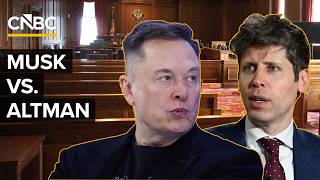
Musk v. Altman OpenAI nonprofit trial begins
TECH

Musk v. Altman OpenAI nonprofit trial begins

28+
Signals

Strategic Overview

  • 01.
    Jury selection in Elon Musk's lawsuit against Sam Altman, Greg Brockman and OpenAI begins Monday in U.S. District Court for the Northern District of California in Oakland, with U.S. District Judge Yvonne Gonzalez Rogers presiding and opening arguments expected Tuesday.
  • 02.
    On the eve of trial Musk dropped his fraud and constructive fraud claims, leaving only two of the original 26 claims for the jury: unjust enrichment and breach of charitable trust.
  • 03.
    Gonzalez Rogers split the trial into a liability phase running through mid-May 2026 and a separate remedies phase, seating 9 jurors with no alternates.
  • 04.
    Musk is asking the court to oust Altman and Brockman, unwind OpenAI's for-profit conversion, and direct any disgorged 'ill-gotten gains' to the OpenAI nonprofit rather than to himself personally.

Deep Analysis

From 26 claims to two: how Musk shrunk his case to a charitable-trust play

Musk filed November 2024 with 26 claims and headline damages of up to $134 billion. By the eve of jury selection that case had been deliberately whittled down to two: unjust enrichment and breach of charitable trust. Bloomberg Law confirmed Musk dropped his fraud and constructive fraud claims on the eve of trial, narrowing the scope of his lawsuit against his business rivals. The streamlining was framed by the court as efficiency, but it is also a strategic recasting of what the trial is about.

The consequence is structural. Charitable-trust and unjust-enrichment claims, when paired with a request for equitable rather than monetary relief, push the most consequential decisions out of the jury box and onto the judge's desk. Local News Matters' legal analysis flagged this directly: equitable remedies 'rest entirely with the judge, not the jury,' calling it a 'significant risk' for Musk. In other words, the headline-grabbing $134 billion number and the jury are now largely decoupled from what Musk actually wants - which is to unwind the for-profit structure itself. The jury will find facts; Judge Gonzalez Rogers will decide whether OpenAI's corporate form survives in its current shape.
Microsoft is the quiet co-defendant with $135 billion of skin in the game

Coverage of Musk v. Altman naturally fixates on the two namesakes, but the most under-discussed exposure on the docket is Microsoft's. CNBC reports Microsoft holds roughly a 27% stake in OpenAI, valued near $135 billion, and is named as a co-defendant on a theory that it aided and abetted OpenAI's alleged breach of charitable trust. Satya Nadella is on the witness list and is expected to testify about Microsoft's role in the 2019 capped-profit transformation and his memorable role in getting Altman reinstated during the November 2023 board crisis.

Musk's filings put numbers on the disgorgement theory: Engadget's review of those filings cites a sought disgorgement of $65.5-$109.43 billion from OpenAI, Altman and Brockman, plus $13.3-$25.06 billion from Microsoft. Even at the low end of the Microsoft range, that is a sum that would dent any large-cap tech balance sheet. And because Musk has redirected proceeds to the OpenAI nonprofit rather than himself, a Microsoft-adverse outcome would not just be a financial transfer - it would arguably re-capitalize the very nonprofit that is supposed to govern the for-profit Microsoft has bet $135 billion on. The conflict-of-structure problem is dizzying, and it explains why Microsoft's day in court matters as much as Altman's.

The Brockman diary: how a 2017 personal note became the trial's narrative anchor

If there is a 'smoking gun' to this trial in the public imagination, it is not a contract or an email - it is a diary excerpt. r/singularity surfaced a 2017 entry in which Greg Brockman mused about flipping OpenAI to for-profit and personally hitting $1 billion in net worth. The thread became the dominant Reddit framing of the case, with commenters reading it as intent-to-deceive evidence: that the for-profit pivot was not an emergent response to compute costs, but a private aspiration that predated the public narrative.

Developer YouTube and r/singularity converged on this excerpt as the trial's narrative anchor, with channels walking viewers through unsealed court documents and broader threads framing the diary as proof of a long-tail intent. The legal weight of a personal diary in a charitable-trust case is contestable - states of mind from 2017 are not the same as 2019 board actions - but the cultural weight is settled. For the public, the diary is the case. That gap between social-media certainty and the much narrower legal question the jury will be asked is itself part of the story: the trial will be re-litigated continuously online against evidence the courtroom may treat as marginal.

The contrarian read: nonprofit-to-for-profit conversions are routine - this case hinges on self-dealing

A more sophisticated current on Reddit, especially in r/OpenAI, argues that the case's actual legal hook is not the conversion itself but the pricing of it. Nonprofit-to-for-profit conversions happen regularly, and donors generally do not get money back when a charity later restructures - that is the contrarian baseline that competes with the popular 'they betrayed the mission' framing. The narrower, harder-to-defend allegation is that OpenAI sold the for-profit to itself without arms-length pricing, which would breach fiduciary duty regardless of how one feels about for-profit AI.

This reframing matters because it tracks how a careful judge is likely to think. Charitable-trust law turns less on mission drift and more on whether trustees enriched themselves or related parties at the trust's expense. UCLA's Michael Dorff frames the surface question as 'OpenAI began as a non-profit organization, and then decided that it needed to be a for-profit organization,' but the operative legal question underneath is about valuation and process: did the board exchange a charitable asset for fair consideration, or did insiders get a deal no third party would have gotten? That is also where Musk's $38 million actual contribution becomes pivotal - not as a damages anchor, but as a marker of what a nonprofit trust's residual interest is supposedly worth on paper versus what the early 2026 reorganization implicitly priced it at when the Foundation took its roughly $130 billion equity stake.

Why this verdict lands now, and what every other AI lab is watching

The trial arrives at a uniquely awkward moment for the AI industry. OpenAI is currently valued at approximately $852 billion, per Bloomberg, and just completed in early 2026 the reorganization in which the for-profit became a public benefit corporation and the nonprofit became the OpenAI Foundation holding an approximately $130 billion equity stake. Anthropic, xAI and other 'mission-driven' labs sit on similar mission-versus-investor tensions. As one r/OpenAI thread put it, the case is 'actually about all of us': can a $44M-donation nonprofit flip to a $500B+ for-profit and have the law shrug?

What the trial therefore tests is precedent, not just personalities. If Gonzalez Rogers grants meaningful equitable relief - even a remedy short of unwinding the conversion - every AI lab restructuring under capped-profit, public-benefit-corporation or foundation-ownership architecture will face new scrutiny on valuation and self-dealing. If she denies relief and the jury also finds for OpenAI, the for-profit playbook is effectively blessed. The market is already pricing skepticism toward Musk: prediction markets put his odds in the 28-36% range as of late March 2026, and Local News Matters reported them favoring Altman 2-to-1 as of April 23. But even a 30% probability of forced restructuring on the most valuable private AI company in the world is not background noise - it is exactly why Nadella is on the witness list.

Historical Context

2015-12
OpenAI is officially formed as a nonprofit Delaware corporation, with Altman and Musk as co-chairs and a charter pledging AI 'for the benefit of humanity.'
2018-02
Musk resigns from OpenAI's board on February 21, 2018, ending his formal governance role months before the for-profit subsidiary is created.
2018-2019
OpenAI creates a capped-profit subsidiary with investor returns capped at 100x ROI and the nonprofit retaining control - the structural pivot now at the center of the trial.
2019-07
Microsoft's first $1 billion investment in OpenAI closes on July 2, 2019, immediately after the capped-profit restructuring - establishing the partnership Musk now calls a breach of charitable purpose.
2024
Musk files his first OpenAI lawsuit on February 29, 2024, voluntarily withdraws it on June 11, 2024, then refiles the operative complaint with 26 claims in November 2024.
2026
OpenAI completes a reorganization in which the for-profit becomes a public benefit corporation and the nonprofit becomes the OpenAI Foundation, holding an approximately $130 billion equity stake - the very transaction Musk is asking the court to unwind.

Power Map

Key Players
Subject

Musk v. Altman OpenAI nonprofit trial begins

EL

Elon Musk

Plaintiff and OpenAI co-founder who departed the board in February 2018; now CEO of Tesla, SpaceX and xAI, OpenAI's direct competitor.

SA

Sam Altman

Defendant, OpenAI CEO and co-founder, expected to take the stand and defend the 2019 capped-profit restructuring.

GR

Greg Brockman

Defendant and OpenAI president whose 2017 personal diary entries about flipping to for-profit have become a central piece of evidence in the case.

MI

Microsoft (and Satya Nadella)

Co-defendant accused of aiding and abetting OpenAI's alleged breach of charitable trust; holds an approximately 27% stake in OpenAI valued near $135 billion, with Nadella expected to testify about the 2019 transformation and Altman's 2023 reinstatement.

JU

Judge Yvonne Gonzalez Rogers

Presiding U.S. District Judge for the Northern District of California (Obama appointee, 2011) who, because Musk pivoted to equitable remedies, will personally decide the most consequential outcomes.

SH

Shivon Zilis

Former OpenAI board member and Musk confidant; expected witness whose testimony will speak to the founding-era nonprofit commitments.

THE SIGNAL.

Analysts

"Frames the case as fundamentally a referendum on OpenAI's nonprofit-to-for-profit transition: 'At the heart of this trial is that OpenAI began as a non-profit organization, and then decided that it needed to be a for-profit organization.'"

Professor Michael Dorff, UCLA
Corporate-law academic

"Argues Musk's late shift to equitable remedies is a strategic gamble because such relief 'rest entirely with the judge, not the jury,' and notes prediction markets favored Altman roughly 2-to-1 as of April 23, 2026."

Local News Matters legal analysis
Trial-strategy commentary

"Even a Musk win likely yields tens of millions, not tens of billions: 'the realistic payout - based on Darrow's analysis - looks closer to $20 to $38 million than $60 billion. Prediction markets as of late March put Musk's odds of winning at 28 to 36 percent.'"

Tech and legal analysts (via Darrow analysis and prediction markets)
Quantitative outcome modeling

"OpenAI plans to argue Musk's claims 'stem more from an effort to hinder a competitor than from protecting the human race,' casting xAI's founder as a competitor weaponizing charitable-trust law."

OpenAI court strategy (per CNBC reporting)
Defense narrative
The Crowd

"A U.S. judge on Friday dismissed Elon Musk's fraud claims in his lawsuit accusing OpenAI and co-founder Sam Altman of betraying OpenAI's original mission, but plans to proceed to trial on Musk's breach of charitable trust and unjust enrichment claims."

@ReutersLegal0

"Today, at the eleventh hour, Elon lodged a court filing pretending to change his tune about attacking the nonprofit OpenAI Foundation. The truth is that this case has always been about Elon generating more power and more money for what he wants."

@OpenAINewsroom0

"Btw, the proceeds of any legal victory in the OpenAI case will be donated to charity. I will in no way enrich myself."

@elonmusk0

"interesting excerpt from from Elon Musk vs OpenAI lawsuit"

@u/JP_525263
Broadcast
Elon Musk vs. Sam Altman, AI Job Loss, and OpenAI's $852B Valuation | EP #247

Elon Musk vs. Sam Altman, AI Job Loss, and OpenAI's $852B Valuation | EP #247

New Court Documents EXPOSE the Altman v Musk AI War...

New Court Documents EXPOSE the Altman v Musk AI War...

Battle Of The Billionaires: Elon Musk And Sam Altman Go To Court

Battle Of The Billionaires: Elon Musk And Sam Altman Go To Court