Apple-Intel US chip manufacturing talks
TECH

Apple-Intel US chip manufacturing talks

36+
Signals

Strategic Overview

  • 01.
    Apple has held early-stage exploratory discussions with Intel and Samsung Electronics about producing the main processors for its devices in the United States, providing an alternative to longtime partner TSMC.
  • 02.
    Talks remain preliminary, no orders have been placed, and Apple has internal concerns about transitioning away from TSMC's manufacturing technology that may keep it from finalizing another partner.
  • 03.
    Intel shares jumped roughly 12-14% on May 5, 2026 to a new all-time high, building on a 114% surge in the prior month after a Q1 2026 earnings beat; Samsung shares hit a record KRW232,500 in Seoul.
  • 04.
    The most likely scenario, per analyst commentary, is that Apple uses Intel's 18A-P process for low-end M-series parts beginning Q2-Q3 2027, while keeping highest-performance silicon on TSMC.

Deep Analysis

The Reversal: Six Years After Apple Walked Away, It Wants Intel's Fabs Back

In 2020 Apple capped a 14-year divorce by completing its Mac transition off Intel-designed CPUs and onto its own M-series silicon. The story Apple told the world was that vertical integration — designing the chip, the OS, and the device together — would beat any commodity processor Intel could ship. Six years later, Apple is reportedly back at Intel's door. The framing reversal is striking, but the technical relationship being negotiated is fundamentally different from the one that ended.

This is the distinction the loudest investor crowds keep glossing over and that the most-upvoted Reddit threads on the news kept correcting: Intel would only be the fabricator, not the designer. Apple's chip teams in Cupertino still own the architecture, the GPU, the Neural Engine, the SoC layout. Intel's job, under this scenario, is to take an Apple-designed M-series die, run it through its 18A-P process at an Arizona or Ohio fab, and ship wafers back. That is the same kind of relationship Apple has had with TSMC for over a decade, and it is categorically different from the 2006-2020 arrangement where Apple shipped Macs running Intel's own CPU architecture. Calling this 'Apple goes back to Intel' is technically accurate and editorially misleading at the same time.

Why $340 Billion Moved on a Bloomberg Scoop

Why $340 Billion Moved on a Bloomberg Scoop
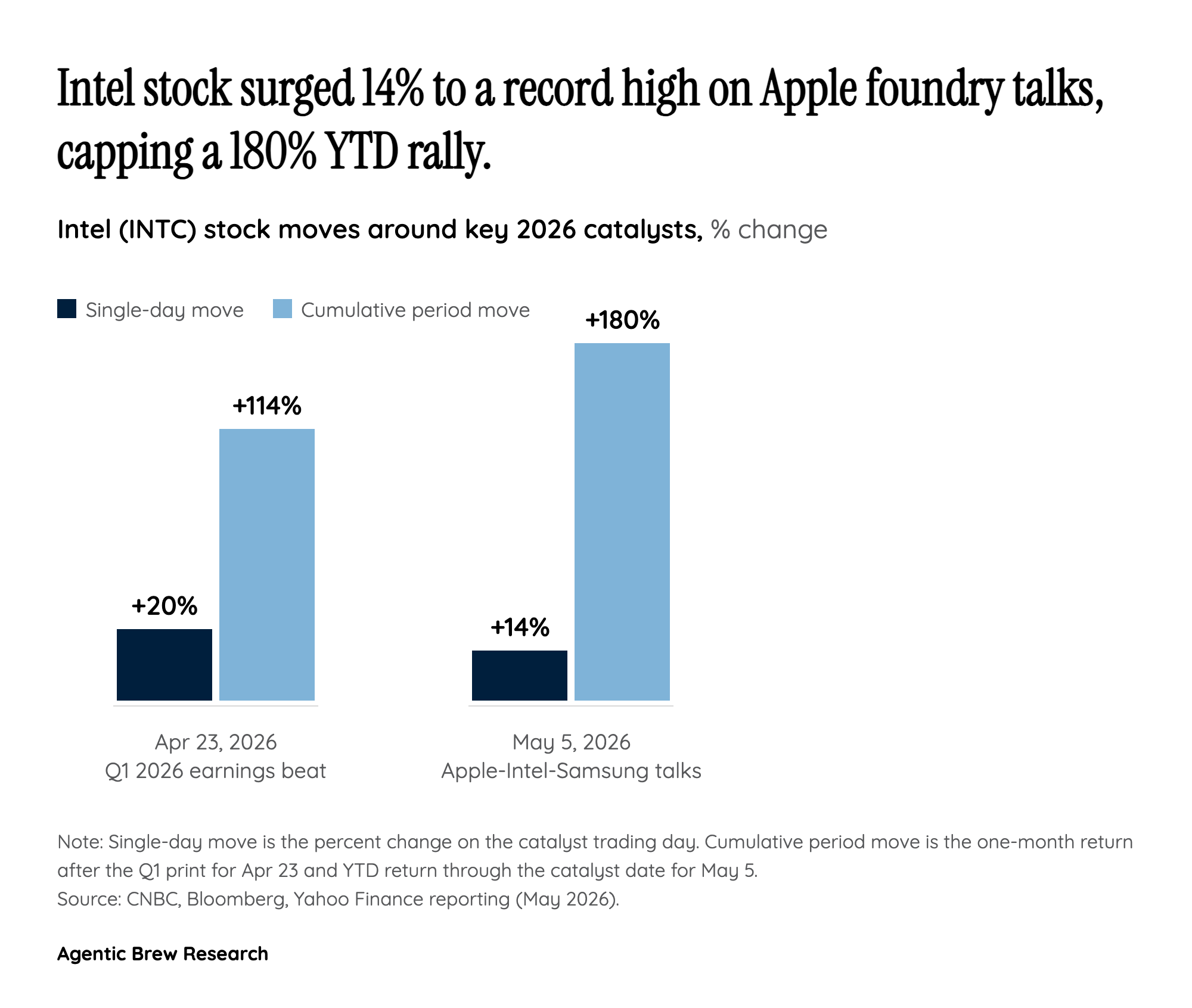
Intel stock movements around the Q1 2026 earnings beat and the May 5 Apple foundry talks report.

Intel's market response told you exactly what kind of news this was. Shares climbed roughly 12-14% on May 5, 2026 to a new all-time high, on top of the 114% rally the stock had already strung together since its Q1 2026 earnings beat in late April. By the close, Intel had added more than $340 billion in market value year-to-date, with the stock up over 180% for the year. Samsung's Seoul listing spiked 5.4% to a record KRW232,500 the same session. These are not numbers that markets put on a 'preliminary discussion.'

The move makes more sense if you read it as a re-rating of Intel's foundry optionality rather than as a discounted Apple deal. For most of the past decade, Intel Foundry was treated by the market as an expensive call option — interesting if it ever hit, but unlikely. An Apple engagement, even a partial one limited to low-end M-series parts, would force a model rebuild: the question stops being 'will Intel land any anchor external customer' and becomes 'how big does the foundry book grow once the most demanding customer in mobile silicon is willing to qualify the process.' Two analyst voices — Ben Bajarin of Creative Strategies and Patrick Moorhead of Moor Insights — pushed back on the 'just discussions' framing within hours, calling the engagement 'much more than exploration.' Markets evidently agreed.

The Squeeze That Forced Cook's Hand

Apple did not pick this fight in 2026 for ideological reasons; the operational pressure became unignorable. Tim Cook has now publicly admitted Apple has 'less flexibility in the supply chain than we normally would,' and the underlying cause is straightforward: AI data center demand and an unexpected lift in Macs purchased to run AI models locally have collided with TSMC's leading-edge node capacity. The most advanced wafers are simply oversubscribed. At the same time, the geopolitical clock has not stopped ticking. Cook told employees as far back as 2022 that '60% coming out of anywhere is probably not a strategic position,' a remark plainly pointed at Taiwan. By 2023, Apple alone consumed roughly 25% of TSMC's revenue, the largest single share of any customer.

The 'why now' question also has a US-manufacturing answer that often gets skipped. TSMC's Arizona fab is real and ramping, but the volume coming out of Arizona in 2026 is, per community discussion of public filings, on the order of 100 million chips — a sliver of Apple's annual A-series and M-series demand. If Apple wants meaningful US-made silicon in this decade, TSMC Arizona alone cannot deliver it on the timeline Cook is staring at. Intel's 18A is, per the same public discussion, the most power-efficient node currently shipping that is also fabricated in the US — and it is ramping under a CEO, Lip-Bu Tan, who is reportedly pushing 7-8% per-month yield improvements. That combination is what makes the 2027 timeline analysts like Ming-Chi Kuo and Jeff Pu keep citing — Q2-Q3 2027 for low-end M-series, and 2028 for a possible non-Pro iPhone extension on 14A — physically plausible rather than aspirational.

Reading the Skeptics: What 'Priced In' Misses and Doesn't

The contrarian take spread fastest on the investor side of Reddit and in process-engineering circles, and it has two parts worth taking seriously. The first is process-quality skepticism. The reference case making the rounds is Qualcomm's Snapdragon 8 Gen 1, fabbed by Samsung, versus the 8+ Gen 1, fabbed by TSMC: the Samsung version had measurably worse performance and thermal behavior despite a similar design. The fear is that any Apple silicon coming out of Intel or Samsung fabs would underperform the TSMC-built variant of the same die, creating a two-tier product experience that Apple — historically obsessive about consistency — would struggle to ship. AppleInsider's analysis lands in the same place: the most likely outcome is Intel or Samsung fabbing only lower-end M-series parts in mid-volume products like MacBook Air and iPad Pro, while highest-performance silicon stays on TSMC.

The second skeptic angle is that the news is 'priced in' after Intel's 114% prior-month rally. That argument is sharper than the first but misses an important second-order effect that several commentators flagged: even if Apple never signs a contract, the signal itself rewires the negotiating table. TSMC now knows its largest customer is publicly courting two alternatives. Samsung now has a credible reason to keep investing in its Texas fab. Intel now has Apple-grade qualification work funded internally — the kind of process discipline that attracts other fabless customers regardless of whether Cupertino ever places an order. In other words, the floor under Intel's foundry valuation moves up even in the no-deal scenario, while TSMC's pricing power on advanced nodes structurally erodes. That is the part the 'priced in' camp is underweighting, and it is also why Apple's own internal hesitation about non-TSMC technology, flagged in the original reporting, does not necessarily kill the trade — Apple has already won leverage simply by being seen at the table.

Historical Context

2014
Then-Intel CEO Paul Otellini declined to manufacture Apple's chips citing margin concerns; TSMC's Morris Chang accepted, and the A8 became the first Apple-designed processor manufactured by TSMC starting that fall.
2020
Apple completed its transition of Macs from Intel-designed CPUs to in-house Apple Silicon, ending a 14-year supplier relationship.
2022
Tim Cook told staff in an all-hands meeting that '60% coming out of anywhere is probably not a strategic position,' referring to chip production concentrated in Taiwan.
2023
Apple alone represented roughly 25% of TSMC's revenue, making it TSMC's largest single customer.
2026-04-23
Intel reported Q1 2026 earnings that topped estimates; the stock surged 20% on the print and rallied 114% over the following month.
2026-05-05
Bloomberg reported Apple held early-stage talks with Intel and Samsung for US manufacturing of main device chips; Intel shares jumped roughly 12-14% to a new all-time high and Samsung shares closed at a record in Seoul.

Power Map

Key Players
Subject

Apple-Intel US chip manufacturing talks

AP

Apple Inc.

Buyer driving diversification away from TSMC. Concentration risk in Taiwan plus advanced-node shortages tied to AI demand are pushing Apple to seek a second source, though leadership has flagged real concerns about non-TSMC technology.

IN

Intel Corporation

Foundry candidate under CEO Lip-Bu Tan. Landing Apple as an anchor customer would validate Intel's 18A roadmap and complete a foundry comeback that has eluded multiple prior CEOs.

SA

Samsung Electronics

Alternative US foundry candidate. Apple executives have visited Samsung's Texas plant under development, and Samsung shares hit a record on the news.

TS

TSMC

Incumbent partner producing virtually all of Apple's leading-edge A-series and M-series chips, and Apple alone represented roughly 25% of TSMC's revenue in 2023. Concentration in southern Taiwan is the geopolitical risk Apple is now openly working to hedge.

TI

Tim Cook

Apple CEO who as far back as 2022 told staff that 60% of chip production coming out of any one geography was 'probably not a strategic position,' and has more recently acknowledged tighter supply-chain flexibility on advanced nodes.

LI

Lip-Bu Tan

Intel CEO leading the foundry turnaround, reportedly pushing 7-8%-per-month yield improvements on 18A and rebuilding manufacturing discipline that an Apple deal would validate externally.

Source Articles

Top 4

THE SIGNAL.

Analysts

"Says Apple is 'much farther along than just discussions' with Intel on foundry, suggesting the engagement is well past the exploratory framing in Bloomberg's report."

Ben Bajarin
CEO, Creative Strategies

"Characterizes the Apple-Intel engagement as 'much more than exploration,' implying substantive technical and commercial progress beneath the public framing."

Patrick Moorhead
Founder/Analyst, Moor Insights & Strategy

"Believes Intel could begin manufacturing Apple's lowest-end M-series chips as early as mid-2027 under what would likely be an exclusive 18A-P arrangement."

Ming-Chi Kuo
Supply chain analyst, TF International Securities

"Has acknowledged real supply constraints — 'we have less flexibility in the supply chain than we normally would' — and previously told staff that 60% concentration in any single geography is 'probably not a strategic position.'"

Tim Cook
CEO, Apple

"Suggests Apple may extend the Intel partnership beyond Macs, tapping Intel to manufacture some non-Pro iPhone chips starting in 2028 on Intel's 14A node."

Jeff Pu
Analyst, GF Securities
The Crowd

"Intel expected to begin shipping Apple's lowest-end M processor as early as 2027. There have long been market rumors that Intel could become an advanced-node foundry supplier to Apple, but visibility around this had remained low. My latest industry surveys, however, indicate that..."

@@mingchikuo0

"Intel is about to become a MONSTER. With the success of the almost sold out 18A fabrication, Intel has attracted Apple, who will reportedly use Intel's fabs to make their low-end M chips in 2027, as well as 14A to make low-end iPhone chips in 2028. This means massive profits..."

@@VadimYuryev0

"$AAPL $INTC | Analyst Says Apple May Expand Intel Partnership to Future iPhone Chips - Macrumors. Apple may tap Intel to manufacture some non-pro iPhone chips starting in 2028, according to GF Securities analyst Jeff Pu, who said he and colleagues 'now expect' Intel to reach a..."

@@AIStockSavvy0

"Apple explores Intel & Samsung for Main Device Chips in US"

@u/Dickasaurus_Rex_760
Broadcast
US-Iran Ceasefire Holds; Apple Weighs Using Intel, Samsung for Processors | Bloomberg Brief 5/5/2026

US-Iran Ceasefire Holds; Apple Weighs Using Intel, Samsung for Processors | Bloomberg Brief 5/5/2026

Why NVIDIA and Apple Refuse to Buy Intel Chips

Why NVIDIA and Apple Refuse to Buy Intel Chips

Apple Just Did the UNTHINKABLE With Intel

Apple Just Did the UNTHINKABLE With Intel