ChatGPT Personal Finance with Plaid
TECH

ChatGPT Personal Finance with Plaid

30+
Signals

Strategic Overview

  • 01.
    On May 15, 2026, OpenAI launched a personal finance preview in ChatGPT for U.S. Pro subscribers, connecting to 12,000+ financial institutions via Plaid in read-only mode.
  • 02.
    The feature defaults to GPT-5.5 Thinking and produces a dashboard of portfolio performance, spending, subscriptions, and upcoming payments, with Intuit integration planned for tax-impact and credit-approval-odds analyses.
  • 03.
    ChatGPT can read balances, transactions, investments, and liabilities but cannot view full account numbers or move money; disconnecting deletes synced data within 30 days.

The Sherlocking Heard Around Fintech

The same week OpenAI shipped its preview, two things happened in quick succession that explain why this feature is louder than its read-only feature set suggests. First, an entire category of indie personal-finance builders woke up to discover that the assistant they cannot out-distribute now ships with Plaid pre-wired and a chat interface their customers already use every day; founders at Bento and Finlingo openly called out being Sherlocked on launch day in the r/MonarchMoney thread, while Monarch's own team confirmed it is racing to ship an MCP server so other AI agents can read the data they aggregate. Second, US fintech stocks moved on Friday as investors priced the competitive shock into robo-advisors and digital-budgeting incumbents — a reaction picked up in Taiwanese financial news coverage of the launch.

The mechanical reason the disruption is so sharp is that OpenAI did not skip the aggregation layer — it leased it. The Plaid OAuth integration ChatGPT now uses is the same plumbing Monarch and Copilot have always used [1]. That collapses the long-running moat of finance apps ("we have the bank connections") into a commodity input. What remains is interface, categorization quality and trust — and ChatGPT enters with a multi-billion-conversation interface already running. Javelin's Dylan Lerner called this OpenAI grabbing "share of mind" in consumer finance [2], which is the polite framing of the same point. Independent app developers framed it less politely on Reddit, and one Monarch power user laid out the technical reason LLMs alone are still imperfect for raw transaction data — context-window blowout and unreliable arithmetic — while noting that the working pattern (dump CSVs into a local SQL store and let the LLM write SQL) is exactly what OpenAI now wraps in a dashboard. The market just learned that the Plaid-plus-UX layer is no longer a defensible product on its own.


Why Now: The 200 Million Question

Read the launch alongside ChatGPT Health, and the strategy stops looking like a feature drop and starts looking like a deliberate sequencing. OpenAI says more than 200 million people already ask ChatGPT personal-finance questions every month [3], mirroring the 230-million-a-week health-question volume the company cited when it launched ChatGPT Health in January [4]. The pattern is identical: identify a high-frequency, low-data category where users are already typing into ChatGPT without account context, then bolt on the integration that turns generic advice into grounded, personalized answers. Finance is the second domain through this template; tax and credit, via the announced Intuit integration, are the next.

The timing also explains the Plaid choice. Plaid's own 2025 Fintech Effect report says nearly 75% of Americans used at least one fintech tool last year, up from 58% in 2020, and that 64% of consumers who have used AI for finances say it improved their ability to evaluate financial products [1]. That is the curve OpenAI is monetizing — not first-time digital adoption, but second-curve AI adoption layered on top of fintech literacy. The Pro-tier price gate is the second deliberate choice: by launching only in the $200-per-month tier, OpenAI is filtering for users with high investable assets and willingness to pay, which is exactly the cohort wealth managers and robo-advisors monetize. The feature can underperform with mass-market users today and still be commercially decisive, because the cohort that actually opted in is the one financial incumbents have always fought hardest for.

The Fiduciary Gap Nobody Wants to Litigate First

ChatGPT will now suggest whether you can afford a house, surface your subscription waste, and answer "is my portfolio overexposed?" The TNW review put the regulatory tension bluntly: a human financial adviser has a legal obligation to act in a client's best interest, and ChatGPT does not [2]. OpenAI's own copy carefully avoids the word "advice" wherever it can and emphasizes that the feature is not a replacement for a professional, but the UX is doing the opposite work — surfacing personalized recommendations grounded in user balances in a way no disclaimer fully neutralizes. The Taiwanese finance broadcast that covered the launch made the same point through a different lens: experts there warned ChatGPT cannot fully model a user's risk tolerance, which is precisely the input a fiduciary is supposed to incorporate.

The data side is just as exposed. Citizens Bank's Chris Powell told Money that sharing nonpublic information with a less-regulated non-financial provider raises real concerns [5], and Harmonic Security's Alastair Paterson advised consumers to keep confidential financial data out of LLM tools altogether [5]. Notice where the friction sits: not in the Plaid handshake (which is read-only and revocable within 30 days) but in what happens once balances and transactions become context for a model whose conversation history is itself a breach surface and whose business model includes ads. Carnegie Mellon's Ramayya Krishnan flagged exactly that — stored conversation history is a compromise vector if the account is breached [5]. Until federal or state regulators decide whether routinized personalized financial guidance through a chat interface triggers existing advisor or data-sharing rules, OpenAI is operating in a window where it gets the upside of advisor-grade UX without the obligations. The first enforcement action, or the first headline-grade incident, will close that window.

Reality Check: What Pro Users Actually Found in Week One

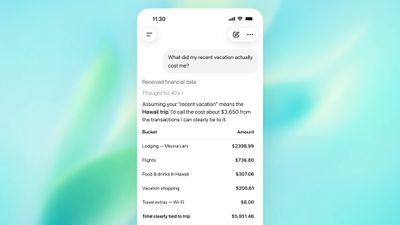
The early hands-on threads tell a more grounded story than either the bullish OpenAI framing or the doom-laden infosec reaction. r/OpenAI Pro subscribers who turned the feature on report that the dashboard does what it claims — surfaces subscriptions, balances, transactions, anticipated costs — but that naive prompts ("what do I spend too much on") yield generic answers anchored on big fixed-cost line items like rent and student loans, while directed prompts ("flag any recurring charge under $20 I haven't used in 60 days") work much better. The product is closer to a smarter terminal than to an autonomous agent today. One user even spotted an arithmetic inconsistency in OpenAI's own marketing example, where a Hawaii trip's line items did not sum to the total shown — a reminder that even when the model has the data, the math still has to be checked.

The more durable Pro-tier complaint is economic, not technical. Monarch Money costs roughly $100 a year for the same Plaid-aggregated view, and several commenters argued ChatGPT Pro at $200 a month is hard to justify on the strength of finance alone, especially while the feature stays gated out of the $20 Plus tier. That gap is the real adoption choke point: until OpenAI ships the feature to Plus, or builds advice quality that meaningfully exceeds a dedicated budgeting app, the working assumption inside the Monarch and Copilot communities is that ChatGPT becomes a complement to existing tools for now — power users keep their budgeting app, and use ChatGPT for one-off questions they would otherwise type into a search box. The strategic risk for incumbents is not Week One; it is the day this feature lands in Plus.

Historical Context

2025-10
OpenAI made its first fintech acquisition by buying AI personal-finance app Roi, signaling the start of a vertical buildout into consumer money.
2026-01-07
Launched ChatGPT Health, the first account-connected vertical experience, letting users link patient portals and wellness data and establishing the integration pattern that the finance feature now extends.
2026-04-13
Acqui-hired AI personal-finance startup Hiro Finance, bringing in founder Ethan Bloch and roughly ten employees; Hiro's consumer app shut down on April 20, 2026.
2026-05-15
Released the ChatGPT Personal Finance preview powered by Plaid on web and iOS for U.S. Pro subscribers, defaulting to GPT-5.5 Thinking.

Power Map

Key Players
Subject

ChatGPT Personal Finance with Plaid

OP

OpenAI

Owns the chat surface where the financial conversation now happens; sets the model (GPT-5.5 Thinking), gates the feature behind the Pro tier, and controls what financial data does or doesn't flow into model training.

PL

Plaid

Sole connectivity layer for the launch, plugging ChatGPT into 12,000+ banks, brokerages and card issuers; CEO Zach Perret has publicly framed this as one of Plaid's most strategic partnerships.

IN

Intuit

Announced as the next data partner; brings TurboTax-grade tax-impact and Credit Karma-style approval-odds modeling into the same ChatGPT surface, extending OpenAI's reach beyond cash and brokerage into tax and credit.

IN

Incumbent personal-finance apps (Monarch, Copilot, Bento, Finlingo)

Already use the same Plaid plumbing OpenAI just licensed; their primary moat now collapses to UX, deterministic categorization and (in Monarch's case) a forthcoming MCP server that exposes data to other AI assistants.

U.

U.S. banking regulators and consumer-protection bodies

Become the de facto check on a non-bank delivering advice that sounds fiduciary; their pace of action will determine whether ChatGPT can keep monetizing financial conversations free of advisor-grade obligations.

Fact Check

9 cited
  1. [1] What ChatGPT's new experience signals for digital finance
  2. [2] OpenAI wants ChatGPT to see your bank account
  3. [3] OpenAI launches ChatGPT for personal finance, will let you connect bank accounts
  4. [4] OpenAI unveils ChatGPT Health, says 230 million users ask about health each week
  5. [5] Why You Should Never Share Your Financial Data With ChatGPT
  6. [6] A new personal finance experience in ChatGPT
  7. [7] ChatGPT will offer personalized financial advice if you connect your bank account
  8. [8] OpenAI Opens ChatGPT to Bank Accounts via Plaid Preview
  9. [9] OpenAI just released new personal finance features for ChatGPT customers

Source Articles

Top 4

THE SIGNAL.

Analysts

"Says AI is transforming how consumers interact with their finances and frames the OpenAI partnership as a step toward bringing sophisticated, personalized financial advice to more people."

Zach Perret
CEO, Plaid

"Positions the launch as a further step toward ChatGPT becoming a personal agent that operates on the user's behalf around the clock, helping at home and at work."

Greg Brockman
President, OpenAI

"Sees OpenAI positioning itself to capture share of mind in consumer finance, potentially disintermediating traditional banking infrastructure."

Dylan Lerner
Analyst, Javelin Research

"Warns that sharing nonpublic financial information with a non-financial-services provider that is not regulated like a bank introduces real risk."

Chris Powell
Head of Deposits, Citizens Bank

"Advises that, for the moment, consumers should not put confidential financial information into any LLM tool."

Alastair Paterson
CEO, Harmonic Security
The Crowd

"Very excited to work with @OpenAI to launch Finances in ChatGPT! AI is transforming how consumers interact with their finances. This is an important step towards bringing sophisticated, personalized financial advice to more people."

@@zachperret0

"Understand and manage your personal finances in ChatGPT. A further step towards ChatGPT becoming your personal agent, operating on your behalf 24/7, for helping you at home and work."

@@gdb0

"So OpenAI literally kill*d many fintech startups today. OpenAI launched a personal finance feature in ChatGPT for Pro users in the US. You connect your bank accounts via Plaid, get a spending dashboard, and can ask GPT-5.5 questions grounded in your actual transaction data"

@@kimmonismus0

"OpenAI launches ChatGPT for personal finance, will let you connect bank accounts"

@u/EditorEdward228
Broadcast
攜手Plaid打入1.2萬家銀行 OpenAI強調不取代專業顧問!Perplexity AI也推金融工具|非凡財經新聞|20260516

攜手Plaid打入1.2萬家銀行 OpenAI強調不取代專業顧問!Perplexity AI也推金融工具|非凡財經新聞|20260516

【AI週報】ChatGPT、銀行口座と接続開始。Plaid連携で変わる個人の資産管理とセキュリティの課題

【AI週報】ChatGPT、銀行口座と接続開始。Plaid連携で変わる個人の資産管理とセキュリティの課題

ChatGPT Pro Can Link Bank Data. Here's the Catch

ChatGPT Pro Can Link Bank Data. Here's the Catch