The Hyperscaler That Walked and the CEO Who Followed
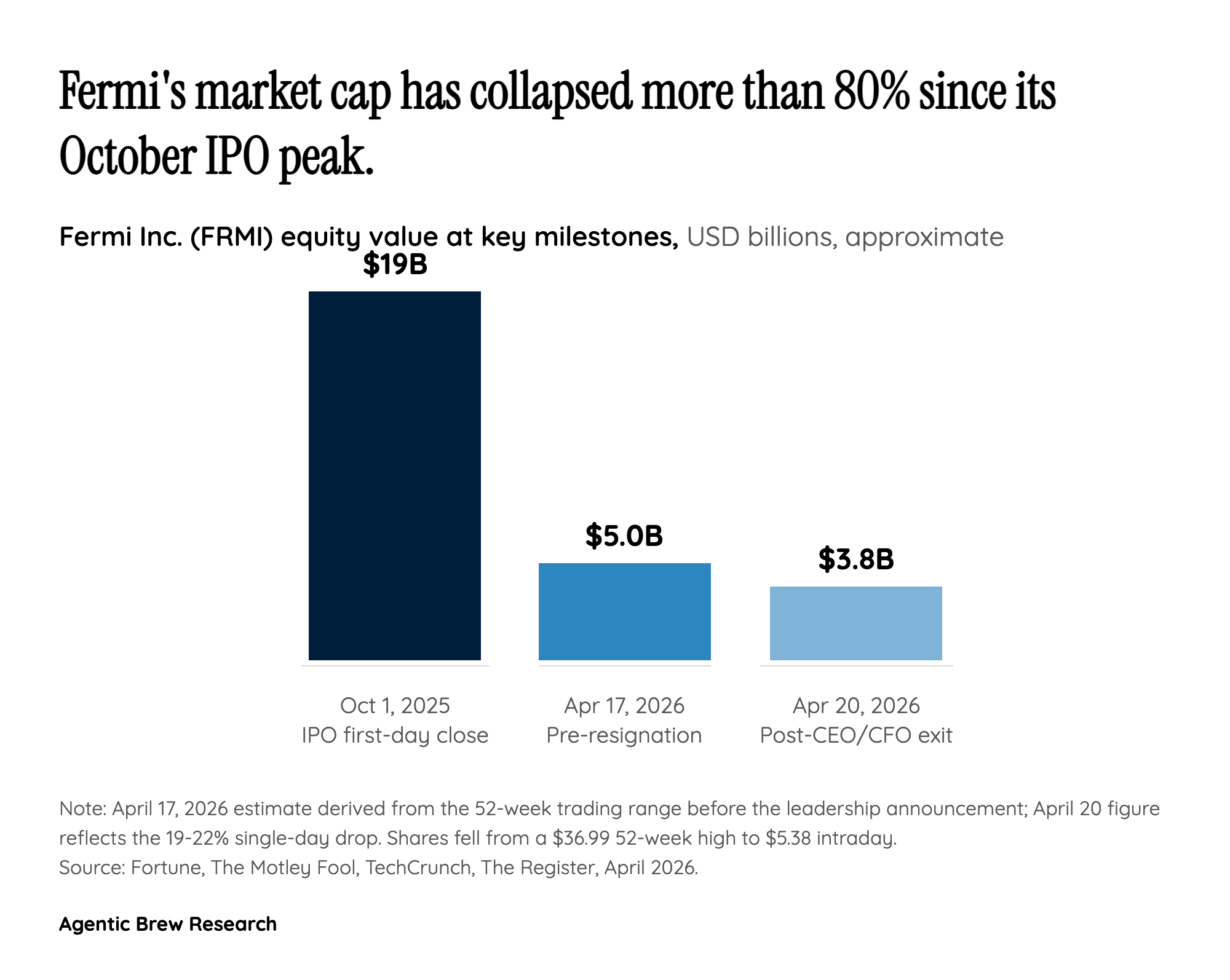
The cleanest way to read Fermi's leadership blowup is as a delayed-reaction event, not a surprise. The chain starts in September 2025, when a prospective hyperscaler signed a non-binding letter of intent to anchor Project Matador, the 5,236-acre AI campus on Texas Tech land near Amarillo. That LOI was the load-bearing asset behind Fermi's October IPO narrative: a REIT with zero revenue was priced at roughly $19 billion because the pitch was that a single marquee customer would validate the 11-17 GW buildout of nuclear, gas, solar and battery capacity over the coming decade.
The pitch broke on December 12, 2025, when that prospective tenant terminated its $150 million Advance in Aid of Construction agreement. The financial hole was immediate — Fermi now had to replace hard construction dollars it had assumed — but the more damaging effect was on Fermi's tenant-pipeline credibility. When the March 2026 deadline for locking in any anchor tenant passed without a replacement, the board's theory of the case (that Neugebauer could personally close a hyperscaler) was empirically falsified. The April 17 CEO exit and April 19 CFO exit are the governance consequence of four months in which the story-stock's underlying story failed to materialize. The 'Fermi 2.0' reset, the Dallas HQ move, the new independent chairman, the Office of the CEO, the retained search firm — every piece of the reshuffle is aimed at one job: convincing a hyperscaler that Fermi is now a normal counterparty.