Vercel Data Breach via Context.ai OAuth Compromise
TECH

Vercel Data Breach via Context.ai OAuth Compromise

31+
Signals

Strategic Overview

  • 01.
    Vercel disclosed on April 19, 2026 that attackers gained unauthorized access to certain internal systems by pivoting through Context.ai, a third-party AI Office Suite tool connected to an employee's Google Workspace via OAuth.
  • 02.
    A limited subset of customer non-sensitive environment variables was exposed; variables explicitly marked 'sensitive' in Vercel remained unreadable, and Vercel says Next.js, Turbopack, and its OSS pipelines were not compromised.
  • 03.
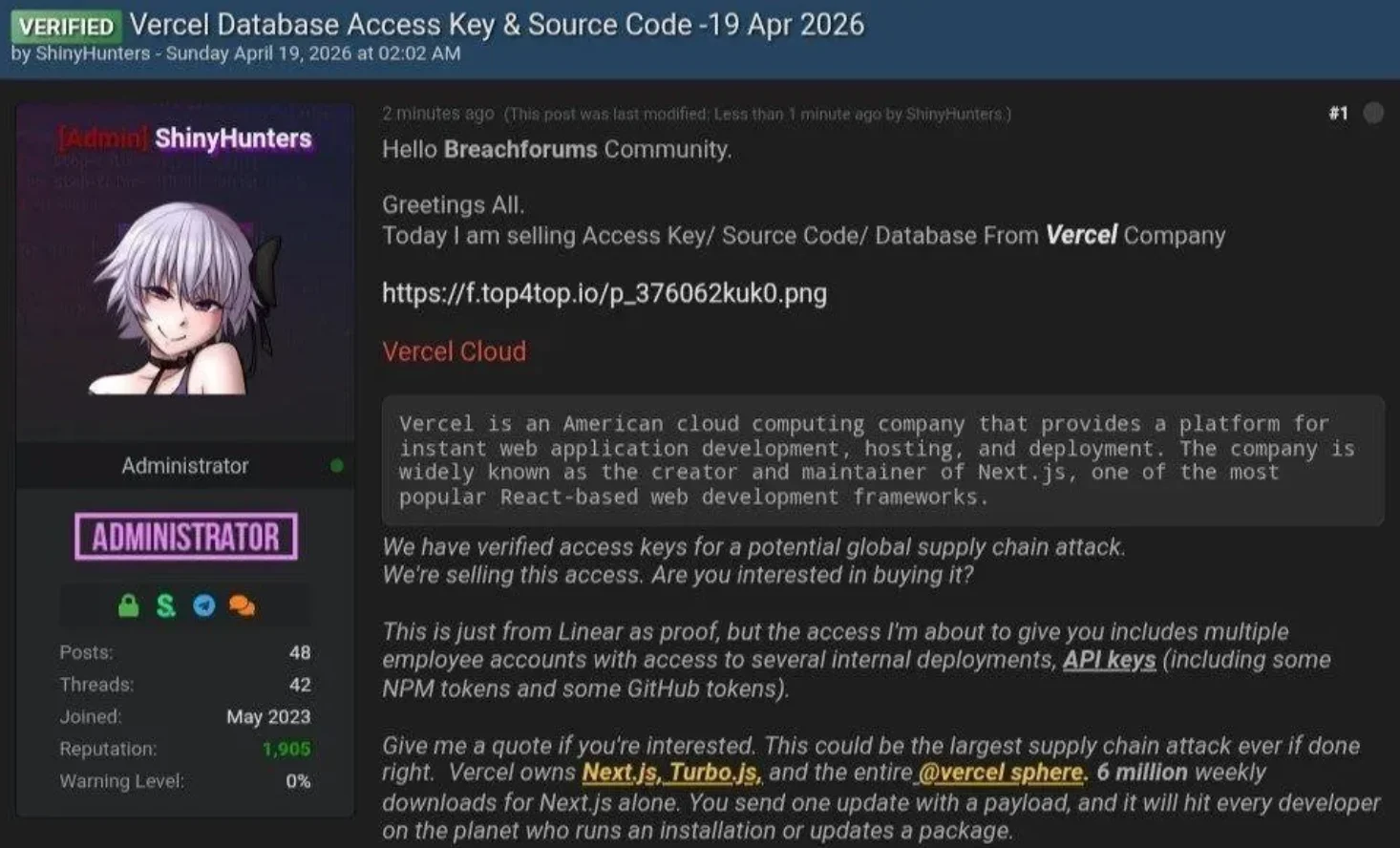
    A threat actor using the ShinyHunters persona advertised stolen data — including API keys, source code, NPM tokens, GitHub tokens, and employee accounts — on BreachForums with a $2 million ransom demand.
  • 04.
    Vercel engaged Mandiant and additional cybersecurity firms, notified affected customers, and urged them to rotate non-sensitive environment variables immediately.

A Roblox Cheat, a Stealer, and an OAuth Token: The Improbable Kill Chain

The most striking part of this incident isn't the $2 million ransom listing on BreachForums — it's how cheaply the attack started. In February 2026, according to Hudson Rock's forensic write-up surfaced by Infostealers.com, a Context.ai employee with sensitive access downloaded Roblox 'auto-farm' scripts onto a corporate laptop. The bundled Lumma infostealer did exactly what Lumma is built to do: it waited for real human mouse movement to evade sandbox detection, called Windows APIs directly to dodge EDR hooks, and then exfiltrated a carefully curated bundle of corporate secrets — Google Workspace cookies, Supabase keys, Datadog credentials, and Authkit tokens — in one pass.

From there, the pivot is a two-hop story that SaaS security has been warning about for three years. The attackers used stolen Context.ai credentials to reach Context.ai's AWS environment in March, and then leaned on the fact that Context.ai's AI Office Suite had been connected to a Vercel employee's Google Workspace via OAuth with broad consent. That OAuth trust relationship — explicitly made by an employee, with no malware on any Vercel machine — became the bridge into Vercel's internal environments, including Linear, GitHub, and the NPM/env-var surface. This is why Guillermo Rauch's public line that the attackers were 'significantly accelerated by AI' lands awkwardly in developer threads: the decisive step wasn't an AI exploit, it was a game cheat on a vendor laptop cashing in a standing OAuth grant.


The 'AI Attack' Rebrand Fight

The sharpest tension in the public reaction isn't whether Vercel mishandled disclosure — by all accounts it moved fast, named the third party, brought in Mandiant, and notified affected customers. The tension is over the naming. Rauch's framing of highly sophisticated, AI-accelerated attackers is doing real narrative work, and practitioners on Reddit are openly pushing back. One widely-upvoted comment summarized it as 'Advanced AI security threat is just C-suite speak for we didn't restrict our OAuth application permissions'; another argued the AI-attack label is 'rebranding legacy infostealer compromises' and that agents connected via SSO should be treated as high-risk users rather than trusted identities. Practitioners pinned the real finding on 'Allow All' OAuth scopes sitting unaudited in most organizations' Google Workspace app lists.

This matters beyond semantics. If the industry accepts 'AI attack' as the primary description, boards and budget cycles will gravitate toward AI-specific defensive tooling. If it accepts the counter-framing — a mundane OAuth-overscope supply-chain failure made expensive by AI's productivity boost on the offense side — the remediation work is cheaper, more boring, and actually effective: tighten OAuth consent screens, inventory third-party app grants, revoke broad-scope consumer AI tools, and treat any SSO-connected agentic app as an unmanaged identity. Gergely Orosz's adjacent skepticism about SOC2 audits rubber-stamping AI vendors like Context.ai sharpens the same point: the compliance surface and the real attack surface have drifted apart.

Why Crypto Frontends Went Into Panic Mode First

Vercel's blast radius is asymmetric. For most SaaS customers a rotation of non-sensitive environment variables is an irritating afternoon; for DeFi and Web3 frontends it's an immediate security incident, because the frontend is often the last untrusted rendering layer between a user and an on-chain transaction. That's why CoinDesk and Dataconomy led with crypto developers 'scrambling to lock down API keys' rather than with Vercel's bulletin itself, and why Binance and Orca issued explicit statements within hours — Binance confirming that 'platform and user assets were not impacted' and Orca noting its on-chain protocol was unaffected. Neither statement is remarkable on its own; together they establish a crypto-sector playbook for a Vercel-scale supply-chain incident in real time.

The practical pressure point for Web3 teams is that Vercel environment variables routinely hold RPC keys, wallet-connect credentials, block-explorer API tokens, and analytics secrets — material that an attacker doesn't need to steal funds directly but can use to surveil, redirect, or front-run. A single leaked Alchemy or Infura key can be abused within hours. The reason Web3 Twitter absorbed this story faster than the mainstream security beat is that the mental model — 'treat a cloud-hosted frontend as part of your threat surface' — is already native to the crypto operations playbook. Next.js's roughly 6 million weekly downloads amplify the fear one layer further: even teams not hosted on Vercel are asking whether any malicious code slipped into the framework itself, a concern Vercel has so far said its supply-chain analysis did not surface.

The Default That Made Exposure Worse Than It Had To Be

The quietly damning technical finding, flagged by Security Boulevard and echoed in the Vercel bulletin, is that Vercel's 'sensitive' flag on environment variables is off by default. Variables explicitly marked sensitive were stored in a form the attackers could not read; everything else — DATABASE_URL, generic API_KEY, third-party service tokens added without toggling the flag — sat in a state that allowed exfiltration once internal access was achieved. In practice, many teams add env vars from the CLI or the UI without touching that toggle, which means the effective default on the platform is 'readable once the perimeter is breached.'

This is the kind of design choice that rarely matters until it suddenly defines the headline. The bulletin's remediation guidance — rotate non-sensitive variables and consider promoting them to sensitive — is a reasonable response, but it also puts the onus back on every customer to correct a default. Expect platform-level pressure over the next few weeks to flip that default, or at minimum to prompt on creation: the cybersecurity community's critique that Vercel's post-mortem says more about what customers should do than what Vercel itself is changing internally captured the critique exactly. A breach narrative that ends with 'rotate your keys' without a corresponding 'and here's how we changed the platform' tends not to age well.

What's Actually New Here: Agentic SaaS as an Unmanaged Identity Class

Strip away the ransom drama and the attack-chain storytelling and the durable lesson of this incident is structural. Agentic AI tools — Context.ai-style Office Suites, meeting copilots, inbox summarizers — are being connected to corporate Google Workspace and Microsoft 365 accounts at volume, usually by individual employees using self-service OAuth consent. Each of those grants creates a persistent, high-scope identity that is invisible to traditional IAM, not covered by endpoint security, and governed by the third party's own security posture. Context.ai's compromise wasn't novel technically; what was novel was that the compromise of a consumer-facing AI vendor translated, via standing OAuth tokens, into internal access at a Fortune-adjacent infrastructure company, with no malware ever touching Vercel's fleet.

The second-order read, visible in both the Security Boulevard coverage and community discussion, is that AI SaaS vendors need to be treated the way early cloud apps were treated fifteen years ago: inventoried, gated behind admin-level consent screens, scope-restricted, and periodically re-authenticated. Vercel is the named victim this week; the structural exposure sits across every organization that has not audited its Google Workspace authorized apps list in the last quarter.

Historical Context

2026-02
A Context.ai employee with sensitive access downloaded Roblox 'auto-farm' scripts onto a corporate laptop, triggering a Lumma infostealer infection that harvested Google Workspace, Supabase, Datadog, and Authkit credentials.
2026-03
Context.ai detected and blocked unauthorized access to its AWS environment tied to the stolen credentials, but the broader OAuth-token blast radius into downstream customers was not yet scoped.
2026-04-19
Vercel published its April 2026 security incident bulletin disclosing unauthorized access to internal systems and a limited exposure of customer non-sensitive environment variables.
2026-04-20
CEO Guillermo Rauch publicly named Context.ai as the entry point, announced Mandiant as incident responder, and urged affected customers to rotate credentials while a ShinyHunters-branded actor listed stolen data on BreachForums for $2 million.

Power Map

Key Players
Subject

Vercel Data Breach via Context.ai OAuth Compromise

VE

Vercel

The breached frontend hosting platform hosting thousands of production apps, including high-traffic Web3 frontends. Its disclosure, customer notifications, and forensic response set the timeline the rest of the ecosystem reacts to.

CO

Context.ai

Third-party AI Office Suite vendor that was the actual entry point. A Lumma stealer infection on one of its employees' laptops harvested corporate credentials and enabled the OAuth-based pivot into Vercel.

GU

Guillermo Rauch (Vercel CEO)

Owns the public narrative, naming Context.ai as the source and explicitly framing the attacker group as AI-accelerated. His messaging is setting the industry's shorthand for the incident.

MA

Mandiant (Google)

Incident response partner leading forensic investigation. Its eventual technical write-up will likely define how the industry categorizes OAuth-pivot breaches going forward.

SH

ShinyHunters persona

The identity claiming responsibility on BreachForums and listing stolen material for $2 million. Their monetization attempt, and the reported denial by ShinyHunters-linked actors, is what converts the breach from internal incident into industry-wide supply-chain panic.

CR

Crypto/Web3 projects (Binance, Orca)

Major Vercel-hosted customers whose emergency key rotations define the blast radius. Their statements that on-chain protocols and user funds remained safe are containing a second-order panic in DeFi.

THE SIGNAL.

Analysts

"Rauch framed the attackers as unusually capable and laid part of the blame on AI tooling: 'We believe the attacking group to be highly sophisticated and, I strongly suspect, significantly accelerated by AI.'"

Guillermo Rauch
CEO, Vercel

"In its bulletin, Vercel attributed the sophistication to operational tempo and insider-grade familiarity: 'We assess the attacker as highly sophisticated based on their operational velocity and detailed understanding of Vercel's systems.'"

Vercel Security Team
Incident response, Vercel

"Context.ai acknowledged the root-cause vector in limited terms, stating attackers 'likely compromised OAuth tokens for some of our consumer users' — a framing that pushes enterprise exposure into the background."

Context.ai
Third-party AI vendor

"Binance publicly moved to reassure users that its exchange was unaffected by the supply-chain exposure, stating 'platform and user assets were not impacted' after an internal review."

Binance Security Team
Binance
The Crowd

"Here's my update to the broader community about the ongoing incident investigation. I want to give you the rundown of the situation directly. A Vercel employee got compromised via the breach of an AI platform customer called Context.ai that he was using. The details are being fully investigated."

@@rauchg6700

"App host Vercel says it was hacked and customer data stolen. App host Vercel confirms security incident, says customer data was stolen via breach at Context AI..."

@@TechCrunch12000

"Guillermo Rauch just confirmed how it happened: -> A Vercel employee used an AI tool called Context AI -> Context AI got breached -> Attackers pivoted into his Google Workspace -> Then into Vercel's internal environments -> Now they're selling DB + NPM + GitHub tokens for $2M"

@@Star_Knight121200

"Vercel just got hacked and it raises a bigger question about AI and security"

@u/Consistent-Paper756976
Broadcast
Your website is not secure anymore | VERCEL Got Hacked

Your website is not secure anymore | VERCEL Got Hacked

Vercel has been breached - Credentials exposed in huge hack!

Vercel has been breached - Credentials exposed in huge hack!

Goodbye Vercel was Hacked! 6 Million Next.js Apps On The Brink

Goodbye Vercel was Hacked! 6 Million Next.js Apps On The Brink