Meta Launches Muse Spark, Its First Closed-Source Frontier AI Model
TECH

Meta Launches Muse Spark, Its First Closed-Source Frontier AI Model

29+
Signals

Strategic Overview

  • 01.
    Meta launched Muse Spark on April 8, 2026, its first AI model from Meta Superintelligence Labs, led by new Chief AI Officer Alexandr Wang. Originally code-named Avocado, the natively multimodal model supports tool-use, visual chain of thought, and multi-agent orchestration across three reasoning modes: Instant, Thinking, and Contemplating.
  • 02.
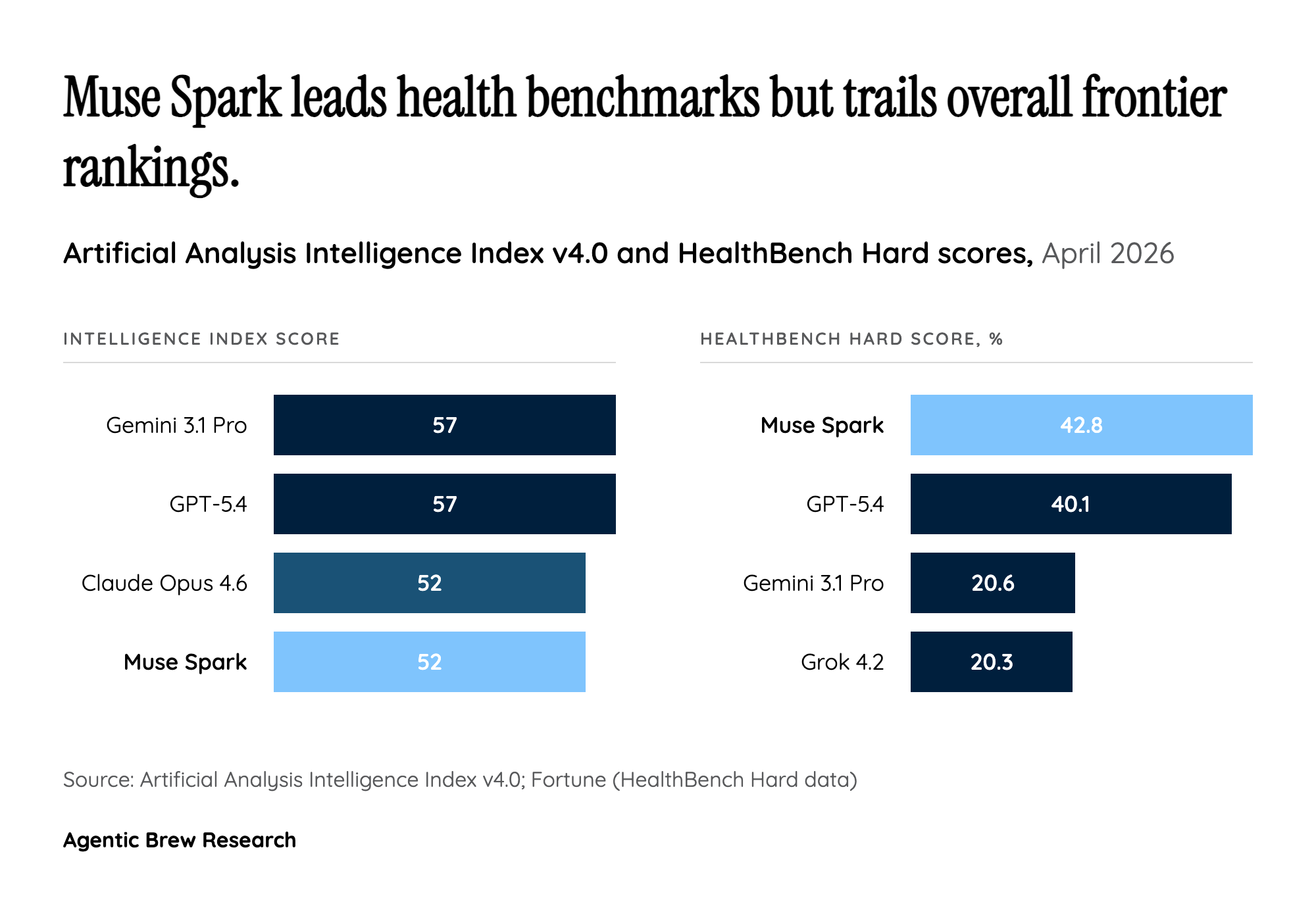
    Muse Spark scores 52 on the Artificial Analysis Intelligence Index v4.0, placing it fourth globally behind Gemini 3.1 Pro Preview, GPT-5.4, and Claude Opus 4.6. It leads all frontier models on health and medical benchmarks with a HealthBench Hard score of 42.8%, and achieves 58% on Humanity's Last Exam in Contemplating mode.
  • 03.
    In a sharp departure from Meta's open-weight Llama series, Muse Spark is proprietary and closed-source. Meta says it hopes to open-source future versions but has not committed to a timeline. The model is free on meta.ai and the Meta AI app, with rollout to WhatsApp, Instagram, Facebook, Messenger, and Meta Ray-Ban AI glasses.
  • 04.
    Wall Street responded enthusiastically, with Meta stock surging approximately 6.5% to $612.42 on launch day, adding roughly $111 billion to its market cap. Analysts across Morgan Stanley, Bank of America, JPMorgan, and Piper Sandler issued positive commentary, with a consensus of 39 Buy ratings and an average price target of $847.70.

From Open Weights to Closed Source: Why Meta Abandoned Its AI Identity

For the past three years, Meta positioned itself as the champion of open-source AI. The Llama model family became the backbone of thousands of startups, research projects, and enterprise deployments. Meta used open weights as a strategic weapon against OpenAI and Google, arguing that commoditizing model intelligence would shift value to the platforms where Meta dominates. Muse Spark abandons that playbook entirely.

The shift is not merely philosophical. It reflects a hard-nosed calculation that open-sourcing frontier models was costing Meta competitive advantage without sufficient return. After Llama 4 landed poorly in April 2025, the internal assessment appears to have been that releasing weights was giving rivals free training signal while Meta itself struggled to keep pace. By going closed-source, Meta can now monetize API access, control the deployment surface, and protect the architectural innovations that Alexandr Wang's team developed from scratch. Meta says it hopes to open-source future versions but has conspicuously avoided any commitment or timeline, suggesting the default path is now proprietary.

The community reaction has been swift and polarized. On X, excitement dominated among AI practitioners who see a newly competitive Meta. But in communities like r/LocalLLaMA, the sentiment runs toward betrayal. These developers built workflows, fine-tuned models, and evangelized Meta's approach precisely because of open weights. Meta's vague open-source promises read to them as corporate hedging rather than genuine intent. The tension between Wall Street's enthusiasm and the open-source community's anger captures a fundamental question: can Meta serve both constituencies, or has it chosen a side?
The $14.3 Billion Bet: How Alexandr Wang Rebuilt Meta's AI in Nine Months

The Muse Spark story is inseparable from the Alexandr Wang story. In June 2025, Meta paid $14.3 billion for a 49% nonvoting stake in Scale AI, a deal structured primarily to install Wang as Meta's first-ever Chief AI Officer. Mark Zuckerberg was reportedly unhappy with Llama's trajectory and wanted someone who could execute a ground-up rebuild. Wang, who had built Scale AI into the dominant data-labeling company powering most frontier AI labs, was given extraordinary latitude: a new organization (Meta Superintelligence Labs), a blank-sheet architecture mandate, and nine months to deliver.

What Wang's team achieved in that timeframe is notable for its efficiency claims. According to Meta, the rebuilt pretraining stack achieves the same capabilities with over an order of magnitude less compute than Llama 4 Maverick. If this claim holds under independent scrutiny, it represents one of the largest efficiency gains in frontier AI development. The implication is that Meta's previous training infrastructure was severely suboptimal, and that the problem was not compute budget but engineering execution. This reframes the narrative: Meta did not need more GPUs to compete; it needed better architecture and data pipelines.

The Scale AI deal also gives Meta something less visible but potentially more valuable: deep integration with the company that manages training data for much of the industry. While the 49% stake is nonvoting, the personnel and knowledge transfer is bidirectional. Wang brought not just his own expertise but a network of relationships and operational playbooks honed across engagements with OpenAI, Google, and Anthropic. Whether this creates conflicts of interest or competitive advantages will play out over the coming year.

Fourth Place Is the New First Place: What Muse Spark's Benchmarks Actually Tell Us

Fourth Place Is the New First Place: What Muse Spark's Benchmarks Actually Tell Us
Muse Spark ranks 4th on the Intelligence Index but leads all frontier models on HealthBench Hard

Muse Spark ranks fourth on the Artificial Analysis Intelligence Index with a score of 52, behind Gemini 3.1 Pro Preview, GPT-5.4, and Claude Opus 4.6. On headline benchmarks like GPQA Diamond (89.5% vs Gemini's 94.3%) and MMMU-Pro vision (80.5% vs Gemini's 82.4%), it trails the leaders by meaningful margins. Yet the market reacted as though Meta had released the world's best model. The disconnect reveals how low expectations had fallen after Llama 4.

The benchmark picture is more nuanced than the overall ranking suggests. Muse Spark leads all frontier models on HealthBench Hard with a score of 42.8%, significantly outperforming GPT-5.4 at 40.1% and dramatically ahead of Gemini 3.1 Pro at 20.6% and Grok 4.2 at 20.3%. This domain-specific dominance in health and medical reasoning could be strategically significant given Meta's massive user base accessing AI through WhatsApp and Instagram, particularly in markets where healthcare access is limited. The Contemplating mode, which orchestrates multiple agents reasoning in parallel, achieves 58% on Humanity's Last Exam and 38% on FrontierScience Research, competitive numbers for what is essentially Meta's first serious attempt at a reasoning system.

The benchmark trust question looms large, however. After Llama 4 faced allegations of benchmark gaming, every Muse Spark number will face extra scrutiny from the research community. Artificial Analysis's independent assessment lending credibility helps, but the real test will be sustained real-world usage. The fact that the model is freely available on meta.ai means millions of users will stress-test it in ways no benchmark can capture. For Meta, the risk is not that Muse Spark is bad, but that the gap between fourth and first proves stubbornly persistent across successive releases.

The Compute Efficiency Angle Wall Street Is Underpricing

Buried beneath the benchmark headlines is perhaps the most consequential claim in Meta's announcement: Muse Spark achieves the same capabilities as Llama 4 Maverick with over ten times less compute. If validated, this efficiency gain has implications that extend far beyond a single model release. Meta has signaled potential capital expenditure of $72 billion on AI infrastructure. If its new training stack can produce frontier-competitive models at a fraction of the compute cost, the return on that infrastructure investment improves dramatically.

This efficiency story also changes the competitive dynamics. The prevailing narrative in AI has been that scale wins: whoever has the most GPUs trains the best models. Meta's claim suggests that architectural innovation and data pipeline quality can substitute for raw compute at a surprisingly favorable ratio. This is consistent with broader industry trends, where techniques like mixture-of-experts, improved tokenization, and better data curation have repeatedly shown that smart engineering can outperform brute-force scaling. But a claimed order-of-magnitude improvement in a single generation is unusually large.

For investors, the efficiency claim matters because it addresses the central bear case against Meta's AI spending: that tens of billions in capex would produce models that remain uncompetitive. Morgan Stanley's Brian Nowak calling Muse Spark 'the first step in re-rating META' and JPMorgan's Doug Anmuth citing 'increased confidence in Meta's scaling trajectory' both point to this efficiency narrative as the key unlock. If Meta can iterate at lower cost while maintaining competitive quality, the $72 billion capex figure transforms from a risk factor into a moat. The 39 Buy ratings and $847.70 average price target suggest Wall Street is beginning to price this in, but the full implications of a structurally more efficient training pipeline may not yet be reflected in consensus estimates.

Historical Context

April 2025
Released Llama 4, which was widely panned as a disappointment and raised concerns about Meta's AI competitiveness.
June 2025
Meta acquired a 49% nonvoting stake in Scale AI for $14.3 billion and hired Alexandr Wang as its first Chief AI Officer to lead the newly formed Meta Superintelligence Labs.
March 2026
Created a new applied AI engineering organization under Maher Saba, further restructuring its AI operations ahead of the Muse Spark launch.
April 8, 2026
Launched Muse Spark as MSL's first model, a closed-source multimodal reasoning system ranking 4th on global intelligence benchmarks, with free access on Meta platforms and API access in private preview.

Power Map

Key Players
Subject

Meta Launches Muse Spark, Its First Closed-Source Frontier AI Model

ME

Meta Platforms

Developer and launcher of Muse Spark. Stock surged ~6.5% on launch day, adding approximately $111B to market cap, reaching $1.59T total valuation.

AL

Alexandr Wang

Meta's first-ever Chief AI Officer and head of Meta Superintelligence Labs. Former Scale AI CEO, brought to Meta via the $14.3B Scale AI acquisition in June 2025. Led the nine-month development of Muse Spark.

MA

Mark Zuckerberg

Meta CEO who was reportedly unhappy with Llama progress and initiated the organizational restructuring that led to MSL's creation and the Scale AI acquisition.

OP

OpenAI, Google, and Anthropic

Primary competitors whose models (GPT-5.4, Gemini 3.1 Pro, Claude Opus 4.6) still lead Muse Spark on the overall Intelligence Index, though Muse Spark is competitive and leads in specific domains like health benchmarks.

OP

Open-Source AI Community

Previously a key Meta constituency through the Llama series. Reports indicate negative and mixed sentiment, particularly in communities like r/LocalLLaMA, over Meta's shift to closed-source with Muse Spark.

THE SIGNAL.

Analysts

"Called Muse Spark 'the first step in re-rating META,' noting that benchmark performance exceeded investor fears following the Llama 4 disappointment."

Brian Nowak
Analyst, Morgan Stanley

"Stated that 'the launch of Muse Spark should provide increased confidence in Meta's scaling trajectory and improve investor sentiment.'"

Doug Anmuth
Analyst, JPMorgan

"Scored Muse Spark at 52 on the Intelligence Index v4.0, ranking it 4th globally, and commented that 'Muse Spark essentially closes the gap between to the frontier in a single release.'"

Artificial Analysis
Independent AI benchmarking organization

"Reiterated a Buy rating with an $880 price target, calling Meta his 'top large-cap pick' following the Muse Spark reveal."

Thomas Champion
Analyst, Piper Sandler
The Crowd

"1/ today we're releasing muse spark, the first model from MSL. nine months ago we rebuilt our ai stack from scratch. new infrastructure, new architecture, new data pipelines. muse spark is the result of that work, and now it powers meta ai."

@@alexandr_wang0

"Meta is back! Muse Spark scores 52 on the Artificial Analysis Intelligence Index, behind only Gemini 3.1 Pro, GPT-5.4, and Claude Opus 4.6. Muse Spark is the first new release since Llama 4 in April 2025 and also Meta's first release that is not open weights."

@@ArtificialAnlys0

"Our first model from MSL, Muse Spark, is now available on meta.ai! This is an efficient all-rounder model. It supports fast responses, deeper thinking, visual chain of thought, a higher inference Contemplating mode. Plus, it's natively multimodal."

@@jack_w_rae0
Broadcast
Why Meta's New AI Model Is Such A Big Deal

Why Meta's New AI Model Is Such A Big Deal

Meta AI Muse Spark Is HERE - Testing Meta's New Frontier Model!

Meta AI Muse Spark Is HERE - Testing Meta's New Frontier Model!

Meta's NEW Llama Replacement - Muse Spark

Meta's NEW Llama Replacement - Muse Spark