
Mistral AI secures $830 million debt financing for European data centers
TECH

Mistral AI secures $830 million debt financing for European data centers

28+
Signals

Strategic Overview

  • 01.
    Mistral AI has raised $830 million (approximately €722 million) in its first-ever debt financing from a consortium of seven banks, marking a strategic shift toward owning its own AI infrastructure rather than relying on US cloud providers like Microsoft Azure, Google Cloud, and CoreWeave.
  • 02.
    The funds will purchase 13,800 Nvidia GB300 GPUs using Grace Blackwell architecture to power a 44 MW data center at Bruyères-le-Châtel south of Paris, expected to go live in Q2 2026, with a second 23 MW facility planned in Sweden.
  • 03.
    Mistral aims to reach 200 MW of AI computing capacity across Europe by end of 2027, with a total long-term infrastructure budget of €4 billion, as the company's annual recurring revenue surged 20x from $20 million to $400 million.

Deep Analysis

Why This Matters

Mistral AI's decision to raise $830 million in debt financing — its first-ever debt raise since the company was founded in April 2023 — signals a fundamental strategic pivot. Rather than continuing to rent compute from US cloud providers like Microsoft Azure, the company is now building its own sovereign GPU infrastructure on European soil. This is not merely a cost optimization play; it reflects a growing conviction among European AI companies that control over physical infrastructure is a prerequisite for genuine technological independence.

The timing is deliberate. Europe's AI sector has seen a surge of large-scale capital deployment in 2026, with competitors like Nscale raising $2 billion, Wayve securing $1.2 billion, and AMI Labs closing $1 billion. Mistral, which has now raised over $3 billion in total equity alongside this new debt facility, is positioning itself at the center of a broader European push to build AI capacity that does not depend on American hyperscalers. CEO Arthur Mensch's framing is explicit: "Scaling our infrastructure in Europe is critical to empower our customers and to ensure AI innovation and autonomy remain at the heart of Europe." For a company that derives over 50% of its revenue from European customers, owning the compute layer is both a competitive moat and a political statement.
How It Works

The debt financing was structured as a consortium loan from seven banks, including Bpifrance (the French state investment bank) and BNP Paribas. Debt financing, as opposed to equity, allows Mistral to fund capital-intensive infrastructure without further diluting existing shareholders — a meaningful consideration for a company valued at €11.7 billion ($13.8 billion) after its Series C. The debt is secured against the tangible asset being purchased: 13,800 Nvidia GB300 GPUs based on the Grace Blackwell architecture, which will be deployed at a data center in Bruyères-le-Châtel, south of Paris.

The Paris facility will deliver 44 MW of computing capacity, with operations expected to begin in Q2 2026. A second facility in Sweden, announced in February 2026 as part of a €1.2 billion digital infrastructure investment with EcoDataCenter, will add 23 MW of capacity and is projected to generate €2 billion in revenue over five years. Together, these form the first phase of Mistral's plan to reach 200 MW of AI computing capacity across Europe by end of 2027, within a long-term infrastructure budget of €4 billion. The involvement of Nvidia extends beyond GPU supply — Nvidia, alongside MGX (Abu Dhabi's $100 billion AI investment fund) and Bpifrance, co-announced plans for a 1.4 GW AI campus near Paris, suggesting Mistral's data centers will sit within a much larger ecosystem of European AI infrastructure.

By The Numbers

By The Numbers
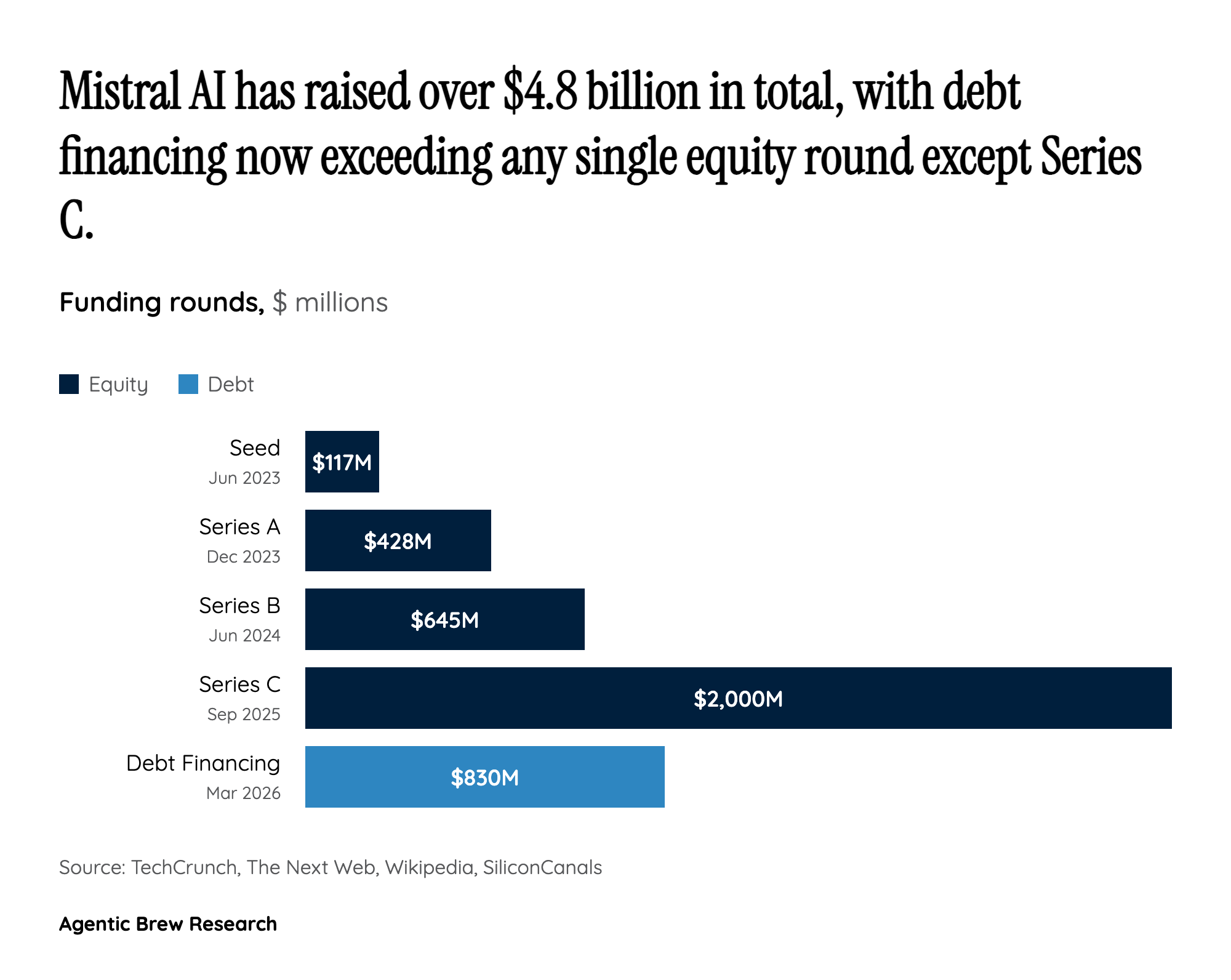
Mistral AI funding rounds from seed through debt financing, showing the scale of the $830M debt raise relative to equity rounds

The financial trajectory of Mistral AI tells a story of extraordinary acceleration. The company's annual recurring revenue (ARR) has surged 20x, from $20 million to $400 million, with a target of reaching $1 billion ARR by the end of 2026. This growth has been fueled by a workforce of approximately 860 employees — still lean by the standards of its American competitors.

On the infrastructure side, the numbers are equally striking. The $830 million (€722 million) debt facility purchases 13,800 Nvidia GB300 GPUs for a single 44 MW data center. The Sweden facility adds 23 MW, and the combined European target is 200 MW by end of 2027. The total infrastructure budget of €4 billion dwarfs the debt raise itself, suggesting additional financing rounds are on the horizon. For context, Mistral's total equity raised now exceeds $3 billion across seed ($117M), Series A ($428M), Series B ($645M), and Series C ($2B), with the company valued at €11.7 billion ($13.8 billion) at its last round.

Impacts and What Is Next

The most immediate impact is a meaningful step toward European AI compute independence. Mistral is building infrastructure that allows European enterprises and governments to run AI workloads on European-owned hardware in European data centers. This addresses growing data sovereignty concerns and regulatory requirements across the EU.

However, a notable tension persists: while Mistral is building European-owned data centers, the infrastructure still relies entirely on American-made Nvidia GPUs. True hardware sovereignty remains elusive for Europe. Additionally, taking on $830 million in debt is a significant financial commitment for a company founded just three years ago, creating pressure to convert its infrastructure investments into sustained revenue growth. Recent infrastructure incidents at competitors like DeepSeek have underscored why owning and controlling compute infrastructure matters, potentially validating Mistral's strategy.

The Bigger Picture

Mistral's $830 million debt raise is best understood not as a single financing event but as the latest move in a continental chess match over who controls the infrastructure layer of the AI stack. In 2026, European AI companies have collectively raised billions — Nscale ($2B), Wayve ($1.2B), AMI Labs ($1B) — in what amounts to a coordinated, if unplanned, effort to build sovereign compute capacity. Mistral, with its €4 billion long-term infrastructure budget and 200 MW target, is arguably the most ambitious of these players, backed by a unique coalition of French state capital (Bpifrance), European banking (BNP Paribas), and sovereign wealth (MGX).

The strategic logic is clear: as long as European AI companies rent compute from American hyperscalers, they remain vulnerable to pricing shifts, policy changes, and geopolitical friction. By owning the GPU layer — 13,800 Nvidia GB300 chips on Grace Blackwell architecture in the Paris facility alone — Mistral is building a physical moat that complements its model development capabilities. The fact that over 50% of Mistral's revenue already comes from Europe suggests the demand signal is real, not aspirational.

Early social media reaction to the news has been positive but measured, consistent with a breaking financial story. On X.com, @CNBC posted "Mistral secures $830 million in debt financing to fund AI data center" (43 likes, 13 retweets), while @WSJTech highlighted the Nvidia angle with "Mistral AI Raises $830 Million in Debt For Nvidia-Powered Data Center" (790 views). Independent commentator @AndrewCurran_ noted simply that "Mistral has secured $830 million in debt financing for their datacenter" (58 likes). Sentiment across these posts was positive to neutral, with no notable criticism or skepticism surfacing in the initial wave. YouTube and Reddit coverage has not yet materialized, which is typical for breaking financial news that has not yet had time to generate longer-form analysis or community discussion.

Whether this sovereign infrastructure bet pays off depends on execution: can Mistral bring 200 MW online by 2027, convert that capacity into $1 billion ARR, and do so while servicing over $800 million in debt? The next 18 months will be decisive — not just for Mistral, but for the broader question of whether Europe can build a self-sustaining AI ecosystem or remain a customer of American platforms.

Historical Context

2023-04-01
Founded in Paris by Arthur Mensch (ex-Google DeepMind), Guillaume Lample (ex-Meta), and Timothée Lacroix (ex-Meta).
2023-06-13
Raised €105 million ($117 million) in seed funding — the largest seed round in European history — at a €240 million valuation.
2023-12-10
Raised €385 million ($428 million) in Series A from Andreessen Horowitz, BNP Paribas, and Salesforce, reaching a $2 billion valuation.
2024-06-11
Secured €600 million ($645 million) in Series B, increasing valuation to €5.8 billion ($6.2 billion).
2025-09-09
Closed €1.7 billion ($2 billion) Series C led by ASML at €11.7 billion ($13.8 billion) valuation.
2026-02-11
Announced €1.2 billion ($1.43 billion) investment into digital infrastructure in Sweden, partnering with EcoDataCenter.
2026-03-30
Secured $830 million (€722 million) in first-ever debt financing from seven banks for Paris-area data center with 13,800 Nvidia GB300 GPUs.

Power Map

Key Players
Subject

Mistral AI secures $830 million debt financing for European data centers

MI

Mistral AI

Paris-based AI startup and borrower building European-sovereign AI infrastructure to compete with OpenAI, Anthropic, and US hyperscalers.

AR

Arthur Mensch

CEO and co-founder of Mistral AI (formerly Google DeepMind); framed the investment in terms of European AI sovereignty and autonomy.

BP

Bpifrance

French state investment bank and one of seven lenders in the consortium; provides government-backed support for French tech sovereignty.

BN

BNP Paribas

Major European bank and consortium member; previously invested in Mistral's Series A round.

NV

Nvidia

GPU supplier providing 13,800 GB300 chips using Grace Blackwell architecture; also co-announced a 1.4 GW AI campus near Paris with MGX and Bpifrance.

MG

MGX (Abu Dhabi)

Abu Dhabi's $100 billion AI investment fund; jointly announced plans with Bpifrance, Nvidia, and Mistral for a 1.4 GW AI campus near Paris.

THE SIGNAL.

Analysts

"Mensch framed the investment as essential for European AI sovereignty, stating: "Scaling our infrastructure in Europe is critical to empower our customers and to ensure AI innovation and autonomy remain at the heart of Europe." He emphasized that infrastructure must be European-controlled to ensure innovation autonomy independent of US cloud providers."

Arthur Mensch
CEO and Co-founder, Mistral AI
The Crowd

"Mistral secures $830 million in debt financing to fund AI data center"

@@CNBC43

"Mistral AI Raises $830 Million in Debt For Nvidia-Powered Data Center"

@@WSJTech0

"Mistral has secured $830 million in debt financing for their datacenter."

@@AndrewCurran_58
Broadcast