OpenAI confidential IPO filing targeting September 2026
TECH

OpenAI confidential IPO filing targeting September 2026

40+
Signals

Strategic Overview

  • 01.
    OpenAI has engaged Goldman Sachs and Morgan Stanley to confidentially file IPO paperwork with the SEC as early as Friday, May 22, 2026, targeting a public debut in September 2026 at a valuation that could exceed $1 trillion.
  • 02.
    The timing follows a federal court dismissing Elon Musk's lawsuit against OpenAI and Sam Altman on May 18, 2026, on statute-of-limitations grounds — clearing the largest legal overhang on the for-profit conversion.
  • 03.
    OpenAI was last valued at $852B post-money in its March 2026 $122B primary round, while Forge Markets secondary indications pushed implied value near $880-906B at $735/share on April 24, 2026. The company has raised roughly $180B in total funding to date.
  • 04.
    OpenAI runs at roughly $25B annualized revenue and over 900 million weekly ChatGPT users, but is projected to lose $14B in 2026 on ~$18B revenue at ~33% gross margins, with cash-flow break-even not expected before 2029.
  • 05.
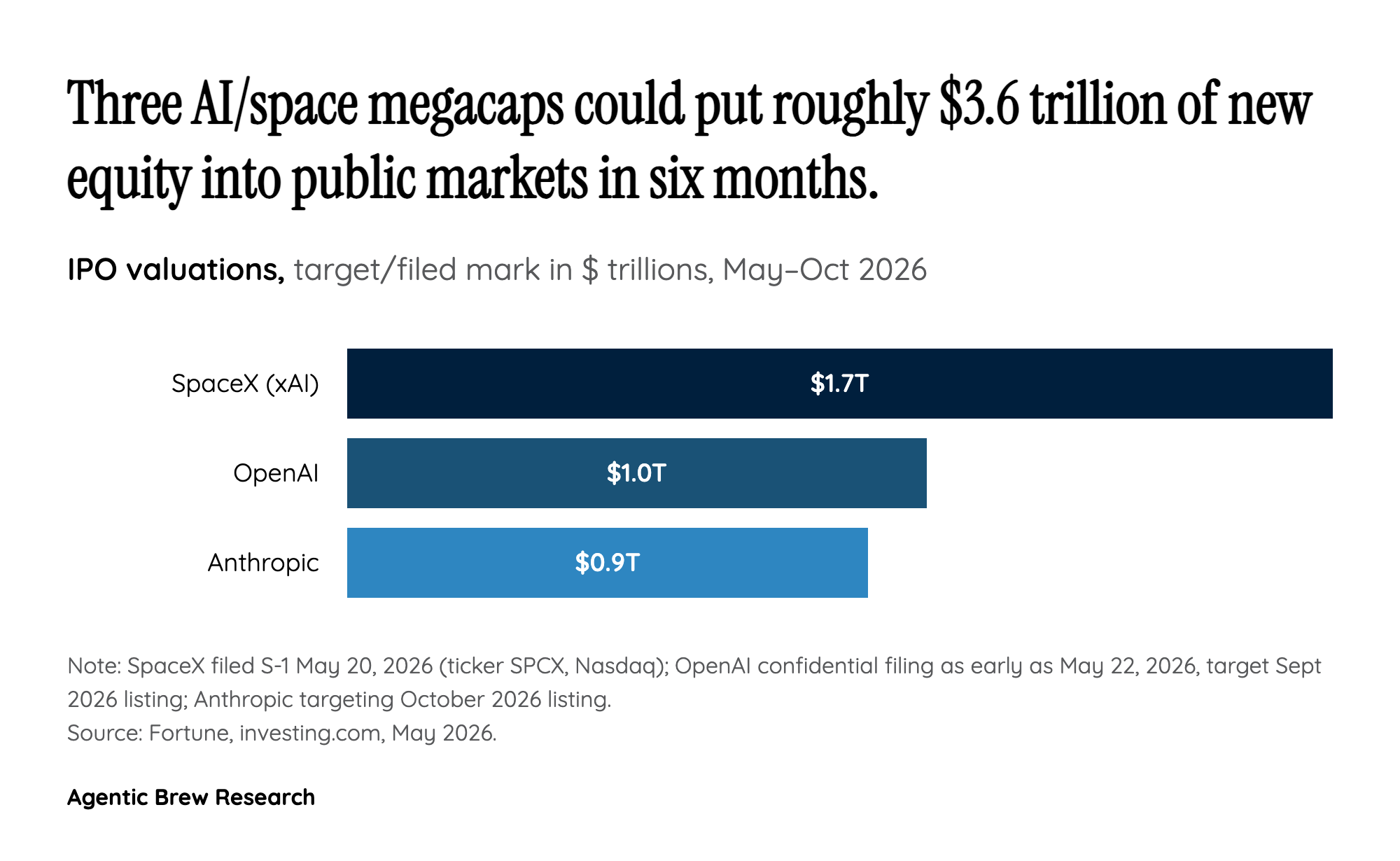
    The filing kicks off a three-way AI IPO sprint: SpaceX (merged with xAI) filed publicly on May 20 seeking $80B at $1.7T, and Anthropic is targeting October 2026 at roughly $900B.

The CEO/CFO timing split is the most important pre-IPO story

Inside OpenAI, the IPO has become a public disagreement between the CEO and the CFO. Sam Altman is pushing for a September 2026 debut [1]; CFO Sarah Friar is reportedly arguing that 2027 is the realistic window, citing public-company-readiness gaps and a yawning mismatch between revenue and OpenAI's roughly $600B in five-year compute and semiconductor spending commitments [2]. Friar's own public characterization of demand — 'going up a vertical wall' — is exactly the kind of language that sounds bullish in a keynote and reads as risk-factor language in an S-1 [2]. PitchBook senior analyst Harrison Rolfes goes further, calling the Q4 2026 target 'overly ambitious' and pegging the realistic window at mid-to-late 2027 because the company still has not demonstrated a credible path to profitability [3]. The reason this split matters for investors: the IPO filing is being engineered around Altman's calendar, not Friar's — and the gap between the two timelines is the gap between selling growth and selling unit economics.

The trillion-dollar valuation math: $852B last mark, 75x sales, $14B in losses

OpenAI's last primary round closed at $852B post-money in March 2026 on $122B raised [1]. Forge Markets secondary indications subsequently pushed implied value to roughly $880-906B at $735/share by late April [1]. A $1T+ IPO range therefore demands public investors absorb a fresh markup on top of an already record-setting private mark [4]. The cash-flow picture is uglier than the headline revenue. Annualized revenue is roughly $25B against 900M+ weekly ChatGPT users [4], but Investing.com modeling shows OpenAI losing about $14B in 2026 on ~$18B of GAAP revenue at a 33% gross margin, with cash-flow break-even not arriving before 2029 [5]. At a $1T+ market cap that implies a sales multiple north of 75x — a figure the same analysis calls a 'supply shock with little modern precedent' once you combine it with SpaceX's concurrent $80B raise [5]. Bottom line: this is a conviction trade on AGI economics, not a multiple-expansion story on margin improvement.

The race against Anthropic — first-to-IPO captures the multiple

The race against Anthropic — first-to-IPO captures the multiple
Three AI/space megacaps could put $3.6T of new equity into public markets in six months. Source: Fortune, investing.com.

The September 2026 target is not arbitrary. Anthropic is reportedly targeting an October 2026 listing at roughly $900B, and Kalshi prediction markets currently give OpenAI an 83% chance of filing first [4]. Beating Anthropic to the prospectus matters because the first listed frontier-model lab gets to set the comparable: it captures the index-inclusion timeline, the option chain, and — most importantly — the scarcity premium for the only liquid AI pure-play on the major exchanges. SpaceX already filed publicly on May 20 seeking $80B at $1.7T [4], which means within roughly six months the market is being asked to absorb three of the largest tech IPOs ever staged back-to-back. Investing.com analysts warn that combined new equity supply from SpaceX and OpenAI alone could approach $135B — a figure with 'little modern precedent' — meaning even if OpenAI prices the deal, every subsequent AI IPO will price off OpenAI's tape [5]. The strategic logic is brutal but coherent: file the S-1 now, even if Friar is right that the company isn't ready.

Legal cloud cleared, but three new overhangs replace it

The May 18 dismissal of Musk's lawsuit — a nine-person advisory jury reached its verdict in under two hours on statute-of-limitations grounds [6]— removes the single biggest legal cloud over OpenAI's for-profit conversion [1]. But three replacement overhangs are now visible in the prospectus draft. First, Musk's counsel has signaled an appeal, meaning residual litigation risk persists even with the jury verdict [6]. Second, Republican attorneys general from six states have asked the SEC to review Altman for potential conflicts of interest tied to OpenAI's investments in Helion Energy and Stoke Space — a political risk factor that arrives precisely as the registration goes effective [3]. Third, the structural risk is permanent: OpenAI's for-profit arm is a Delaware public-benefit corporation controlled by a nonprofit foundation, which means directors must balance shareholder returns against the nonprofit mission — a governance shape public-market investors have historically discounted [7]. Add concentrated Microsoft counterparty risk — roughly 27% as-converted ownership and about $6B in 2026 payment obligations — and the headline 'legal path cleared' summary undersells how much the risk factors section will have to disclose [5].

The narrative gap: skeptical retail vs cautiously bullish wires

Across YouTube and Reddit, engagement is clustering around the contrarian side of the trade, not the celebratory side. On YouTube, bearish operator commentary framing the IPO as a CFO-led delay is outperforming neutral wire-style coverage, while a Yahoo Finance segment with Crossmark's Victoria Fernandez explicitly debates whether OpenAI is 'worth $1 trillion' and Firstpost frames the listing as a two-horse race with Anthropic rather than a coronation. On Reddit, sentiment is skeptical to cynical: r/wallstreetbets discussion frames the SpaceX/OpenAI same-week filings as 'overvalued' and treats the S-1 as a bubble-pricker; r/BetterOffline pushes a 'first IPO is the last' thesis grounded in the $600B compute obligation versus actual revenue. The gap between mainstream financial coverage (cautiously bullish) and retail/operator sentiment (skeptical) is unusually wide for a pre-filing window. That gap typically closes on the S-1 print, when the actual unit economics become public — and the practical implication for retail investors is to wait for the audited financials rather than chase the secondary-market markup.

Historical Context

2024
Filed a lawsuit alleging Altman and Brockman broke a founding promise to keep OpenAI a nonprofit by converting it into a for-profit entity — the legal cloud that has shadowed every prior IPO rumor.
2026-03
Closed a $122B primary round at an $852B post-money valuation — the largest private funding round in history and the anchor mark public investors will benchmark the IPO range against.
2026-04-24
Secondary-market indications priced OpenAI shares at $735, implying a value near $880B — well above the last primary mark and providing the strike-zone bankers will reference.
2026-05-18
A nine-person advisory jury unanimously found Musk's claims time-barred in under two hours; Judge Gonzalez Rogers accepted the verdict and dismissed the case, removing the for-profit-conversion legal overhang.
2026-05-20
Filed a public S-1 seeking to raise $80B at a $1.7T valuation under ticker SPCX — beating OpenAI to the prospectus filing and setting the comparable for the AI/space mega-IPO sprint.

Power Map

Key Players
Subject

OpenAI confidential IPO filing targeting September 2026

SA

Sam Altman

OpenAI CEO pushing for an accelerated September 2026 / Q4 2026 IPO timeline to capture first-mover positioning vs Anthropic.

SA

Sarah Friar

OpenAI CFO reportedly advocating to delay the IPO to 2027, citing public-company readiness gaps, $600B in compute spending commitments, and missed revenue targets.

GO

Goldman Sachs

Lead underwriter on OpenAI's IPO.

MO

Morgan Stanley

Co-lead underwriter on OpenAI's IPO.

MI

Microsoft

Largest strategic partner with a ~27% as-converted stake and roughly $6B in 2026 payment obligations to OpenAI — a kingmaker whose pricing concessions directly hit OpenAI's gross margin.

JU

Judge Yvonne Gonzalez Rogers

U.S. District Court (N.D. Cal.) judge who accepted the advisory jury verdict and dismissed Musk's lawsuit on statute-of-limitations grounds.

EL

Elon Musk

OpenAI co-founder turned adversary; his lawsuit against OpenAI and Sam Altman was dismissed May 18, 2026, but counsel has signaled appeal. Now runs xAI/SpaceX, which is pursuing its own competing IPO.

AN

Anthropic

Closest frontier-model rival, targeting an October 2026 IPO at ~$900B — Kalshi prediction markets give OpenAI an 83% chance of filing first.

SP

SpaceX (combined with xAI)

Filed a public S-1 on May 20, 2026, seeking $80B at a $1.7T valuation under ticker SPCX on Nasdaq — the comparison print OpenAI's book-runners now have to beat.

RE

Republican State AGs (six states)

Filed a complaint asking the SEC to review Altman for potential conflicts of interest tied to OpenAI's investments in Helion Energy and Stoke Space — a political overhang on the pre-effective registration.

Fact Check

8 cited
  1. [1] OpenAI Set to File for IPO Within Days as $1 Trillion Target Looms
  2. [2] OpenAI IPO Debate: CFO Sarah Friar Pushes For 2027 Delay
  3. [3] OpenAI IPO: Altman Faces SEC Review, CFO Warnings, and Governance Concerns
  4. [4] SpaceX and OpenAI Race to Public Markets in Historic IPO Sprint
  5. [5] The Trillion-Dollar IPO Test: SpaceX and OpenAI Face Public Markets
  6. [6] Jury dismisses Elon Musk's lawsuit against OpenAI and Sam Altman
  7. [7] OpenAI IPO: What Investors Need to Know
  8. [8] OpenAI Pre-IPO: Secondary Market Activity and Employee Cash-Out

Source Articles

Top 5

THE SIGNAL.

Analysts

"Argues OpenAI's Q4 2026 IPO target was overly ambitious given persistent profitability questions, and that the realistic listing window has slipped to mid-to-late 2027."

Harrison Rolfes
Senior research analyst, PitchBook

"Demand is 'going up a vertical wall,' but OpenAI is not yet ready for public-company reporting and faces a structural gap between revenue and committed compute spending — hence her reported push to delay until 2027."

Sarah Friar
OpenAI CFO

"A $1T+ IPO target implies a sales multiple north of 75x, and combined OpenAI + SpaceX listings could push roughly $135B of new equity into the market — a supply shock with 'little modern precedent.'"

Investing.com equity research
Equity research analysis

"Frames the Musk verdict as confirmation that the suit was strategic harassment by a competitor — clearing the for-profit-conversion narrative ahead of the prospectus."

OpenAI legal team
OpenAI defense counsel
The Crowd

"OpenAI is preparing to file for an IPO, possibly as early as Friday"

@u/vanceraa2700

"SpaceX and OpenAI both filing IPOs the same week. Who you backing - Elon or Sam?"

@u/InterestingCat308451

"OpenAI Is Preparing to File for an IPO Very Soon"

@u/FrankLucasV2117
Broadcast
OpenAI is reportedly preparing to go public, but is it worth $1 trillion?

OpenAI is reportedly preparing to go public, but is it worth $1 trillion?

OpenAI vs Anthropic: The $1 Trillion AI IPO Battle | Vantage on Firstpost | 4K

OpenAI vs Anthropic: The $1 Trillion AI IPO Battle | Vantage on Firstpost | 4K

OpenAI IPO Delay Until 2027 - CFO Knows It's Bad

OpenAI IPO Delay Until 2027 - CFO Knows It's Bad