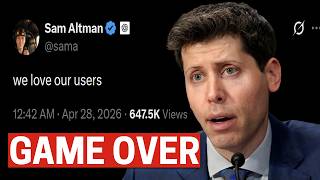
OpenAI Missed Revenue and User Targets Trigger AI Stock Selloff
TECH

OpenAI Missed Revenue and User Targets Trigger AI Stock Selloff

39+
Signals

Strategic Overview

  • 01.
    A Wall Street Journal report on April 28, 2026 disclosed that OpenAI fell short of its own internal targets for new users and revenue, including a goal of reaching 1 billion weekly active ChatGPT users by the end of 2025.
  • 02.
    The story triggered an immediate selloff in AI-linked equities, with Oracle, Nvidia, AMD, Broadcom, Arm, CoreWeave, and SoftBank all sliding as investors reassessed whether OpenAI can fund roughly $1.5 trillion in long-term compute commitments.
  • 03.
    OpenAI pushed back hard, with CFO Sarah Friar and CEO Sam Altman issuing a joint statement calling the report 'ridiculous' and the company labeling the piece 'prime clickbait,' while internally Friar has reportedly warned colleagues she is unsure how OpenAI will pay for future contracts.

Deep Analysis

The Trillion-Dollar Math Problem Behind a Single Earnings Miss

The reason a missed user goal moved hundreds of billions in market cap is arithmetic. By Sam Altman's own November 2025 disclosure, OpenAI is staring at roughly $1.4 to $1.5 trillion in compute commitments over the next eight years, including the $500 billion Stargate buildout with SoftBank and Oracle and a separate $300-plus billion Oracle deal. ZeroHedge's analysis pegs OpenAI's current revenue at approximately 2 percent of those commitments, and the company's most recently disclosed 2024 revenue of $13.1 billion came against an operating loss near $5 billion. For the math to work, revenue effectively has to double every year — which is precisely the assumption the WSJ report just punctured.

CFO Sarah Friar has reportedly told colleagues she is worried about whether OpenAI can pay for future contracts at all, a concern that until this week was confined to short-sellers and skeptics like Gary Marcus, who flatly called OpenAI 'probably toast.' The investing community ran the same arithmetic in real time: hitting widely-reported $100 billion-plus revenue projections would require something like 80 million paid business subscribers at $100 a month, versus roughly 9 million today. The miss didn't change the commitments. It changed the credibility of the path to paying for them.

The CFO-CEO Split That Leaked Into the Market

The most market-moving detail in the WSJ story wasn't the user miss — it was the daylight between Sarah Friar and Sam Altman. According to Fortune and ZeroHedge, Friar has privately told colleagues she is worried OpenAI cannot pay for future compute contracts if revenue growth slows, and has cautioned that the company's internal controls are not ready for public-market reporting standards. Altman, by contrast, is reportedly pushing for an IPO by year-end at a rumored $1 trillion valuation and continues to favor aggressive compute dealmaking. The two co-signed a joint statement calling the WSJ piece 'ridiculous' and pledging they are 'totally aligned on buying as much compute as we can,' but the choreography of a joint denial is itself a tell — public companies don't usually need to announce that their CFO and CEO agree.

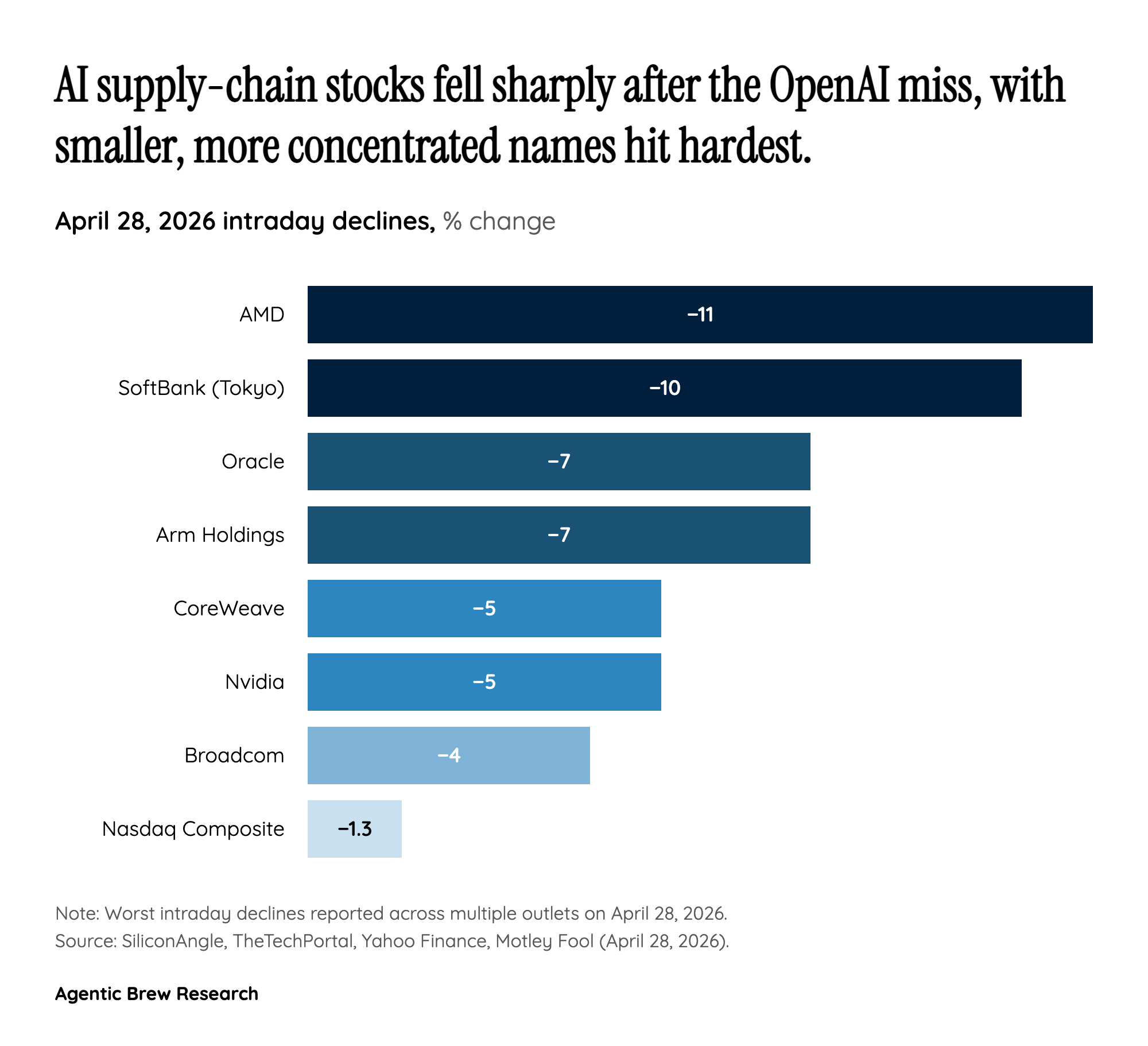
Markets read the gap, not the statement. SoftBank fell roughly 10 percent in Tokyo, Oracle slid as much as 7 percent, and CoreWeave dropped about 5 percent. The contrarian camp, led by Wedbush's Dan Ives and Deepwater's Gene Munster, argues the selloff is a 'way overreaction' and that OpenAI is 'still in a great place.' But community discussion skewed sharply toward Friar's funding anxiety as the load-bearing detail — the governance optics, not the numbers themselves, are now driving the narrative.

This Isn't Just a Revenue Miss — It's a Market-Share Story

Buried beneath the trillion-dollar headlines is a competitive collapse most observers underestimated. ChatGPT's global market share fell from 87.2 percent at the start of 2025 to roughly 68 percent, while Google Gemini climbed from 5.4 percent to 18.2 percent over the same window. Anthropic, meanwhile, has been quietly eating OpenAI's lunch in coding and enterprise — Fortune reports that's directly responsible for OpenAI missing multiple monthly revenue targets earlier in 2026.

The user-growth miss to 1 billion WAU therefore isn't a story of AI adoption stalling; it's a story of OpenAI's first-mover lead eroding as competitors catch up on capability and undercut on price. ChatGPT subscriber churn is reportedly elevated as competing assistants improve. That reframes the entire investment thesis: if OpenAI is losing share in the most monetizable segments while its compute bill keeps climbing, the gap between revenue and obligations widens not from spending discipline failures but from competitive pressure the company can't unilaterally fix. As one investing-forum framing put it, these names 'were priced for OpenAI executing perfectly' — and Anthropic and Google just made perfect execution materially harder.

By The Numbers: The Selloff Geometry and the Concentration Problem

By The Numbers: The Selloff Geometry and the Concentration Problem
Worst intraday declines on April 28, 2026 across the AI supply chain.

The April 28 tape made the AI supply chain's customer concentration impossible to ignore. Oracle dropped 4 to 7 percent. Nvidia, the most valuable company in the world, fell 3 to 5 percent and was the worst-performing Magnificent 7 component on the day. AMD slid 4 to as much as 11 percent across reports. Broadcom shed roughly 4 percent, Arm Holdings 6 to 7 percent, CoreWeave about 5 percent, and SoftBank's Tokyo shares fell roughly 10 percent. The Nasdaq slid 1.3 percent at midday.

Aggregate hyperscaler 2026 AI capex sits near $660 billion — Google up to $185 billion, Meta up to $135 billion, Amazon $200 billion, Microsoft $140 billion — with 40-percent-plus year-over-year growth projected for 2027. Goldman's Rich Privorotsky's framing — that 'equities are being driven by one thing…AI spend' with 'extreme' velocity — captures why the move was so violent: when a market is bid up on one customer's growth, that customer's miss compresses multiples across the entire chain. The contrarian read is that OpenAI's miss is capacity-constrained rather than demand-constrained, which would justify the Wedbush 'buy the dip' call. The bear read, surfacing in deeper investing threads, is that OpenAI's $122 billion war chest only buys time through 2028, after which the math becomes inescapable.

Historical Context

2025-01-21
OpenAI announced the Stargate Project with SoftBank and Oracle, a $500 billion, four-year commitment to build AI infrastructure in the US.
2025-07-01
OpenAI and Oracle expanded their Stargate partnership by 4.5 GW, anchoring an over-$300 billion, five-year compute deal.
2025-11
Altman publicly disclosed OpenAI was looking at roughly $1.4 to $1.5 trillion in compute commitments over the next eight years, raising bubble concerns.
2026-02
Weekly active ChatGPT users had crossed 900 million by February 2026, confirming the company missed its end-of-2025 1 billion WAU goal.
2026-03-22
OpenAI began pivoting away from being a builder of mega data centers toward being a purchaser of cloud capacity, a shift CNBC tied to looming IPO scrutiny.
2026-04-15
OpenAI pulled back from a Stargate Norway data center deal, with Microsoft taking it over, signaling further spend retrenchment.
2026-04-28
WSJ broke that OpenAI missed internal user and revenue targets, triggering an AI-stock selloff and reigniting bubble debate.

Power Map

Key Players
Subject

OpenAI Missed Revenue and User Targets Trigger AI Stock Selloff

OP

OpenAI

Subject of the WSJ report; pushed back publicly with a joint Friar/Altman statement calling the piece 'ridiculous' and 'clickbait,' while internally grappling with whether revenue growth can fund roughly $1.5 trillion in compute commitments.

SA

Sarah Friar (OpenAI CFO)

Reportedly told colleagues she is worried OpenAI may not be able to pay for future compute contracts if revenue growth slows, and has cautioned that internal controls aren't ready for public-market scrutiny — putting her at odds with Altman on IPO timing.

SA

Sam Altman (OpenAI CEO)

Favors a faster IPO timeline and continued aggressive compute investment; co-signed the denial of the WSJ report and has publicly disclosed roughly $1.4 to $1.5 trillion in compute commitments over the next eight years.

OR

Oracle

Holds a roughly $300 billion, multi-year compute partnership with OpenAI; shares fell 4 to 7 percent on the report but Oracle publicly defended OpenAI's growth.

NV

Nvidia, AMD, Broadcom, Arm, CoreWeave

OpenAI's GPU and compute supply chain; all fell sharply on April 28 as investors questioned whether picks-and-shovels demand is too dependent on a single customer.

SO

SoftBank

One of OpenAI's largest investors and a Stargate partner; ADRs and Tokyo shares sank roughly 10 percent on the WSJ report.

Source Articles

Top 5

THE SIGNAL.

Analysts

"Called the selloff a 'way overreaction' and said he would be a buyer of AI stocks, especially Oracle, on the dip; disputes the notion that OpenAI growth is weakening. Quote: 'OpenAI has been tracking very high demand on both the consumer and enterprise front and we strongly disagree with the notion that growth is weakening.'"

Dan Ives
Global Head of Technology Research, Wedbush

"Believes the WSJ story is true but Wall Street is over-analyzing it. Quote: 'I think this is a true story—it is an example of over-analyzing... The bigger picture: it's still growing, we're still early in AI, and they're still in a great place.'"

Gene Munster
Managing Partner, Deepwater Asset Management

"Argues OpenAI is in serious trouble, comparing the situation to WeWork; says OpenAI 'squandered its tremendous lead' as it misses projections while losing share. Verdict: 'OpenAI is probably toast.'"

Gary Marcus
AI researcher, author of Marcus on AI

"Notes that equities are dominated by AI spend with extreme velocity, implying fragility if the narrative wavers. Quote: 'Equities are being driven by one thing…AI spend... it's hard not to respect the strength of the AI bid, but the velocity has been extreme.'"

Rich Privorotsky
Goldman Sachs trader/strategist

"Said the WSJ reporting was poorly timed for AI-exuberant investors heading into mega-cap earnings. Quote: 'The WSJ's OpenAI reporting is not what exuberant investors needed to hear today.'"

Steve Sosnick
Chief Strategist, Interactive Brokers
The Crowd

"WSJ: OpenAI MISSED internal targets for weekly users and revenue, including its goal of reaching 1 billion weekly ChatGPT users by the end of last year, raising new concerns inside the company over whether growth can support its huge data center spending ahead of a possible IPO."

@@wallstengine0

"Stocks are down big this morning on a WSJ report that OpenAI missed internal revenue targets at the end of 2025. Few thoughts on why this might not be as bad as it is being interpreted: - Part of the reason OpenAI did not meet its revenue backlog is because they did not have [enough capacity]..."

@@amitisinvesting0

"OpenAI missed an internal goal of reaching one billion weekly active users for ChatGPT by the end of last year. It also missed its yearly revenue target for ChatGPT. The company has also struggled with defection rates among subscribers - WSJ. CFO Sarah Friar has reportedly told [staff about funding concerns]..."

@@SawyerMerritt0

"Market slumps as OpenAI reportedly misses internal targets for active users and revenue"

@u/circuitloss4000
Broadcast
THE HOUSE OF CARDS IS CRUMBLING -OPEN AI CFO FEARS IT CAN'T PAY $1.5 TRILLION IN FUNDING OBLIGATIONS

THE HOUSE OF CARDS IS CRUMBLING -OPEN AI CFO FEARS IT CAN'T PAY $1.5 TRILLION IN FUNDING OBLIGATIONS

OpenAI is Collapsing and Sam Altman is Panicking

OpenAI is Collapsing and Sam Altman is Panicking

OpenAI Missed Revenue and Growth Targets - Tech Stocks Crash as AI Bubble Pops

OpenAI Missed Revenue and Growth Targets - Tech Stocks Crash as AI Bubble Pops