Meta AI taggable account on Threads
TECH

Meta AI taggable account on Threads

31+
Signals

Strategic Overview

  • 01.
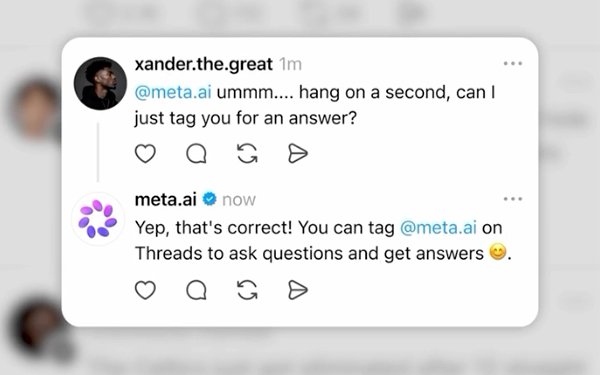
    Meta is beta-testing a taggable @meta.ai account on Threads that lets public-account users summon Meta AI inside posts and replies for real-time answers about trends, breaking stories, recipes, and streaming recommendations.
  • 02.
    The early beta is live only for users in Argentina, Malaysia, Mexico, Saudi Arabia, and Singapore, although the @meta.ai profile and its text-only responses are viewable platform-wide.
  • 03.
    Threads users cannot block the @meta.ai account; Meta points them to mute, hide-replies, and 'Not interested' as alternatives.
  • 04.
    Within roughly 24 hours of launch, 'Users cannot block Meta AI' surged to the top trend on Threads with more than one million posts.

Deep Analysis

The Consent Hole That Made @meta.ai a User-Rights Flashpoint

The technical launch was unremarkable: a taggable assistant account that returns text replies when summoned. The political launch is the part Meta did not script. By shipping @meta.ai with mute, hide-replies, and 'Not interested' as the only user controls — and no block — Meta turned a routine feature test into what TechBuzz.ai called a 'user rights flashpoint' [1]. Engadget reported that 'Users cannot block Meta AI' crossed one million posts on Threads within roughly a day, surfacing as the platform's top trend [2]. Dataconomy echoed the same trend data and underlined that the alternatives Meta points to do not satisfy people who want a hard opt-out [3]. MediaPost surfaced the raw temperature with quoted user replies such as 'Either I get to block you or I uninstall this godforsaken app' [4].

The asymmetry that drives the anger is simple: Meta can post on your feed and into your replies, but you cannot make Meta go away. That is the design choice users are reacting to, not the assistant itself.

Grok Catch-Up With a 'Safeguards' Marketing Layer

Coverage across outlets framed @meta.ai on Threads as a direct response to xAI's Grok integration on X. TechCrunch reported Meta's own pitch verbatim — the bot is meant to help users 'get real-time context about trends and breaking stories, as well as receive recommendations, all within conversations' [5]. Engadget's earlier scoop on the in-development feature explicitly compared it to the Grok behavior where 'seemingly every viral post has at least one prominent reply asking Grok some variation of is this true???' [6].

The differentiator Meta is leaning on is governance, not capability: TheAIInsider reported that Meta is publicly positioning the assistant as carrying 'stronger content safeguards' than Grok and plans to 'refine the experience based on early feedback' from the five test markets [7]. The competitive read is that Meta is willing to ship a less-mature product into a smaller geographic footprint to get a defensible foothold inside conversational feeds before Grok-style fact-check tagging hardens into a habit users associate exclusively with X.

The 2025 Replay: 'Bug' Then, 'Feature' Now

This is the second time in roughly sixteen months that Meta has shipped an unblockable AI persona into a social feed. In January 2025, after a Connor Hayes Financial Times interview reignited attention on Meta's AI character profiles such as 'Liv' and 'Grandpa Brian', users discovered they could not block them — and Meta removed the accounts, blaming a 'bug' [8]. NBC News documented the same retreat, with Meta shutting down AI-generated character accounts after public outcry [9].

What is different in May 2026 is that the unblockability is being defended rather than apologized for: Meta is publicly enumerating mute, hide-replies, and 'Not interested' as substitutes [2][10]. On Reddit's r/ThreadsApp thread covering the launch, a top commenter reported in real time that users were initially able to mass-block @meta.ai before Meta closed that path, then attempted reporting the account as a workaround until that route was also walled off. The 'bug' framing of 2025 has effectively been converted into a policy, and the backlash is calibrated accordingly.

Why Meta Wants @meta.ai to Be Unblockable Infrastructure

The product rationale that makes the controversial design legible is distribution. Unlike Google's AI Overviews or ChatGPT — where engagement is opt-in and isolated to a single surface — TechBuzz.ai notes that Meta's approach embeds the assistant inside the social graph where users already are [1]. Every @meta.ai reply becomes a public, indexable artifact on the @meta.ai profile in the original poster's language, as SocialMediaToday and TheAIInsider both confirmed [7][10].

That gives Meta two compounding assets if the feature survives backlash: a live corpus of real-world prompts attached to real-world posts, and a top-of-feed surface where the assistant is summoned by users rather than pushed by the algorithm — a distribution model competitors building standalone chat apps cannot replicate. A blockable assistant fragments that corpus and that surface. The product manager logic for 'no block' is the same logic that makes the user backlash predictable: the feature is most valuable to Meta precisely when individual users cannot remove it from their experience.

Geographic Asymmetry: A Quiet Beta That Got Loud Outside the Test Markets

The rollout is operationally narrow but discursively global. TechCrunch and SocialMediaToday confirmed that only Argentina, Malaysia, Mexico, Saudi Arabia, and Singapore can summon @meta.ai today [5][10]. But because the @meta.ai profile and its replies are viewable platform-wide, every user can see the assistant in action even though most cannot use or test it — which is exactly the condition that produces a backlash dominated by people who have not actually interacted with the product.

The social signal layer reflects this split: regional voices in the five test markets, particularly Malaysia, surfaced more favorable framings — notably the point that Meta's tag-to-ask is free where Grok on X is gated behind paid Premium — while English-language X and Reddit discourse skewed sharply negative and was anchored on the no-block policy rather than on the assistant's actual answers. The geography of who is talking about @meta.ai is not the same as the geography of who is using it, which is a structural problem Meta will face again whenever it expands the test.

Public Hallucinations Under a Meta-Branded Handle

One understated risk in the design: @meta.ai's answers are not private DMs. SocialMediaToday and TheAIInsider both noted that every reply is text-only and publicly visible on the @meta.ai profile, served in the original post's language [7][10]. That makes any factual error a publicly archived artifact under a Meta-owned handle inside live news and sports threads — exactly the surfaces where the bot is being marketed as a 'real-time context' tool [5].

Meta's own 2024 review of fact-checking labels and Meta AI responses already conceded the tension between AI-generated answers and the company's integrity systems [11]. Stacking that on top of a 2025 incident in which standalone Meta AI conversations leaked into a public 'Discover' feed — what TechCrunch called a 'privacy disaster' — gives users reason to be skeptical that Meta has fully reasoned through the failure modes of a Meta-branded chatbot speaking in their replies [12]. The unblockable design amplifies the exposure: every user whose post the bot replies to becomes an involuntary distribution channel for whatever @meta.ai says next.

Historical Context

2023-09
Meta introduced AI-generated character profiles such as 'Liv' and 'Grandpa Brian' on Facebook and Instagram, the conceptual precursor to placing AI personas directly inside social feeds.
2025-01-03
After backlash sparked by a Connor Hayes Financial Times interview, Meta removed remaining AI character profiles, attributing the inability to block them to a 'bug'.
2025-06
The standalone Meta AI app drew criticism after private-feeling chats surfaced inside a public 'Discover' feed, fueling broader privacy distrust now resurfacing with the Threads integration.
2026-05-12
Meta announced the @meta.ai taggable Threads beta in Argentina, Malaysia, Mexico, Saudi Arabia, and Singapore, with text-only public replies in the original post's language.
2026-05-13
'Users cannot block Meta AI' surged to the top trend on Threads with more than one million posts within a day of launch.

Power Map

Key Players
Subject

Meta AI taggable account on Threads

ME

Meta Platforms

Product owner of Threads and Meta AI; rolling out and defending the @meta.ai taggable account, controlling block/mute settings, and positioning the bot as a real-time context layer competing with Grok.

TH

Threads users in Argentina, Malaysia, Mexico, Saudi Arabia, Singapore

First cohort with the ability to tag @meta.ai; effectively the live test bed whose behavior will shape Meta's global rollout decisions.

BR

Broader Threads user base

Cannot summon @meta.ai yet but can see its replies in feeds; driving the 'Users cannot block Meta AI' trend with more than one million posts.

XA

xAI / Grok

De facto benchmark for in-feed AI assistants; sets user expectations Meta is trying to match while marketing 'stronger content safeguards'.

Fact Check

12 cited
  1. [1] Meta Won't Let You Block Its AI Account on Threads
  2. [2] Threads users are pissed they can't block Meta's new AI chatbot
  3. [3] Threads users backlash as Meta AI chatbot cannot be blocked
  4. [4] Threads Tests Meta AI Integration, Angering Some Users
  5. [5] Threads tests a Meta AI integration that works similarly to Grok
  6. [6] Hey Meta AI, is that true? Threads is testing a Grok-like AI feature
  7. [7] Threads Integrates Meta AI into Conversations to Deliver Real-Time Trends and Recommendations
  8. [8] Meta deletes its AI character accounts after backlash
  9. [9] Meta shuts down AI-generated character accounts after user outcry
  10. [10] Meta Expands Meta AI Chatbot Access to Threads
  11. [11] Review of fact-checking label and Meta AI responses
  12. [12] The Meta AI app is a privacy disaster

Source Articles

Top 3

THE SIGNAL.

Analysts

"Frames the launch as Meta's direct answer to Grok on X, emphasizing Meta's pitch that the bot delivers real-time context about trends and breaking stories inside conversations."

Sarah Perez
Reporter, TechCrunch

"Argues the unblockable design transforms a routine product test into a 'user rights flashpoint' and contrasts Meta's approach with Google Overviews and ChatGPT, where engagement is opt-in."

TechBuzz.ai analysis
Tech analysis publication

"Notes that Meta is positioning the bot with stronger safeguards than Grok and plans to iterate from early-market feedback before wider rollout."

TheAIInsider editorial
AI industry publication

"Aggregates direct user reactions including verbatim replies such as 'Either I get to block you or I uninstall this godforsaken app', showing the launch is being received as an unwanted imposition rather than a value-add."

MediaPost
Marketing/media trade publication
The Crowd

"Oh no I can't block the thing on the platform no one uses"

@@vozercozer183

"Meta AI is now being tested on Threads Malaysia, and you guys can get answers right in your threads just by tagging that AI account. What's awesome is, you don't need to pay anything to use this feature, unlike platform X where you need a premium subscription."

@@officialwisermy166

"An AI that can't be blocked is the digital equivalent of that guy at parties who doesn't understand social cues. Except this one has infinite stamina."

@@Goxy_ai107

"Meta won't let you block its AI account on Threads"

@u/MarvelsGrantMan136435
Broadcast
Threads Just Got Its Own Grok. Meet @meta.ai.

Threads Just Got Its Own Grok. Meet @meta.ai.