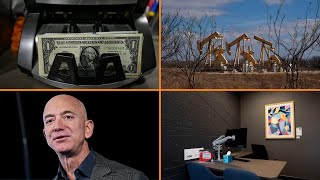
Bezos $100B AI Manufacturing Fund
TECH

Bezos $100B AI Manufacturing Fund

40+
Signals

Strategic Overview

  • 01.
    Jeff Bezos is in talks to raise a $100 billion fund to acquire legacy manufacturing companies in chipmaking, defense, and aerospace, then modernize them using AI-driven automation. Investor documents describe it as a 'manufacturing transformation vehicle.'
  • 02.
    The fund is closely tied to Project Prometheus, Bezos's AI startup that launched in November 2025 with $6.2 billion in funding. Prometheus builds AI systems that learn from real-world physical experimentation — including simulations of material reactions and airflow — rather than text data, and would supply the core technology deployed at acquired companies.
  • 03.
    Bezos has been meeting with large asset managers during trips to the Middle East and Singapore, including reported talks with the Abu Dhabi Investment Authority and JPMorgan CEO Jamie Dimon. The fundraise remains in early stages as of March 19, 2026, with no formal close announced.
  • 04.
    At $100 billion, the fund would match SoftBank's Vision Fund in scale and exceed most of the world's largest buyout funds, making it one of the largest single investment vehicles ever assembled.

Deep Analysis

Why This Matters

The $100 billion manufacturing fund is not simply a large bet on AI — it is a structured thesis that manufacturing is the most underpriced sector in the AI transition. While software, finance, and media have absorbed enormous AI investment over the past five years, physical manufacturing has lagged due to capital intensity, legacy infrastructure, and the difficulty of replacing specialized human labor with general-purpose AI. Bezos is positioning the fund to exploit that gap: buy companies at valuations that reflect their pre-AI capabilities, modernize them with Prometheus technology, and capture the value uplift.

The geopolitical dimension adds a second layer of urgency. The explicit targeting of chipmaking and defense sectors places this fund squarely inside the national security conversation around supply chain reshoring. The U.S. government, along with allied sovereign wealth investors in the Middle East and Singapore, has strong incentives to support a privately led effort that accelerates domestic industrial AI adoption in strategically sensitive sectors — without requiring direct state capital. Bezos's fundraising in Abu Dhabi and Singapore, alongside reported conversations with JPMorgan, signals a coalition-building strategy designed to give the fund both the scale and the geopolitical legitimacy to operate in these sensitive verticals.

Personally, the fund also marks Bezos's most assertive return to hands-on operational leadership since leaving Amazon's CEO role in 2021. Taking a co-CEO title at Project Prometheus — rather than the advisory or chairman roles typical of billionaire-founder ventures — signals deliberate ambition to build a second institution, not just allocate capital.
How It Works

The fund operates as a vertically integrated acquisition-and-transformation vehicle with a two-layer structure. The $100B fund acquires controlling stakes in legacy manufacturing companies. Project Prometheus, funded separately at $6.2 billion, develops the AI technology that gets deployed at those acquired companies. The key innovation is that Prometheus is not building conventional large language models trained on text — it is building AI systems that learn from physical experimentation: simulating material reactions under pressure, airflow dynamics around aerodynamic components, and other phenomena that govern real-world manufacturing quality and efficiency. This physics-grounded AI is directly applicable to the kinds of engineering processes found in aerospace assembly, semiconductor fabrication, and defense hardware.

Once a manufacturing company is acquired by the fund, Prometheus's simulation and optimization models would be integrated into production lines, quality control systems, and supply chain logistics. The theory is that AI-driven optimization can dramatically reduce waste, defect rates, and cycle times in industries where even marginal improvements translate to very large financial returns — particularly in high-value sectors like chips and aerospace components where individual parts carry high unit economics.

The fund's structure also means Bezos controls both sides of the value chain: the AI technology provider (Prometheus) and the companies consuming that technology (fund portfolio). This eliminates the typical go-to-market friction that AI startups face when trying to sell transformation services to skeptical industrial incumbents, and allows Prometheus to iterate its models against live production environments rather than simulated datasets — a significant technical advantage in developing industrial AI.

By The Numbers

The $100 billion target fund size is the defining statistic. For scale: it matches SoftBank's Vision Fund, the previous benchmark for a single technology investment vehicle. It exceeds the assets under management of most top-tier global buyout funds. The U.S. manufacturing sector alone generates over $2 trillion in annual value — meaning even a 5% efficiency uplift across acquired assets would represent $100 billion in annualized gains at sector scale, providing a theoretical return framework for the fund's ambitions.

Project Prometheus launched in November 2025 with $6.2 billion — one of the largest AI startup funding rounds on record at inception. Within roughly one month, it had grown to over 120 employees drawn from Meta, OpenAI, and DeepMind, indicating rapid talent acquisition at the frontier of AI research. Bezos's prior investment of $400 million in Physical Intelligence in 2024 foreshadowed the thesis and provided early market intelligence on physical-AI development timelines. Taken together, Bezos has committed or is raising over $106 billion toward physical-world AI in less than two years — a capital concentration with few historical parallels outside sovereign wealth funds or national industrial programs.

Impacts and What's Next

The most immediate and widely discussed impact is labor displacement. AI-driven automation in legacy manufacturing typically replaces manual and semi-skilled roles first — quality inspection, materials handling, process monitoring — before moving into more complex assembly tasks. A $100B fund explicitly designed to automate acquired factories would, at scale, represent one of the largest single sources of industrial job displacement since the offshoring wave of the 1990s and 2000s. Social media commentary captured this immediately: posts framing Bezos as 'putting a target on every factory worker's job in America' reached significant engagement on day one of the story.

In the medium term, the fund would intensify competitive pressure across manufacturing M&A. A well-capitalized AI-first acquirer entering the market for legacy industrial assets would compress deal timelines, inflate valuations, and force other private equity and strategic acquirers to articulate their own AI transformation theses. Companies in chipmaking, aerospace, and defense would face pressure to either partner with or preemptively resist acquisition by fund vehicles of this type. The concentration of AI-modernized industrial capacity under a single ownership structure also raises antitrust questions that regulators in the U.S., EU, and potentially host countries of target companies would need to address.

Longer term, if the model succeeds — if Prometheus's physics-simulation AI genuinely produces measurable efficiency and quality gains at acquired companies — it would validate the entire thesis of applying foundation models to physical manufacturing at scale, likely triggering similar vehicles from other tech-era capital holders. The fund could become a template, accelerating AI adoption across industrial sectors far beyond what organic enterprise technology sales would achieve.

The Bigger Picture

The Bezos manufacturing fund sits at the intersection of three converging macro-trends: the maturation of AI from digital to physical applications, the geopolitical imperative to reshore critical industrial supply chains, and the concentration of post-tech-era wealth seeking deployment in hard assets with defensible moats. Each of these trends was already driving capital and policy attention toward manufacturing before this fund was announced — the fund's scale and structure make it a potential organizing event for all three simultaneously.

The rivalry narrative with Elon Musk, noted in YouTube social signals, is analytically significant beyond the personal dimension. Musk has built a vertical integration empire across EVs (Tesla), rockets (SpaceX), and AI (xAI) by combining manufacturing capability with advanced automation and AI. Bezos, through the combination of Prometheus and the $100B fund, is constructing a parallel architecture — but through acquisition rather than organic build, and with explicit focus on the sectors (defense, chips) where Musk has been most dominant or most politically active. Whether competitive rivalry is a primary driver or a secondary effect, the structural result is two of the world's most capital-intensive private actors converging on AI-driven physical manufacturing as the defining investment arena of the late 2020s.

For the broader AI industry, the fund's fundraising success or failure will serve as a critical market signal. If sovereign wealth funds and institutional investors commit at the scale required, it will confirm that AI's value creation in physical industries is legible enough for institutional-grade capital allocation — a validation that could unlock trillions in follow-on investment globally. If the fundraise stalls or closes well below target, it will suggest that the manufacturing AI thesis, however compelling in theory, remains too operationally uncertain for capital at this scale.

Historical Context

2021
Bezos stepped down as Amazon CEO, transitioning to executive chairman and signaling a shift toward external ventures.
2024
Bezos invested $400 million in Physical Intelligence, a robotics AI firm focused on physical-world automation, establishing his early thesis in embodied AI.
2025-11-17
Project Prometheus was publicly revealed with Bezos as co-CEO alongside Vik Bajaj, backed by $6.2 billion in funding and focused on AI for the physical economy.
2025-12
Prometheus grew to over 120 employees, recruiting AI researchers from Meta, OpenAI, and DeepMind, with offices in San Francisco, London, and Zurich.
2026-03-19
The Wall Street Journal reported that Bezos is in talks to raise a $100 billion fund to acquire and AI-modernize legacy manufacturing companies, with fundraising roadshows already underway in the Middle East and Singapore.

Power Map

Key Players
Subject

Bezos $100B AI Manufacturing Fund

JE

Jeff Bezos

Amazon founder and co-CEO of Project Prometheus; orchestrating the $100B fundraise and serving as operational leader of the AI startup providing the transformation technology.

VI

Vik Bajaj

Co-founder and co-CEO of Project Prometheus. Former Google X leader who oversaw Waymo, Wing drone delivery, and exoskeleton projects; also co-founded Verily. Holds a PhD in physical chemistry from MIT and leads the technical direction of Prometheus.

AB

Abu Dhabi Investment Authority (ADIA)

UAE sovereign wealth fund reportedly in active talks to commit capital to the $100B manufacturing fund.

JA

Jamie Dimon / JPMorgan

JPMorgan CEO reportedly in discussions with Bezos, potentially as a financial structuring or anchor investor partner for the fund.

MI

Middle East and Singapore Sovereign Wealth Funds

Primary target institutional investors; Bezos conducted fundraising roadshows in both regions to secure the large-scale commitments required for a $100B vehicle.

LE

Legacy Manufacturing Companies (Chipmaking, Defense, Aerospace)

Primary acquisition targets; companies in these capital-intensive sectors that have lagged in AI adoption represent the core investment thesis and operational transformation opportunity.

THE SIGNAL.

Analysts

"Bezos intends to apply Prometheus's physics-simulation AI directly to companies the fund acquires, creating a vertically integrated pipeline from AI R&D to industrial ownership — a structure with no real precedent in private equity."

Matt Day
Reporter, Bloomberg News

"Manufacturing has lagged behind other sectors in adopting AI at scale, often constrained by legacy systems and high capital costs, making it structurally ripe for disruption — and for a well-capitalized buyer willing to absorb transformation costs."

The Deep Dive Analysts
Industry Analysis, The Deep Dive

"Frames the $100B fund and Project Prometheus together as Bezos's most ambitious post-Amazon venture — a deliberate attempt to build a second landmark enterprise around physical-world AI rather than digital software."

Bobby Allyn
Tech Reporter, NPR
The Crowd

"Breaking: Jeff Bezos is in talks to raise $100 billion for a new fund that would buy manufacturing companies and use AI to automate them"

@@WSJ3100

"One of the richest men alive just put a target on every factory worker's job in America. This is a $100 billion fund built to acquire physical companies and gut them with AI."

@@MilkRoadAI0

"BREAKING: Jeff Bezos is in talks to raise $100 billion for a new fund that would buy manufacturing companies and use AI to automate them, per WSJ."

@@KobeissiLetter96
Broadcast
Jeff Bezos reportedly creating AI startup Project Prometheus

Jeff Bezos reportedly creating AI startup Project Prometheus

Jeff Bezos has a secretive new AI project & worries over world's first suspected AI cyberattack

Jeff Bezos has a secretive new AI project & worries over world's first suspected AI cyberattack

Bloomberg Money Minute: Bezos AI Fund and Record US Household Wealth

Bloomberg Money Minute: Bezos AI Fund and Record US Household Wealth