AI's New Moat: Organizational Design as Competitive Edge
TECH

AI's New Moat: Organizational Design as Competitive Edge

23+
Signals

Strategic Overview

  • 01.
    The 'services as software' thesis — AI delivering outcomes rather than selling seats — is now the default frame for B2B investing in 2026, and agents are moving from generating outputs to executing complete workflows end-to-end.
  • 02.
    Feature-level moats have collapsed because a solo developer can replicate a core product feature in a weekend; the remaining defensible advantages are non-functional — brand, taste, trust, governance, and organizational tempo.
  • 03.
    Average employee count at new unicorns has collapsed from 1,128 in 2023 to 544 in 2025 to 323 in 2026 YTD, and Sam Altman has publicly called the first one-person billion-dollar company inevitable.
  • 04.
    Real AI advantage comes from systems thinking rather than task automation — intelligence compounding across an ecosystem of interconnected workflows generates increasing returns where tools only deliver linear efficiency gains.

Deep Analysis

The Moat Has Moved Up The Stack

For two decades, software defended itself with features. A new workflow, a clever integration, a proprietary interface — these were the bricks that built durable SaaS businesses. In 2026 that defensive logic has inverted. As Steven Cen puts it bluntly, when a solo developer can replicate your core feature in a weekend, what exactly are you defending? The shelf-life of any technical advantage, Datategy notes, is now measured in weeks rather than years. The application layer is collapsing into infrastructure, and infrastructure does not generate moats — it generates parity.

What remains, according to the convergent view from Foundation Capital, Vivaldi Group, HarbourVest, and McKinsey, are non-functional advantages: brand, taste, trust, governance, deployment speed, and — most importantly — the organizational tempo at which intelligence compounds. Foundation Capital's 'services as software' thesis reframes the contest entirely: companies are no longer selling seats, they are selling outcomes, and the firm that ships outcomes fastest is the firm whose internal organization can reason, execute, and learn as a single integrated system. Vivaldi captures the underlying physics in one line — tools generate efficiency gains, systems generate increasing returns. The moat moved up the stack from the product to the org chart, because the org chart is the only layer competitors cannot clone over a weekend.
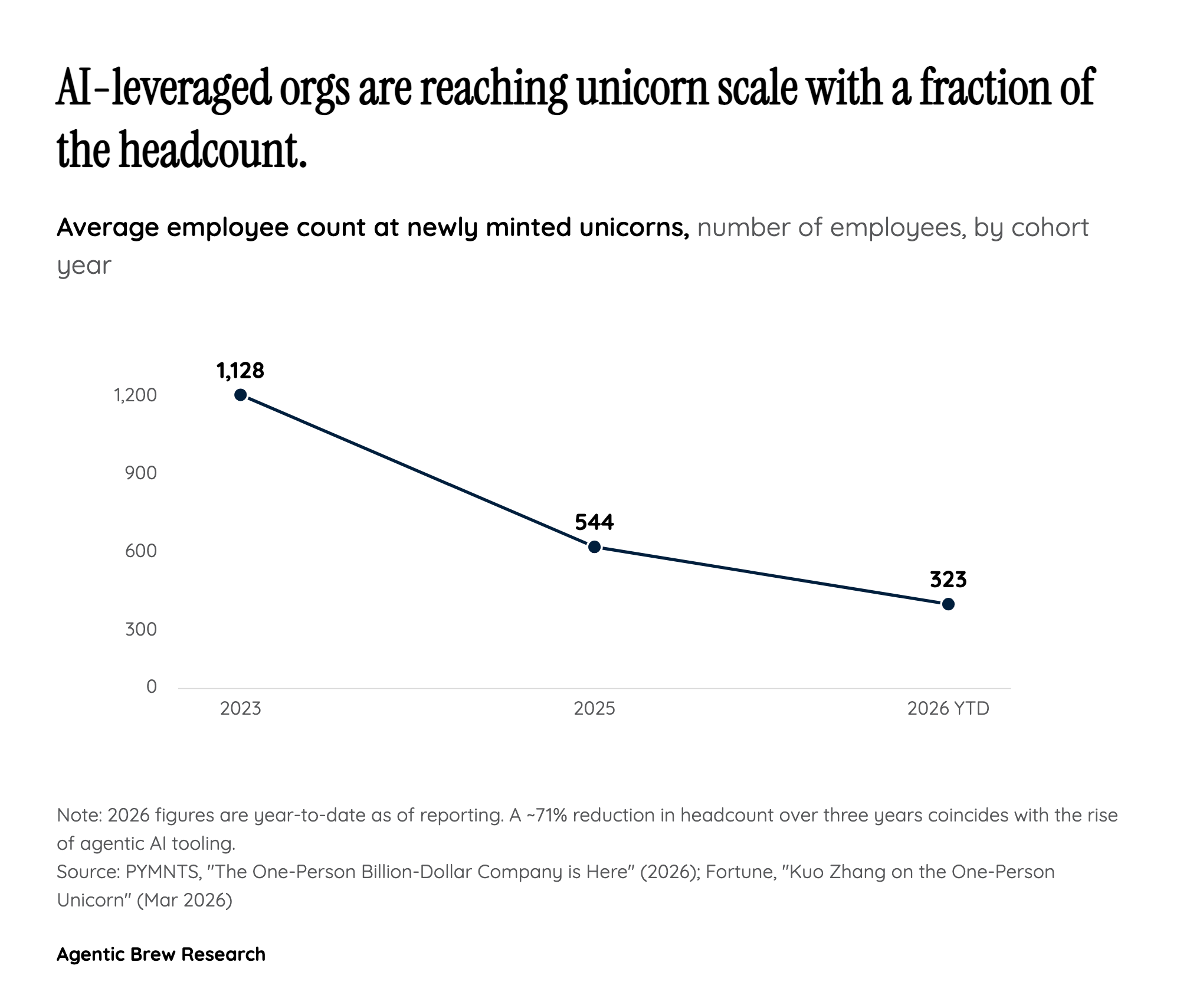

The 323-Employee Unicorn

The 323-Employee Unicorn
Average employee count at newly minted unicorns has fallen from 1,128 in 2023 to 323 in 2026 YTD — a ~71% headcount compression as agentic AI redefines what an org needs.

The most legible signal of this shift is headcount. The average employee count at newly minted unicorns has fallen from 1,128 in 2023 to 544 in 2025 to 323 in 2026 year-to-date — a roughly 70% compression in three years. Sam Altman has called the first one-person billion-dollar company inevitable, and Alibaba.com president Kuo Zhang has framed the underlying mechanism in terms of unit economics: when the cost of execution collapses toward zero, a lone entrepreneur gains the operational reach of a Fortune 500 company. The argument is no longer hypothetical. Medvi, a GLP-1 telehealth startup launched from a Los Angeles home in September 2024 with $20,000 in starting capital and zero employees, generated $401M in sales, 250,000 customers, and a 16.2% net profit margin in its first full year — operating with roughly a dozen AI tools rather than a workforce.

The numbers are not just an interesting statistical curiosity; they are a reframing of what a company is for. If a 250,000-customer business can be run with near-zero headcount, then headcount itself has stopped being a proxy for capability and started being a proxy for organizational debt. Javelin's Alex Gurevich draws the operational conclusion: winners will not be those with the best model but those who are world-class at leveraging GenAI internally. The unicorn definition is unchanged — a billion dollars of value — but the org chart required to produce one has thinned to a sliver, and that sliver is now the unit of competition.

Why Hierarchy Is Now A Tax

The Signals (aktagon) thesis from April 2026 makes the contrarian, second-order point most clearly: hierarchy impedes the information flow AI requires by design. Companies move fast or slow based on how information moves, and traditional management layers exist precisely to filter, summarize, and slow that flow so humans can cope with it. AI removes that constraint. When agents can read every Slack channel, every ticket, every commit, and act on the synthesis, the middle layer of an org chart stops being a translator and starts being a tax on tempo.

This is why Cen's claim about cross-functional, departmental-wall-less teams reaching 'unified goal alignment that large organizations structurally cannot match' is more than startup rhetoric — it is an architectural statement. The incumbent's hierarchy was an asset under conditions of expensive human coordination; under conditions of cheap agentic coordination, the same hierarchy is friction. Vivaldi's observation that roughly half of companies are stuck in the 'Deploy' phase and two-thirds have not scaled AI across the enterprise is the empirical shadow of this same problem: the deployment is not blocked by the technology, it is blocked by the org. The moat is now precisely the willingness — and ability — to redesign around an AI substrate rather than bolting AI onto a structure built for a different physics.

Build Your Own Glass

If org design is the moat, what does the playbook look like in practice? Ramp has provided the most concrete worked example. The company built 'Glass,' an internal AI productivity suite, and paired it with a 'Dojo' — an internal marketplace where employees share, discover, and remix more than 350 AI skills. The explicit framing is striking: internal productivity is a moat, and 'you do not hand your moat to a vendor.' This is the operational counterpart to Gurevich's claim about internal GenAI leverage — every employee gets an AI coworker, and every employee's improvements compound back into the shared skill library.

The Ramp pattern matters because it is replicable and it is non-obvious. Replicable, because the architecture is recognizable: a shared substrate, a marketplace for skills, and a cultural norm that codifies AI workflows rather than hoarding them. Non-obvious, because the natural instinct of most companies is to buy AI productivity from a vendor, which delivers the same parity that killed the feature moat in the first place. The Ramp lesson is that the moat is not in having AI; it is in owning the loop by which AI gets better inside your specific organization. That loop — proprietary skills, internal data, fast learning cycles, and an org structure flat enough to let those skills propagate — is what HarbourVest, McKinsey, and Foundation Capital are all describing from different angles. It is the only edge that does not have a weekend-long replication time.

What The Skeptics Are Right About

The contrarian voices in the discourse are not wrong, and a serious treatment of org-design-as-moat has to absorb their objections. Reddit's r/Futurology thread on AI flattening corporate org charts surfaced three durable counterpoints. First, organizational flattening predates AI — Amazon's two-pizza teams, Moderna's digital-first design, and McKinsey's own reorganizations all began before the current wave, so attributing the entire trend to AI overstates the causal arrow. Second, one-person organizations carry obvious single-point-of-failure risk: Medvi is impressive precisely because it is rare, and bus-factor concerns scale poorly. Third, operational coordination is not a new problem — incumbents like SAP and Teamcenter have run enterprise coordination for decades without AI, so the claim that agentic systems uniquely solve it deserves scrutiny.

HarbourVest's 'great software reset' framing offers a useful reconciliation. The firm argues moats persist where switching costs are high — mission-critical systems of record, embedded fintech, regulatory criticality, and R&D velocity. In those domains, org design alone is not the moat; org design plus regulated entrenchment is. The honest synthesis is that the org-as-moat thesis applies most strongly in fast-moving, low-regulation, services-as-software domains, and least strongly in regulated, integration-heavy enterprise stacks. The frontier of the debate is not whether org design matters — every source surveyed agrees it does — but how far up the regulatory and complexity stack the new physics reaches before older moats reassert themselves.

Historical Context

2024-09-01
Matthew Gallagher launches Medvi from his Los Angeles home with $20K, zero employees, and roughly a dozen AI tools — the launch event that later anchors the one-person-unicorn narrative.
2026-01-18
Publishes analysis arguing deployment speed is the new AI moat, observing that the shelf-life of any technical advantage in 2026 is now measured in weeks rather than years.
2026-03-23
Alibaba.com's president publicly forecasts the one-person unicorn, naming agentic AI as the structural shift that collapses execution cost toward zero.
2026-03-31
Launches a $10M fund and Builders program explicitly aimed at application-layer founders building atop commoditized foundation models — capital allocation that assumes the model itself is no longer the moat.
2026-04-01
Publishes 'From Hierarchy to Intelligence,' arguing that AI is redesigning org structures away from coordination hierarchies because hierarchy itself impedes the information flow AI requires.

Power Map

Key Players
Subject

AI's New Moat: Organizational Design as Competitive Edge

FO

Foundation Capital

Venture firm popularizing the 'services as software' investment thesis, reframing AI startups as competing in services rather than seat-priced software.

VI

Vivaldi Group

Consultancy arguing AI advantage shifts from workflow automation to systems thinking, where organizational architecture is the source of compounding returns.

ME

Medvi (Matthew Gallagher)

GLP-1 telehealth startup launched solo in September 2024 with $20K and ~12 AI tools, now the canonical case study for org-as-moat with $401M sales and 16.2% net margin in its first full year.

RA

Ramp

Fintech that built 'Glass', an internal AI productivity suite with 350+ shared skills exchanged through a 'Dojo' marketplace — a concrete worked example of internal-productivity-as-moat.

MC

McKinsey & Company

Strategy firm framing AI moats as reinforcing systems of advantage — proprietary data, network effects, and faster learning cycles compounding inside an organization.

HA

HarbourVest

PE/VC firm framing the 'great software reset' — moats shift toward mission-critical systems of record, embedded fintech, regulatory criticality, and R&D velocity.

Source Articles

Top 1

THE SIGNAL.

Analysts

"Agentic AI differs from earlier automation because it reasons and executes, and as the cost of execution collapses toward zero, a single founder can command the operational reach of a Fortune 500 company — making the one-person unicorn a structural outcome rather than a curiosity."

Kuo Zhang
President, Alibaba.com

"The first one-person billion-dollar company would have been unimaginable without AI and is now inevitable — implying that the binding constraint on company-building has moved from headcount to org design."

Sam Altman
CEO, OpenAI

"Winners will not be those with the best model but those who are world-class at leveraging GenAI internally — internal AI leverage, not external feature parity, is the structural startup advantage."

Alex Gurevich
Partner, Javelin Venture Partners

"Feature-level moats are dead, and operational tempo from small, cross-functional teams with no departmental walls is structurally inaccessible to incumbents — unified goal alignment is the new moat large organizations cannot match."

Steven Cen
SaaS strategy analyst

"AI does not create advantage by making tasks faster; it creates advantage when intelligence compounds across an ecosystem, which is a property of organizational design rather than of any individual tool or model."

Vivaldi Group
Brand and systems consultancy
The Crowd

"@EvanSpiegel: "15 years ago, we learned that software is not a moat. This is something that everyone is discovering today with AI.""

@@lennysan0

"The Collapse Of Terminal Value - What Happens If AI Makes Every Moat Temporary?"

@@chamath0

"From our ~50 AI portfolio companies at Antler India, the moat patterns we're seeing early (pls be aware these are thesis around moats and it takes time for building these into real moats): 1) Bundling Software + Hardware 2) Deep domain + complex workflows 3) Proprietary data and..."

@@GowriShankarNag0

"We Built Every Employee at Ramp Their Own AI Coworker"

@u/ramplovesyou0
Broadcast
Why AI Moats Still Matter (And How They've Changed)

Why AI Moats Still Matter (And How They've Changed)

The 7 Most Powerful Moats For AI Startups

The 7 Most Powerful Moats For AI Startups

Europe Is Half as Likely to Adopt AI. Here Is What That Costs Them

Europe Is Half as Likely to Adopt AI. Here Is What That Costs Them