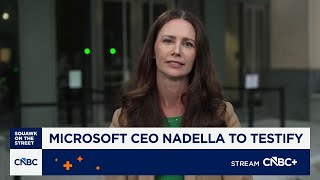
Musk v. OpenAI trial: Nadella and Sutskever testify as case nears conclusion
TECH

Musk v. OpenAI trial: Nadella and Sutskever testify as case nears conclusion

37+
Signals

Strategic Overview

  • 01.
    Microsoft CEO Satya Nadella testified on May 11, 2026 that Elon Musk never personally raised concerns about Microsoft's $13B+ in OpenAI investments, even though the two have each other's direct phone numbers.
  • 02.
    Former OpenAI chief scientist Ilya Sutskever testified that he spent roughly a year gathering evidence of Sam Altman's alleged dishonesty and prepared a 52-page document for the board, but also expressed regret over voting to fire Altman in November 2023.
  • 03.
    Of Musk's original 26 claims filed in 2024, only two remain heading into closing arguments: breach of charitable trust and unjust enrichment.
  • 04.
    Closing arguments are set for Thursday before U.S. District Judge Yvonne Gonzalez Rogers; a nine-person jury will deliver an advisory verdict, with the judge issuing the final ruling.

Deep Analysis

Nadella's 'next IBM' nightmare: a rare admission of strategic peril

The most striking exhibit from Nadella's testimony was an internal April 2022 email surfaced at trial, in which the Microsoft CEO drew an explicit historical parallel to Microsoft's 1980s PC partnership with IBM — worrying that, as Microsoft prepared to invest another $10 billion in OpenAI, it could end up being eclipsed the way IBM was after the original PC deal [1]. It is a remarkably candid admission from a sitting Big Tech CEO, captured in writing and now part of the public record. On the witness stand, however, Nadella's framing pulled the other direction: he testified that 'OpenAI had all the rights and resources they always had' and that Musk — who has his direct phone number — never once called to flag concerns about the deepening partnership [1]. The juxtaposition matters because Musk's case hinges on the claim that Microsoft's escalating investments effectively privatized a charitable mission. Nadella's testimony attempts to thread a needle: yes, Microsoft was strategically anxious about being subordinated by OpenAI, but no, the partnership did not strip OpenAI of independence or breach any commitment to its nonprofit roots.
Sutskever's double-edged testimony cuts both ways

Ilya Sutskever's appearance was arguably the trial's most psychologically loaded moment. He testified that he spent roughly a year gathering evidence of what he described as a 'consistent pattern of lying' and Altman 'undermining and pitting executives against one another,' culminating in a 52-page document delivered to the OpenAI board [2]. That dossier is exactly the kind of contemporaneous, insider-built record Musk's lawyers want the judge to weigh against Altman's character. Yet in the same proceedings, Sutskever expressed regret over his 2023 vote to fire Altman, saying simply, 'I simply cared for it, and I didn't want it to be destroyed' [2]. That softening — combined with his eventual vote to reinstate Altman — gives OpenAI's defense the human-scale narrative it needs: a brilliant scientist who acted on incomplete information, then corrected course. Developer-leaning YouTube discussion around the deposition has fixated on reporting that the firing was planned roughly a year in advance, framing it as evidence of a slow-building governance crisis rather than a panic move.

The case has already shrunk: from 26 claims to 2

What the headlines don't always make clear is how much narrower this trial is than the case Musk originally filed. Of the 26 claims Musk asserted in 2024, only two remain at trial: breach of charitable trust and unjust enrichment [3]. The original lawsuit sought up to $134 billion in damages and included fraud and racketeering theories that did not survive procedural challenges [3]. That winnowing is itself a story. It means the legal question the jury and judge are actually being asked is not 'did Altman and Microsoft commit fraud?' but the narrower charitable-trust question that expert witness David Schizer framed bluntly: a for-profit subsidiary of a nonprofit is appropriate only when it advances the charitable mission, 'not when used as a vehicle to create wealth and profit for insiders' [4]. That framing is consequential because California's October 2025 regulatory approval of OpenAI's for-profit conversion already happened — the trial is now litigating whether the path to that approval was lawful, not whether the structure can exist.

Money math: the lawsuit didn't slow the train

The dollar comparisons surfaced at trial reframe the dispute as a fight over scale, not just principle. Musk's roughly $38 million in early donations helped seed an entity now valued in the hundreds of billions — Musk himself cited an $800 billion figure on the stand and called the dynamic a 'bait and switch' [5]. Microsoft has since deployed more than $13 billion across 2019, 2021, and 2023 tranches [1]. And critically, OpenAI raised approximately $122 billion after Musk filed suit — meaning the litigation has functioned as background noise rather than a chilling event for investors [6]. Fortune's Jeremy Kahn argues the trial generates 'more heat than light on the bigger concerns about who controls AI' [6]. The contrarian read circulating in finance-skeptical online communities is the inverse: that a Musk win could block an OpenAI IPO and trigger investor clawbacks. Both can be true — fundraising momentum during the trial does not mean OpenAI is safe from an adverse final ruling on remedies.

Musk's own cross-examination weaknesses and the credibility battle

Local News Matters analysts assessed at the trial's midpoint that OpenAI's defense strategy is to 'keep the focus on Musk, his credibility and his motives — both those announced and unannounced' [4]. The trial record gives them ammunition. Under cross-examination, Musk admitted that his rival xAI uses OpenAI's models for validation — partially distilling them — telling the court, 'It is standard practice to use other AIs to validate your AI' [5]. Greg Brockman testified that Musk himself pushed for OpenAI to become a for-profit with Musk as CEO and walked away when offered only equal equity [3]. Shivon Zilis, a former OpenAI board member, added that Musk had previously tried to poach Altman to lead a Tesla AI lab [3]. Community reaction online has split along predictable lines: a 'both sides lose' contingent on AI-skeptic forums treating the trial as mutual reputational damage, and a smaller legally-curious cohort arguing the charitable-trust theory is stronger than the personality drama suggests. Procedurally, the judge — not the nine-person advisory jury — issues the final ruling, which means the credibility narrative shapes a one-person decision.

Historical Context

2015-12-11
Musk, Altman, Brockman, Sutskever and others co-founded OpenAI as a nonprofit AI research lab.
2018
Musk left OpenAI after unsuccessfully trying to merge it with Tesla.
2019
OpenAI accepted a $1 billion investment from Microsoft and transitioned to a 'capped-profit' hybrid structure.
2021
Microsoft added a $2 billion investment in OpenAI.
2023-01
Microsoft committed an additional $10 billion to OpenAI, deepening the partnership that is now under legal scrutiny.
2023-11-17
OpenAI's nonprofit board fired Altman, saying he was 'not consistently candid' with the board.
2023-11-22
After mass employee threats to leave for Microsoft, Altman returned as CEO within five days.
2024-08-05
Musk refiled his lawsuit in federal court with claims including fraud and unjust enrichment after initially filing in San Francisco Superior Court in February 2024.
2025-10
OpenAI formally established a for-profit entity after California regulators approved the structural conversion.
2026-04-27
A nine-person jury was seated in Oakland federal court; opening arguments and Musk's own testimony dominated the first week.

Power Map

Key Players
Subject

Musk v. OpenAI trial: Nadella and Sutskever testify as case nears conclusion

SA

Satya Nadella

Microsoft CEO; defends Microsoft's $13B+ OpenAI investment and testified that Musk never personally raised concerns, undermining a central premise of Musk's case.

IL

Ilya Sutskever

OpenAI co-founder and former chief scientist; his 52-page dossier on Altman's alleged dishonesty supports Musk's narrative, while his expressed regret about the 2023 firing aids OpenAI's defense.

EL

Elon Musk

Plaintiff and OpenAI co-founder turned rival via xAI; seeks to unwind OpenAI's for-profit conversion and reclaim its nonprofit mission, citing roughly $38M in early donations.

SA

Sam Altman

OpenAI CEO and lead defendant facing breach of charitable trust and unjust enrichment claims; expected to take the stand as early as Tuesday.

GR

Greg Brockman

OpenAI president and co-defendant; testified that Musk himself pushed OpenAI to become a for-profit with Musk as CEO and walked out when offered only equal equity.

JU

Judge Yvonne Gonzalez Rogers

Presiding U.S. District judge for the Northern District of California; will receive the nine-person jury's advisory verdict and issue the binding final ruling.

Fact Check

6 cited
  1. [1] Microsoft CEO Satya Nadella testifies in Musk vs. Altman trial
  2. [2] OpenAI trial: Sutskever testifies on Altman firing
  3. [3] Musk v. Altman Week 2: OpenAI fires back and Shivon Zilis reveals that Musk tried to poach Sam Altman
  4. [4] Musk v. Altman Week 2 analysis: OpenAI targets Musk's motives as trial hits midpoint
  5. [5] Musk v. Altman Week 1: Musk says he was duped, warns AI could kill us all, and admits that xAI distills OpenAI's models
  6. [6] Musk's court fight with OpenAI

Source Articles

Top 5

THE SIGNAL.

Analysts

"Argues a for-profit subsidiary of a nonprofit is legitimate only when designed to advance the charitable mission, not when used to enrich insiders — a framing that goes to the heart of Musk's surviving breach-of-charitable-trust claim."

David Schizer
Former Dean, Columbia Law School; expert witness on nonprofit governance

"Contends the trial generates 'more heat than light on the bigger concerns about who controls AI' and notes the lawsuit has not impeded OpenAI's fundraising momentum."

Jeremy Kahn
AI Editor, Fortune

"Assess that OpenAI is winning the credibility battle by keeping the focus on Musk's mixed motives — including his rival xAI venture and prior attempts to control OpenAI himself."

Trial analysts cited by Local News Matters
Midpoint trial analysis
The Crowd

"Day 9 of Musk v. Altman trial in federal court in Oakland, California. Ilya Sutskever, former OpenAI chief scientist, and Satya Nadella, Microsoft CEO, will testify."

@@michelletomkim390

"Ilya Sutskever and the rest of the OpenAI board briefly fired Sam Altman as CEO in 2023. "This kind of environment, where the executives [don't] exactly have the correct information, makes the environment not conducive to attaining any difficult, grand goal," such as "safe AGI""

@@michelletomkim19

"Following Sam Altman's brief firing in 2023, Microsoft CEO Satya Nadella testified he wanted to hire Altman and other OpenAI employees at Microsoft so as not to lose them to Microsoft competitors."

@@KatieMiller35

"BREAKING: Two Days Before Trial, Musk Texted OpenAI's Brockman About a Settlement. When Brockman Said Drop All Claims, Musk Replied: 'By the End of This Week, You and Sam Will Be the Most Hated Men in America.'"

@u/InterstellarKinetics1400
Broadcast
BREAKING: Ilya Sutskever DEPOSED, Sam Altman firing was planned a year in advance and more...

BREAKING: Ilya Sutskever DEPOSED, Sam Altman firing was planned a year in advance and more...

The Musk Vs. OpenAI Trial Is Underway - Here's Where Things Stand

The Musk Vs. OpenAI Trial Is Underway - Here's Where Things Stand

Satya Nadella to testify in Elon Musk vs. OpenAI trial

Satya Nadella to testify in Elon Musk vs. OpenAI trial