Anthropic in talks to buy AI chips from UK startup Fractile
TECH

Anthropic in talks to buy AI chips from UK startup Fractile

41+
Signals

Strategic Overview

  • 01.
    Anthropic is in early talks with London-based startup Fractile to buy AI inference chips, with potential supply contingent on Fractile shipping silicon as soon as 2027.
  • 02.
    Fractile's design fuses memory and compute on a single chip using SRAM and a RISC-V in-memory compute architecture, claiming up to 100x the speed and 10x lower cost than Nvidia GPUs for LLM inference.
  • 03.
    The move is part of Anthropic's broader strategy to diversify chip supply beyond Google TPUs, AWS Trainium, and Nvidia after its gross profit margin fell short last year on higher-than-expected inference costs.
  • 04.
    Fractile is separately reported to be raising more than $200 million at a roughly $1 billion valuation, with Accel partly leading, while Anthropic is also reportedly exploring designing its own chips.

Deep Analysis

Why SRAM in-memory compute matters: the inference memory wall

The technical center of this story is that Fractile is not building a faster GPU — it is attacking a different bottleneck. In a conventional GPU stack, transformer inference repeatedly shuttles model weights between high-bandwidth memory (HBM) and the compute units for every token generated. Once models are large and batches are small, that data movement, not raw FLOPs, dictates how many tokens per second a chip can produce and how much energy each token costs. Fractile's design stores the data needed for computations directly next to the transistors that perform the arithmetic, an in-memory compute (IMC) architecture built on SRAM and RISC-V control logic.

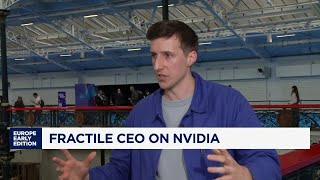
The payoff Fractile claims from collapsing that memory hierarchy is dramatic: roughly a hundred-fold increase in effective bandwidth and, by extension, the option to either serve users 100x faster or let the model 'think 100 times harder' at the same throughput. Public marketing numbers stack up to 100x speed, 10x cost reduction, and 20x better performance per watt versus Nvidia GPUs, with ComputerWeekly citing a 50x speed and 10% cost figure for trained-model inference. Whether the silicon actually hits those numbers in production is a separate question, but the architectural premise — that the inference workload is memory-bound, not compute-bound — is exactly the bet several non-GPU challengers are now making, and it is what makes Fractile interesting to a buyer like Anthropic rather than just to a sovereign-AI policy file.

Anthropic's margin math: why a frontier lab is shopping for inference silicon

Anthropic's interest in Fractile is downstream of a very specific financial pain point. Reporting around the talks notes that Anthropic's gross profit margin on AI products fell short of target last year because inference costs ran higher than expected, and that the company expects annual server-and-chip spend to climb into the tens of billions. When inference is the dominant cost line — and industry estimates cited in the research put inference at roughly two-thirds of AI compute spend in 2026 versus one-third in 2023 — even a partial substitution of cheaper, more efficient inference silicon has outsized P&L impact.

That reframes the Fractile conversation as a margin lever, not a moonshot. Anthropic already has a deliberately diversified chip stack: Google TPUs (recently expanded with Broadcom), AWS Trainium, and Nvidia GPUs. Adding Fractile, and separately exploring its own custom chips, is consistent with using supplier breadth as negotiating leverage and as a hedge against any one vendor's capacity constraints. The signal worth catching is that a frontier lab with this much spending power is openly de-risking its dependence on the dominant GPU supplier — and is willing to engage a pre-silicon startup to do it. That posture, more than any individual deal, is what other inference-chip startups will read most carefully.

The 2027 timing paradox and execution risk

The most under-discussed feature of this story is the timeline. Fractile is targeting a chip prototype by the end of 2026 and a shipping product in 2027, and Anthropic's interest is reportedly contingent on chips shipping in roughly that window. That means a deal which looks like a 'now' headline is really a bet on inference economics 18-plus months out, with no shipping silicon yet on the table. Reporting also explicitly notes the talks are early and a deal may not be reached.

The execution risk on Fractile's side is concrete. Public coverage indicates the company has so far validated its designs primarily in simulation and is fabless, which means TSMC capacity and tape-out timelines, not just engineering, will gate the 2027 product. Community-skeptic readings emphasize that point repeatedly: chip design is not the bottleneck, fabrication is. The flip side is that Anthropic is using a soft, early-stage commitment to align an inference roadmap to its own cost curve — a low-cost option on a potentially asymmetric upside. For Fractile, even an exploratory anchor customer like Anthropic is a credibility unlock that meaningfully de-risks the $200M raise it is reportedly closing in parallel.

Sovereign AI hardware: the UK industrial-policy subtext

Strip away the Anthropic headline and Fractile is also a UK industrial-policy story. The company has received a $6.52M grant from the UK government's ARIA program, just announced a £100M three-year UK expansion across London and Bristol that adds roughly 40 hardware roles, and has been publicly endorsed by AI Minister Kanishka Narayan as evidence the UK can 'reinforce our leadership in AI' through domestic hardware investment. Pat Gelsinger's personal investment adds semiconductor-industry validation on top of the policy frame.

The sovereign-AI argument shows up sharply in Fractile's own external messaging: the company's growth lead has publicly argued that the chip race is 'not just about snappier chatbots' but about 'national survival,' and a 2025 conference panel made the case that stockpiling Nvidia chips is not an adequate national-security posture for a country that wants real AI sovereignty. An Anthropic supply discussion validates that pitch on commercial terms a policymaker can point to: a US frontier lab is willing to engage a UK-built non-GPU architecture. If Fractile lands the 2027 product, the deal becomes the first concrete data point that UK-built AI silicon can sit inside a hyperscale-class inference stack — exactly the outcome the UK's AI hardware policy is structured to produce.

Community reaction: enthusiasm, skepticism, and the fab question

Social discussion around the news clusters around a recurring tension. UK-focused communities frame Fractile as a homegrown chip champion worth backing, while broader AI and UK-general communities push back with a consistent set of objections: that even a $200M raise and a £100M UK expansion are an order of magnitude below the capital intensity of frontier silicon, that vertical-integration analogies (Apple's M-series is the most cited) took more than a decade and many billions to mature, and that Fractile's fabless model means the real bottleneck sits with TSMC capacity rather than chip design itself.

The most contrarian camp dismisses Fractile-class startups as vehicles to capture investor enthusiasm without ever shipping competitive volume; the counter-camp argues that exact defeatism is what cost the UK previous semiconductor cycles and that an Anthropic-shaped anchor customer is precisely the kind of demand signal needed to break the cycle. The shape of that debate is more useful than any individual post: it tells you the deal will be judged not on the announcement but on whether 2027 silicon actually ships in volumes that move Anthropic's inference cost curve. Until then, both narratives — UK champion and underfunded long shot — will coexist.

Historical Context

2022
Fractile founded in London by Walter Goodwin (Oxford Robotics Institute PhD) and Yuhang Song to commercialize in-memory compute AI chips.
2024-07
Fractile emerged from stealth with a $15M seed round led by Oxford Science Enterprises, joined by NATO Innovation Fund, Kindred Capital, and Cocoa Capital.
2024-10
Fractile received a $6.52M grant from the UK government's ARIA program, anchoring sovereign-AI policy support.
2025-01
Former Intel CEO Pat Gelsinger disclosed a personal angel investment in Fractile, lending semiconductor-industry credibility to the in-memory compute thesis.
2026-03-31
Reports surfaced that Fractile is in talks to raise $200M at a $1B valuation, with Accel partly leading the round.
2026-04
Fractile announced a £100M, three-year UK expansion across London and Bristol, adding around 40 hardware engineering roles.
2026-04-10
Reports emerged that Anthropic is exploring designing its own AI chips to address compute shortages, signaling an aggressive multi-track silicon strategy.
2026-05-02
The Information reported Anthropic is in early talks to buy AI inference chips from Fractile, contingent on the startup shipping silicon as soon as 2027.

Power Map

Key Players
Subject

Anthropic in talks to buy AI chips from UK startup Fractile

AN

Anthropic

Prospective buyer of Fractile inference chips, looking to diversify supply beyond Google, Amazon, and Nvidia and to reduce inference costs that hurt last year's AI product gross margin.

FR

Fractile

London-based AI inference chip startup founded in 2022 by Walter Goodwin; building SRAM-based in-memory compute chips and targeting a 2026 prototype with a 2027 shipping product.

NV

Nvidia

Incumbent GPU supplier whose inference dominance is the explicit target of Fractile's pitch and the implicit motivation for Anthropic seeking alternatives.

GO

Google and Amazon

Anthropic's existing custom-silicon partners through TPUs and Trainium; a Fractile addition would extend rather than replace this multi-vendor stack.

AC

Accel and Oxford Science Enterprises

Reported investors in Fractile's pending $200M round at a $1B valuation; OSE also led the company's 2024 seed.

UK

UK Government / AI Minister Kanishka Narayan

Public backer of Fractile's £100M UK expansion, framing domestic AI hardware as a sovereign-AI priority.

Source Articles

Top 4

THE SIGNAL.

Analysts

"Fusing memory and inference processing on a single chip delivers 'a hundred-fold increase in effective bandwidth and much higher energy efficiency,' which translates either into chatbots that respond 100x faster or models that 'think 100 times harder' at the same throughput."

Walter Goodwin
Founder & CEO, Fractile

"Argues that running models orders of magnitude faster, cheaper, and at a 'dramatically lower power envelope' provides 'a performance leap equivalent to years of lead on model development' — implying inference silicon, not parameter count, is the next axis of competition."

Pat Gelsinger
Former CEO, Intel; angel investor in Fractile

"Frames Fractile's expansion as proof that 'investing in British tech innovation' is how the UK reinforces leadership in AI and global influence — positioning the deal as much an industrial-policy story as a commercial one."

Kanishka Narayan
UK AI Minister

"Has publicly argued Fractile is 'not just about snappier chatbots' but about 'national survival,' making the case that sovereign AI capacity requires sovereign hardware rather than stockpiled imports."

Tom Westgarth
Growth lead, Fractile (former UK government AI policy)
The Crowd

"UK chip startup Fractile to expand UK operations with £100m investment"

@u/Sea-Heron8062686

"Anthropic reportedly considering designing its own AI chips to reduce dependence on NVIDIA"

@u/ComplexExternal4831678

"UK chip startup Fractile to expand UK operations with £100m investment"

@u/Electricbell20199
Broadcast
How UK chip startup Fractile is hoping to challenge Nvidia

How UK chip startup Fractile is hoping to challenge Nvidia

This isn't just about snappier chatbots. It's national survival: Tom Westgarth, Fractile | VENTURES

This isn't just about snappier chatbots. It's national survival: Tom Westgarth, Fractile | VENTURES

Sovereign Compute in the Age of AI with Arondite and Fractile (Resilience Conference 2025)

Sovereign Compute in the Age of AI with Arondite and Fractile (Resilience Conference 2025)