Intel stock surges on AI-driven turnaround
TECH

Intel stock surges on AI-driven turnaround

34+
Signals

Strategic Overview

  • 01.
    Intel shares soared roughly 24% on April 24, 2026, closing just under $83 — the company's best single-day gain since October 1987 — after a Q1 2026 earnings beat that surpassed even its dot-com era peak and pushed 2026 gains above 100%.
  • 02.
    Q1 2026 revenue came in at $13.58 billion, up about 7% year-over-year and roughly $1.2 billion above consensus, with non-GAAP EPS of $0.29 versus a $0.01 estimate; Data Center and AI revenue grew 22% to $5.1 billion as Intel Xeon 6 was selected as the host CPU for NVIDIA's DGX Rubin NVL8 systems.
  • 03.
    CEO Lip-Bu Tan's turnaround narrative was reinforced by Tesla's Austin 'Terafab' becoming Intel's first announced major external 14A customer, a $5 billion NVIDIA equity investment at $23.28 per share, and a U.S. government 9.9% stake now worth roughly $36 billion against an $8.9 billion cost.
  • 04.
    The rally extended sector-wide, with AMD up around 14% and Arm Holdings around 15% on the read-through that AI inference is reviving CPU demand, even as Wedbush and Morgan Stanley flagged stretched valuation and continued share-loss risk.

Deep Analysis

The CPU's Quiet Comeback

For most of the last three years, the AI trade has been a GPU trade — and Intel was the company the AI era was supposed to leave behind. Lip-Bu Tan's Q1 2026 message inverts that framing. 'In recent months we have seen clear signs that the CPU is reasserting itself as the indispensable foundation of the AI era,' Tan told investors, pointing to inference and agentic workloads where orchestration, memory, and general-purpose compute live on the host CPU rather than the accelerator. The numbers back the rhetoric: Data Center and AI revenue grew 22% year-over-year to $5.1 billion, AI-driven businesses now make up roughly 60% of total revenue and grew about 40% year-over-year, and Intel sold chips it had previously written off because demand exceeded supply.

The NVIDIA deal anchors the thesis architecturally. Jensen Huang described the partnership as 'tightly couples NVIDIA's AI and accelerated computing stack with Intel's CPUs,' and Intel Xeon 6 was named as the host CPU for NVIDIA's DGX Rubin NVL8 systems — meaning every Rubin-class rack NVIDIA ships pulls Xeon along with it. CFO David Zinsner reinforced the demand picture by noting Q1 results would have been even stronger if supply could keep up. The bullish read is that AI inference is not a GPU monopoly; it is a system problem, and Intel sits at the orchestration layer of that system.

Follow the Money: How Washington Became Intel's Biggest Shareholder

The most underappreciated character in the Intel rally is the U.S. government. In August 2025, the Trump administration converted $5.7 billion of unpaid CHIPS Act funds and $3.2 billion of Secure Enclave funds into 433 million Intel shares at $20.47 — an $8.9 billion cost basis for what is now a 9.9% stake. After Thursday's close, that position is worth roughly $36 billion, a 300% return and an unrealized gain of about $26.5 billion. By any normal accounting, U.S. taxpayers are now Intel's biggest cornerstone investor and the single largest beneficiary of the AI turnaround.

That changes the political economy of the story. The CHIPS-to-equity conversion was controversial when it happened: critics framed it as state capitalism, supporters as a smart use of leverage to align incentives. The April 2026 print is a powerful piece of evidence for the supporters' side — the same administration that inherited a struggling national champion now holds a paper position larger than the entire market cap of most semiconductor peers. It also tightens the political alignment around Intel's foundry strategy. Washington has $36 billion of skin in the game on 14A working, on Tesla's Terafab being delivered, and on Intel keeping its U.S. manufacturing footprint — meaning policy support is structurally biased toward Intel for as long as that stake is outstanding.

By The Numbers: A 39-Year Record Falls

By The Numbers: A 39-Year Record Falls
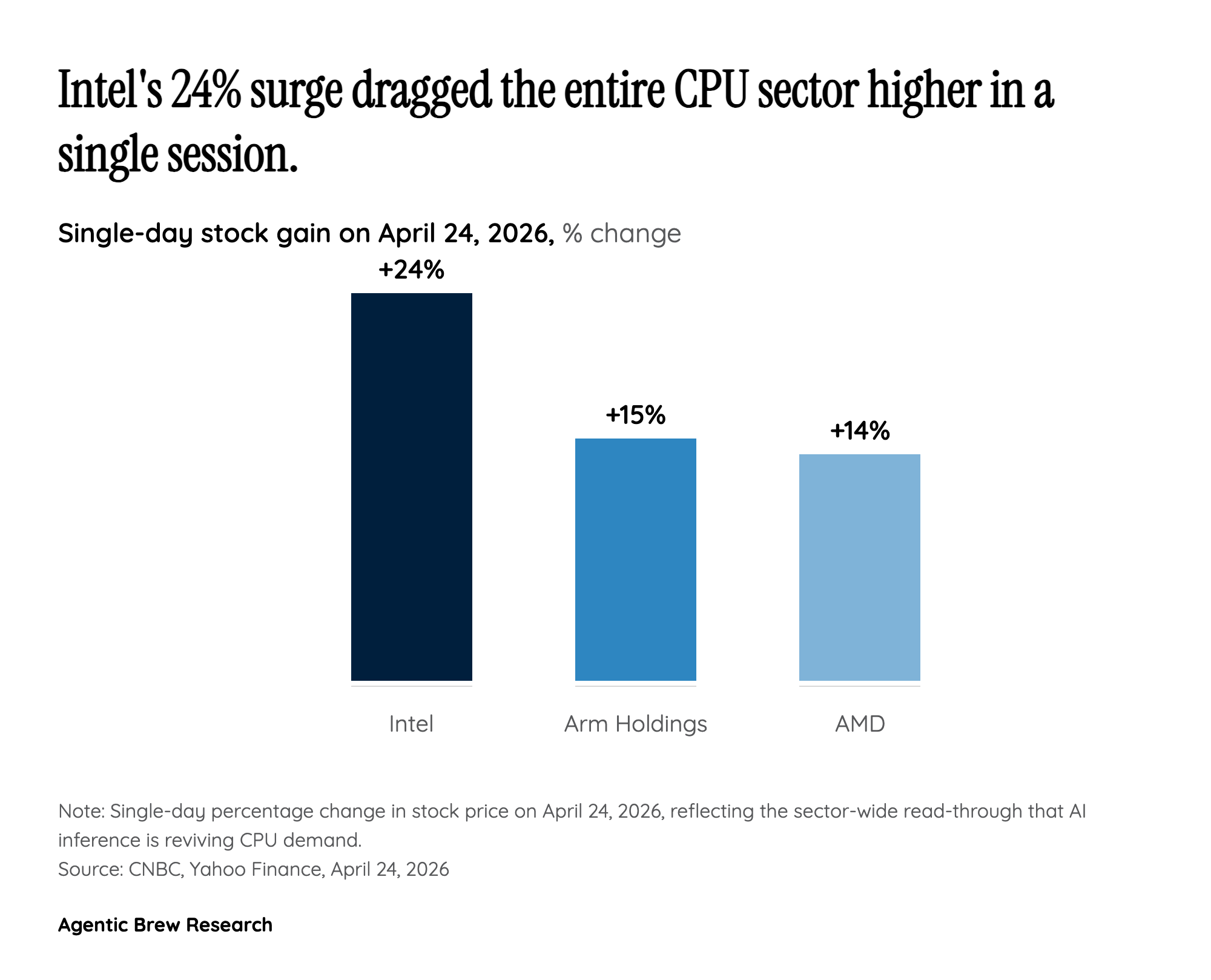
Single-day stock gain on April 24, 2026: Intel +24%, Arm Holdings +15%, AMD +14%.

The single-day move was historic in the most literal sense. Intel's roughly 24% gain on April 24, 2026, was its best trading day since October 1987 — a 39-year record that the chipmaker held through the dot-com bubble, the 2008 financial crisis, the 2020 COVID crash, and the 2022 chip-cycle reset. The rally also pushed Intel above its August 2000 dot-com era high, an all-time peak that had stood for roughly 26 years. Year-to-date 2026 gains now exceed 100%, the 12-month gain is approximately 224%, and market capitalization is above $416 billion.

The ripple effects are nearly as striking. AMD rallied around 14% and Arm Holdings around 15% in the same session — both companies that Morgan Stanley flagged as Intel's structural competitive risk — on the broader signal that AI inference revives CPU demand industry-wide. Q1 specifics: revenue of $13.58 billion versus a $12.42 billion estimate, non-GAAP EPS of $0.29 versus a $0.01 consensus (a roughly 29x beat), and a sixth consecutive quarter above Intel's own guidance. On the foundry side, Tesla's announced 14A commitment is the first major external customer; broader 14A commitments from prospective customers are not expected until the second half of 2026 or first half of 2027, once PDK 1.0 ships. The chart below frames how the day-of move sits against Intel's 12-month run.

What the Skeptics Are Watching

The bull case is loud, but the bear case is structured. Wedbush flagged Intel's valuation as 'stretched' even as it acknowledged improving fundamentals. Morgan Stanley raised its price target to $73 from $56 but kept a Neutral rating, explicitly citing 'market share to Advanced Micro Devices (AMD) and Arm Holdings' as the reason not to upgrade. The implication: even if Intel is winning the next eighteen months, the longer-run server CPU socket is increasingly contested — AMD has been taking share in cloud and enterprise for years, and ARM-based custom hosts inside the hyperscalers are quietly displacing x86 sockets in workloads that scale to the tens of millions.

Execution risk on 14A is the other open question. Tan has previously warned that Intel would exit manufacturing without an outside 14A customer; Tesla's Terafab announcement clears the existential bar but does not yet translate into firm committed volume from Google, Apple, AMD, or NVIDIA, all of whom are expected to make decisions in late 2026 or 2027. Supply constraints are a near-term cap on the upside — CFO David Zinsner said Q1 results would have been even stronger if Intel could produce more chips, which is bullish on demand but bearish on how much of that demand actually converts to revenue this year. Community sentiment captures the split: Wall Street Bets is processing the move through nostalgia and meme — one viral post counts the years since the 'Nana' inheritance bet became a winner — while cable-news analysts frame the move as 'cautious optimism' on Tan's turnaround rather than a clean victory lap.

Historical Context

1987-10
Intel's previous best single-day gain occurred around the October 1987 crash period; the April 24, 2026 surge breaks that 39-year record.
2000-08
Intel's previous all-time high was set during the dot-com bubble; the April 2026 rally finally eclipses that peak after roughly 26 years.
2025-08
The Trump administration converted $5.7B of unpaid CHIPS Act funds and $3.2B of Secure Enclave funds into a 9.9% Intel equity stake at $20.47 per share, for a total cost of $8.9B.
2025-09
NVIDIA announced its $5B Intel equity investment and joint custom-CPU/SoC partnership; the FTC cleared the deal in December 2025.
2025-12-29
NVIDIA closed the $5B Intel share purchase, acquiring roughly 217.4 million shares at $23.28; that stake was already worth around $7.58B before the April rally.
2026-04-23
Elon Musk announced on Tesla's Q1 2026 call that the Austin Terafab will use Intel 14A — Intel's first major announced 14A customer, landing the same day as Intel's earnings beat.

Power Map

Key Players
Subject

Intel stock surges on AI-driven turnaround

IN

Intel Corporation

Subject of the rally; Q1 2026 results delivered a sixth consecutive quarter above expectations and validated Lip-Bu Tan's turnaround playbook.

LI

Lip-Bu Tan (Intel CEO)

Architect of the turnaround; framed the CPU as the 'indispensable foundation of the AI era' and pushed cost cuts, foundry pivot, and an outside-customer mandate for the 14A node.

NV

NVIDIA / Jensen Huang

Strategic investor with a $5B equity stake (~4%) and partner on NVLink-connected x86 CPUs and RTX-chiplet SoCs; the deal effectively legitimizes Intel's AI roadmap.

U.

U.S. Government / Trump Administration

Holds a 9.9% Intel stake acquired in August 2025 by converting CHIPS Act and Secure Enclave funds into equity; now sitting on a roughly $26.5B unrealized gain.

TE

Tesla / Elon Musk

First major announced 14A customer; the Austin 'Terafab' project commits Tesla's silicon to Intel's most advanced node and de-risks Intel Foundry.

AM

AMD and Arm Holdings

Rivals that rallied 11–15% on the read-through that AI inference revives CPU demand, while simultaneously named by Morgan Stanley as the structural share-loss risk to Intel.

THE SIGNAL.

Analysts

"Argues the CPU has reasserted itself as the foundational layer for AI inference and agentic workloads, repositioning Intel from existential survival to a capacity-and-scale problem."

Lip-Bu Tan
CEO, Intel

"Says demand exceeds Intel's current supply and that Q1 results would have been even stronger if production could keep up — a signal that capacity adds, not demand, are the next bottleneck."

David Zinsner
CFO, Intel

"Frames the partnership as a foundational coupling of NVIDIA's AI and accelerated computing stack with Intel CPUs, anchoring x86 in the next computing era."

Jensen Huang
CEO, NVIDIA

"Says securing any external 14A customer matters more than the schedule, because the binary question for Intel Foundry is whether the world will use the node at all."

Jay Goldberg
Analyst, Seaport Research Partners

"Raised the price target to $73 from $56 but maintained a Neutral rating, citing concerns about market share loss to Advanced Micro Devices and Arm Holdings."

Morgan Stanley Analysts
Sell-side, Morgan Stanley
The Crowd

"Intel Shares Surge 24%—Breaking Dot-Com Record After Earnings Fuel Turnaround Optimism"

@@Forbes0

"#Intel is back. $INTC +18% after hours, best level since 2000. The AI wave everyone thought would bypass Intel? It's here. Data Center revenue +22%. AI-driven CPU demand is real. Rev $13.6B beat $12.4B est. EPS $0.29 crushed $0.01 est. Full insights on earnings."

@@Phemex_official0

"Intel Beat Earnings Expectations - Revenue: $13.6 billion (vs. consensus ~$12.3-12.4B; +7% YoY). Non-GAAP EPS: $0.29 (vs. consensus ~$0.01; massive beat). Data Center & AI: Strong at $5.1B (beat expectations of ~$4.4B). AI-related businesses now ~60% of revenue, up 40%"

@@BraVoCycles0

"Sometimes I Think About That Man Who Invested All Inheritance Into INTEL"

@u/Interesting_Week_9179021
Broadcast
Intel Rips +20% on Agentic-AI Earnings as Trump Reschedules Pot and Freezes $344M in Iran Crypto

Intel Rips +20% on Agentic-AI Earnings as Trump Reschedules Pot and Freezes $344M in Iran Crypto

Intel stock pops on earnings, analyst says there's 'cautious optimism'

Intel stock pops on earnings, analyst says there's 'cautious optimism'

Stocks Fall on Iran Jitters, Intel Delivers Earnings Beat | The Close 4/23/2026

Stocks Fall on Iran Jitters, Intel Delivers Earnings Beat | The Close 4/23/2026