Cerebras Upsized IPO
TECH

Cerebras Upsized IPO

33+
Signals

Strategic Overview

  • 01.
    Cerebras upsized its IPO on May 11, 2026 to 30 million shares (from 28 million) and lifted the price range to $150-$160 per share, up from $115-$125 — the latest upward revision in roughly a week.
  • 02.
    At the high end of the revised range Cerebras could raise approximately $4.8 billion, with a market cap of $33.36B at the $155 midpoint and up to $48.8B fully diluted at the top.
  • 03.
    Investor orders exceeded available shares by more than 20x, the direct trigger for the upsize and repricing.
  • 04.
    Cerebras is expected to list on Nasdaq under symbol CBRS around May 13-14, 2026, putting it on track to be the largest tech IPO of the year so far, anchored by an OpenAI compute commitment valued at over $20 billion.

Deep Analysis

The Bookbuilding Mechanism: How 20x Demand Repriced the Deal in Days

In a normal IPO, bookbuilding is a slow tide: underwriters set an initial price range, road-show the deal for two weeks, gauge institutional interest, and price near the midpoint on listing eve. Cerebras has done something different. The original terms — 28 million shares at $115-$125 — would have raised roughly $3.5 billion <research_source_url_1>. Within days, indications of interest from institutions exceeded the available float by more than 20 times <research_source_url_2>. That kind of cover ratio is what underwriters call a 'multiple-times-oversubscribed' book; when it crosses 10x it typically triggers an upsize, and when it crosses 20x it forces a meaningful repricing because allocators are signaling they would accept a materially higher clearing price. Joint book-runners Morgan Stanley, Citigroup, Barclays, and UBS responded by lifting the range to $150-$160 on 30 million shares, raising the targeted proceeds to approximately $4.8 billion <research_source_url_3> <research_source_url_1>.

What 20x oversubscription actually means in practice is that for every share offered, more than twenty shares' worth of orders were submitted at or above the indicated price. That does not mean every order is firm at the new top of range — some orders are conditional, some get cut on allocation — but it does mean the bankers have very high confidence the deal will clear at $160 and that aftermarket appetite is real. The flip side, and the reason sophisticated investors are paying attention to the cadence, is that lifting both the share count and the price range in such a compressed window is unusual. It suggests either that the original range was deliberately conservative to manufacture momentum, or that the demand environment is moving so fast that underwriters are repricing in near-real time. Either reading carries implications for how the stock trades when CBRS is expected to list on Nasdaq <research_source_url_4>.

Following the Money: The OpenAI Entanglement

Customer concentration is a standard S-1 risk factor. Cerebras's relationship with OpenAI is something more structural. OpenAI is, simultaneously, Cerebras's anchor customer (a 750-megawatt multi-year compute commitment valued at over $20 billion), a lender ($1 billion extended at 6% to fund data center buildout), and a warrant holder (over 33 million Class N shares) <research_source_url_5> <research_source_url_4>. In equity terms, Cerebras's largest customer is also among its largest economic claimants on the upside. That is a structure usually associated with strategic joint ventures, not arms-length supplier contracts.

The bull case is straightforward: a $20B-plus multi-year commitment provides revenue visibility most IPO chipmakers can only dream of, and it converts what would be a speculative inference bet into a contracted backlog. The bear case is equally clean. Cerebras's S-1 disclosures show that G42 accounted for 24% of 2025 revenue (down from 85% in 2024) and MBZUAI alone made up 62% of 2025 revenue <research_source_url_5>. Layering OpenAI on top concentrates the customer base even further. If OpenAI's own compute mix shifts — toward its in-house silicon ambitions, toward more diversified inference partners, or simply through renegotiation — Cerebras's revenue trajectory does not have many places to hide. The warrants make the picture more interesting still: as Cerebras's equity value rises, OpenAI's economic interest as a warrant holder grows alongside it, meaning OpenAI has direct upside exposure to the very stock its purchasing decisions support. This is the entanglement skeptics are pricing, even as institutional buyers treat it as a feature rather than a bug.

The Contrarian Math: Why Highly-Upvoted Retail Skeptics Aren't Disputing the Chip

The most striking feature of the community conversation is not that retail investors are skeptical — they often are around hot AI listings — but where the skepticism is and isn't. Retail discussion on r/stocks is sharply split, with the most upvoted analytical post arguing that at $160 Cerebras trades at roughly PS 67x on a 43% gross margin with three major customers, a profile that compares unfavorably to Nvidia, Broadcom, and AMD on essentially every axis the writer considered. The conclusion that gained the most traction was blunt: the bankers have repeatedly repriced the deal beyond what the underlying fundamentals would support on a comparable-multiples basis. A separate widely-upvoted thread surfaced a more tactical view: with small-float AI IPOs, the relevant inflection point is often the six-month lock-up expiry, when pre-IPO holders unlock and can compress price toward fundamentals.

What is notably absent from the skeptical case is any serious dispute about the technology. The WSE-3 wafer-scale engine is, by independent equity-research accounts, roughly 57 times larger than the largest competing GPU die and delivers inference throughput in the range of 1,800-2,100 tokens per second versus approximately 90-150 on Nvidia's H100 <research_source_url_6>. Even Reddit's most cited bear acknowledges those numbers. The disagreement is entirely about the entry price relative to defensible margin structure, customer concentration, and Nvidia's CUDA-driven switching costs, which independent analysts describe as 'measured in years' <research_source_url_6>. In other words, the institutional bid and the sophisticated retail skeptic are looking at the same chip and reaching opposite conclusions about valuation — a rare and clean disagreement that the first weeks of CBRS trading will help arbitrate.

From CFIUS Halt to $48.8B in Nineteen Months: The Markup Arc

From CFIUS Halt to $48.8B in Nineteen Months: The Markup Arc
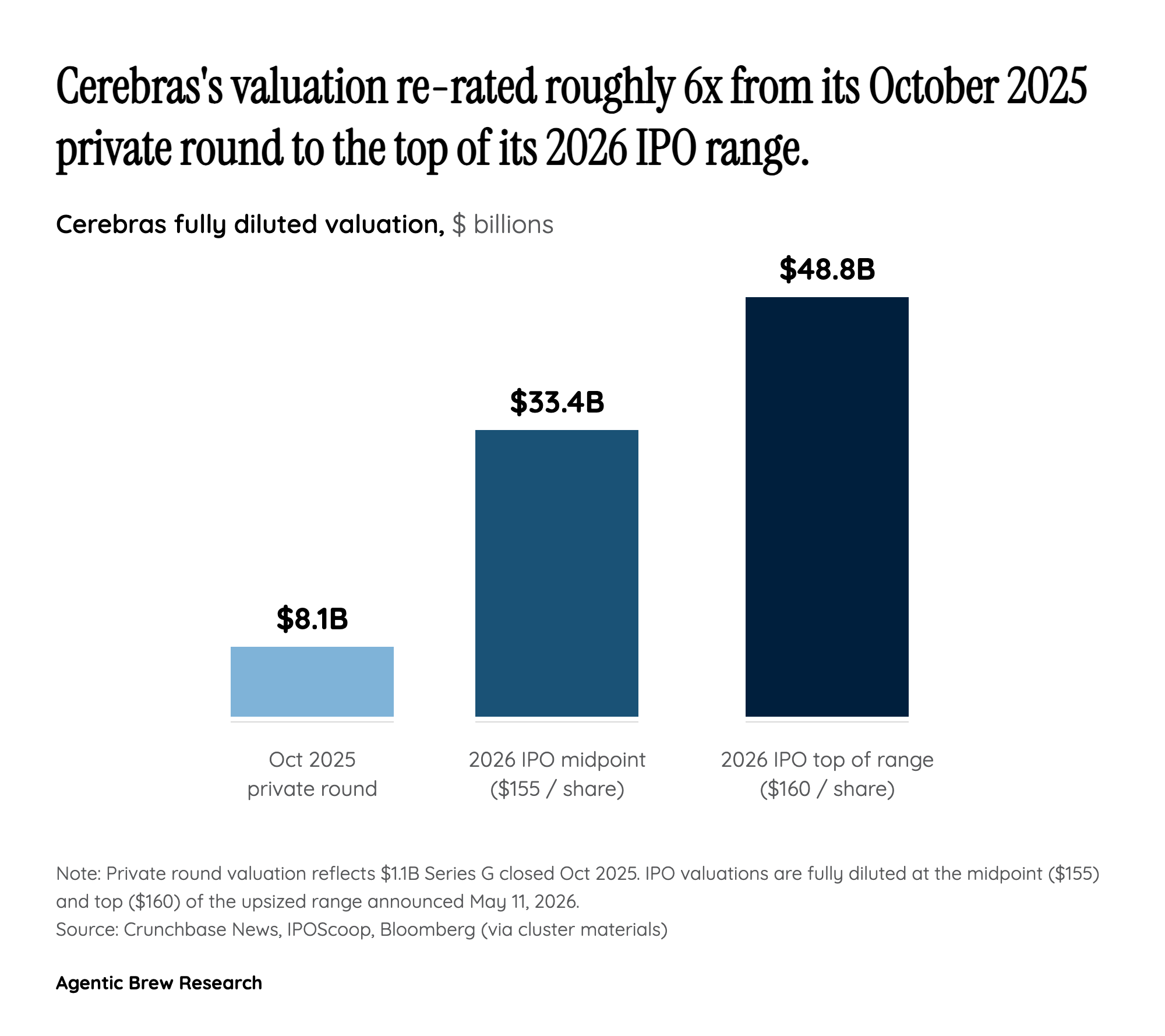
Cerebras's fully diluted valuation re-rated roughly 6x from its October 2025 private round to the top of the May 2026 IPO range.

The most underappreciated context for today's pricing is how recently Cerebras was valued at a small fraction of where it is about to list. Cerebras filed its first S-1 in September 2024 <research_source_url_7>. That offering was effectively frozen by a CFIUS review of the company's ties to Abu Dhabi's G42, which at the time accounted for 85% of Cerebras's revenue <research_source_url_5>. CFIUS cleared the review in March 2025, but by then the deal calendar had moved on. In October 2025, Cerebras formally withdrew its registration and raised a $1.1 billion private round at an $8.1 billion valuation <research_source_url_7>. That price tag — set by sophisticated late-stage private investors with full access to financials — was the company's reference point seven months ago.

At the top of the current range, Cerebras would list at a fully diluted valuation of roughly $48.8 billion <research_source_url_3>. That is approximately a 6x markup from the October 2025 private round, in a span of about seven months. Some of that markup is genuinely earned: 2025 revenue grew 76% to $510 million, net income reached $238 million (a 47% net margin), and the OpenAI compute commitment materially de-risked future revenue <research_source_url_5> <research_source_url_6>. Some of it is the demand environment: the global AI inference market is estimated at $106.2 billion in 2025 and projected at $255 billion by 2030 <research_source_url_8>, and CBRS is a relatively rare pure-play. But the steepness of the re-rating — combined with repeated upward revisions to both share count and price range in a single week — is itself the central narrative of this offering. Cerebras is not just going public; it is going public at a price that requires the inference thesis to substantially deliver.

Historical Context

2024-09-30
Cerebras filed its first public S-1, beginning its initial attempt to go public in late 2024.
2024-12-01
OpenAI received warrants for over 33 million Cerebras Class N shares as part of a multi-year compute agreement, binding the two companies financially well before the IPO.
2025-01-01
OpenAI extended a $1B loan at 6% to Cerebras to fund data center buildout supporting their compute deal.
2025-03-01
CFIUS cleared its review of Cerebras-G42 ties — the regulatory blockade that had stalled the original 2024 IPO — opening the door to a refile.
2025-10-03
Cerebras formally withdrew its IPO registration with the SEC after raising a $1.1B private round at an $8.1B valuation, resetting its capital base ahead of a future refile.
2026-04-17
Cerebras's refiled S-1 became public after a confidential February 2026 submission, formally restarting its path to listing.
2026-05-11
Cerebras upsized the offering to 30 million shares at $150-$160 — the latest upward revision in roughly a week — ahead of expected May 13-14 pricing on Nasdaq under symbol CBRS.

Power Map

Key Players
Subject

Cerebras Upsized IPO

CE

Cerebras Systems

Sunnyvale-based AI chipmaker conducting the upsized IPO; producer of the WSE-3 wafer-scale chip optimized for AI inference, listing on Nasdaq under symbol CBRS.

OP

OpenAI

Anchor customer, lender, and warrant holder: signed a 750MW multi-year compute deal worth over $20B, extended a $1B loan at 6%, and holds warrants for over 33 million Class N shares.

G4

G42

Abu Dhabi-based AI firm that historically dominated Cerebras revenue (85% in 2024, 24% in 2025) and whose ties triggered the CFIUS review that derailed the 2024 IPO.

NV

Nvidia

Dominant AI accelerator incumbent with ~70-80% market share; its GPU plus CUDA software ecosystem is the moat Cerebras's inference-first thesis seeks to bypass.

MO

Morgan Stanley, Citigroup, Barclays, UBS

Joint book-running lead underwriters managing demand allocation and the repeated price revisions.

AN

Andrew Feldman

Co-founder and CEO of Cerebras; publicly framed the prior 2024 prospectus as 'out of date' when the deal was refiled in 2026.

Source Articles

Top 4

THE SIGNAL.

Analysts

"At ~51-53x trailing 2025 revenue Cerebras is priced steeply, but GAAP profitability and 20x+ institutional oversubscription suggest the market views the multiple as defensible. Quote: 'At $135 per share, Cerebras is priced at approximately 51 to 53 times its 2025 trailing revenue.'"

TradingKey analysis
Equity research, TradingKey

"The WSE-3 architecture is the technical case for the offering. Quote: 'Cerebras's Wafer-Scale Engine (WSE-3) uses the entire wafer as a single chip, roughly 57 times larger than the largest competing GPU die,' giving on-chip memory and bandwidth advantages that translate into 1,800-2,100 inference tokens/sec versus ~90-150 on Nvidia's H100."

TradingKey analysis
Equity research, TradingKey

"The bear case is software, not silicon. Quote: 'Nvidia controls approximately 70 to 80% of the AI accelerator market and its CUDA software ecosystem creates switching costs that are measured in years' — a structural cap on how quickly Cerebras can take share even with a faster chip."

TradingKey analysis
Equity research, TradingKey

"On why the 2024 prospectus had to be scrapped and refiled after the CFIUS-driven delay: he described the original filing as simply 'out of date' given how dramatically AI conditions had shifted between 2024 and the 2026 refile."

Andrew Feldman
CEO, Cerebras Systems

"Frames Cerebras's positioning explicitly as an Nvidia challenger built on workload specialization. Quote: 'Cerebras has emerged as a notable rival to Nvidia Corp by focusing on specialized processors optimized for AI inference rather than traditional training workloads.'"

Benzinga market analysis
Markets coverage, Benzinga
The Crowd

"BREAKING: Cerebras to raise IPO price range to $150 to $160 a share as demand surges, per CNBC"

@@unusual_whales1000

"CEREBRAS UPSIZES IPO TO $4.8B AFTER 20X DEMAND $CRBS filed to sell 30M shares at $150-$160 each, up from 28M shares at $115-$125. At the top of the new range, the AI chipmaker would raise roughly $4.8B, compared with $3.5B under the prior terms. Reuters says the IPO drew [strong demand]"

@@wallstengine258

"Cerebras increased the size of its initial public offering, now seeking to raise as much as $4.8 billion, as demand for the AI chipmaker and data center operator's shares continues to build — AI Chipmaker Cerebras Systems Seeks $4.8 Billion in Upsized IPO (bloomberg.com)"

@@business40

"CEREBRAS JUST HIKED ITS IPO PRICE RANGE FOR THE SECOND TIME IN THREE DAYS"

@u/cowardbeater1969115
Broadcast
Cerebras CEO, Andrew Feldman on Why Raise $1BN and Delay the IPO & Why NVIDIA's Worried About Growth

Cerebras CEO, Andrew Feldman on Why Raise $1BN and Delay the IPO & Why NVIDIA's Worried About Growth

The $25B AI Chip Taking On Nvidia (Cerebras IPO)

The $25B AI Chip Taking On Nvidia (Cerebras IPO)

Nvidia challenger Cerebras files for IPO

Nvidia challenger Cerebras files for IPO