Canva AI 2.0 launch
TECH

Canva AI 2.0 launch

37+
Signals

Strategic Overview

  • 01.
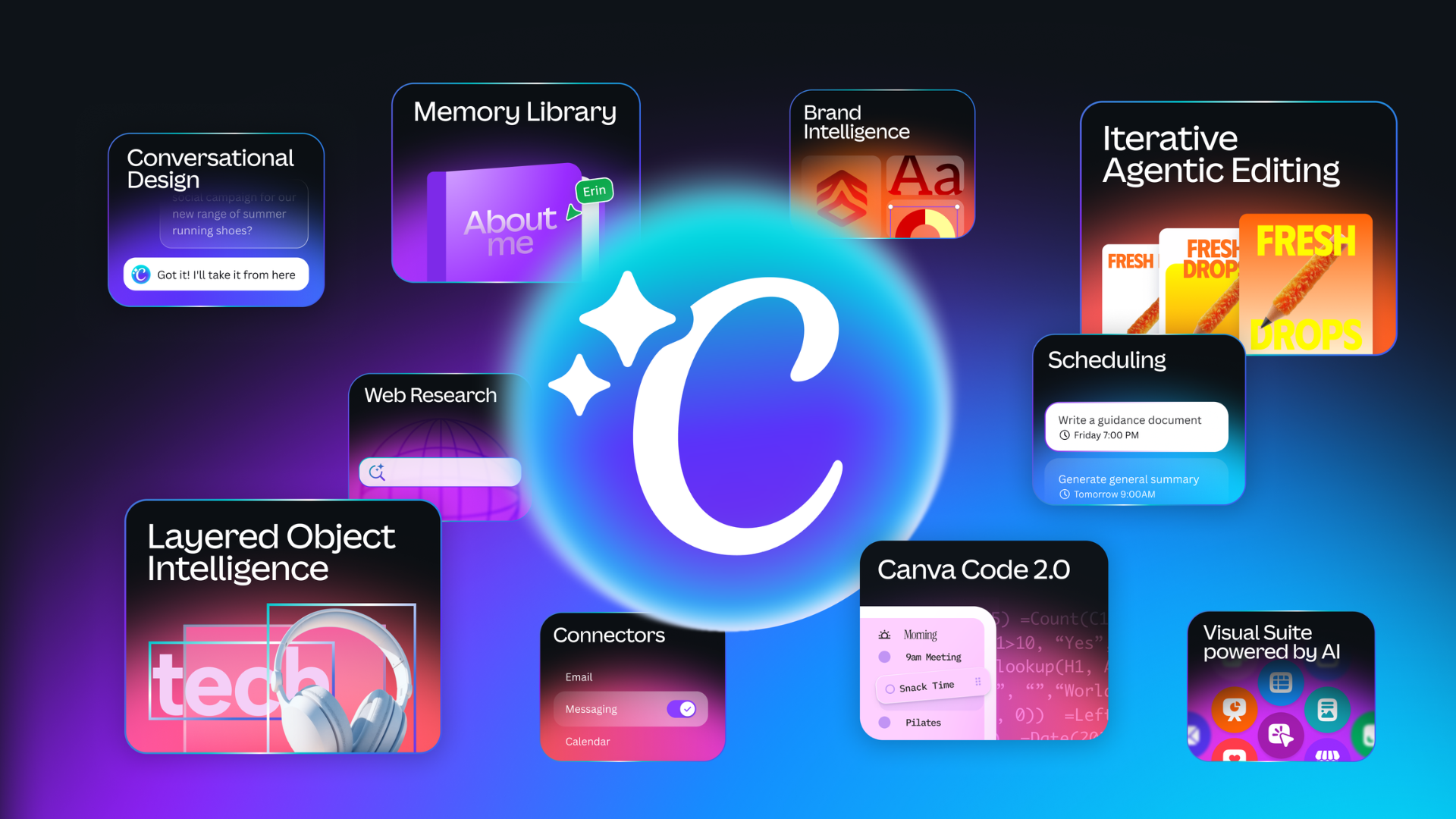
    Canva unveiled AI 2.0 on April 16, 2026 at Canva Create in Los Angeles, framing it as the company's most significant product shift since its 2013 debut and pivoting the platform from a design tool toward a conversational, agentic workplace system.
  • 02.
    The release rests on four architectural pillars - Conversational Design, Agentic Orchestration, Layered Object Intelligence, and a Memory Library (Living Memory) - plus six intelligent workflows: Connectors, Scheduling, Web Research, Brand Intelligence, Sheets AI, and Canva Code 2.0.
  • 03.
    Object-Based Intelligence generates editable objects rather than flat locked images, letting users swap and tweak individual elements without regenerating the whole design, while Connectors pull context from Slack, Notion, Zoom, HubSpot, Gmail, Google Drive, and Google Calendar.
  • 04.
    Canva AI 2.0 rolls out as a research preview to the first one million users via the Canva homepage, with access expanding over the coming weeks; AI features remain free under existing plans, with a new 'AI Pass' add-on offering higher rate limits.

Why Canva built its own design-native foundation model instead of renting frontier APIs
Why Canva built its own design-native foundation model instead of renting frontier APIs
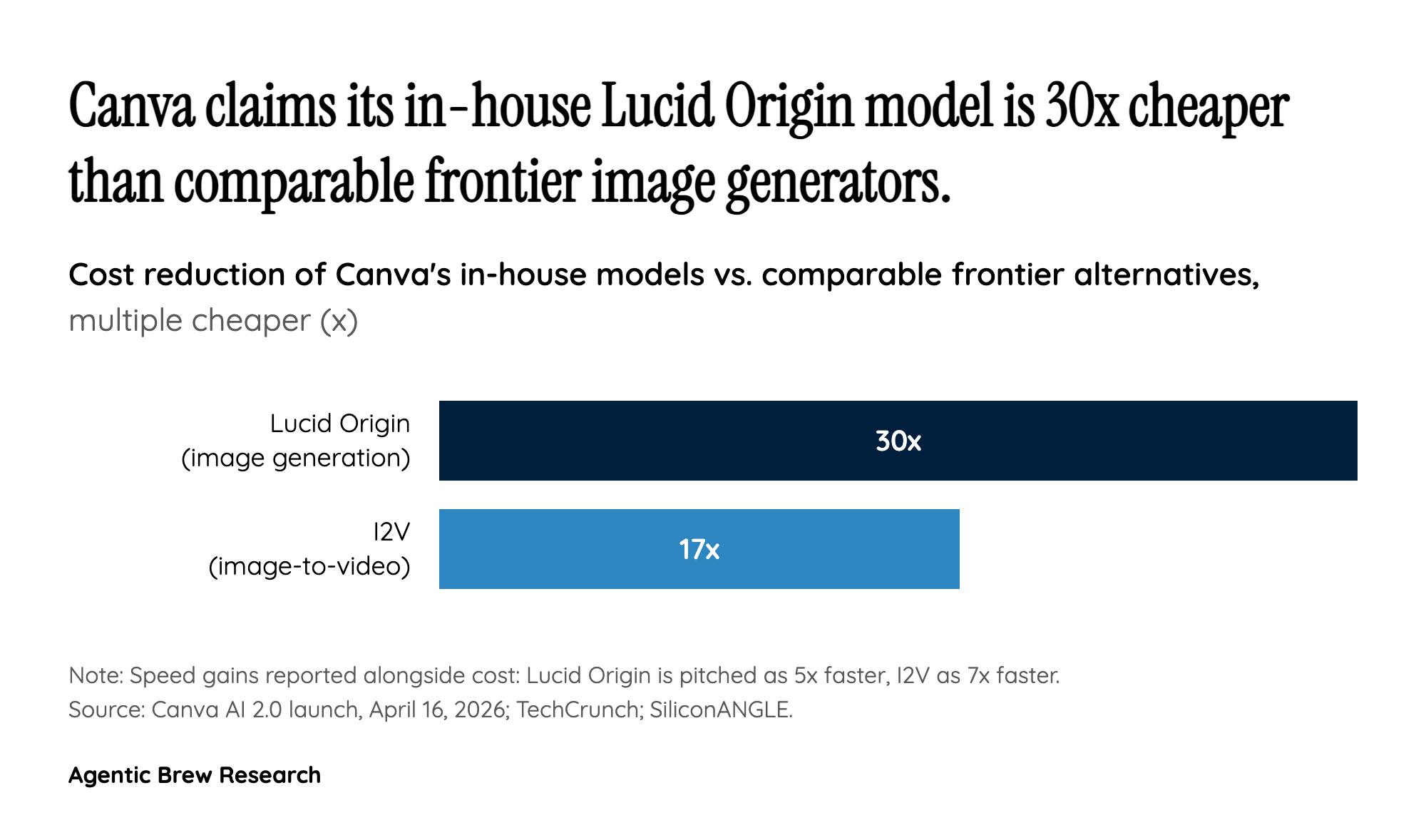
Canva's claimed cost multiples vs. comparable frontier alternatives.

The headline economic claim of AI 2.0 is not a feature but a model: Lucid Origin, Canva's image-generation model, is pitched as 5x faster and 30x cheaper than comparable frontier alternatives, and its image-to-video (I2V) model as 7x faster and 17x cheaper. Those numbers explain a strategic choice. Canva has over 100 researchers inside its CORE (Canva Original Research and Exploration) group, and since acquiring Leonardo.Ai in 2024 it has been quietly building a design-layer foundation model rather than wiring Stable Diffusion or a frontier API underneath its canvas. At the volume Canva generates - 27 billion Canva AI uses to date, tripling in the past year - a 30x cost gap is not a margin story, it is the difference between offering AI for free under existing plans and gating it behind per-seat pricing.

That also reframes Object-Based Intelligence. Flat diffusion outputs are commercially cheap but editorially expensive, because every iteration is a full regeneration. A model trained to emit layered, editable objects lets Canva keep a user inside one design session across dozens of tweaks without a corresponding inference bill. Combined with Magic Layers - the Canva Design Model feature used more than nine million times in the month before launch - the pattern is clear: Canva is betting that vertically specialized, cheaper-to-serve models beat rented frontier horsepower for the narrow task of editable design generation, and it is using that cost structure as the price wedge that keeps AI free at scale.
The 'final mile' gambit: positioning Canva beneath every other AI assistant

The most revealing line from Cliff Obrecht is that Canva works 'incredibly well with Anthropic, Google, and OpenAI' - meaning those assistants can call Canva for content and hand it back - 'but they always need to end up doing the final mile of editing, collaboration, and deployment.' That is not the language of a company trying to out-chatbot ChatGPT. It is the language of a company trying to sit underneath all of them. Connectors plug the other direction too: Canva AI reaches into Slack, Notion, Zoom, HubSpot, Gmail, Google Drive, and Google Calendar, so a prompt can silently assemble a newsletter from this week's Slack threads or a pitch deck from yesterday's HubSpot leads.

That dual posture - be callable from other LLMs, and pull context from the rest of the workplace - is how Canva turns commoditized text-to-image capability into a defensible distribution position. Liz Miller's read at Constellation Research captures the shift precisely: Canva is 'not bolting on AI to its tools, but shifting to put AI in front,' and is 'less interested in becoming a tool innovation machine' than in 'democratizing the work.' If Canva succeeds, the strategic question for Adobe Firefly's assistant and Figma's agentic workflows is no longer who has the best model. It is who owns the layer where design actually gets finished, approved, and shipped - and Canva is betting that's still a canvas, not a chat window.

An IPO-year pivot: why this ships now, at a $42 billion valuation

AI 2.0 is landing with unusually loud strategic framing - 'Canva's biggest shift since 2013' - and the timing is not incidental. Obrecht has confirmed that Canva is working toward a 2027 IPO. The company enters that window at a $42 billion valuation, $4 billion ARR as of end of 2025, 265 million monthly active users, 31 million paid subscribers, and enterprise revenue growing 100% year-on-year. The gap a public market will scrutinize is not user growth. It is the narrative gap between 'templates-and-drag-and-drop' and 'AI-native workplace platform' - and AI 2.0 is built to close it.

Read through that lens, every piece of the release does double duty. The research preview capped at one million users manufactures scarcity and generates the kind of creator-channel coverage that lifts the launch beyond press-release reach. The 'AI Pass' add-on plants an explicit upsell lever on top of the free tier, giving public-market analysts a visible path to monetize the 265 million MAU base. Connectors with Slack, HubSpot, and the Google suite position Canva as an enterprise operating layer rather than a creative tool, feeding the 100%-YoY enterprise growth story. And positioning Canva as the 'final mile' to Anthropic, Google, and OpenAI makes the company complementary rather than substitutable in an AI landscape investors are actively trying to map. AI 2.0 is, among other things, an S-1 in product form.

The community backlash Canva doesn't want on the keynote reel

Outside the press coverage, the reception inside Canva's own community has been notably colder than the launch deck. On r/canva, a post titled 'Dear Canva' climbed to the top of the subreddit with commenters asking the company to stop 'facelifting' the product week after week. The official Canva Create 2026 megathread drew unusually low engagement, with live reactions complaining that 'AI is the first thing presented,' dismissing demos as 'more AI slop,' and asking whether the keynote was 'just a day long ad for AI.' Pricing rumors around the AI Pass - anecdotally floated in the $10 to $100 per-user range - surfaced alongside worries about AI fatigue and missing fundamentals like kerning, alternate characters, and glyphs, with some design professionals saying they are migrating back toward Adobe, Affinity, and Kittl.

That tension matters because it maps cleanly onto Liz Miller's framing: Canva is deliberately stepping back from being a 'tool innovation machine' in favor of democratizing the underlying work with AI. The creative professionals who care most about precise typography and granular controls are, in effect, being told they are not the target user anymore. Canva's bet is that the hundreds of millions of non-designers newly empowered by conversational prompts and Connectors will more than offset the pros drifting toward specialist tools. That bet may well pay off commercially - but the first wave of hands-on reactions makes clear it is a bet, not a consensus, and the loudest dissent is coming from inside Canva's own most engaged community rather than from Adobe or Figma.

Historical Context

2013-01-01
Canva launched, moving design from desktop software into the browser; AI 2.0 is explicitly framed as the biggest shift since this debut.
2019-01-01
Shipped its first AI feature, Background Remover, marking the start of Canva's in-product AI journey.
2022-01-01
Debuted native generative AI tools Text-to-Image (now Magic Media) and Magic Write, which has since generated over one billion words.
2023-10-04
Launched Canva Magic Studio, a unified AI suite, on the company's 10-year anniversary.
2024-01-01
Acquired Leonardo.Ai and had Magic Studio named one of TIME's Best Inventions of 2024.
2025-01-01
Launched Visual Suite 2.0 and introduced Canva AI as a conversational all-in-one creative partner, alongside an in-house design-layer foundation model.
2026-03-01
Released Magic Layers powered by the Canva Design Model, which was used more than nine million times before AI 2.0 shipped.
2026-04-16
Unveiled Canva AI 2.0 at Canva Create in Los Angeles as a research preview to the first one million users.

Power Map

Key Players
Subject

Canva AI 2.0 launch

CA

Canva

Launching company repositioning from design tool to conversational, agentic workplace platform; targets its 265 million monthly active users and 31 million paid subscribers with this pivot.

CA

Cameron Adams

Co-founder and Chief Product Officer; public-facing spokesperson describing AI 2.0 as 'Canva reimagined as a conversational, agentic platform.'

CL

Cliff Obrecht

Co-founder and COO; positions Canva alongside Anthropic, Google, and OpenAI in agentic workflows and has confirmed an IPO targeted for 2027.

DA

Danny Wu

Head of AI at Canva; articulates the multi-year research path behind AI 2.0 and the design-native foundation model work.

LE

Leonardo.Ai

Australian AI lab acquired by Canva in 2024; underpins research capabilities, foundation model work, Dream Lab, and the Lucid Origin model.

AN

Anthropic, Google, OpenAI

Named LLM partners; their users can call Canva from external agentic workflows and send generated content back into those assistants.

SL

Slack, Notion, Zoom, HubSpot, Gmail, Google Drive, Google Calendar

Integration partners surfaced through Connectors, giving Canva AI visibility into team conversations, documents, meetings, and schedules.

AD

Adobe (Firefly) and Figma

Competitive rivals; both expanding into agentic creative workflows, intensifying the three-way race for AI-assisted design.

THE SIGNAL.

Analysts

"Reads AI 2.0 as a strategic pivot that puts AI in front of the product experience rather than layering it on top, and argues Canva is deliberately de-emphasizing tool innovation to focus on democratizing the underlying work. Quote: 'This is a big move for Canva. Canva is not bolting on AI to its tools, but shifting to put AI in front.' And: 'Canva is less interested in becoming a tool innovation machine. Instead, the company is focused on the work and democratizing the work with the tools.'"

Liz Miller
Analyst, Constellation Research

"Positions Canva as the 'final mile' in a multi-LLM world and stresses its centrality to small-business workflows. Quote: 'We also work incredibly well with Anthropic, Google, and OpenAI, so if someone is doing their agentic workflows in those products, they can call Canva, get content, and they can get it back into those LLMs. But they always need to end up doing the final mile of editing, collaboration, and deployment. That's where we really are strong.' And: 'I think a lot of small businesses start and end their day, and they'll do a lot of their workflows completely, in Canva.'"

Cliff Obrecht
Co-founder and COO, Canva

"Frames AI 2.0 as the culmination of long-running research ambitions rather than a reactive release. Quote: 'This is something we've been dreaming of and working towards for quite a while.'"

Danny Wu
Head of AI, Canva
The Crowd

"Canva's AI 2.0 update goes all in on prompt-powered design tools"

@@verge23

"The creative stack is being rebuilt for the AI era. Congrats to @canva on the launch of Canva AI 2.0. Where a prompt becomes a finished, on-brand design. - Conversational design + agentic orchestration - 6 new workflows spanning research, scheduling, and code - 27+ billion..."

@@coatuemgmt20

"Canva unveils Canva AI 2.0, which can generate editable layered designs from conversational prompts using Canva's foundation model built specifically for design (@oliviapohtech / Bloomberg)"

@@Techmeme2

"Dear Canva"

@u/LetPlus8553154
Broadcast
Canva Create 2026

Canva Create 2026

Canva AI 2.0 Just Changed Everything

Canva AI 2.0 Just Changed Everything

NEW Canva Features You HAVE TO know about! (Canva Create 2026)

NEW Canva Features You HAVE TO know about! (Canva Create 2026)