Google signs classified AI deal with Pentagon
TECH

Google signs classified AI deal with Pentagon

47+
Signals

Strategic Overview

  • 01.
    Google has signed a classified agreement letting the U.S. Department of Defense run Gemini on classified networks for 'any lawful government purpose,' confirmed publicly on April 28, 2026.
  • 02.
    The reported $200 million contract obligates Google to adjust its AI safety settings and content filters at the government's request, while disclaiming any right to control downstream operational use.
  • 03.
    Google joins OpenAI and Elon Musk's xAI in similar 'any lawful purpose' Pentagon deals, after Anthropic refused to drop guardrails on weapons and surveillance use and was designated a 'supply chain risk.'
  • 04.
    On April 27, 2026, more than 580-600 Google and DeepMind employees, including 20+ directors and VPs, signed a letter urging CEO Sundar Pichai to reject any classified Pentagon workloads.
  • 05.
    Contract language states Gemini is not intended for domestic mass surveillance or autonomous weapons target selection without 'appropriate human oversight,' but employees and analysts argue this language is advisory rather than enforceable on air-gapped classified networks.
  • 06.
    The same week, Google quietly withdrew from a separate ~$100 million Pentagon drone-swarm contest, citing 'a lack of resourcing,' even as it doubled down on the broader classified Gemini contract.

Deep Analysis

The 'Any Lawful Purpose' Clause Reversed Who Has Bargaining Power

For most of the past decade, frontier-AI vendors set the terms of engagement with the U.S. government. Companies wrote acceptable-use policies, refused specific deployments, and treated their safety stacks as non-negotiable product surface. The Pentagon's new procurement standard — 'any lawful government purpose' — inverts that posture. Instead of the vendor enumerating what the customer cannot do, the customer asserts an open-ended right limited only by U.S. law itself. That phrasing is what Anthropic refused to accept, and the consequences became the bargaining lever for everyone else.

When the Pentagon designated Anthropic a 'supply chain risk' in March 2026 and pulled a reported $200 million contract, it converted a values-based refusal into a federal-contracting penalty that radiates across the industry. Google, OpenAI and xAI now operate inside a market where saying no to the standard clause does not just lose one contract — it can attach a security label to your company. Google's signature, on a contract reportedly the same $200M size as the one Anthropic lost, is the clearest signal yet that the leverage has flipped: the Pentagon, not the model lab, now sets the safety perimeter.

Air-Gapped AI Is the Unverifiability Problem

The contract specifies that Gemini 'is not intended for, and should not be used for, domestic mass surveillance or autonomous weapons (including target selection) without appropriate human oversight and control.' On a normal commercial deployment, that language would be backed by telemetry — Google can see queries, log outputs, and revoke access. On a classified, air-gapped network, none of that holds. The vendor, by design, cannot observe what its model is doing.

That is the substantive concern in the employee letter, and it is not rhetorical. The signatories argue that 'the only way to guarantee that Google does not become associated with such harms is to reject any classified workloads,' precisely because verification is structurally impossible after deployment. Combined with Google's separate contractual concession to adjust safety filters at the government's request, the practical effect is that the published red lines exist on paper while the runtime configuration of the model can be tuned by the customer alone, on a network the vendor cannot inspect. Reddit and X commenters fixated on the 'lawful' qualifier as a 'blank check'; the deeper problem is that even a tighter qualifier would be unenforceable in this deployment topology.

2018 vs 2026: Same Playbook, Opposite Outcome

The 2018 Project Maven revolt is the historical reference everyone is reaching for, and the comparison is instructive precisely because the playbook is identical and the result is reversed. In 2018, roughly 4,000 Google employees signed a petition; the contract was killed and Sundar Pichai published the AI Principles a week later, pledging Google would not build AI for weapons or surveillance violating international norms. In 2026, 580-600 employees signed (TechCrunch later reported the count grew to 950), 20+ directors and VPs put their names on it — and Google confirmed the deal one day later.

Four things changed. First, the AI Principles themselves were quietly walked back in 2024, removing the moral commitment management could be held to. Second, Pentagon AI spending is now structural rather than experimental: $13.4B in FY2026, $54.6B requested for FY2027 across the Defense Autonomous Warfare Group, and a $9B JWCC cloud envelope — refusing this market is no longer refusing a side project. Third, the competitive landscape compressed: with OpenAI and xAI already signed, abstaining means watching rivals capture the entire federal AI surface. Fourth, and most pointedly, Anthropic's experience demonstrated that refusal has a price tag now. Reddit threads captured the cynicism bluntly, with multiple top comments predicting the signatories would be on the next layoff list — a read on internal power dynamics that the 2018 cohort did not have to consider.

The Safety-Filter Concession Is the Detail That Matters Most

Buried in the contract language is the line that separates Google's deal from OpenAI's: Google has agreed to 'assist in adjusting its AI safety settings and filters at the government's request.' OpenAI, by reporting, retained tighter control over its safety stack. That difference is small in print and large in operation. AI safety filters are not a single switch; they are a layered system of refusal classifiers, system prompts, output post-processors, and fine-tuning interventions that determine whether the model declines, hedges, or complies on a given query.

Contractually committing to adjust those layers on request means the customer can specify that the model cooperate with categories of queries it would otherwise refuse — surveillance prompts, weapons-adjacent reasoning, content the consumer-facing Gemini would block. Combined with the air-gapped deployment described above, this is the mechanism by which the 'not intended for' guardrails become advisory in practice: the customer can re-tune what 'intended' means at the configuration layer, and the vendor has agreed in advance to help. This is the technical specificity behind the employees' argument that internal red lines are unenforceable, and it is why DeepMind researchers in particular — the people who actually build those filters — are the most visible signatories.

Anthropic Is Now the Test Case Every Future Refuser Will Inherit

Anthropic's lawsuit is no longer a one-off corporate dispute; it is the precedent any AI company contemplating refusal will have to plan around. Judge Rita Lin's March 26 injunction called the supply-chain-risk designation 'Orwellian' and found 'nothing in the governing statute supports' branding a U.S. company a potential adversary for expressing disagreement with the government. That is a forceful district-court ruling, but on April 8 the D.C. Circuit declined to extend the block while litigation continues — meaning the Pentagon's leverage tool is, for now, intact on appeal.

This matters beyond Anthropic. The 'supply chain risk' label is the enforcement mechanism that makes 'any lawful purpose' a take-it-or-leave-it offer rather than a negotiation. Until the appellate posture clarifies, every refusal carries an asymmetric cost: lose the contract and risk the label. Anthropic has reportedly received up to $40 billion in investment commitments, providing a financial cushion most refusers would not have. The combination explains why Google's employees framed the moment as 'irreparable' — not because one classified contract reshapes the company, but because each signed deal entrenches the precedent that the Pentagon's procurement standard is the AI industry's safety floor, set externally rather than by the labs themselves.

Historical Context

2017-04-26
DoD memo establishes Project Maven, the 'Algorithmic Warfare Cross-Functional Team' that becomes the seed of every subsequent Pentagon AI partnership.
2018-06-01
After ~4,000 employees petitioned and several resigned, Google declined to renew its Project Maven contract for analyzing drone footage.
2018-06-07
Sundar Pichai published Google's AI Principles pledging not to design AI for weapons or surveillance violating international norms; those pledges were quietly walked back in 2024.
2026-03-09
Anthropic sued the Trump administration after the Pentagon labeled it a 'supply chain risk' for refusing unrestricted DoD use of Claude.
2026-03-26
Federal judge granted Anthropic an injunction blocking the Pentagon's supply-chain-risk designation while the case proceeds.
2026-04-08
Federal appeals court denied Anthropic's bid to temporarily block the Pentagon's blacklisting while litigation continues.
2026-04-27
Letter to Sundar Pichai signed by 580-600+ Googlers and DeepMind researchers urging refusal of classified Pentagon workloads.
2026-04-28
Google publicly confirms the classified Pentagon deal one day after the employee letter, and the same day withdraws from a separate $100M Pentagon drone-swarm contest citing 'a lack of resourcing.'

Power Map

Key Players
Subject

Google signs classified AI deal with Pentagon

GO

Google / Alphabet

Signatory of the classified contract; CEO Sundar Pichai is the named target of the employee letter, and Google DeepMind under Demis Hassabis houses many of the dissenting researchers. Holds the leverage of being the chosen 'any lawful purpose' vendor after Anthropic's refusal.

U.

U.S. Department of Defense / Pentagon

Counterparty obtaining classified Gemini access. Defense Secretary Pete Hegseth and Under Secretary for Research & Engineering Emil Michael drove the 'any lawful purpose' procurement standard that Anthropic refused, effectively turning vendor compliance into a precondition for federal AI work.

GO

Google employees and DeepMind researchers

580-950 signatories, including 20+ directors/VPs, demanding Pichai refuse classified workloads. Named voices include AI research engineer Sofia Liguori and DeepMind research scientist Andreas Kirsch, who went public with personal statements.

AN

Anthropic

The lone holdout — refused to drop guardrails, was branded a 'supply chain risk' by the Pentagon in March 2026, lost a reported $200M contract, and is now in active litigation with the DoD. Its court fight is the legal precedent any future refuser will inherit.

OP

OpenAI and xAI

Already signed similar classified 'any lawful purpose' Pentagon contracts. OpenAI is reported to have retained tighter control over its safety stack than Google did, making Google's filter-adjustment concession the most permissive of the three.

Source Articles

Top 5

THE SIGNAL.

Analysts

"Publicly stated he is 'speechless' and called the deal 'shameful,' adding that internal employee pressure had failed to change the outcome."

Andreas Kirsch
Research Scientist, Google DeepMind

"Argue that classified, air-gapped workloads make any internal red lines unverifiable, so the only meaningful safeguard is refusing the entire category of work: 'the only way to guarantee that Google does not become associated with such harms is to reject any classified workloads.'"

Google employee letter signatories
Open letter to CEO Sundar Pichai (580-950 employees)

"Frame the moment as reputationally pivotal: 'Making the wrong call right now would cause irreparable damage to Google's reputation, business and role in the world,' and warn that AI systems centralize power and make mistakes that no one outside the classified network will see."

Google employee letter signatories
Open letter to CEO Sundar Pichai

"Ruled the Pentagon's 'supply chain risk' designation against Anthropic legally unsupported and chilling to protected speech, calling it 'Orwellian' to brand a U.S. company a saboteur for disagreeing with the government."

Judge Rita Lin
U.S. District Court (Anthropic v. DoD)
The Crowd

"#BREAKING: Google has officially signed a classified AI deal with the Pentagon."

@@rawsalerts5000

"Over three million uniformed and civilian personnel now have access to Google's new Gemini for Government models on GenAI.mil. Warfighters are actively transforming @DeptofWar operations to be faster and more efficient, condensing critical project timelines from..."

@@DoWCTO115

"GOOGLE EMPLOYEES OPPOSE PENTAGON AI DEAL WITH GEMINI. More than 600 Google employees have urged Google CEO Sundar Pichai to reject a Pentagon proposal, according to Tech In Asia. The deal would allow Gemini AI to be used in classified military operations. Staff from DeepMind..."

@@BSCNews22

"Google employees ask Sundar Pichai to say no to classified military AI use / After a report that Google is in talks with the Pentagon, hundreds of employees signed a letter against the idea."

@u/MarvelsGrantMan1361400
Broadcast
Google, Pentagon in talks to deploy Gemini in classified systems, report says

Google, Pentagon in talks to deploy Gemini in classified systems, report says

Google signs classified AI deal with Pentagon, The Information reports

Google signs classified AI deal with Pentagon, The Information reports

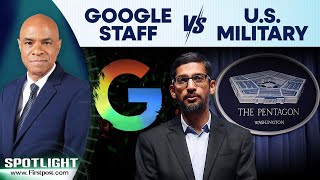
Google Staff Write to CEO Pichai Against AI Deal With US Govt | Spotlight | N18G

Google Staff Write to CEO Pichai Against AI Deal With US Govt | Spotlight | N18G