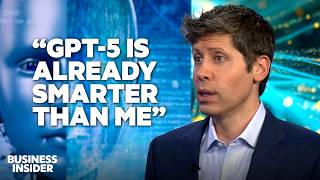
Sam Altman's AI Jobs Manifesto
TECH

Sam Altman's AI Jobs Manifesto

32+
Signals

Strategic Overview

  • 01.
    OpenAI published a 13-page manifesto on April 8, 2026 titled 'Industrial Policy for the Intelligence Age: Ideas to Keep People First,' proposing a public wealth fund, a robot tax, and a four-day workweek without a pay cut.
  • 02.
    Altman explicitly rejected 'jobs doomerism' as long-term wrong, predicting workers will be 'busier (and hopefully more fulfilled) than ever' even as he conceded near-term disruption will be painful.
  • 03.
    The document calls for rebalancing the U.S. tax base toward capital — higher capital gains taxes at the top, corporate income taxes, and targeted measures on sustained AI-driven returns and automated labor.
  • 04.
    Two days after publication, a 20-year-old hurled an incendiary device at Altman's San Francisco home and attempted to attack OpenAI HQ, dramatizing the anti-AI backlash the manifesto was partly designed to defuse.

Deep Analysis

The 'Policymercial' Read: Marketing Copy in Policy Clothing

The sharpest critique of the manifesto comes not from labor activists but from tech-policy researchers who treat the document as a genre exercise. Eryk Salvaggio, writing in Tech Policy Press, calls it a 'policymercial' — marketing copy dressed as policy proposals — and argues OpenAI 'has ultimately co-opted the idealism of public infrastructure while actively undermining concrete steps toward it.' Paul Nemitz, in a follow-up critique, frames the same document as 'a sophisticated exercise in corporate reputation management,' with a structural conflict of interest baked in: a private company at the center of the AI labor shock cannot also be the disinterested architect of the policy response to it.

What makes this read difficult to dismiss is the manifesto's actual policy menu. A public wealth fund, a robot tax, capital gains hikes at the top, and a four-day workweek without a pay cut are not centrist talking points — they are surprisingly progressive levers. But none of them are inside OpenAI's gift to deliver, and several would require federal action OpenAI is simultaneously lobbying around. The document therefore functions on two layers: as a sincere-sounding wishlist that buys reputational room, and as a frame that locates the burden of adjustment on Congress rather than on the firms producing the disruption.
The Augmentation Pitch Meets OpenAI's Own Hiring Curve

The manifesto urges other firms to 'retain, retrain, and invest in workers' rather than replace them — language that lands awkwardly against OpenAI's own labor footprint. CNBC, citing the Financial Times, reported OpenAI is on track to nearly double its workforce to roughly 8,000 by the end of 2026, even as Altman has said he can imagine 40% of tasks in today's economy being done by AI in the not-distant future. The implicit asymmetry is that OpenAI is hiring aggressively for the people who build the systems while modeling a future in which the people who use those systems are working four-day weeks subsidized by capital taxes.

Workers, especially Gen Z, appear to be reading that asymmetry. Surveys cited in Fortune and The New Republic show Gen Z excitement about AI fell from 36% to 22% in a single year while anger rose from 22% to 31%, and only 23% of the public hold positive long-term views about AI's effect on jobs versus 73% of experts. The Reddit reaction sharpened the same gap: top threads in r/technology (with thousands of upvotes) reframed Altman's earlier 'maybe they weren't real work' line as a 'let them eat cake' moment, with the most upvoted comment insisting people are not afraid of losing jobs but of losing livelihoods. A defense thread in r/cscareerquestions argued the headline was ragebait and that Altman was making a philosophical point about how 'real work' is socially constructed — which is itself a tell about how thin the trust margin has gotten.

The Firebombing Frame: A Manifesto Overtaken by Its Own Backlash

Two days after the document's April 8 release, a 20-year-old named Daniel Moreno-Gama allegedly hurled an incendiary device at Altman's $27 million San Francisco home and then attempted to attack OpenAI HQ. The proximity is not subtext — it is the dominant frame the manifesto now lives inside. SF Standard's coverage explicitly tied the attack to the manifesto's reception, and Fortune used it as the lede for a broader piece on rising anti-AI sentiment turning violent.

The wider numbers explain why the document landed in such combustible air. Just 26% of U.S. voters held positive views of AI in April 2026 against 46% negative, and 95% of corporate AI pilot programs reportedly returned zero, with 80% of AI-using companies seeing no productivity impact. In other words, the manifesto was published into a country where the public is souring on AI, the productivity case is contested, and the most visible firm in the space is the one promising salvation. Altman's call to 'de-escalate the rhetoric' reads differently after a Molotov cocktail — less as a debate-norms appeal and more as a recognition that the abstraction layer between policy papers and street-level reaction has thinned dramatically.

Two Frontier CEOs, Two Labor Forecasts: The Altman vs. Amodei Split

The manifesto is best understood not as a standalone document but as one half of an open argument between the two leading AI labs. Anthropic's Dario Amodei has predicted that half of all white-collar jobs could be eliminated by AI; Altman's manifesto and his accompanying tweets — including agreement with Jensen Huang's 'a ton of stuff to do in the world' framing and his own 'you just don't bet against evolutionary biology' line — are deliberately the opposite bet. One frontier CEO is forecasting mass displacement; the other is forecasting that people 'are going to be busier (and hopefully more fulfilled) than ever.'

This split matters because both CEOs have privileged information about model capabilities and neither is incentivized to be wrong in public. Boston College economist Aleksandar Tomic compares the moment to the Industrial Revolution and warns 'technology is moving really fast...institutions are lagging,' noting the previous transition 'took us about 50 years to figure it out, and two world wars.' If Amodei is right, the manifesto's four-day-week and public-wealth-fund proposals are too modest. If Altman is right, they may be unnecessary. The policy debate is therefore being run on top of a model-capability disagreement that neither lab has fully shown its work on.

What Just Shifted in the Overton Window

Whatever one thinks of OpenAI's motives, a frontier AI lab publicly endorsing a robot tax, higher capital gains taxes, taxes on automated labor, a sovereign-style public wealth fund, and a shorter workweek is itself a notable repositioning. These are proposals that would have read as fringe in mainstream U.S. tech-policy discourse a few years ago; they now sit in a 13-page document from the most-watched AI company in the world. The document's three-principle frame — 'share prosperity broadly, mitigate risks, democratize access' — is also a tacit concession that the default trajectory of AI-driven growth concentrates wealth and control rather than distributing them.

The second-order effect is that other actors — labor groups, Democratic legislators, and rival labs — can now argue against OpenAI from the left of OpenAI's own paper, asking why these ideas are presented as aspirations rather than commitments. Critics like Salvaggio note OpenAI is 'actively undermining concrete steps' toward public infrastructure even as it praises the idea, and tech-policy writers have flagged that OpenAI is expanding its lobbying spending in parallel. The manifesto may therefore widen the policy menu more than it narrows it: once a company at the center of the AI economy says capital taxation and a public wealth fund are reasonable, the question 'why not?' becomes harder for political actors who previously avoided it.

Historical Context

2024-09-26
Altman published 'The Intelligence Age' on his personal site, an earlier utopian essay envisioning superintelligence within 'a few thousand days' that drew critiques for its blind spots about costs and limits.
2026-02-19
Altman publicly stated that AI would soon perform a CEO's job better than himself, escalating the discourse about white-collar disruption.
2026-03-12
Altman conceded AI is breaking the labor-capital balance and that 'nobody knows' what to do — a public concession that foreshadowed the formal policy paper.
2026-04-08
OpenAI published 'Industrial Policy for the Intelligence Age: Ideas to Keep People First,' the formal jobs manifesto proposing a public wealth fund, robot tax, and four-day workweek.
2026-04-10
Days after the manifesto's release, a 20-year-old hurled an incendiary device at Altman's $27M San Francisco home and attempted to attack OpenAI HQ, underscoring the violent edge of the anti-AI backlash.

Power Map

Key Players
Subject

Sam Altman's AI Jobs Manifesto

SA

Sam Altman / OpenAI

Author and publisher of the manifesto, using the document to shape U.S. policy debate while OpenAI itself is reportedly nearly doubling its workforce to roughly 8,000 by end of 2026.

U.

U.S. policymakers and Congress

Primary target audience for the proposed industrial policy, including capital-based taxation, a robot tax, and a public wealth fund — pitched as OpenAI concurrently expands federal lobbying activity.

AN

Anthropic (Dario Amodei)

Industry counterweight whose alarmist labor predictions — that 'half of all white-collar jobs' could be eliminated — frame the doomerism Altman is publicly pushing back against.

AN

Anti-AI activists and the suspect Daniel Moreno-Gama

Backlash actors; the firebombing of Altman's San Francisco home days after publication illustrates the violent edge of broader anti-AI public sentiment.

WO

Workers and the Gen Z labor force

Intended beneficiaries of 'people-first' policy and among the most skeptical; entry-level hiring softness has fueled distrust of Altman's optimistic framing.

Source Articles

Top 1

THE SIGNAL.

Analysts

"Reads the manifesto as corporate marketing rather than a genuine reform agenda, arguing OpenAI co-opts the language of public infrastructure while opposing concrete legislation that would build it."

Eryk Salvaggio
Gates Scholar at the University of Cambridge; Affiliated Researcher at the Max Planck Institute; Tech Policy Press fellow

"Calls the document sophisticated reputation management with a structural conflict of interest, arguing its democratic framing obscures OpenAI's commercial stakes."

Paul Nemitz
Tech Policy Press contributor

"Compares the AI labor transition to the Industrial Revolution and warns that institutions are far behind the pace of technological change — and that the previous transition required decades and two world wars to absorb."

Aleksandar Tomic
Economist, Boston College

"Argues Altman's writing reveals an untrammelled optimism in progress that ignores real costs and limits, a blind spot that runs through the latest manifesto as well."

Hallam Stevens
Professor of Interdisciplinary Studies, James Cook University

"Acknowledges the underlying labor-capital shift while defending optimism and calling for rhetorical de-escalation as the debate intensifies."

Sam Altman
CEO, OpenAI
The Crowd

"Sam Altman says I'm not a jobs doomer even if the short-term transition is rough We're evolutionarily wired to care about status, purpose, and creative expression, so the drive to work won't disappear "you just don't bet against evolutionary biology""

@@slow_developer0

"agree with lots of what jensen has been saying about ai and jobs; there is a ton of stuff to do in the world. people will 1) do a lot more than they could do before; ability and expectation will both go up 2) still care very much about other people and what they do 3) still be..."

@@sama0

"Sam Altman Says If Jobs Gets Wiped Out, Maybe They Weren't Even "Real Work" to Start With"

@u/MetaKnowing18000

"Sam Altman Says If Jobs Gets Wiped Out, Maybe They Weren't Even "Real Work" to Start With"

@u/[deleted]2400
Broadcast
Elon Musk vs. Sam Altman, AI Job Loss, and OpenAI's $852B Valuation | EP #247

Elon Musk vs. Sam Altman, AI Job Loss, and OpenAI's $852B Valuation | EP #247

AI CEOs Come Online: Sam Altman's Replacement Plan, Job Loss & 'Solve Everything' Launches | EP #230

AI CEOs Come Online: Sam Altman's Replacement Plan, Job Loss & 'Solve Everything' Launches | EP #230

Sam Altman Explains Why AI Will Replace 40% Of Your Work

Sam Altman Explains Why AI Will Replace 40% Of Your Work