Google Cloud Next 2026: Gemini Enterprise Agent Platform replaces Vertex AI with governance, observability, and a split-TPU silicon stack
TECH

Google Cloud Next 2026: Gemini Enterprise Agent Platform replaces Vertex AI with governance, observability, and a split-TPU silicon stack

29+
Signals

Strategic Overview

  • 01.
    At Google Cloud Next '26 in Las Vegas, Google rebranded Vertex AI as the Gemini Enterprise Agent Platform, a single surface for building, scaling, governing, and optimizing AI agents — and confirmed all future Vertex AI roadmap work will ship exclusively through this platform.
  • 02.
    The platform is structured around four pillars — Build (Agent Studio + ADK), Scale (Agent Runtime + Memory Bank), Govern (Agent Identity, Registry, Gateway), and Optimize (Simulation, Evaluation, Observability) — with each agent receiving a unique cryptographic identity for audit and policy enforcement.
  • 03.
    Google split its eighth-generation TPU into two purpose-built chips: TPU 8t for training (engineered with Broadcom, scaling to 9,600-chip superpods with 2 PB of shared HBM) and TPU 8i for inference (engineered with MediaTek, delivering 80% better performance-per-dollar than the prior generation).
  • 04.
    Model Garden offers first-class access to 200+ models including Gemini 3.1 Pro, Gemini 3.1 Flash Image, Lyria 3, Gemma 4, and Anthropic's Claude family, while the Linux Foundation–governed Agent2Agent (A2A) protocol now reportedly runs in production at 150 organizations as the default cross-platform interoperability layer.

The Rebrand Is a Tell: The AI Buyer Just Changed
The Rebrand Is a Tell: The AI Buyer Just Changed
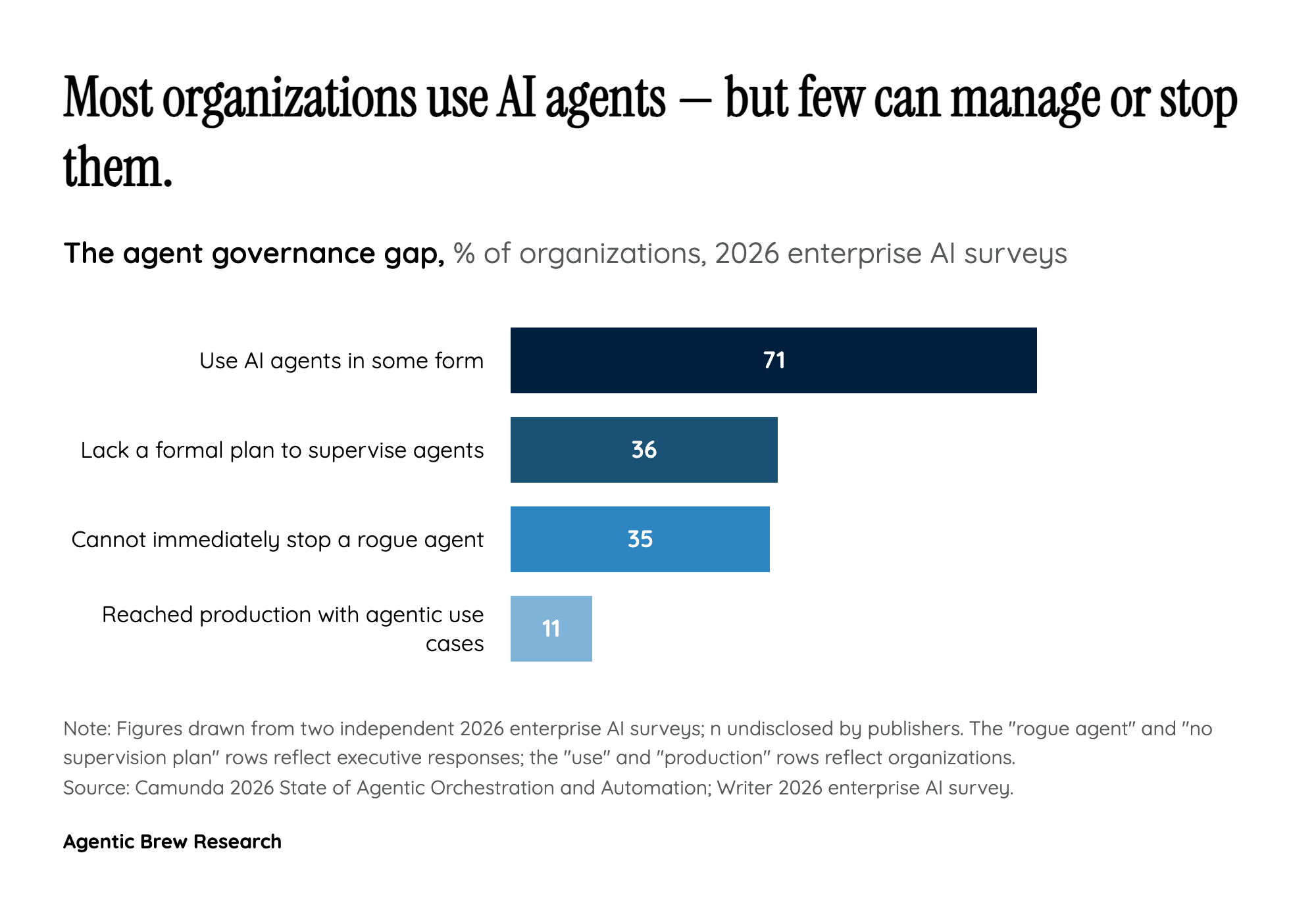
The agent governance gap — 71% of organizations use AI agents, but only 11% reach production and roughly a third cannot stop a rogue agent. (Camunda 2026; Writer 2026.)

Vertex AI was a 2021-vintage MLOps platform — a tool ML engineers chose to train, deploy, and monitor models. Gemini Enterprise Agent Platform is a 2026 control plane — a tool a CISO and a CFO must approve before a single agent reaches production. The pillar names give the game away: Build is one of four, and the other three (Scale, Govern, Optimize) are entirely about runtime risk and unit economics. Google is no longer selling to the data science org; it is selling to the people who say no to the data science org. Forrester's Devin Dickerson reads the change as roughly six parts taxonomy reorganization and four parts a chance to bolt on enterprise features, which is a polite way of saying the product surface had to be re-skinned to fit the new buyer.

That reframing is also a quiet admission about what is blocking enterprise rollout. Independent surveys consistently show the same gap: 71% of organizations are using AI agents but only 11% reached production in the past year, 36% of executives have no formal plan for supervising agents, and 35% cannot immediately stop a rogue agent. Gartner now expects more than 40% of agentic AI projects to be canceled by the end of 2027. The platform's shape — Agent Identity issuing cryptographic IDs, Agent Gateway acting as 'air traffic control' with Model Armor protections, Agent Anomaly Detection flagging reverse shells and connections to bad IPs — is precisely the checklist a security review team writes when an experiment tries to ship. Google has effectively turned the governance objection list into a product.

The Split-TPU Bet: Different Physics for Training and Inference

The most structurally interesting announcement is not the platform — it's the silicon underneath. Google split its eighth-generation TPU into two distinct chips co-designed with DeepMind, Broadcom, and MediaTek. TPU 8t is built for compute-intensive training, with superpods that scale to 9,600 chips and two petabytes of shared high-bandwidth memory, targeting up to 2.8x better training price-performance versus seventh-generation Ironwood. TPU 8i is built for the iterative, latency-sensitive work that defines multi-agent inference: triple the on-chip SRAM at 384 MB, double the inter-chip bandwidth at 19.2 Tb/s, a Boardfly topology that cuts network diameter by roughly 56%, and 80% better performance-per-dollar than the previous generation.

The bet behind the bifurcation is that training and inference have diverged enough as workloads that one chip can no longer be Pareto-optimal for both. Training is bursty, bandwidth-hungry, and tolerant of latency; agentic inference is constant, memory-bound, and unforgiving on tail latency because each user-facing action may chain through dozens of model calls. By fabbing two chips with two partners — Broadcom for training, MediaTek for inference — Google also splits its supplier risk and preserves the option to scale either side independently as the agent-economy mix shifts. IDC's Matthew Flug notes that TPUs already have 'the strongest reputation behind GPUs for AI workloads,' and the 8t/8i split is the first time Google has aligned that hardware credibility directly to the cost curve enterprises actually face when agents move from pilot to production.

Less Model Lock-In, More Platform Lock-In

Putting Anthropic's Claude Opus, Sonnet, and Haiku into Model Garden as first-class citizens alongside Gemini 3.1 Pro, Gemini 3.1 Flash Image, Lyria 3, and Gemma 4 looks generous, and on the model layer it is. The 200+ model catalog plus the Linux-Foundation-governed A2A protocol — reportedly running in production at 150 organizations — give buyers a credible story that picking Google does not mean betting against the rest of the model frontier. The r/singularity thread that surfaced after the keynote read this exact dynamic correctly: commenters argued LLMs themselves are commoditizing, and that Google is intentionally playing one layer up at the platform.

That is where the lock-in re-enters. Every agent in this world has a Google-issued cryptographic identity, runs through Google's Agent Gateway, is observed by Google's Agent Observability stack, and has its memory pinned in Google's Memory Bank. The model is portable; the audit trail, the policy enforcement plane, and the operational telemetry are not. Bradley Shimmin of Futurum Group called the bundle of agents, tools, skills, MCP servers and gateway-based policy 'a holistic approach where others might not be as comprehensive,' which is praise — and also a description of how thoroughly the surrounding control plane wraps whichever model a customer picks. Multi-model is the carrot; multi-control-plane is the stick that keeps a workload from migrating once it is regulated and audited inside this stack.

The Skeptics Have a Point: Rebrand Fatigue Is Real

Reddit's reaction to the announcement was sharper than the analyst circuit. The r/Bard thread voiced the 'this is the 50th different AI product from Google to enterprise' framing and explicitly asked whether Agentspace — itself a recent enterprise launch that has now been folded into Gemini Enterprise — was even still a thing. That is not idle snark; it is exactly the institutional memory enterprise buyers carry into a renewal conversation. Vertex AI customers who built on its SDKs and pipelines now face a roadmap that ships only through the Agent Platform, which is functionally a forced migration even when Google calls it an evolution. Google framed the platform around moving customers 'from managing individual AI tasks to delegating business outcomes with total confidence' — a beautifully phrased pitch that also requires those customers to re-platform mid-flight.

Developer-channel YouTube content skewed toward production-readiness — cryptographic identity for agents, Memory Bank for long-running state, sandboxes to limit blast radius — rather than raw model demos, which is a useful signal about where Google itself thinks the credibility battle is. The official X messaging reinforced the same governance framing: 'the conversation around AI agents is no longer about how to build them — it's about how to manage thousands of them.' The contrarian read is that this messaging discipline is itself doing heavy lifting because the underlying execution risk is real: a platform that asks every Vertex AI customer to migrate, every model partner to integrate through a Google-owned gateway, and every regulated industry to trust a brand-new identity layer is a platform whose first eighteen months will be judged less on its keynote and more on whether the migration tooling is boring enough to actually use.

Historical Context

2021-05-18
Vertex AI launched at Google I/O 2021 as a unified MLOps platform — the predecessor that the Gemini Enterprise Agent Platform now subsumes and rebrands.
2026-04-22
Google Cloud Next '26 keynote unveils the Gemini Enterprise Agent Platform and confirms the dual eighth-generation TPU architecture (TPU 8t for training, TPU 8i for inference).
2026-04-22
TPU 8t (Broadcom-engineered training chip) and TPU 8i (MediaTek-engineered inference chip) announced as part of the AI Hypercomputer, with general availability planned for later in 2026.
2026-04-22
Agent2Agent (A2A) protocol v1.x reaches 150 organizations in production, becoming the default interoperability layer of the new platform under neutral Linux Foundation governance.

Power Map

Key Players
Subject

Google Cloud Next 2026: Gemini Enterprise Agent Platform replaces Vertex AI with governance, observability, and a split-TPU silicon stack

GO

Google Cloud

Platform vendor consolidating Vertex AI's MLOps lineage with new agent-era governance, gateway, and observability layers — repositioning itself as the full-stack agent platform rather than a model-and-MLOps shop.

GO

Google DeepMind

Co-designer of TPU 8t and 8i; aligns silicon architecture to evolving Gemini and agent workloads, giving Google a tighter model-to-metal feedback loop than competitors who lease GPUs.

BR

Broadcom and MediaTek

Engineering partners on the training (8t) and inference (8i) chips respectively — diversifying Google's silicon supply chain and giving it negotiating leverage versus Nvidia for both ends of the workload spectrum.

AN

Anthropic

Third-party model provider with Claude Opus, Sonnet, and Haiku available as first-class options inside Model Garden — a multi-model concession that softens model lock-in while reinforcing platform lock-in around Google's governance plane.

LI

Linux Foundation

Neutral steward of the Agent2Agent (A2A) protocol, lending cross-vendor legitimacy to the interoperability layer that lets agents built on different platforms route real tasks between each other.

RE

Reference enterprise customers (Merck, Walmart, Bosch, KPMG, Signal Iduna, ASCO)

Lighthouse deployments validating the platform across pharma research, retail, manufacturing, professional services, and insurance — the proof points Google is using to argue the rebrand is more than a rename.

Source Articles

Top 3

THE SIGNAL.

Analysts

"Frames Google's vertically integrated stack against rival modular offerings, arguing competitors are 'handing you the pieces, not the platform' — positioning Google's own glue layer as the differentiator."

Thomas Kurian
CEO, Google Cloud

"Argues that moving toward a 'truly autonomous enterprise, one where agents can act with the same independence and reliability as a member of your team' requires a foundation that can sustain that level of trust — a clear repositioning around governance rather than model capability."

Michael Gerstenhaber
Vice President of Product Management, Google Cloud

"Calls Google's unification of agents, tools, skills, MCP servers and gateway-based policy enforcement 'a holistic approach where others might not be as comprehensive,' singling out the policy gateway as the structurally novel piece."

Bradley Shimmin
Analyst, Futurum Group

"Reads the rebrand as roughly six parts taxonomy reorganization and four parts an opportunity to layer in enterprise-grade features — a measured framing that neither dismisses nor over-celebrates the rename."

Devin Dickerson
Analyst, Forrester Research

"Argues TPUs give Google 'the strongest reputation behind GPUs for AI workloads' — credibility that matters more now that the dual-chip 8t/8i split aligns silicon to the actual training-versus-inference cost curve of agentic systems."

Matthew Flug
Analyst, IDC

"Sees Google's Wiz integration as 'a more credible and differentiated operating model for securing agents across mixed environments,' tying the security acquisition story directly to the new Agent Gateway pitch."

Katie Norton
Analyst, IDC
The Crowd

"The conversation around AI agents is no longer about how to build them — it's about how to manage thousands of them. Today we're introducing Gemini Enterprise Agent Platform, a new way to build, scale, govern and optimize agents."

@@Google0

"We're launching Gemini Enterprise Agent Platform with @GoogleCloud: a platform for businesses to develop, scale, govern and optimize agents. It's the evolution of Vertex AI, bringing together model selection and agent building with new features for integration, security and management."

@@GoogleDeepMind0

"Google $GOOGL just unveiled a bunch of new tools to build AI agents aimed at helping companies automate tasks. Google said its Gemini Enterprise Agent Platform would include new features such as Memory Bank and Memory Profile to help agents to remember past interactions."

@@StockMKTNewz0

"Google introduces Gemini Enterprise Agent Platform"

@u/WhyLifeIs4108
Broadcast
Google Announces Gemini Enterprise Agent Platform: The Future of Agentic AI

Google Announces Gemini Enterprise Agent Platform: The Future of Agentic AI

What is Gemini Enterprise Agent Platform?

What is Gemini Enterprise Agent Platform?

From Prototype to Production: Building with Gemini Enterprise Agent Platform

From Prototype to Production: Building with Gemini Enterprise Agent Platform