Chinese EV makers' AI feature war
TECH

Chinese EV makers' AI feature war

31+
Signals

Strategic Overview

  • 01.
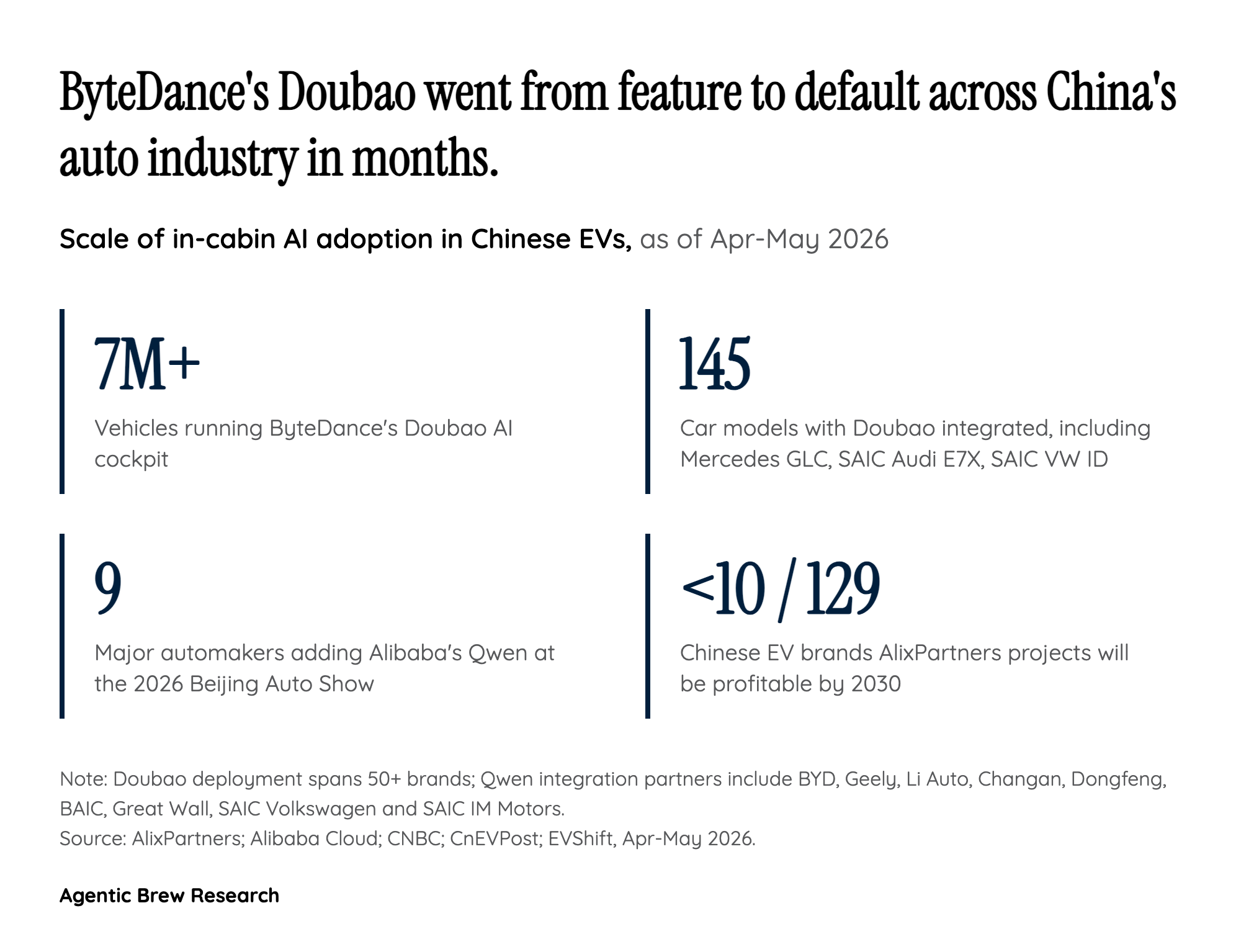
    ByteDance's Doubao AI model is now deployed across 145 car models and more than 7 million vehicles from over 50 brands, including the all-electric Mercedes-Benz GLC, the SAIC Audi E7X and SAIC Volkswagen ID.
  • 02.
    On the opening day of the 2026 Beijing Auto Show, nine leading Chinese automakers — BYD, Geely, Li Auto, Changan, Dongfeng, BAIC, Great Wall, SAIC Volkswagen and SAIC IM Motors — announced integration of Alibaba's Qwen for in-cabin services like booking hotels, ordering food and tracking parcels.
  • 03.
    BYD has integrated ByteDance's Doubao large model into its DiLink intelligent cockpit across all five sub-brands — Yangwang, Denza, Fangchengbao, Dynasty and Ocean — treating large-model cockpits as basic configuration rather than a premium add-on.
  • 04.
    AlixPartners projects that fewer than 10 of roughly 129 Chinese EV brands (15 in an optimistic case) will be profitable by 2030 if the discount-and-feature war continues, with the top 20 best-selling EVs above 100,000 yuan already offering near-identical AI and driver-assist feature sets.

Deep Analysis

The platform-power flip: foreign luxury brands now license Chinese cockpit AI

The most striking signal in this story isn't Chinese OEMs adopting Chinese AI — it's foreign luxury brands doing the same to stay competitive in China. Mercedes-Benz expanded its LLM cooperation with ByteDance in August 2024 to make virtual assistants 'smarter and more knowledgeable.' SAIC Audi (E7X) and SAIC Volkswagen (ID series) followed by licensing Doubao outright, and SAIC Volkswagen now appears among the nine automakers integrating Alibaba's Qwen. SCMP also reported that Tesla, Volvo and Mercedes-Benz won approval to deploy in-vehicle AI assistants in China, with Tesla reportedly preparing to integrate Doubao around April 22, 2026.

For decades the cockpit-software stack was a place where premium German brands could project quality. In China, that layer has effectively been outsourced to ByteDance and Alibaba. The implication: Chinese tech platforms now sit between global automakers and their highest-margin customers, holding the API for the experience that defines a 'modern' car.

Why AI cockpits cannot hold a premium

Why AI cockpits cannot hold a premium
Doubao now spans 7M+ vehicles and 145 models; nine more automakers added Qwen at the 2026 Beijing Auto Show.

AlixPartners' Stephen Dyer puts the math bluntly — features 'disseminate so quickly' that automakers 'have to race and keep racing.' The mechanism is structural: when ByteDance and Alibaba license Doubao and Qwen to dozens of OEMs through Volcano Engine and Alibaba Cloud, the underlying capability is the same component used by competitors.

AlixPartners notes that the top 20 best-selling EVs above 100,000 yuan already offer near-identical driver-assist and infotainment feature sets. BYD's decision to push Doubao across all five sub-brands — Yangwang, Denza, Fangchengbao, Dynasty and Ocean — confirms this; large-model cockpits are now baseline configuration, not a premium upcharge. Pair that with an 11% drop in average vehicle prices from CN¥217,000 to CN¥194,000 between 2023 and 2025 (roughly CN¥471 billion of industry revenue erased) and you get a feature war that cannot do what the price war could not: rebuild margin.

A ByteDance-Alibaba duopoly is forming around in-cabin AI

Two players now functionally control the cockpit operating system for the Chinese auto industry. ByteDance's Volcano Engine has scale — 145 models, 7M+ vehicles, 50+ brands, plus a halo from Doubao's 155M weekly active users — and is running roughly 30B-parameter on-device models with deeply customized cabin solutions (Seres alone invested 100M+ yuan in this work).

Alibaba's counter is architectural: a Qwen-Omni multimodal model on NVIDIA DRIVE AGX Thor for environmental perception, paired with cloud-side agentic AI handling multi-step workflows like booking hotels, buying attraction tickets and tracking parcels. The on-device parameter gap (ByteDance's ~30B vs Qwen's ~4B) hints at divergent bets: ByteDance leans into local intelligence and customization, while Alibaba leans into cloud agents that can transact. Either way, OEM bargaining power is shrinking — the carmakers risk becoming distribution channels for someone else's AI.

The contrarian read: 'pointless bloat' and the user-experience question

Sino Auto Insights' Tu Le argues AI 'should run in the background to support the user experience, not necessarily be a feature' — a pointed critique of the marketing-first cockpit cycle. That view has unexpected support outside the analyst class. On Reddit, a recurring counter-narrative dismisses AI cockpits as bolt-on novelty; one Porsche Macan owner's reaction — 'jam packing everything with pointless AI features is what everyone wants these days. It gets the people going' — captures the skeptical mood.

Meanwhile X.com chatter is more bullish, treating Doubao/Qwen integration as inevitable infrastructure, but even there the framing is utility, not delight. The thread connecting AlixPartners, Tu Le and the contrarian Reddit voices is the same: when a feature exists in 145 models within months, it is no longer a feature, it is plumbing — and plumbing does not justify a price premium.

Where differentiation goes next

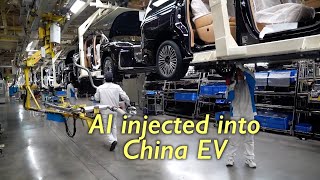
If AI cockpits become plumbing, where does the next moat live? AlixPartners' Dyer expects the battleground to shift to 'outside-of-car' lifestyle experiences — the luxury-brand playbook of ecosystems, services and ownership rituals that cannot be cloned by licensing a model. MERICS analysts argue Chinese OEMs are already advantaged in the software-and-UX layer because 'there is less differentiation in motors and technical specs,' and YouTube coverage from Voyah/Dongfeng's manufacturing base showed AI-equipped vehicles rolling off the line every 118 seconds — AI absorbed into production, not just product.

The harder question is whether European incumbents, who historically anchored their identity in driving dynamics and engineering, can pivot to lifestyle-as-product fast enough. AlixPartners' projection that fewer than 10 of ~129 Chinese EV brands will be profitable by 2030 suggests the consolidation pressure will be brutal even for the home team — a reminder that winning the AI feature war is not the same as winning the auto industry.

Historical Context

2023-01
Tesla cut Model 3/Y prices by 20,000-48,000 RMB in January 2023, igniting the sector-wide Chinese EV price war that would later push automakers toward AI features as a non-price battleground.
2023-2024
BYD launched Champion Edition and Honor Edition models with successive price cuts (e.g., Qin PLUS Glory Edition from 99,800 to 79,800 RMB), prompting authorities to advise restraint and accelerating the search for non-price differentiation.
2024-08-14
Mercedes-Benz announced expanded LLM and generative AI cooperation with ByteDance for China-market in-car virtual assistants, building on the 2023 Volcano Cheyu app collaboration on the E-class.
2025-02
BYD rolled its Smart Driving Edition ADAS into 21 models starting at 100,000 yuan, signaling the industry's shift from a price-only war to feature-based competition.
2026-04-16
Reports surfaced that ByteDance is intensively developing customized Doubao smart cabin solutions; Seres invested over 100M yuan in development with ByteDance running roughly 30B-parameter on-vehicle models.
2026-04-24
On the opening day of the 2026 Beijing Auto Show, BYD, Geely, Li Auto, Changan, Dongfeng, BAIC, Great Wall, SAIC Volkswagen and SAIC IM Motors announced Qwen integration into their intelligent cockpits.
2026-05-01
CNBC's reporting crystallized the 'price war to AI arms race' narrative, citing 7M+ cars on Doubao and the rapid commoditization of cockpit AI as the new strategic problem facing Chinese OEMs.

Power Map

Key Players
Subject

Chinese EV makers' AI feature war

BY

ByteDance (Volcano Engine / Doubao)

Dominant in-car AI model provider with Doubao in 7M+ cars and 145 models, running roughly 30B-parameter on-device models and reshaping smart cabin interaction logic via deeply customized cockpit solutions.

AL

Alibaba (Qwen / Alibaba Cloud)

Challenger AI provider embedding Qwen across nine Chinese automakers using an edge+cloud architecture (Qwen-Omni on NVIDIA DRIVE AGX Thor plus cloud-side agentic AI for multi-step in-cabin commerce).

BY

BYD

China's largest EV maker; deployed Doubao across all five sub-brands and committed to Qwen integration, signaling that large-model cockpits are now a baseline expectation rather than a margin-defending differentiator.

ME

Mercedes-Benz, SAIC Audi, SAIC Volkswagen

Foreign-branded automakers licensing Doubao for China-market models (GLC, E7X, ID series), validating Chinese AI stacks as table-stakes for the local market and deepening Chinese tech firms' platform leverage over global brands.

AL

AlixPartners

Consultancy whose research frames the price-war-to-feature-war narrative; projects only 10-15 of ~129 Chinese EV brands will be profitable by 2030 and warns that AI cockpit features commoditize too quickly to anchor premium pricing.

Source Articles

Top 3

THE SIGNAL.

Analysts

"Argues the price war has morphed into a cockpit-tech feature war but features become similar so quickly that automakers must keep racing: 'technology, they're going to have to race and keep racing, because it disseminates so quickly.' Differentiation, he says, will shift to outside-of-car lifestyle experiences."

Stephen Dyer
Partner & Managing Director, Head of Asia Automotive and Industrials, AlixPartners

"On the macro toll of the discount era: 'This environment has driven remarkable advances in technology and cost efficiency, but it has also left many companies struggling to achieve sustainable profitability.'"

Stephen Dyer
Partner & Managing Director, AlixPartners

"Believes AI shouldn't be sold as a headline feature; it 'should run in the background to support the user experience, not necessarily be a feature' — implying current marketing of AI cockpits is misaligned with actual consumer value."

Tu Le
Managing Director, Sino Auto Insights

"Frame Chinese EVs as 'AI-on-wheels' produced at dazzling speed thanks to deep tech-sector integration: 'Because there is less differentiation in motors and technical specs, Chinese carmakers often distinguish their offerings with software and user experience.' European OEMs lag because they cannot innovate as quickly on software and UX."

MERICS analysts
Mercator Institute for China Studies
The Crowd

"At Volcano Engine FORCE conference, ByteDance announced it will work w/ BYD to put Doubao Model in the DiLink smart cockpit for all BYD brands. Cooperation will extend to smart digital key, infotainment system & voicecom. BD continues to push AI integration into major OEMs."

@@tphuang0

"Tesla, Volvo and Mercedes-Benz win China's approval to deploy AI chatbots in cars. China has approved the first foreign carmakers to roll out in-vehicle AI assistants, opening the door for wider adoption"

@@BienPerez0

"Tesla vehicles in China will soon get a Grok-like vibe soon. Tesla China is reportedly to integrate two Chinese LLMs as in-car AI assistants. April 22, 2026 - Tesla vehicles in China to integrate Doubao large model."

@@ray4tesla0

"After call from Beijing, China's auto industry races to embed AI in just about everything"

@u/tech5748
Broadcast
What 72hrs in China taught me about the future (AI, EVs, more)

What 72hrs in China taught me about the future (AI, EVs, more)

How Chinese EVs Could Take Over America: The Nvidia Deal Blueprint

How Chinese EVs Could Take Over America: The Nvidia Deal Blueprint

Chinese EV makers are speeding up AI transformation for efficiency and smarter cars

Chinese EV makers are speeding up AI transformation for efficiency and smarter cars