OpenAI ends Microsoft cloud exclusivity and lands on AWS Bedrock with GPT-5.5, Codex, and Managed Agents
TECH

OpenAI ends Microsoft cloud exclusivity and lands on AWS Bedrock with GPT-5.5, Codex, and Managed Agents

53+
Signals

Strategic Overview

  • 01.
    On April 27, 2026, Microsoft and OpenAI announced an amended partnership ending Microsoft's exclusive cloud access to OpenAI's models and products, with Microsoft's IP license extended through 2032 on a non-exclusive basis.
  • 02.
    Less than 24 hours later, AWS and OpenAI launched a limited preview of GPT-5.5, GPT-5.4, Codex, and Bedrock Managed Agents on Amazon Bedrock, inheriting AWS enterprise controls including IAM, PrivateLink, guardrails, and CloudTrail logging.
  • 03.
    OpenAI revenue share to Microsoft continues through 2030 at the same percentage subject to a total cap, while Microsoft no longer pays revenue share to OpenAI; MSFT shares fell as much as ~5% intraday on the news before paring losses.
  • 04.
    Bedrock Managed Agents, built on the OpenAI agent harness with persistent memory and per-agent identity for full action auditability, marks a step beyond simple API model hosting toward a managed agentic-runtime layer.

Deep Analysis

The Trigger Wasn't Strategy — It Was Legal Peril Around a $50B Check

Public framing makes the breakup sound like a clean strategic pivot. The sequencing tells a different story. In February 2026, Amazon committed up to $50B to OpenAI — $15B initial plus $35B conditional on deploying roughly 2GW of Trainium capacity — and Microsoft initially asserted that its exclusivity might block AWS from hosting OpenAI's Frontier agent platform. That's not a footnote; that is an existing investor's hyperscaler counterpart claiming veto rights over a deployment Amazon was already paying for. TechCrunch's reporting describes the renegotiation as resolving exactly that brewing legal conflict, and the timing — exclusivity formally ending April 27, OpenAI models live on Bedrock April 28 — looks less like a coincidence and more like a settlement schedule.

Layer in active antitrust probes in the US, UK, and EU over whether the original Azure-exclusive structure gave Microsoft an unfair cloud advantage, and the 'amended partnership' starts to look like the cheapest path through several converging risks at once. Microsoft trades exclusivity it could not realistically defend in court for a non-exclusive IP license through 2032 and a capped revenue share through 2030 — the same percentage, but with the ceiling that exclusivity protected against now formally written in. Read this way, the surprise isn't that the deal was unwound. It's that Microsoft conceded the structural piece (exclusivity) while keeping the financial piece (revenue share) intact. The legal risk was simply the more expensive one to carry.

The Buried Lede: The AGI Clause Got Replaced With a Calendar Date

The most-cited bullet points are the obvious ones: exclusivity gone, revenue share capped, IP license extended. But the most interesting line in the contract may be one most coverage skipped: the original deal's AGI clause — under which Microsoft's rights would terminate when OpenAI's board declared AGI achieved — is being replaced with a fixed 2032 termination date. Reddit's most upvoted long-form analysis on r/OpenAI flagged this directly: the AGI clause is the buried lede. A subjective, board-declarable trigger is now a deterministic calendar event.

This matters because the AGI clause was, in effect, OpenAI's optionality. It was the lever that let the lab argue its most valuable IP could be reclaimed unilaterally if the board decided a threshold had been crossed. Trading that for 2032 makes the relationship more legible to lawyers, regulators, and capital markets — but it also locks OpenAI into a six-year window where Microsoft's non-exclusive license is contractually guaranteed regardless of how capabilities evolve. For Microsoft, removing the AGI clause removes a real existential risk in the financial model. For OpenAI, it is a meaningful concession that almost no one is calling a concession.

The community read also surfaces a second-order point: locking the end date frees both parties to talk publicly about what comes after 2032 without violating implicit expectations. That's the kind of clarity sell-side analysts can model, and it explains why UBS — calling this the third major partnership revision in 16 months — still kept a Buy on Microsoft with a $510 target. Predictable bad news prices better than ambiguous good news.

Multi-Cloud Isn't a Choice — It's a Capacity Confession

Multi-Cloud Isn't a Choice — It's a Capacity Confession
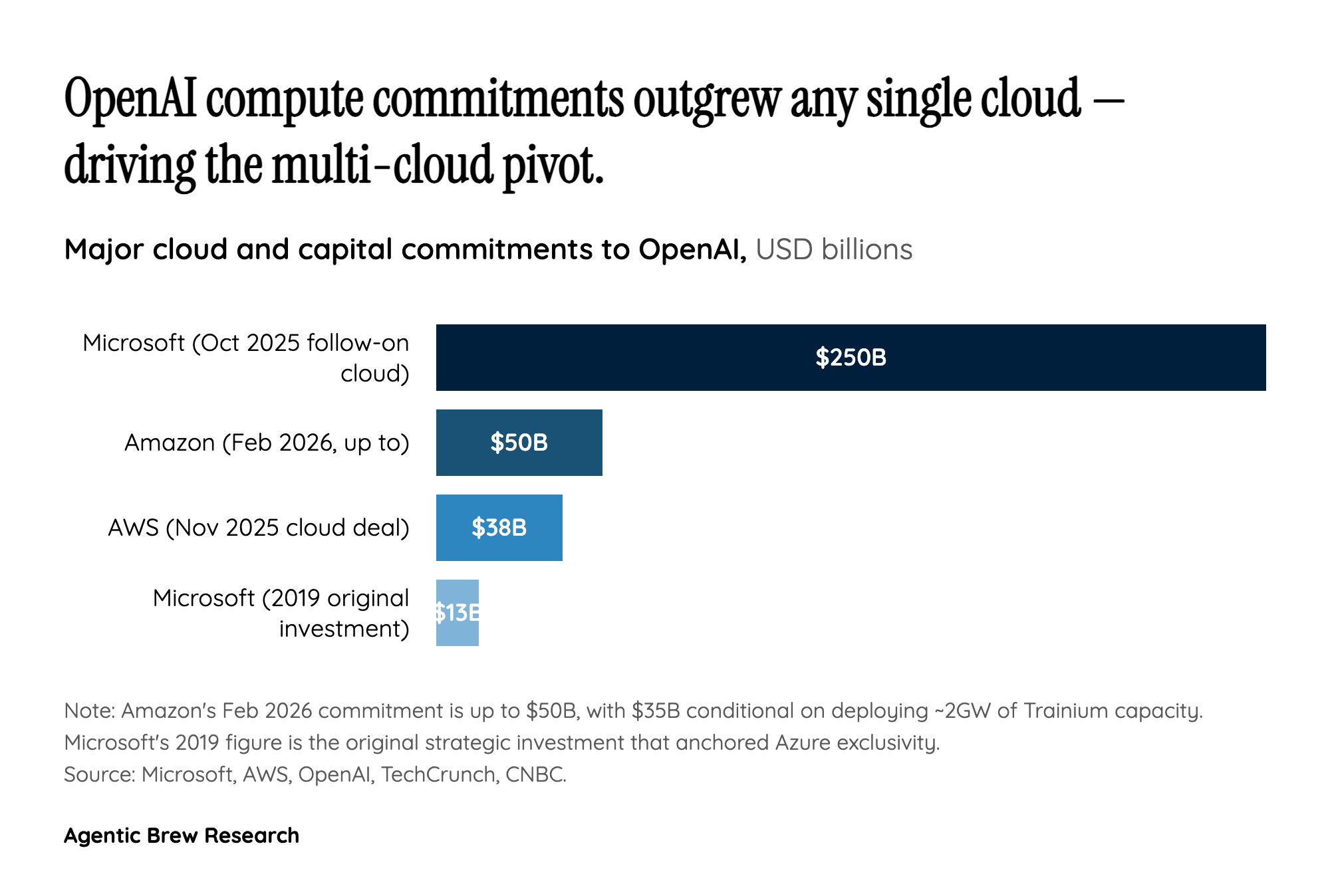
Cloud commitments stack-up: Microsoft's ~$250B October 2025 follow-on vs. AWS's $38B initial deal plus up to $50B expanded investment.

There's a cleaner story floating around: OpenAI wanted multi-cloud freedom, Microsoft was holding it back, the deal corrects that. The harder story, which surfaced in long-form Reddit analysis on r/singularity and r/OpenAI, is that OpenAI's announced compute commitments — Stargate, Oracle, CoreWeave, the new $50B Amazon program tied to ~2GW of Trainium — already exceed what Azure can physically rack in the relevant timeframe. Microsoft's own October 2025 follow-on commitment of an additional ~$250B in cloud services to OpenAI did not close the gap. Multi-cloud, by this read, is less a strategic upgrade than an admission that no single hyperscaler can underwrite frontier-model demand alone.

That reframes who is actually conceding what. Barclays analysts hint at the same thing from the opposite direction: removing Microsoft's obligation to host all of OpenAI's compute lets Microsoft redirect capital toward Copilot and other Azure-native workloads with healthier unit economics. If OpenAI's compute appetite is structurally larger than Azure's near-term build pace, then exclusivity was costing Microsoft balance sheet flexibility while delivering nothing it could enforce in practice. The 'win' for AWS — instantly gaining frontier OpenAI models on Bedrock — and the 'relief' for Microsoft are the same physical fact viewed from two seats: the workload had outgrown the contract.

Bedrock Managed Agents Is the Real Product Story

If the day-one read is 'OpenAI models on AWS,' the week-two read should be 'AWS just shipped a new managed-service category.' Bedrock Managed Agents powered by OpenAI is not a model endpoint. It is the OpenAI agent harness — persistent memory, built-in security, per-agent identity, full action auditability — packaged as a managed runtime that inherits Bedrock's existing enterprise primitives: IAM, PrivateLink, guardrails, encryption, and CloudTrail. Customer data does not leave AWS. Ben Thompson's read after interviewing Sam Altman and Matt Garman is that this is genuinely new: a harness-plus-model service where both companies are meeting in the middle of the stack, not just hosting an API.

The enterprise unlock here is the unspoken story commenters on r/ArtificialInteligence keep returning to. Many large enterprise security teams pre-approved AWS years ago but have not pre-approved OpenAI as a vendor. Putting OpenAI inference and OpenAI's agent harness behind an AWS account, governed by IAM roles and CloudTrail logs, collapses a procurement cycle that previously took quarters. Box's CTO Ben Kus is the public reference customer making exactly this point — that production-scale agent deployment requires the governance layer enterprises already trust, not a new one to vet. Codex landing on Bedrock alongside the agents — across CLI, desktop app, and VS Code extension — adds a developer-tools wedge directly into AWS-bound engineering orgs that, until this week, mostly used Claude Code or stayed on Azure. The competitive pressure on Anthropic, whose flagship distribution channel was Bedrock itself, is the part of this story still being underpriced.

How the Community Read It: Historic Pivot, Skeptical Mechanics

The sentiment shape across platforms is unusually bifurcated. Headline-driven X discussion framed this as a generational moment — a six-year, $13B-plus partnership rewritten in an afternoon — with Andy Jassy's confirmation that OpenAI models would land on Bedrock 'in the coming weeks' read as a flex, not a footnote. Long-form video coverage on Bloomberg Technology and CNBC leaned into the Azure-narrative-reset angle and the Pentagon thread (AWS GovCloud as the next domino), treating the announcement as an inflection point rather than a routine partnership update.

Reddit, by contrast, was analytical rather than celebratory. The most upvoted threads on r/singularity and r/OpenAI did the contract-reading work most outlets skipped: that Microsoft still holds IP through 2032, that the AGI clause swap is the buried lede, that OpenAI's announced compute commitments already outrun Azure's build pace, and that enterprise security teams' pre-approval of AWS is what actually unlocks Bedrock as a distribution channel. A contrarian thread argued MSFT 'actually went up today — maybe it's good to decouple a bit from a bag of hot air,' which mirrors the Barclays capex-relief read almost word for word. The split is informative: the breaking-news layer scored this as a Microsoft loss and an Amazon win, while the analytical layer scored it as a structural rebalancing where every party's public posture is downstream of the same physical constraint — that frontier-model compute demand has outgrown any single cloud.

Historical Context

2019
Microsoft and OpenAI established the original strategic partnership making Azure the exclusive cloud for OpenAI products, defining the relationship for the next seven years.
2025-10
Microsoft committed an additional ~$250B in cloud services to OpenAI as part of an earlier partnership reset.
2025-11-03
OpenAI signed an initial $38B multi-year strategic AWS deal; Amazon stock closed at a record high on the news.
2026-02
Amazon committed up to $50B (with $35B conditional on deploying ~2GW of Trainium capacity) to OpenAI; Microsoft initially asserted exclusivity might block AWS hosting of OpenAI's Frontier agent platform.
2026-04-27
Microsoft and OpenAI publish 'next phase' agreement removing exclusivity, capping OpenAI-to-Microsoft revenue share through 2030, extending the IP license non-exclusively through 2032, and removing Microsoft's revenue share obligation to OpenAI.
2026-04-28
AWS and OpenAI launch limited preview of GPT-5.5, GPT-5.4, Codex, and Bedrock Managed Agents on Amazon Bedrock — less than 24 hours after exclusivity ended.

Power Map

Key Players
Subject

OpenAI ends Microsoft cloud exclusivity and lands on AWS Bedrock with GPT-5.5, Codex, and Managed Agents

OP

OpenAI

Gains multi-cloud distribution rights to sell GPT-5.5, GPT-5.4, and Codex on AWS, Google Cloud, and elsewhere; still ships products first on Azure unless Microsoft cannot support, but is no longer structurally tied to a single hyperscaler's capacity.

MI

Microsoft

Loses exclusivity but retains a non-exclusive IP license through 2032 and remains 'primary cloud partner'; collects capped OpenAI revenue share through 2030 and reportedly recognized ~$7.5B in OpenAI-related revenue last quarter prior to the renegotiation.

AM

Amazon / AWS

Tactical winner: instantly closes a frontier-model gap on Bedrock, ships Codex and Bedrock Managed Agents powered by OpenAI, and builds on a prior $38B multi-year AWS-OpenAI cloud deal plus an expanded ~$50B Amazon-OpenAI investment tied to ~2GW of Trainium capacity.

GO

Google Cloud

Indirect beneficiary: the dismantled exclusivity also frees OpenAI to sell on Google Cloud, broadening the multi-cloud frontier-model field that Bedrock just expanded.

AN

Antitrust regulators (US, UK, EU)

Implicit stakeholder: the end of cloud exclusivity may help Microsoft and OpenAI answer scrutiny over whether the prior tie-up gave Microsoft an unfair advantage in cloud and enterprise AI markets.

BO

Box

Lead enterprise reference customer for Bedrock Managed Agents powered by OpenAI; CTO Ben Kus frames it as the production-scale path to deployed agents.

Source Articles

Top 5

THE SIGNAL.

Analysts

"Frames OpenAI's role as a horizontal 'token factory' supplying frontier intelligence and agent harnesses across all clouds, with the next phase defined by agents running inside companies rather than chatbots returning text."

Sam Altman
CEO, OpenAI

"Positions OpenAI on Bedrock as consistent with AWS's partner-first model: customers should pick the best frontier model rather than be locked into one provider, with Bedrock as the neutral distribution layer."

Matt Garman
CEO, AWS

"Internally framed Microsoft exclusivity as a constraint on enterprise growth that 'limited our ability to meet enterprises where they are,' justifying the multi-cloud pivot."

Denise Dresser
Revenue chief, OpenAI

"Calls the renegotiation a major win for Amazon and the third major Microsoft-OpenAI partnership revision in 16 months, while still maintaining a Buy on MSFT with a $510 price target."

UBS analysts
Sell-side equity research, UBS

"More constructive on Microsoft, arguing capacity relief lets Microsoft redeploy capital to Copilot and other cloud workloads instead of underwriting all of OpenAI's data-center needs."

Barclays analysts
Sell-side equity research, Barclays

"Reads Bedrock Managed Agents as a genuinely new managed-service layer beyond API hosting — a harness-plus-model offering — that closes a real competitive gap for AWS-bound enterprises."

Ben Thompson
Author/analyst, Stratechery

"Sees Bedrock Managed Agents powered by OpenAI as the production-scale enabler enterprises need to move from prototypes to deployed agents under existing AWS governance."

Ben Kus
CTO, Box
The Crowd

"Sam announced a breakup and framed it like a software patch. "We have updated our partnership." That's it. That's the whole announcement. What it actually says. Microsoft put in $13B for exclusive cloud access to OpenAI. That exclusivity is now gone. Revenue share payments are [capped through 2030]."

@@aaditsh0

"Very interesting announcement from OpenAI this morning. We're excited to make OpenAI's models available directly to customers on Bedrock in the coming weeks, alongside the upcoming Stateful Runtime Environment. With this, builders will have even more choice to pick the right [model for their use case]."

@@ajassy0

"OpenAI just ended Microsoft's exclusive access to its models. After $13 billion invested. After 6 years. The most important AI partnership in history just changed forever. Here's what actually changed: What OpenAI gained: -> Can now offer products on any cloud — Amazon, Google, [etc.]"

@@CodeByPoonam0

"OpenAI ends its exclusive partnership with Microsoft"

@u/JackFisherBooks256
Broadcast
Breaking Down Microsoft & OpenAI's New Deal

Breaking Down Microsoft & OpenAI's New Deal

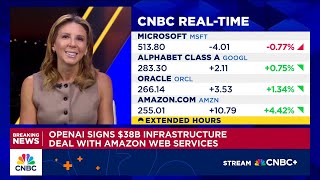
OpenAI signs $38B infrastructure deal with Amazon Web Service

OpenAI signs $38B infrastructure deal with Amazon Web Service

OpenAI Drops Exclusivity Deal with Microsoft | Bloomberg Tech 4/27/2026

OpenAI Drops Exclusivity Deal with Microsoft | Bloomberg Tech 4/27/2026