AI-Driven Memory Chip Investment Boom
TECH

AI-Driven Memory Chip Investment Boom

46+
Signals

Strategic Overview

  • 01.
    The 2026 HBM market has reached $54.6 billion with a 58% year-over-year increase, and is projected to hit a $100 billion total addressable market by 2028, as AI workloads drive unprecedented demand for high-bandwidth memory.
  • 02.
    Three companies — Samsung, SK Hynix, and Micron — control 95% of global DRAM production and are collectively investing over $100 billion in capacity expansion, with Samsung committing a record $73.2 billion, Micron allocating $20 billion in FY2026, and SK Hynix building a $12.9 billion advanced packaging plant.
  • 03.
    DRAM prices surged 246% in 2025 and spiked 75% in a single month (December-January), while AI firms have locked up HBM supply through 2027 and Micron is completely sold out through 2026.
  • 04.
    The AI memory supercycle is creating severe collateral damage for consumer electronics: Nvidia is cutting RTX 50-series gaming GPU production by 30-40%, Sony may delay PlayStation to 2028-2029, and Micron has discontinued its 30-year-old Crucial consumer brand to reallocate capacity to AI.

Deep Analysis

Why This Matters

The AI memory chip investment boom represents a fundamental restructuring of the global semiconductor supply chain. For the first time in the industry's history, a single application category — artificial intelligence — is powerful enough to redirect tens of billions in capital investment, force the abandonment of established consumer product lines, and create a supply shortage severe enough to delay major consumer electronics launches by years. This is not a cyclical uptick; it is a structural reallocation of the world's memory manufacturing capacity toward a new class of customer.

The economics driving this shift are stark. A single HBM chip consumes three times the silicon wafer area of a commodity DRAM chip, meaning every unit of HBM produced directly reduces the supply of memory available for PCs, smartphones, and gaming consoles. With HBM now consuming 23% of total DRAM wafer output (up from 19% in 2025), the memory industry is making an explicit choice: AI infrastructure gets priority, and everything else gets what is left. When Micron kills a 30-year-old consumer brand and Nvidia cuts gaming GPU production by 30-40%, these are not temporary adjustments — they are signals that the industry has permanently reordered its priorities around AI demand.

How It Works

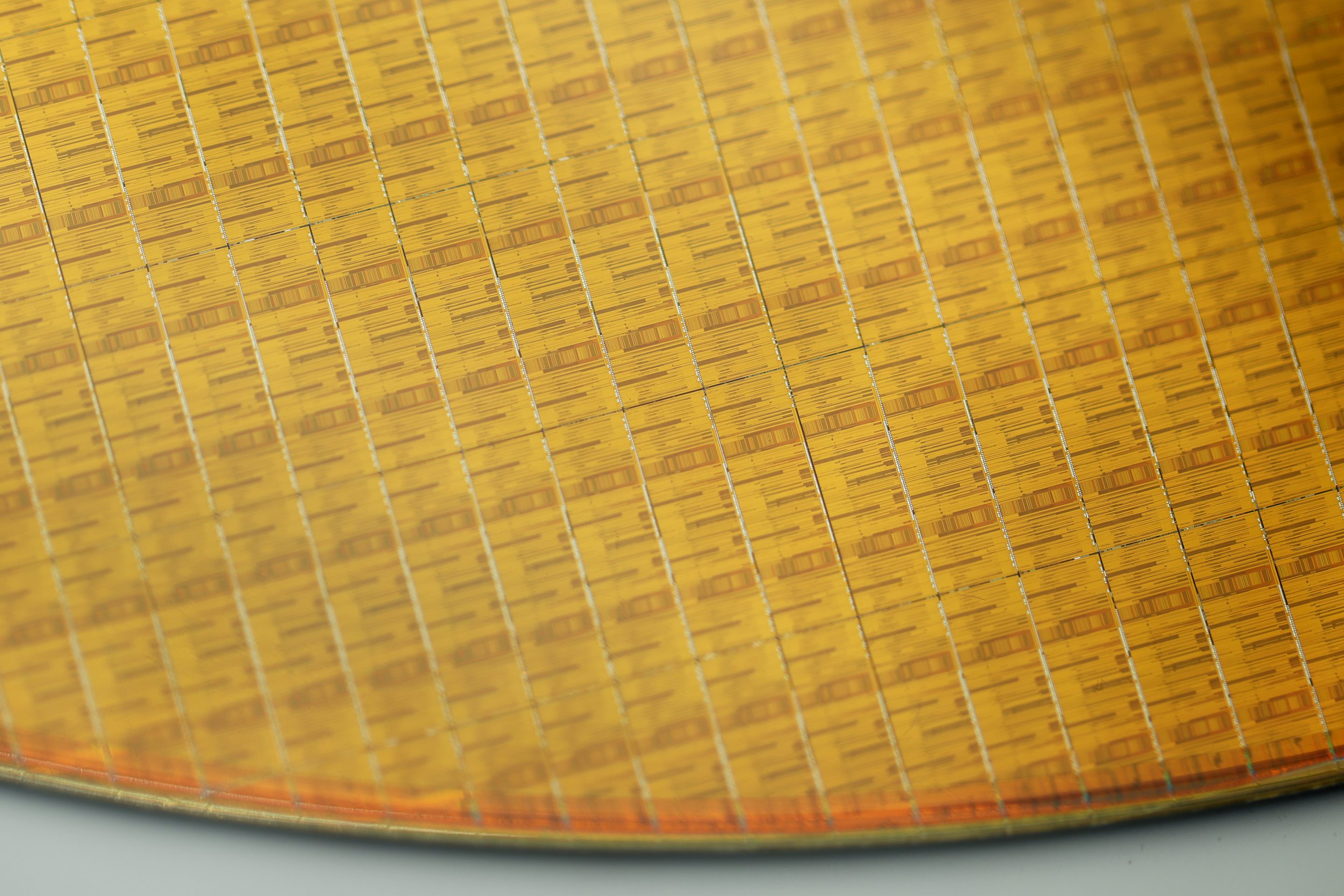
High Bandwidth Memory (HBM) is a specialized DRAM architecture that stacks multiple memory dies vertically using through-silicon vias (TSVs) and advanced packaging techniques. Unlike conventional DRAM, which sits on a separate module connected to the processor via a motherboard, HBM is bonded directly adjacent to or on top of the GPU die using a silicon interposer, enabling dramatically higher data transfer rates. Nvidia's Blackwell accelerators, for instance, use 192GB of HBM per chip, and a single NVL72 rack consumes 13.4TB of memory — orders of magnitude more than any previous computing system.

The manufacturing bottleneck lies not in the DRAM dies themselves but in the advanced packaging step. Stacking 8, 12, or 16 layers of memory dies requires extreme precision in TSV alignment, thermal management, and yield control. As Korea Semiconductor Industry Association EVP Ahn Ki-hyun noted, the transition from 12 to 16 layers is 'technically much harder than 8 to 12.' This is why SK Hynix is investing $12.9 billion specifically in advanced packaging capacity, and why Samsung is racing to scale its HBM wafer starts to 250,000 per month. The constraint is not silicon wafer supply — it is the ability to stack and package that silicon into functional HBM modules at scale.

By The Numbers

By The Numbers
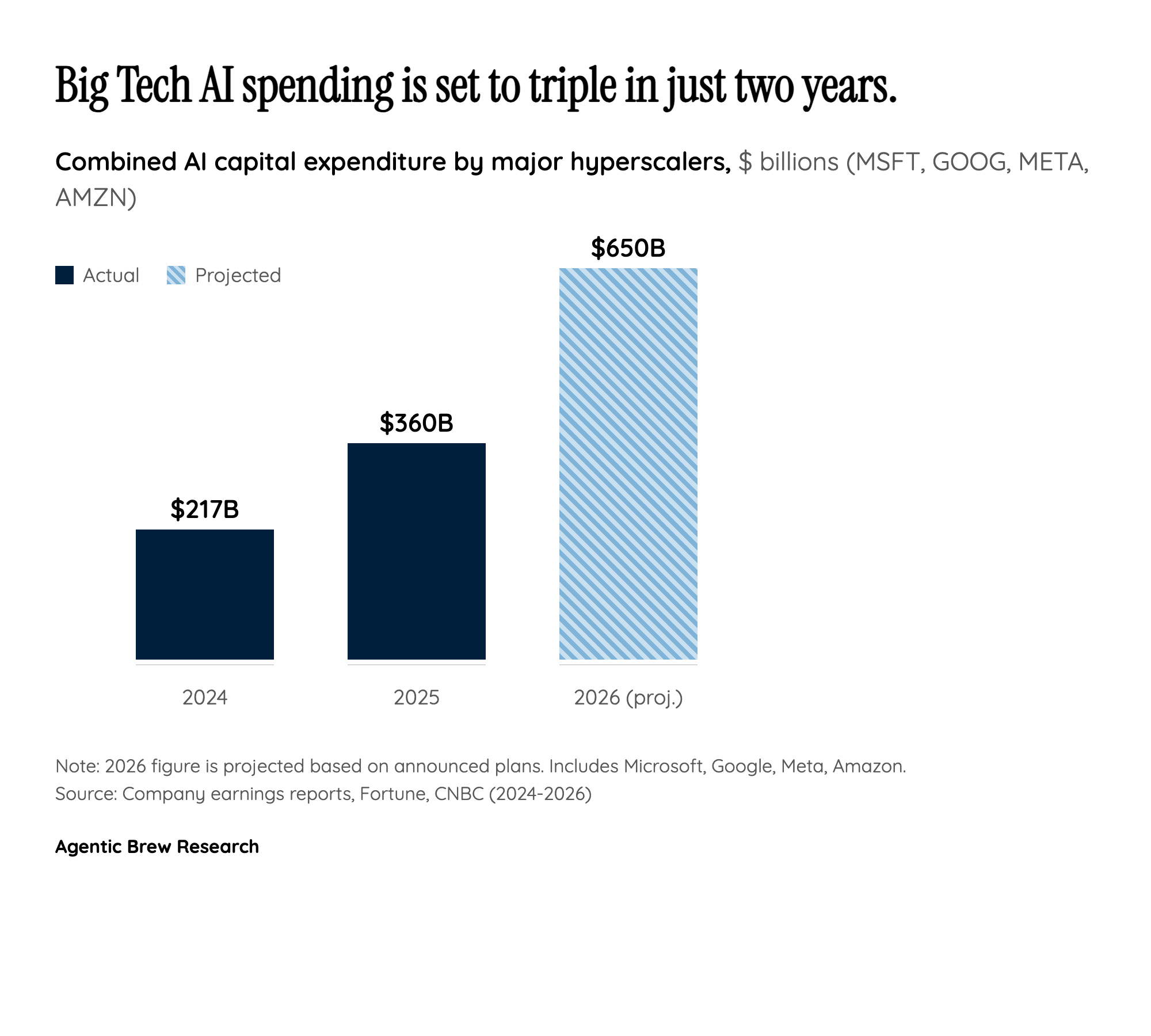
Big Tech AI capital expenditure tripling from $217B (2024) to a projected $650B (2026)

The financial scale of the AI memory supercycle is staggering. The HBM market alone reached $54.6 billion in 2026, a 58% year-over-year increase, and is projected to reach a $100 billion total addressable market by 2028. This growth is being fueled by Big Tech AI capital expenditure that has gone from $217 billion in 2024 to $360 billion in 2025 to a projected $650 billion in 2026 — essentially tripling in two years.

On the supply side, the three-company oligopoly is investing at historic levels: Samsung's $73.2 billion (a record 22% increase), Micron's $20 billion in FY2026 capex, and SK Hynix's $12.9 billion new plant. The pricing effects have been dramatic — DRAM prices surged 246% in 2025, with a 75% spike in a single month between December and January. Micron's financials tell the story of the boom: revenue tripled year-over-year and gross margins jumped from 22% in FY2024 to over 50%, while SK Hynix commands 62% of the HBM market, followed by Micron at 21% and Samsung at 17%. The global semiconductor market itself has swelled to approximately $975 billion in 2026, growing more than 25% year-over-year.

Impacts & What's Next

The immediate impact is a bifurcation of the technology economy into AI haves and have-nots. Companies with locked-in HBM supply contracts (hyperscalers, Nvidia) are positioned to scale their AI infrastructure, while everyone else faces higher memory costs and constrained availability. Consumer electronics is the most visible casualty: Sony's potential PlayStation delay to 2028-2029, Oppo's 20% production target cut, and Nvidia's own 30-40% reduction in gaming GPU output all reflect a world where AI demand has crowded out consumer supply. As Sha Rabii of Majestic Labs put it, the biggest AI players are effectively imposing a 'RAMageddon' — a tax on the entire economy.

Looking further out, several dynamics will shape the next phase. New U.S. fabs (including Micron's and Samsung's domestic facilities) will not be operational until 2028 or later, meaning the supply squeeze will persist for at least two more years. The technical challenges of scaling to 16-layer HBM stacking will constrain yield improvements. On the demand side, AI model sizes continue to grow, and the shift from training to inference workloads will sustain memory demand even if AI investment sentiment cools. Reddit skeptics who see this as a typical boom-bust cycle may underestimate how structurally different this shortage is — when three companies control 95% of supply and their biggest customers have locked up capacity through 2027, the cycle dynamics are very different from historical precedents.

The Bigger Picture

The AI memory supercycle is the clearest illustration yet of a thesis that has been building since 2023: artificial intelligence is not just another software trend — it is a physical infrastructure buildout on par with electrification or the buildout of the internet backbone. The difference is speed and concentration. While the internet's infrastructure buildout was distributed across thousands of companies over two decades, the AI infrastructure buildout is being driven by fewer than a dozen hyperscalers over fewer than five years, flowing through a three-company memory oligopoly.

This concentration creates both opportunity and risk. The opportunity is visible in Micron's tripled revenue and 50%+ margins, in SK Hynix's market dominance, and in Samsung's record investment commitment. The risk is equally visible: a market where three companies control a critical input to the global economy, where AI firms can lock up supply years in advance, and where consumer technology innovation is being actively deprioritized. Social media sentiment captures this tension perfectly — bullish on the investment thesis, deeply concerned about the bottlenecks and downstream effects. The Bloomberg documentary on Samsung falling behind, the Reddit posts about manufacturers going bankrupt, and Karpathy's analysis of memory-compute orchestration all point to the same conclusion: memory has become the binding constraint of the AI era, and whoever controls it controls the pace of AI progress itself.

Historical Context

2009
A wave of consolidation began that would reduce the global DRAM market from 10 manufacturers to just 3 (Samsung, SK Hynix, Micron) by 2014, creating the oligopoly that now controls 95% of supply.
2015
AMD launched the first consumer product using High Bandwidth Memory, establishing HBM as a viable high-performance memory architecture that would later become critical for AI accelerators.
2023
HBM3 entered mass production, marking the beginning of the modern HBM era that would fuel the AI training and inference infrastructure buildout.
2024-06
Generative AI demand triggered a global memory supply shortage as hyperscalers began aggressively locking up HBM capacity for next-generation AI training clusters.
2025-11
Micron discontinued its 30-year-old Crucial consumer memory brand to reallocate manufacturing capacity entirely toward higher-margin AI memory products, signaling the industry's decisive pivot away from consumer markets.
2026-01
SK Hynix announced a $12.9 billion investment in a new advanced packaging plant to address the HBM production bottleneck, the largest single fab investment in the company's history.
2026-01
Micron began volume shipments of HBM4 memory for Nvidia's Vera Rubin AI platform, becoming the first US manufacturer to ship next-generation high-bandwidth memory at scale.
2026-03
Samsung unveiled a record $73.2 billion investment plan with plans to boost HBM production capacity to 250,000 wafers per month, a 47% surge aimed at closing the gap with SK Hynix.

Power Map

Key Players
Subject

AI-Driven Memory Chip Investment Boom

SK

SK Hynix

Dominant HBM supplier with 62% market share, providing approximately 90% of Nvidia's HBM supply. Investing $12.9 billion in a new advanced packaging plant to maintain its lead as the primary enabler of AI infrastructure scaling.

SA

Samsung

Third-place HBM competitor (17% share) mounting an aggressive comeback with a record $73.2 billion investment and plans to boost HBM production to 250,000 wafers per month (47% increase). Raising memory prices up to 60% to capitalize on the shortage.

MI

Micron Technology

The only US-based DRAM manufacturer (21% HBM share), tripled revenue year-over-year with gross margins exceeding 50%. Exited the consumer market by discontinuing the Crucial brand to fully pivot toward AI memory, and began HBM4 volume shipments for Nvidia's Vera Rubin platform.

NV

Nvidia

Primary demand driver whose Blackwell accelerators consume 192GB of RAM each (13.4TB per NVL72 rack). Planning 30-40% cuts to RTX 50-series consumer GPU production to prioritize AI chip supply, effectively channeling the memory shortage toward data center customers.

HY

Hyperscalers (Microsoft, Google, Meta, Amazon)

Collectively spending a projected $650 billion on AI capital expenditure in 2026 (up from $217 billion in 2024), these companies have locked up HBM supply through 2027, effectively pricing out smaller competitors and consumer electronics manufacturers from accessing memory capacity.

CO

Consumer Electronics OEMs

The losers in the memory reallocation: Sony may delay the next PlayStation to 2028-2029, Oppo has cut production targets by 20%, and gaming GPU availability is shrinking as manufacturers prioritize AI-grade memory over consumer products.

THE SIGNAL.

Analysts

"Described the current situation as 'the most significant disconnect between demand and supply in magnitude and time horizon' in his 25 years in the industry, signaling that this is not a typical cyclical shortage but a structural shift in how memory capacity is allocated."

Manish Bhatia
Executive Vice President, Micron Technology

"Stated 'We stand at the cusp of something bigger than anything we have faced,' framing the AI memory demand cycle as the most significant inflection point in semiconductor equipment history and signaling sustained multi-year investment in fab capacity."

Tim Archer
CEO, Lam Research

"Warned that memory chip prices are going 'parabolic,' reflecting the extreme supply-demand imbalance where locked-in contracts and limited production capacity are creating runaway pricing that has already seen DRAM costs surge 246% in a single year."

Mark Li
Senior Analyst, Bernstein

"Highlighted that the transition from 12-to-16-layer HBM stacking is 'technically much harder than 8 to 12,' identifying a critical manufacturing bottleneck that will constrain HBM supply growth even as billions in new investment come online."

Ahn Ki-hyun
Executive Vice President, Korea Semiconductor Industry Association

"Coined the term 'RAMageddon' to describe how the biggest AI players are effectively imposing a tax on the entire economy by absorbing memory capacity that would otherwise serve consumer devices, gaming, and smartphones."

Sha Rabii
Founder, Majestic Labs
The Crowd

"The AI boom just hit a wall nobody saw coming. And it's not software. It's not regulation. It's not even energy... It's memory chips. Right now, Dell is raising PC prices by 30%. Intel can't ship chips. Nvidia is slashing GPU production by 40%."

@@Ric_RTP3200

"With the coming tsunami of demand for tokens, there are significant opportunities to orchestrate the underlying memory+compute *just right* for LLMs. The fundamental and non-obvious constraint is that due to the chip fabrication process, you get two completely distinct pools of..."

@@karpathy7400

"This is the clearest map I've seen of how AI infrastructure constraints move in sequence. Every time one wall falls, another appears. I've watched this pattern since 2020: first it was 'can we get enough GPUs,' then 'can we get HBM attached,' now it's 'can we plug it all in'..."

@@ai2100

"Many consumer electronics manufacturers will go bankrupt or exit product lines by the end of 2026 due to the AI memory crisis, Phison CEO reportedly says"

@u/lkl3412483
Broadcast
Why Samsung Is Falling Behind in the AI Chips Race

Why Samsung Is Falling Behind in the AI Chips Race

Micron Stock (MU) Has THE MOST Upside for 2026 - Here's Why

Micron Stock (MU) Has THE MOST Upside for 2026 - Here's Why

DRAM Shortage Crisis explained..

DRAM Shortage Crisis explained..