AI Agent Ecosystem: Infrastructure, Autonomy, and Real-World Applications
TECH

AI Agent Ecosystem: Infrastructure, Autonomy, and Real-World Applications

53+
Signals

Strategic Overview

  • 01.
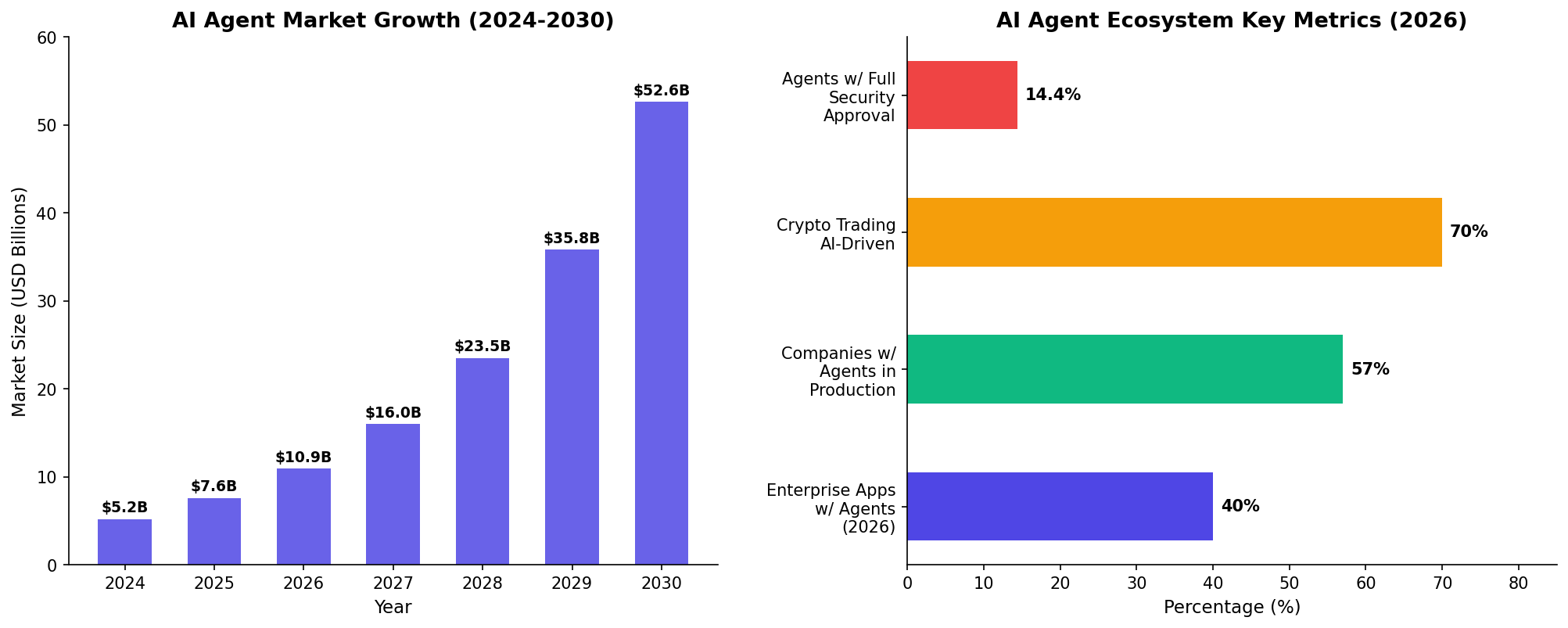
    The global AI agent market has reached $10.9 billion in 2026, growing at a 46-49% CAGR with projections to exceed $52 billion by 2030, as enterprises rapidly adopt autonomous agents across finance, blockchain, and business automation.
  • 02.
    NIST launched the AI Agent Standards Initiative on February 17, 2026, establishing the first formal framework for interoperable and secure autonomous agents, while Gartner predicts 40% of enterprise applications will embed AI agents by year-end 2026.
  • 03.
    Blockchain infrastructure for AI agents is accelerating: OKX launched OnchainOS processing $300M in daily trading volume across 60+ blockchains, Coinbase introduced Agentic Wallets enabling 50M+ machine-to-machine transactions, and 60-80% of crypto trading is already AI-driven.
  • 04.
    A critical production readiness gap persists: while 57% of companies report agents in production, only 14.4% launched with full security approval, and an estimated 80-90% of agent projects fail in production environments.

Deep Analysis

Why This Matters

The AI agent ecosystem has crossed a critical inflection point in early 2026. What was a speculative technology category just 18 months ago is now a $10.9 billion market with 57% of surveyed companies reporting agents in production. This is not incremental growth -- it represents a fundamental shift in how software interacts with the world, moving from passive tools that respond to prompts to autonomous systems that plan, execute, and adapt independently.

The convergence of three forces makes this moment uniquely significant. First, enterprise adoption has accelerated dramatically, exemplified by BNY Mellon deploying 20,000 agents and ClickUp reporting 3,258 AI agents working alongside 1,300 human employees. Second, blockchain infrastructure has emerged as the unexpected backbone for agent-to-agent commerce, with OKX, Coinbase, and BNB Chain building the payment rails and identity systems agents need to transact autonomously. Third, standards bodies like NIST are now actively shaping the governance framework, signaling that AI agents have moved from research curiosity to a technology requiring formal institutional oversight. Together, these developments suggest we are witnessing the early formation of an autonomous digital economy.
How It Works

Modern AI agent systems operate on a three-tier sophistication model, as popularized by educational content reaching millions of viewers. At the base level, large language models provide reasoning capabilities. The middle tier adds structured workflows with tool use, memory, and planning loops. The top tier -- true agents -- combines these with autonomous goal-setting, environmental perception, and the ability to delegate subtasks to other agents. The key infrastructure enabling this progression includes persistent memory layers (companies like Mem0), context engineering protocols (Model Context Protocol or MCP), and dedicated hardware (NVIDIA BlueField-4 with context memory storage).

In the blockchain-AI convergence specifically, the architecture is becoming increasingly sophisticated. OKX's OnchainOS provides a unified toolkit that connects AI agents to 60+ blockchains through a single API layer, handling the complexity of cross-chain operations. Coinbase's x402 protocol enables HTTP-native micropayments where agents can pay for services programmatically without human intervention. BNB Chain's ERC-8004 standard gives agents verifiable on-chain identities, solving the critical trust problem of knowing which agent you are transacting with. Meta-learning approaches, highlighted by AI researcher Jeff Clune, are now enabling agents to design their own memory mechanisms, suggesting the infrastructure layer itself may become increasingly self-optimizing.

By The Numbers

By The Numbers

The financial trajectory of the AI agent market tells a compelling growth story. From $5.2 billion in 2024, the market has roughly doubled to $10.9 billion in 2026, with projections ranging from $52.6 billion by 2030 (Grand View Research) to $182.97 billion by 2033, representing a sustained 46-49% compound annual growth rate. North America currently commands 39.63% of the global market, though Asia-Pacific adoption is accelerating rapidly through crypto-native infrastructure like OKX and BNB Chain.

Enterprise adoption metrics paint a picture of rapid but uneven deployment. While 57% of companies report having agents in production according to G2's enterprise survey, only 14.4% of those agents were launched with full security approval -- a gap that Vasu Jakkal of Microsoft has specifically flagged as a critical risk. In the crypto sector, the numbers are even more dramatic: 60-80% of cryptocurrency trading is already AI-driven, OKX processes 1.2 billion daily API calls through its agent infrastructure, and Coinbase's Agentic Wallets have facilitated over 50 million machine-to-machine transactions since February 2026. Perhaps the most sobering statistic comes from a RAND study cited across Reddit discussions: an estimated 80-90% of AI agent projects fail in production, suggesting the gap between prototype and deployment remains the ecosystem's biggest challenge.

Impacts and What Is Next

The immediate impact is a restructuring of enterprise software architecture. Microsoft's full-stack approach -- spanning Azure Foundry for development, Fabric for data, and Copilot for end-user interaction -- signals that major platform vendors see agents not as a feature but as the new application paradigm. Samsung's expansion of its Galaxy AI multi-agent ecosystem with partners like Perplexity extends this to consumer devices, suggesting agents will soon mediate how hundreds of millions of people interact with their phones. The financial services sector is furthest along, with BNY Mellon's 20,000-agent deployment serving as a proof point for large-scale institutional adoption.

Looking ahead, several trajectories are becoming clear. The blockchain-AI convergence will likely accelerate as Changpeng Zhao's prediction of agents generating a million times more payments than humans creates massive demand for programmable money. The NIST standards initiative will establish compliance baselines that could either accelerate adoption (by reducing risk uncertainty) or slow it (by imposing costly requirements). The International AI Safety Report's identification of three risk categories -- malicious use, malfunctions, and systemic risks -- suggests regulatory frameworks will increasingly treat agents as a distinct category from traditional AI. Most critically, the production readiness gap (80-90% failure rate, 14.4% security compliance) must close for the market to reach its $52 billion 2030 projection. Google's leaked 64-page guide on agent production operations, flagged on X.com, suggests major players are already investing heavily in closing this gap.

The Bigger Picture

What emerges from cross-platform analysis is a technology ecosystem in the midst of a classic hype-to-reality transition, but with a crucial difference: the infrastructure buildout is real and accelerating even as many individual projects fail. The Reddit skepticism about 'agent washing' -- where vendors rebrand chatbots as agents -- coexists with genuine multi-billion-dollar infrastructure investments from NVIDIA, Microsoft, and major crypto exchanges. Only approximately 130 of thousands of claimed vendors are building genuinely agentic systems, suggesting the market is simultaneously overhyped at the vendor level and underhyped at the infrastructure level.

The most significant non-obvious finding from this analysis is the depth of the blockchain-AI convergence. While mainstream tech coverage focuses on enterprise copilots and coding assistants, the crypto ecosystem has quietly built the most advanced infrastructure for truly autonomous agents: identity systems (ERC-8004), payment rails (x402), and multi-chain execution environments (OnchainOS). This suggests that the first truly autonomous AI economies may emerge not in traditional enterprise settings but in decentralized finance, where the permissionless nature of blockchain removes the institutional gatekeeping that slows enterprise deployment. The tension between this bottom-up autonomy and the top-down governance frameworks from NIST and international safety bodies will likely define the next phase of the AI agent ecosystem.

Historical Context

2024-01-01
The global AI agents market stood at approximately $5.2 billion, with enterprise adoption still below 5% of applications.
2025-08-26
Gartner predicted 40% of enterprise applications would embed task-specific AI agents by 2026, up from less than 5% in 2025.
2026-02-04
BNB Chain deployed ERC-8004, a new standard for on-chain AI agent identities enabling verifiable autonomous agent operations on blockchain.
2026-02-11
Coinbase launched Agentic Wallets using the x402 protocol, enabling machine-to-machine payments that have since processed over 50 million transactions.
2026-02-17
NIST announced the AI Agent Standards Initiative, the first U.S. government-led framework for ensuring interoperable and secure autonomous AI agents.
2026-03-03
OKX launched OnchainOS, an AI agent toolkit spanning 60+ blockchains and 500+ decentralized exchanges, processing 1.2 billion daily API calls.
2026-03-05
Luma launched creative AI agents powered by its new unified intelligence models, extending agent capabilities beyond enterprise into creative workflows.
2026-03-15
The 2026 International AI Safety Report identified three risk categories for AI agents: malicious use, malfunctions, and systemic risks requiring coordinated governance.

Power Map

Key Players
Subject

AI Agent Ecosystem: Infrastructure, Autonomy, and Real-World Applications

MI

Microsoft

Full-stack AI agent provider building Azure Foundry, Fabric, and Copilot platforms, positioning itself as the primary enterprise infrastructure layer for agent development and deployment.

NV

NVIDIA

Hardware infrastructure leader powering agentic AI with BlueField-4 DPUs and Inference Context Memory Storage Platform, delivering 5x efficiency gains for agent workloads.

NI

NIST

U.S. standards body driving the first formal interoperability and security framework for autonomous AI agents, shaping regulatory expectations globally.

OK

OKX

Crypto exchange building OnchainOS, an AI agent toolkit spanning 60+ blockchains and 500+ DEXs, processing 1.2 billion daily API calls and approximately $300M in daily trading volume.

BN

BNY Mellon

Largest custodian bank deploying 20,000 AI agents across its global workforce, serving as the benchmark for enterprise-scale agent adoption in financial services.

CO

Coinbase

Pioneering machine-to-machine payments with the x402 protocol and Agentic Wallets, enabling over 50 million autonomous transactions and establishing crypto as the payment rail for AI agents.

THE SIGNAL.

Analysts

"AI agents will become blockchain's primary users, with AI handling the front-end experience and blockchain serving as the back-end infrastructure for trustless agent coordination and transactions."

Illia Polosukhin
Co-founder, NEAR Protocol

"AI agents will eventually generate one million times as many payment transactions as humans, making cryptocurrency the natural payment infrastructure due to its programmability and speed."

Changpeng Zhao
Founder, Binance

"The future of AI agents is not about replacing humans but amplifying them, with agents serving as force multipliers that extend human capability across enterprise workflows."

Aparna Chennapragada
Chief Product Officer, Microsoft

"Every AI agent should receive security protections equivalent to those given to human employees, including identity management, access controls, and activity monitoring."

Vasu Jakkal
Corporate Vice President of Security, Microsoft
The Crowd

"How many AI agents work at your company? We now have over 3,258 agents working alongside 1,300 humans. The crazy part is these agents were created by EVERY EMPLOYEE at our company... sales reps, marketers, customer support, product, eng. Literally EVERYONE."

@@DJ_CURFEW102

"Can AI agents design better memory mechanisms for themselves? Introducing Learning to Continually Learn via Meta-learning Memory Designs. A meta agent automatically designs memory mechanisms, including what info to store, how to retrieve it, and how to update it, enabling agentic continual learning."

@@jeffclune78

"Google just dropped a 64-page guide on AI agents that is basically a reality check for everyone building agents right now. The brutal truth: most agent projects will fail in production. Not because the models are not good enough, but because nobody is doing the unsexy operational work."

@@godofprompt30

"Are AI agents just hype?"

@u/unknown250
Broadcast
AI Agents, Clearly Explained

AI Agents, Clearly Explained

Generative vs Agentic AI: Shaping the Future of AI Collaboration

Generative vs Agentic AI: Shaping the Future of AI Collaboration

What is MCP? Integrate AI Agents with Databases and APIs

What is MCP? Integrate AI Agents with Databases and APIs