OpenAI AI-First Smartphone Development
TECH

OpenAI AI-First Smartphone Development

50+
Signals

Strategic Overview

  • 01.
    OpenAI is reportedly co-developing a custom smartphone processor with MediaTek and Qualcomm, with Luxshare Precision Industry — an existing iPhone assembler — serving as the exclusive system co-design and manufacturing partner.
  • 02.
    The device is designed so AI agents replace traditional apps as the primary interface, with the phone running a mix of on-device and cloud inference while continuously tracking the user's real-time context.
  • 03.
    Component specifications and the full supplier list are expected to be finalized by late 2026 or Q1 2027, with mass production targeted for 2028. None of OpenAI, Qualcomm, or MediaTek have publicly confirmed the partnership; the disclosure traces to an April 27, 2026 supply-chain note from analyst Ming-Chi Kuo.
  • 04.
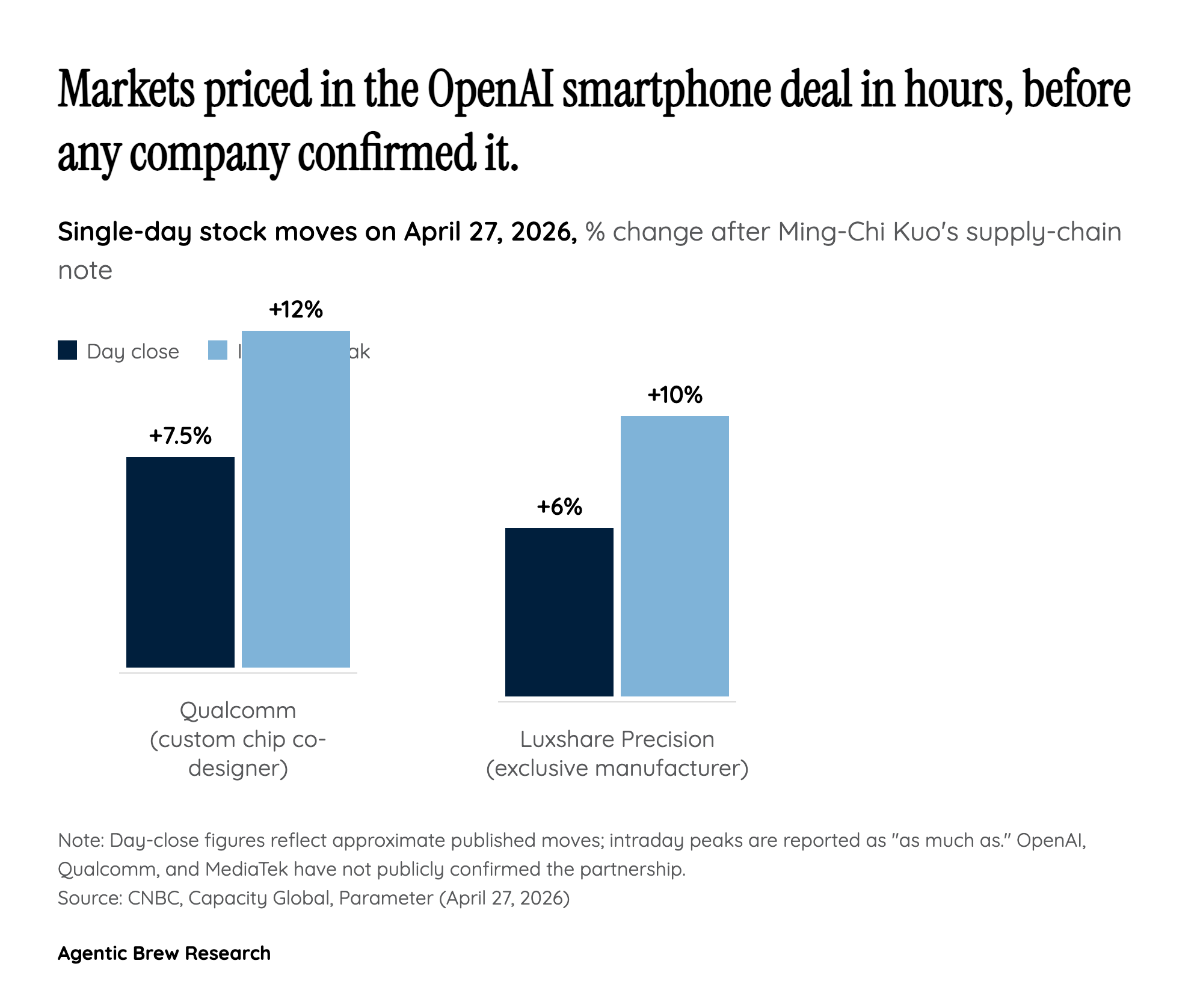
    The report triggered an immediate semiconductor-supply-chain rally: Qualcomm shares surged as much as ~12% intraday on April 27, 2026, while Luxshare Precision rose as much as 10%.

Deep Analysis

The agent-as-OS thesis: why OpenAI thinks it has to own the silicon

The core mechanical claim in Kuo's note is that an agent-first device cannot be built on top of iOS or Android. Per Kuo, the smartphone is 'the only device that captures a user's full real-time state, including location, activity, communication, and context' — and capturing that state continuously requires permissions, background execution, and on-device inference that Apple and Google's permission sandboxes deliberately constrain. Sam Altman's framing makes the same argument from the other direction, calling this 'a good time to seriously rethink how operating systems and user interfaces are designed.' The architecture Kuo describes — a custom Qualcomm/MediaTek processor running 'a mix of on-device and cloud inference' — is the physical embodiment of that thesis: small models on the chip handle ambient context capture, larger models in the cloud handle reasoning, and an OpenAI-controlled OS removes the gatekeeper that today decides which signals an agent can see.

This is also why Luxshare matters more than its assembly role suggests. It is the 'exclusive system co-design' partner, not just a manufacturer — meaning the boundary between silicon, sensors, and OS is being designed as one stack. If the agent is the interface and the app is obsolete, as TechCrunch and TheNextWeb both frame it, then the unit of optimization shifts from a screen full of icons to a continuous inference loop that needs power, memory bandwidth, and sensor access tuned to it. That is a hardware problem, not a software one, which is the strategic justification for OpenAI taking on first-time-OEM execution risk.
Follow the supply chain: a $6.5B design acquisition and a 12% one-day chip rally

Follow the supply chain: a $6.5B design acquisition and a 12% one-day chip rally
Qualcomm and Luxshare both rallied on April 27, 2026 after Ming-Chi Kuo disclosed OpenAI smartphone supply-chain partnerships.

The financial footprint of this project is already visible even though no device exists. OpenAI paid $6.5 billion in May 2025 to acquire Jony Ive's io Products outright after previously holding a 23% stake — a price that only makes sense if hardware is a multi-product, multi-year strategic line rather than a one-off experiment. Kuo's April 27, 2026 disclosure then revealed the second tranche of commitment: dual-sourcing custom silicon across Qualcomm and MediaTek, plus an exclusive co-design and manufacturing relationship with Luxshare, the iPhone assembler. The market reaction priced this in immediately — Qualcomm rose as much as ~12% intraday and roughly 7-8% on the day, nearly erasing its 2026 losses, while Luxshare jumped as much as 10%.

What the rally actually says is that investors believe the incremental chip and assembly volumes are real even if the consumer-product outcome is uncertain. That is a meaningful signal: supply-chain analysts are calibrated to whether components will be ordered, not whether end devices will sell. A 2028 production target with specs and suppliers locking in by late 2026 or Q1 2027 implies tooling, wafer allocation, and assembly-line commitments are already in motion. For Qualcomm specifically, an OpenAI design win is a hedge against Apple's continued march toward in-house modems and SoCs — even a partial program that ships tens of millions of units would matter materially. The market did the math in hours.

The credibility gap: ambition Kuo himself calls unprecedented

Buried inside the same Kuo note that drove the rally is an extraordinary disclaimer. Kuo projects 300-400 million annual shipments if successful — a figure that would exceed Apple's iPhone volumes — but TheNextWeb's coverage flags that this scale has 'no precedent' for a new entrant and 'is not a reasonable base case' for a first-generation device from a non-hardware company. Both numbers come from the same analyst on the same day, and the tension between them is the most honest thing in the cycle: the upside is civilization-scale, the base case is a shipped product nobody has demonstrated yet.

The expert chorus skews toward the cautious read. Ben Lovejoy at 9to5Mac states he would 'bet very heavily that the OpenAI smartphone will either never materialize or will be a commercial failure,' arguing the agent-first vision is incompatible with the current reliability of AI systems — 'given the schoolboy errors made by AI systems at present, it will be a very long time indeed before I will trust an agent to do anything important for me.' Perplexity's Aravind Srinivas pushes harder, rejecting the disruption frame entirely: 'the iPhone is actually not getting disrupted by AI at all. In fact, the more AI works better, the iPhone essentially becomes your digital passport.' Reddit communities drew the obvious historical parallels — Facebook Phone, Amazon Fire Phone, Windows Phone, Rabbit R1, Humane AI Pin — and YouTube explainers leaned into the same cautionary catalog. The contrarian read is not that OpenAI cannot ship hardware; it is that the agent-as-interface premise may simply not be ready for 2028, regardless of who builds it.

The privacy inversion: a device explicitly designed to see everything

The least-discussed second-order effect is what 'capturing a user's full real-time state' means as a product requirement rather than a side effect. Apple's platform identity for the past decade has been built on data minimization, on-device processing, and a hard line against persistent ambient capture. The OpenAI device inverts that contract by design: the agent is only as capable as its context, and the context is only as rich as what the device is permitted to observe. Reddit threads on r/technology and r/mobiles repeatedly framed this not as a phone story but as a data-collection story — a critique that lands harder when the same Kuo note that drives the engineering pitch also describes continuous tracking of 'location, activity, communication, and context' as the central feature.

The contrast becomes a positioning weapon for incumbents. Even commentators who think the OpenAI phone will fail, like Lovejoy, expect it to push Apple and Google to accelerate agent-first features in iOS and Android — but those features will arrive wrapped in the platform-trust language Apple has spent a decade building. Elon Musk's framing pushes the privacy stakes even further: he describes a future where 'the phone will just display the pixels and make the sounds that it anticipates you would most like to receive,' a vision in which the device is fully passive and the AI edge node is fully predictive. That is a world in which the question of who owns the inference layer — and what they observe to power it — becomes the central regulatory and consumer-trust battle of the late 2020s. OpenAI's bet is that users will trade Apple's data discipline for an agent that actually works. The next two years of execution will determine whether that trade exists.

Historical Context

2024
Former Apple chief designer Jony Ive co-founded io Products with Scott Cannon, Evans Hankey, and Tang Tan to develop AI hardware.
2025-05-21
OpenAI acquired Jony Ive's io Products in a $6.5B deal (having previously held a 23% stake), merging the io team into OpenAI with Ive and LoveFrom taking deep design responsibility.
2025-11-24
Altman and Ive publicly described an AI device as 'playful, bite worthy, and as peaceful as a cabin by a lake,' framing it as bringing 'peace and calm' instead of unsettling notifications.
2026-01-19
OpenAI policy chief Chris Lehane told Axios the company aimed to debut its first device in the latter part of 2026 as the 'most likely' timeline.
2026-04-27
Analyst Ming-Chi Kuo published a supply-chain note disclosing OpenAI's smartphone partnerships with MediaTek, Qualcomm, and Luxshare and a 2028 mass-production target; Qualcomm and Luxshare shares spiked.

Power Map

Key Players
Subject

OpenAI AI-First Smartphone Development

OP

OpenAI

Project owner pursuing a full-stack AI device — silicon, operating system, and applications — with agents replacing apps to capture real-time user context for inference.

QU

Qualcomm

Co-developer of the custom smartphone processor; its stock surged as much as ~12% intraday on the April 27, 2026 report, nearly erasing 2026 losses.

ME

MediaTek

Joint chip design partner alongside Qualcomm for OpenAI's custom mobile silicon.

LU

Luxshare Precision Industry

Exclusive system co-design and manufacturing partner; an existing iPhone assembler whose shares jumped as much as 10% on the news.

JO

Jony Ive / io Products

Design lead. OpenAI acquired io Products for $6.5B in May 2025 (after previously holding a 23% stake), with Ive and LoveFrom taking deep design responsibility for OpenAI hardware.

AP

Apple

Incumbent target. Kuo's projected 300-400M annual shipments would exceed iPhone volumes if achieved, though analysts caution this has 'no precedent' for a first-generation device from a non-hardware company.

Source Articles

Top 5

THE SIGNAL.

Analysts

"Argues smartphones are uniquely positioned for AI agents because they capture a user's full real-time state — location, activity, communication, context — and that OpenAI must control both the OS and hardware to deliver a comprehensive agent service."

Ming-Chi Kuo
Supply Chain Analyst, TF International Securities

"Has signaled this is a strategic moment to redesign operating systems and user interfaces around AI from first principles, saying it 'feels like a good time to seriously rethink how operating systems and user interfaces are designed.'"

Sam Altman
CEO, OpenAI

"Skeptical the OpenAI smartphone will succeed, arguing current AI agents are not yet trustworthy enough for the agent-first vision Kuo describes — but believes the project will accelerate Apple's AI roadmap and benefit iPhone users regardless."

Ben Lovejoy
Writer, 9to5Mac

"Disputes the disruption narrative, arguing AI strengthens rather than displaces the iPhone: 'The phone, the iPhone is actually not getting disrupted by AI at all. In fact, the more AI works better, the iPhone essentially becomes your digital passport.'"

Aravind Srinivas
CEO, Perplexity

"Predicts smartphones, operating systems, and apps will disappear within ~5-6 years, replaced by AI edge nodes that anticipate and deliver content directly: 'It's just the phone will just display the pixels and make the sounds that it anticipates you would most like to receive.'"

Elon Musk
CEO, Tesla / xAI
The Crowd

"This is WILD! OpenAI is building a phone and if they get it right, it ends the smartphone era as we know it. Industry checks from Ming-Chi Kuo reveal OpenAI is co developing a custom AI smartphone processor with MediaTek and Qualcomm, with Luxshare as the exclusive [manufacturer]"

@@MilkRoadAI0

"Ming-Chi Kuo reported today that OpenAI is developing a phone with MediaTek and Qualcomm. Target: 2028 mass production. The reasoning is straightforward. AI agents need full OS-level access to be useful. Running inside someone else's permission sandbox limits everything. This is [the play]"

@@poezhao06050

"This looks like the right strategy to me. Apple may face a serious risk of losing control over its unified hardware and software platform. I wonder why Elon doesn't do it. "OpenAI is working with MediaTek and Qualcomm to develop smartphone processors, with Luxshare as the [exclusive manufacturer]""

@@The_AI_Investor0

"OpenAI Reportedly Working on an AI Smartphone to Rival iPhone"

@u/anonboxis159
Broadcast
OpenAI Is Building The AI Phone Apple Should Fear

OpenAI Is Building The AI Phone Apple Should Fear

The Screenless OpenAI Device That Could Replace Your Phone | Sam Altman

The Screenless OpenAI Device That Could Replace Your Phone | Sam Altman

OpenAI's Secret AI Smartphone Just LEAKED - The OpenAI Smartphone Explained

OpenAI's Secret AI Smartphone Just LEAKED - The OpenAI Smartphone Explained