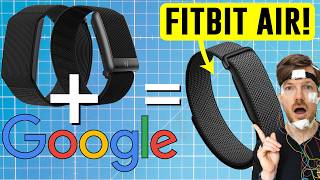
Google Fitbit Air launch and Google Health rebrand
TECH

Google Fitbit Air launch and Google Health rebrand

31+
Signals

Strategic Overview

  • 01.
    Google launched the Fitbit Air, a screenless 'pebble'-style fitness tracker, at $99.99 with pre-orders opening May 7, 2026 and retail availability starting May 26, 2026 in 20 markets.
  • 02.
    The Fitbit app is being rebranded as the Google Health app starting May 19, 2026 via an automatic over-the-air update, with Fitbit Premium becoming Google Health Premium and the annual plan rising from $79.99 to $99.99.
  • 03.
    A Gemini-powered Google Health Coach exits preview on May 19, supporting conversational logging of workouts, meals, and health records by text, voice, or photo upload.
  • 04.
    Google Fit will be shut down before the end of 2026, with a migration tool to move user data into the Google Health app arriving later in the year.

The Whoop Playbook, Inverted

Whoop spent the better part of a decade convincing serious athletes that a screenless wrist (and bicep) band was worth roughly $30 a month forever, with the hardware effectively bundled into the subscription. The Fitbit Air upends that mechanic from the opposite direction: $99.99 for the device, three months of Google Health Premium thrown in, and absolutely no required ongoing subscription to get the core functionality. TechCrunch and TechRadar both cast the Air as the 'Whoop-like' option, and the press release leans hard into the same product DNA — a 5.2-gram pebble, 12 grams with the strap, designed to be 'simple, affordable and comfortable enough to wear 24/7.'

The attack is structural, not just price-tagged. By stripping the screen, Google removes the comparison axis Apple Watch, Garmin, and the Pixel Watch all dominate, and instead competes on 'never have to think about it.' The optional Google Health Premium tier ($9.99/month or $99.99/year) becomes upside, not gating. And by handing every Fitbit Air buyer three months of Premium, Google gets a long enough window for the Gemini-powered coaching to either hook the user or reveal itself as inessential — without the buyer having ever felt subscription pressure at point of sale. Wearables YouTube has already started running the 'Whoop killer' framing on the launch, and Reddit's r/fitbit has explicit comments along the lines of being 'tired of paying Whoop monthly,' suggesting the pricing wedge is landing exactly where Google aimed it.

The Quiet Death of the Fitbit Brand

The Quiet Death of the Fitbit Brand
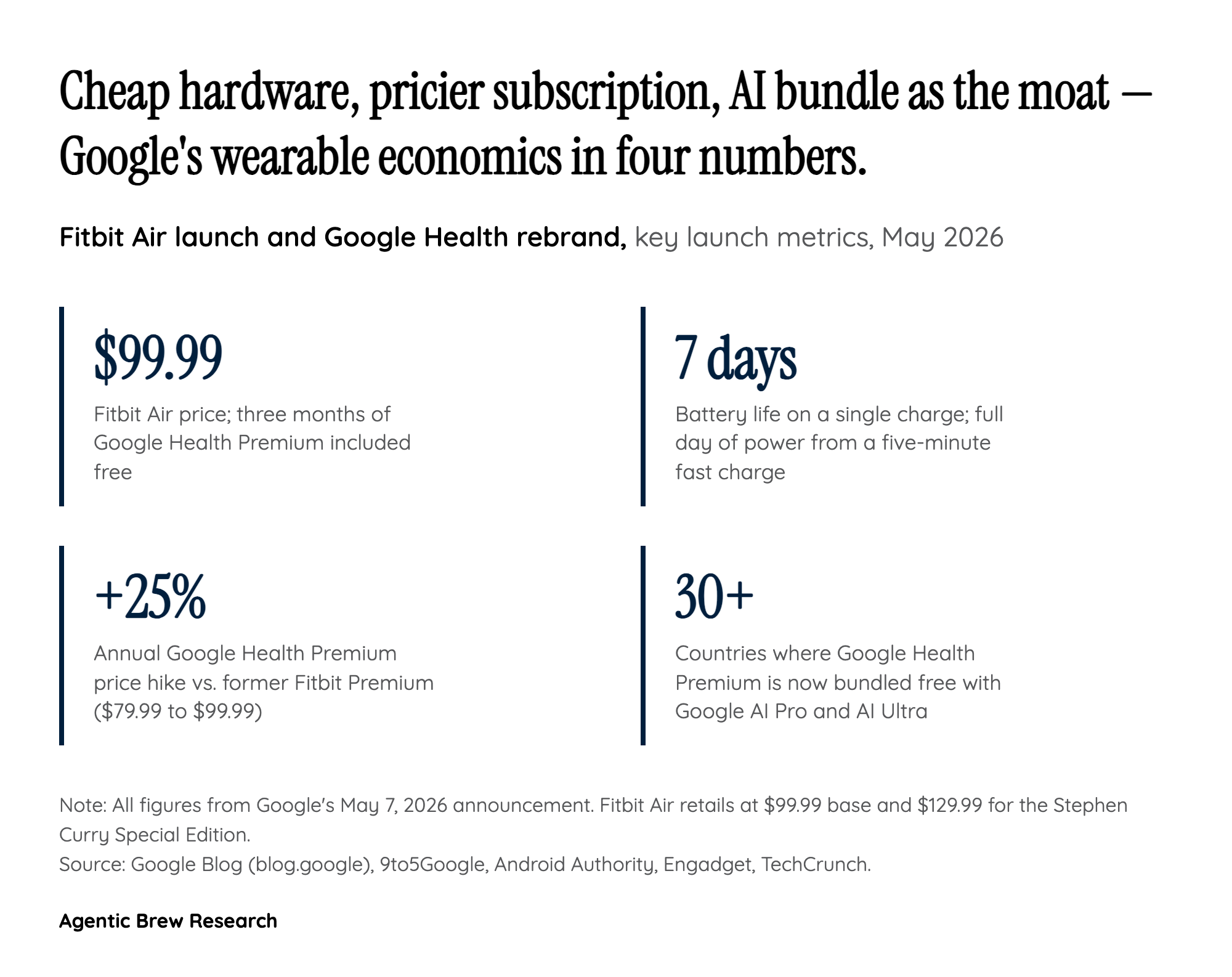
Key Fitbit Air launch metrics: hardware price, battery life, Premium price hike, and AI Pro bundle reach.

May 19, 2026 is the date the Fitbit name effectively ends. On that day, an automatic OTA update converts the Fitbit app into the Google Health app for every existing user; Fitbit Premium becomes Google Health Premium; existing data carries over with no manual migration; and the AI Health Coach moves out of preview. Two weeks later the Air ships as the first device launched under the Google Health umbrella rather than as a Fitbit-branded product (even though 'Fitbit Air' remains the SKU name). Before the year is out, Google Fit — Google's parallel fitness app dating from the Wear OS era — also shuts down, with a migration tool funneling its users into Google Health.

The transition isn't free for incumbents. Annual Fitbit Premium subscribers face a 25% price hike, from $79.99 to $99.99, even though the monthly tier holds at $9.99 — a small but pointed signal that Google sees more value in locking users into yearly commitments now that AI features anchor the tier. In exchange, Google Health Premium is bundled at no extra cost into Google AI Pro ($19.99/month) and AI Ultra in more than 30 countries, which converts the health subscription into a retention tool for Google's AI plans rather than a standalone P&L. The 2021 acquisition cost Google $2.1 billion; five years later, the brand absorption is finally complete and the value capture mechanism has shifted from selling Fitbits to selling Gemini access — with Fitbit user health data, per Google's binding 2021 commitment, still walled off from Google Ads.

Gemini Is the Real Product

Reading the launch as a wearable launch misses what Google is actually shipping. The hardware is intentionally minimal — no GPS, no altimeter, no ECG, no display — and Engadget pulled out the line that probably matters most: the new Health is 'powered by advanced new machine learning models that are 15% more accurate than our previous models.' The pitch is that Gemini, not the sensor stack, is now what closes the gap between raw biometrics and useful behavior change.

Mechanically, the Health Coach lets users log workouts, meals, and health records by dictating to it or by uploading photos or files — point your phone at a plate, get a meal entry; describe a run, get it logged; upload a lab PDF, get it indexed. That's a meaningful break from the typical fitness-app loop of tapping through dropdowns, and it explains why Google is willing to bundle Premium into AI Pro: the Health Coach is one of the most concrete, daily-use cases for a Gemini subscription Google has shipped. Tech analyst Max Weinbach captured the strategic read on X — Google Health is the unifying layer absorbing Fitbit's app and accepting data from any tracker, with Gemini built in. The Air becomes, in his framing, 'a nice entry product if you're just sorta curious about Google Health and don't want a watch.' The wearable is the funnel; the AI is the product.

What the $99 Price Tag Doesn't Buy

The hardware gaps are sharp enough that a coherent contrarian case writes itself. There is no built-in GPS — the Air piggybacks on the phone — no altimeter, no ECG, and notably no bicep band option, which DC Rainmaker's Ray Maker calls a serious omission for athletes who want to escape wrist-based optical heart-rate noise during weight training. Maker's blunt summary is that the Air is essentially a Fitbit Charge 6 with the display removed; the seven-day battery, while above Polar's, falls well short of Whoop's 14-day claim. For runners and cyclists who want to leave the phone behind, the Air is simply the wrong device.

The Reddit reception in r/fitbit sharpens the same critique from a consumer angle. Threads circle three concerns: missing GPS and altimeter for serious training, AI-and-data-privacy unease, and a sense that the form factor is a 'revamped Inspire 3' rather than a true new platform. Privacy-skeptical voices read the AI Health Coach push as a soft ask for medical-record access, while pro-minimalist commenters celebrate the screenless design as finally letting them wear a real watch on the other wrist. The honest read is that Google has chosen its battles: it's not trying to win the athlete segment Garmin and Whoop already own, it's trying to win the much larger middle of casual wearers who never wanted the Apple Watch tax in the first place — and trusting that the AI coaching layer, plus the Pixel Watch on the high end, will cover the gaps. Whether that bet survives the first round of reviews from accuracy-focused creators like The Quantified Scientist is the open question worth tracking through the May 26 ship date.

Historical Context

2019-11-01
Google announced its agreement to acquire Fitbit, kicking off a roughly 15-month antitrust review.
2021-01-14
Google completed the $2.1 billion acquisition of Fitbit with binding privacy commitments restricting use of health data for ads.
2022-08
Google rebranded Fitbit devices as 'Fitbit by Google' on Fitbit's website and the Google Store, beginning the slow brand absorption.
2025-10
Google unveiled a Gemini-powered Personal Health Coach in public preview within the Fitbit app, ahead of its 2026 graduation.
2026-05-07
Google formally announced the Fitbit Air, the Google Health app and Premium rebrand, the AI Health Coach exiting beta, and the Google Fit sunset.
2026-05-19
Fitbit app rolls into Google Health globally via OTA update; Health Coach exits preview with full launch.
2026-05-26
Fitbit Air goes on retail sale at $99.99 across 20 launch markets including the US, UK, Canada, Australia, Japan, Singapore, and 13 European countries.
2026-12-31
Google Fit is scheduled to shut down before the end of 2026, with a data migration tool to Google Health planned for later in the year.

Power Map

Key Players
Subject

Google Fitbit Air launch and Google Health rebrand

GO

Google (Health & Home division)

Owner of Fitbit since 2021 and the launch's central actor; absorbing Fitbit's app, subscription, and hardware roadmap into a Gemini-anchored Google Health platform.

RI

Rishi Chandra

GM of Health & Home at Google; positioning the rollout as an opening move in a longer effort to make health tools more accessible and intuitive.

WH

Whoop

Direct competitor in the screenless, subscription-coupled wearable category; Google explicitly engineered the Air as a cheaper, no-required-subscription alternative.

ST

Stephen Curry

Celebrity collaborator on the $129.99 Fitbit Air Special Edition Performance Loop Band, lending athletic credibility to the launch.

EX

Existing Fitbit Premium subscribers

Captive base being moved to Google Health Premium via OTA update; annual subscribers absorb a $20 price increase on renewal while the monthly tier holds at $9.99.

GO

Google AI Pro and AI Ultra subscribers

Beneficiaries of cross-product bundling: Google Health Premium is now included at no extra cost in 30+ countries, sweetening the AI subscription's value proposition.

Source Articles

Top 5

THE SIGNAL.

Analysts

"Frames the Fitbit Air as 'essentially taking a Fitbit Charge 6, and removing the display,' and flags the missing bicep band as a real ecosystem weakness compared with Whoop."

Ray Maker
Wearables and sports-tech reviewer, DC Rainmaker

"Notes the 7-day battery 'isn't as good as Whoop's 14-day claim (and reality), but is above Polar's battery life,' positioning the Air as a middle-of-the-pack endurance device."

Ray Maker
Wearables and sports-tech reviewer, DC Rainmaker

"Reads the launch as opening 'a new era of screenless fitness tracking to take on Whoop and Garmin' at a much lower upfront cost than incumbents."

TechRadar
Wearables and consumer tech publication

"Highlights Google's claim that Health is 'powered by advanced new machine learning models that are 15% more accurate than our previous models,' reframing the launch as fundamentally an AI upgrade."

Engadget
Consumer technology publication

"Frames the launch as the start of a longer effort: 'We're just getting started and will continue to make health more accessible and intuitive for everyone.'"

Rishi Chandra
GM, Health & Home, Google
The Crowd

"Google just announced Google Health It's a new Health suite taking the place of the Fitbit app, which lets you import data from ANY tracker and view/manage your health and wellness data. It also has Gemini built in with an AI coach to make recommendations or tracking easier"

@@mweinbach0

"Google also announced a Fitbit Air today It's an $100 tracker, similar in function to Whoop. It's nice! Been thinking about it for the past week after hearing about it, seems like a nice entry product if you're just sorta curious about Google Health and don't want a watch"

@@mweinbach0

"GOOGLE FITBIT AIR SPECIAL EDITION OPENS FOR PRE-ORDER TODAY AND HITS STORES IN THE U.S. ON MAY 26 FOR $129.99."

@@FirstSquawk0

"Google Fitbit Air is about to launch with no screen and a big AI health push"

@u/Maslakovic90
Broadcast
Fitbit Air Explained: A True Whoop Competitor?

Fitbit Air Explained: A True Whoop Competitor?

Fitbit Air: The Future of Fitbit ($100 WHOOP alternative)

Fitbit Air: The Future of Fitbit ($100 WHOOP alternative)

Let's talk about Fitbit Air (and the end of Fitbit!)

Let's talk about Fitbit Air (and the end of Fitbit!)