OpenAI Codex Feature Expansion: Appshots, Goal Mode, Plugin Sharing, and Advanced Annotation
TECH

OpenAI Codex Feature Expansion: Appshots, Goal Mode, Plugin Sharing, and Advanced Annotation

34+
Signals

Strategic Overview

  • 01.
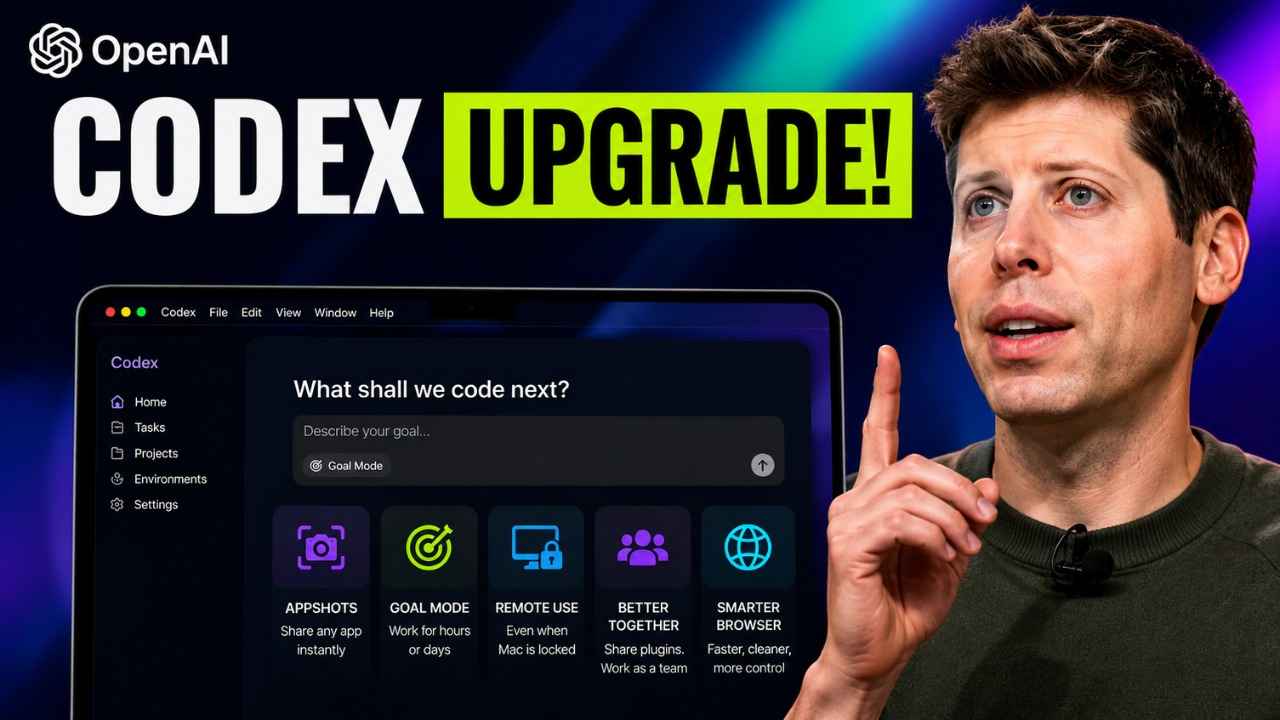
    On May 21, 2026 (build 26.519, internally dubbed 'Codex Thursday'), OpenAI shipped five Codex updates: Appshots, Goal Mode general availability, plugin sharing for ChatGPT Business, advanced in-app browser annotations, and remote computer use that keeps Codex operating Mac desktop apps after lock.
  • 02.
    Appshots lets Mac users press Command-Command to send the frontmost app window to a Codex thread with both a screenshot and accessible text, including content beyond what is visible onscreen.
  • 03.
    Goal Mode (`/goal`) has graduated from experimental to general availability across the Codex app, IDE extension, and CLI, with persistent objectives and pause/resume/clear controls supporting hours- or days-long runs.
  • 04.
    Plugin sharing distributes reusable bundles of skills, app connections, and MCP servers across ChatGPT Business workspaces (Enterprise on early access), gated by an admin-level `plugin_sharing` policy.

Appshots is a primitive, not a screenshot

The headline-friendly framing of Appshots — press Command-Command, send your window to Codex — undersells what's actually shipped. The capture uses a hybrid of macOS ScreenCaptureKit for the visual and the Accessibility APIs for structured text extraction, so Codex receives both the pixels of the frontmost window and the underlying accessible text tree, including content scrolled off-screen [1][2]. That detail matters: a Figma board, a long Slack thread, or a Jira ticket below the fold all arrive in the thread without the user having to scroll-and-stitch. Two more constraints reveal intent. Appshots default to opening a new thread, but if the user touched Codex within the last 60 seconds the capture is appended to that recent thread — supporting consecutive captures during an iteration loop without polluting history [1]. And the feature is Mac-only and explicitly unavailable from the CLI, requiring Screen Recording and Accessibility permissions [1].

Curtis Pyke at Kingy AI reads this as a deliberate human-AI handoff pattern: 'not just screenshot to chat,' but a least-friction primitive for visual context that the user fires on demand rather than streams ambiently [2]. The contrast with always-on recall products is the point — OpenAI is betting developers want a discrete capture key, not surveillance.


Goal Mode's real economics: autonomy is rationed, not free

The official pitch for Goal Mode going GA is straightforward — define a completion condition, a success-check method, and constraints, then let /goal run for hours or days with pause, resume, and clear controls [3][4]. What the announcement doesn't quantify is the cost. Reddit's r/codex community surfaced specific power-user numbers: one developer ran a 210-task backlog overnight in 28 hours, holding context over 7.8 million tokens through 31+ compactions — and burned 70% of their weekly quota on a $100 plan to do it. The same thread converges on a working heuristic of roughly 1% of weekly quota per hour on the xhigh tier.

Multi-hour autonomy is real, but it isn't free, and the pricing curve means that the canonical 'leave it running overnight' demo is a once-or-twice-a-week move on the lower-tier plans, not a daily workflow. The community's working consensus on what actually fits /goal is unusually clean: vulnerability identification and resolution across large codebases, framework or language migrations, and telemetry-driven refactors with crisp 'done' criteria. The bad fit is gameplay or feel-based work that needs human-in-loop review — exactly the kind of subjective task where the autonomy-versus-cost tradeoff inverts. Goal Mode GA, in other words, isn't a green light for every team; it's a green light for the engineering tasks that have a verifiable stopping condition.

The launch rollout exposed Codex's platform tier system

Two friction stories from launch day tell you more about OpenAI's roadmap than the feature list does. First, an OpenAI developer-experience engineer had to publicly walk users through manually enabling Goal Mode — codex features enable goals, then restart the app — and that workaround tweet attracted more engagement than the official launch announcement. Reddit corroborated the experience, with users noting /goal 'just started working without fanfare' for some and not at all for others until the manual flag was flipped. The pre-built Codex CLI v0.133.0 makes goals enabled by default, but the desktop app didn't ship that way.

Second, Windows-WSL users reported the update bricking their desktop app entirely; an OpenAI employee responded in-thread that Windows parity ships next week. Mac mobile relay — the remote computer use feature that lets Codex keep operating apps after lock and via Codex Mobile — was also flaky in field testing. The cumulative read is that Codex now has a clear platform tier hierarchy: Mac desktop is the reference target, CLI is the fast-moving substrate (v0.128/0.129 added persisted goals, codex update, Vim editing, allowlists, Hooks, and Programmatic Access Tokens), Codex for Chrome is the new browser surface, and Windows is the still-catching-up tail. For teams standardizing on Codex, this matters more than any individual feature: the same release rolls out to different audiences at different times.

Plugin sharing is the real enterprise wedge

The flashy features get the headlines, but plugin sharing is the move with the deepest commercial logic. Codex's plugin marketplace launched in March 2026 with 20+ integrations including Slack, Figma, and Notion and JSON-policy-based governance controls [5]. The May update lets ChatGPT Business workspaces distribute reusable bundles — skills, app connections, and MCP servers — to teammates, gated by an admin-level plugin_sharing = false policy in Codex cloud's Policies & Configurations, with Enterprise on early access and full rollout 'coming soon' [6][7].

This is the textbook network-effect playbook: once a team's internal AI tools are codified as plugin bundles and circulating inside one workspace, the switching cost compounds with every new plugin authored against the bundle. The Business-first/Enterprise-later stagger is calculated — it lets OpenAI demonstrate adoption and admin tooling at the SMB tier before promising the same to procurement-heavy enterprise buyers. The competitive frame matters too: The New Stack's hands-on review says Codex now matches Claude Code on breadth while Anthropic retains a quality edge, and Codex reports 1M+ active developers and 20x usage growth against Claude Code's reported $1B ARR [8][9]. Plugin sharing is how Codex turns breadth into stickiness — a feature Anthropic does not yet match at the workspace tier. The risk OpenAI's own docs flag is plugin sprawl and policy drift; the deliberate plugin_sharing switch and approval settings exist precisely because shadow tooling inside workspaces will follow.

Historical Context

2021-08-10
Unveiled the original Codex as a code-specialized GPT-3 descendant, scoring 28.8% on the HumanEval benchmark — the era when 'AI coding' meant single-function autocomplete.
2023-03-01
Deprecated the original Codex models from its API; Copilot moved to GPT-4 under Copilot X, effectively ending the first Codex chapter.
2025-05-16
Relaunched Codex as a full autonomous software-engineering agent in research preview, powered by codex-1 (an o3-based reasoning model) — the pivot from completion engine to agent.
2026-02-05
Released the Codex desktop app and the GPT-5.3-Codex model, followed a week later by GPT-5.3-Codex-Spark for lower-latency interactive coding.
2026-03-31
Launched the Codex plugin marketplace with 20+ integrations (Slack, Figma, Notion) and JSON-policy-based enterprise governance controls — the substrate that May's plugin sharing now distributes across teams.
2026-05-21
'Codex Thursday' shipped Appshots, Goal Mode GA, plugin sharing for Business, advanced annotation mode, and remote computer use in build 26.519 — five features that converge on the long-horizon, visually-grounded, team-distributed agent.

Power Map

Key Players
Subject

OpenAI Codex Feature Expansion: Appshots, Goal Mode, Plugin Sharing, and Advanced Annotation

OP

OpenAI

Vendor shipping the Codex update wave; controls feature rollout, the Codex Thursday cadence, and tier-gating between Business (plugin sharing now) and Enterprise (early access only).

CH

ChatGPT Business customers

First-tier beneficiaries of team-wide plugin sharing; can distribute skills, app connections, and MCP servers inside the workspace, gated by an admin-level plugin_sharing policy.

CH

ChatGPT Enterprise customers

Awaiting general plugin-sharing rollout; can request early access in the interim — a deliberate stagger that pressures enterprise procurement timelines.

MA

Mac frontend and game developers

Primary target users for Appshots and the in-app browser annotation mode — workflows where pointing at a pixel beats describing it in text.

AN

Anthropic (Claude Code)

Chief competitor and the reference point for Codex's strategy; reportedly at $1B ARR and still leading on raw code quality while Codex pushes feature breadth.

Fact Check

10 cited
  1. [1] Appshots — OpenAI Developers
  2. [2] Appshots: Inside OpenAI Codex's New Command-Command Trick for macOS
  3. [3] Follow goals with Codex — OpenAI Developers
  4. [4] OpenAI Codex /goal: The New Long-Horizon Mode for Agentic Coding
  5. [5] OpenAI Launches Plugin Marketplace with Codex Enterprise Controls
  6. [6] Plugins — OpenAI Developers
  7. [7] OpenAI upgrades Codex with Appshots, Goal Mode and more developer-focused tools
  8. [8] OpenAI Codex vs Claude Code — The New Stack
  9. [9] OpenAI Codex vs Claude Code: Business Adoption
  10. [10] Codex in-app browser — OpenAI Developers

Source Articles

Top 5

THE SIGNAL.

Analysts

"Frames Appshots as a deliberately constrained, on-demand visual-context primitive rather than ambient surveillance, positioned at the 'least friction' point in visual-context tooling for developers — 'OpenAI's bet on a very particular pattern of human-AI handoff.'"

Curtis Pyke
Author, Kingy AI

"Argues `/goal` represents a structural shift from 'answer this prompt' interaction to 'pursue this outcome' persistence — wiring app-server APIs, model tools, runtime continuation, and TUI controls into a single long-horizon loop."

Kingy AI analysis
Independent AI publication

"After testing the new features on a real Python codebase, calls Codex 'the strongest Claude Code rival yet' — but notes Codex pulls ahead on breadth while Claude Code retains the quality edge on raw code output."

The New Stack review
Developer publication review
The Crowd

"Codex app update: Appshots, goal mode, and more 26.519 What changed: • Appshots on macOS: press both Command keys to send the frontmost app window to Codex with a screenshot and available text • Goal mode is now generally available in the Codex app, IDE extension, and CLI • https://t.co/lhLeSW6NNc"

@@CodexReleases278

"Heads up: in the Codex app you might have to ask Codex to enable the feature. > Run `codex features enable goals` Then restart the app. We will have a fix rolling out soon to properly enable it by default."

@@dkundel571

"【朗報】Codex新機能「Appshots」が登場。Macでキーを両押しするだけで、作業中アプリの文脈をCodexに渡せる。 スクショ不要でこれは便利そう。 ・スクショ+利用可能テキストを取得 ・対応アプリなら画面外の文字も取得 ・直近60秒以内のスレッドへ自動追加 https://t.co/SQA0n8UMMP"

@@masahirochaen341

"Codex Update - 5/21/2026"

@u/DiarrheaButAlsoFancy211
Broadcast
OpenAI Codex Can Now Use Your Computer! (Full Breakdown + Testing)

OpenAI Codex Can Now Use Your Computer! (Full Breakdown + Testing)

OpenAI Codex Now Works from Anywhere (Dispatch Killer?)

OpenAI Codex Now Works from Anywhere (Dispatch Killer?)

Run long tasks in Codex using goals

Run long tasks in Codex using goals