Apple raises Mac mini starting price to $799
TECH

Apple raises Mac mini starting price to $799

37+
Signals

Strategic Overview

  • 01.
    Apple discontinued the $599 256GB M4 Mac mini on May 1, 2026, making the 512GB M4 model with 16GB RAM the new entry point at $799 — a $200 (~33%) jump in the starting price without any individual SKU's list price changing.
  • 02.
    Tim Cook attributed the squeeze to limited availability of the advanced process nodes Apple's SoCs ride on, paired with faster-than-expected customer adoption of Mac mini and Mac Studio as platforms for local AI and agentic workloads.
  • 03.
    Apple's Q2 Mac revenue hit $8.4 billion against expectations near $8 billion (Mac sales up 6% YoY), while total revenue rose 17% YoY to $111.2 billion — but the company warned of significantly higher memory costs in the current quarter as AI hyperscalers absorb DRAM supply.
  • 04.
    Even at the new $799 floor, the 512GB base model is backordered into mid-June, and Apple plans to begin assembling Mac minis in Houston later this year as part of a broader U.S. manufacturing buildout including TSMC Arizona, GlobalWafers, and Amkor.

Deep Analysis

A price hike that isn't a price hike: how Apple did SKU surgery instead

Apple did not raise the price of any single Mac mini configuration on May 1. The $799 model with 512GB storage already existed; the $599 model with 256GB storage simply vanished from the configurator. By the strict letter of Apple's price sheet, nothing got more expensive. By the practical reality of what a customer pays to walk in the door, everything did — by $200, or roughly a third.

Macworld's Jason Cross described the maneuver as the cleanest path to a margin-protecting hike: 'By removing the base storage tier rather than raising prices, Apple absorbs memory cost increases while maintaining profit margins through forced upgrades — customers now receive double the storage but pay $200 more.' That framing matters because it limits the headline damage. Apple can tell investors and regulators it did not raise prices, while telling the supply chain it has effectively repriced the product. The optics gap is the entire point of the move. It also creates a cleaner narrative for the inevitable next round: if memory costs keep climbing, the same playbook can retire the next-cheapest tier, and the entry price drifts upward without ever triggering a 'Apple just raised prices' news cycle until — as happened here — the bottom rung disappears entirely.
Three shortages stacked on top of each other

Three shortages stacked on top of each other
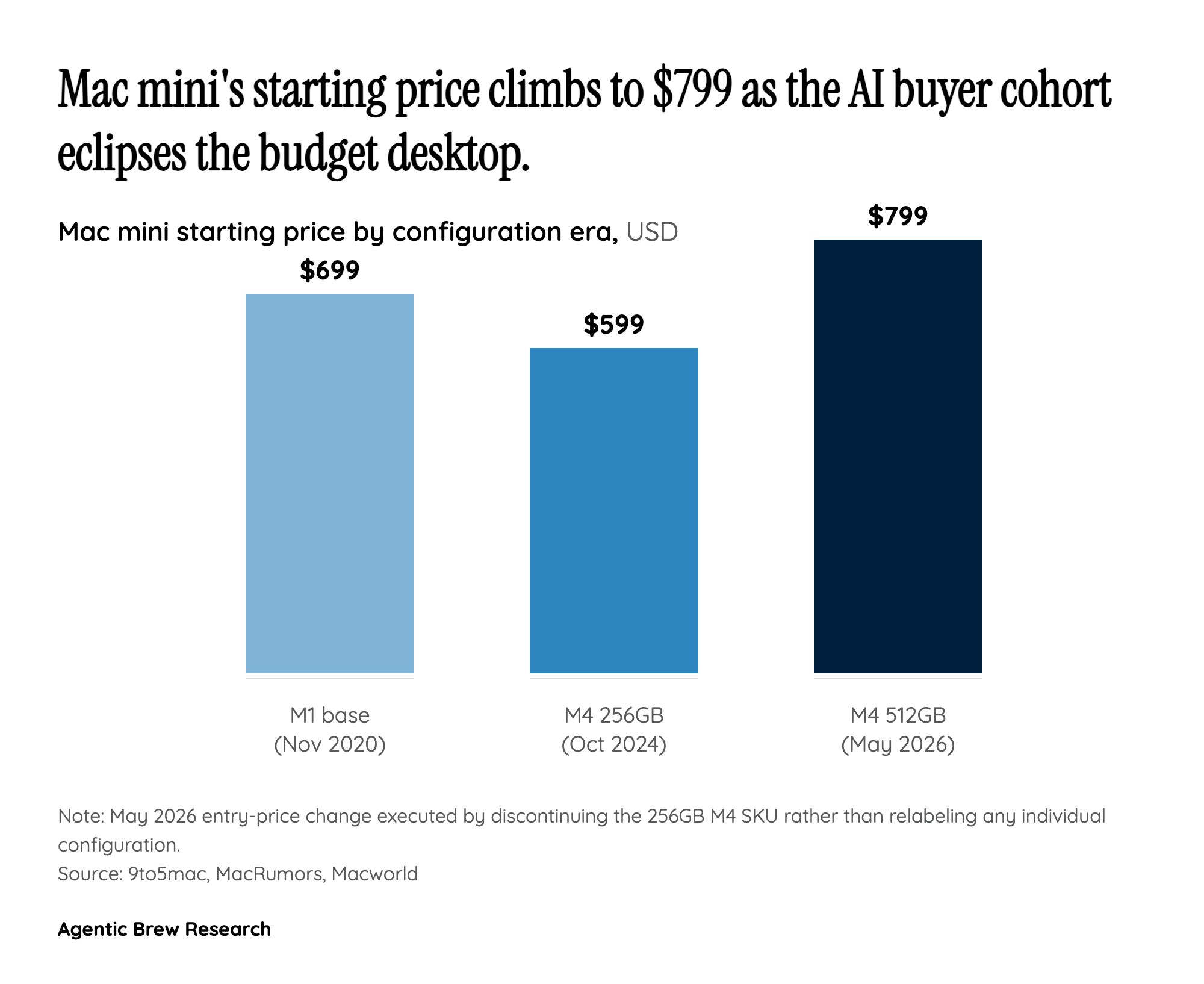
Mac mini starting price by configuration era — $699 (M1, 2020) → $599 (M4 256GB, 2024) → $799 (M4 512GB, 2026).

Tim Cook's earnings-call explanation pointed at one constraint — advanced-node chip availability — but the Mac mini story is really three shortages compounding. The first is silicon: the leading-edge process nodes that fabricate Apple's M-series SoCs are physically supply-constrained, with Cook saying the squeeze would not 'end anytime soon' and projecting several months before supply and demand rebalance. The second is DRAM: AI hyperscalers building data centers are absorbing high-capacity memory chips, pushing prices up sharply enough that Apple warned investors of 'significantly higher memory costs' this quarter. The third is downstream demand: customers buying Mac minis specifically to run local LLMs and agentic tools, a use case Apple did not forecast at the volume it materialized.

None of these alone would be enough to retire the $599 SKU. Stack them and Apple's calculus changes. The cheapest configuration is the one most exposed to every input cost — its bill of materials is dominated by chip and memory costs that have no margin to absorb increases. When DRAM prices rise and the cheapest Mac mini already sells through faster than Apple can build it, the rational move is to delete that configuration and let demand redistribute upward. The $799 floor is what falls out of that equation. As Cook put it on the call, Apple 'just under-called the demand,' and the Mac mini price floor is the visible artifact of that miscalculation.

The Mac mini quietly became a personal AI server

The Mac mini's positioning has shifted under Apple's feet. For two decades the device was Apple's cheapest desktop, marketed as a starter Mac or a switcher's bridge from Windows. The M-series transition added a second use case as a developer machine and creative workstation. Over the last several months, a third use case has eclipsed both: the Mac mini as a personal AI server. Developer-focused YouTube creators have demonstrated multi-billion-parameter models running on the base 16GB M4, OpenClaw and similar local agentic frameworks have drawn AI hobbyists who want terminal-level access without sending data to a cloud API, and the Mac mini's low idle power draw makes it viable as an always-on home appliance. TechCrunch's Sarah Perez identified the dynamic clearly, noting that Apple's power-efficient Mac minis 'have become popular devices for testing and running at-home, on-device AI models, beginning with the OpenClaw craze but now extending to OpenClaw alternatives.'

This reframing is what Apple's pricing is responding to. A budget desktop sold to switchers is price-elastic — push it above $700 and you lose volume. A personal AI server bought to run local LLMs is far less price-elastic, especially when the alternative is renting equivalent inference from a cloud provider. The customers showing up at $599 will pay $799 because the math against ongoing API spend still works. Apple effectively discovered a new buyer cohort for an existing product and priced accordingly. The cost is the loss of Mac mini's identity as the cheap entry into the Mac ecosystem — the audience that bought it as 'my first Mac' is the one most likely to balk at the new floor.

The skeptical counter-read: a rebase, not a hike — and an AI fad to boot

Not everyone is treating this as a price increase. A widely-upvoted contrarian thread on r/macmini argued the move is not a price hike at all: Apple just removed the 256GB SKU and rebased on 512GB, and dollar-per-GB is roughly unchanged. That math is technically defensible: customers do receive double the storage, NVMe and SSD prices have roughly doubled in the same window — one Reddit thread cited a 2TB WD 850 going from $158 to $360 — and the marginal cost-per-gigabyte at $799/512GB is comparable to the old $599/256GB tier. By that lens, Apple is passing through component cost reality rather than capturing margin.

A second strain of skepticism targets the demand story itself. One commenter bluntly predicted that '99% of the people buying it to run local models are going to be very disappointed,' and other threads estimated that the bulk of Mac mini 'AI' usage is actually just calling cloud APIs from an idle machine — the local-LLM narrative is, on this read, vibes more than workload. If that view is right, much of the demand spike Cook described is fad-driven, which has uncomfortable implications: Apple is repricing the entire Mac mini line around a buyer cohort that may evaporate when the OpenClaw novelty fades and people realize their 16GB unified-memory desktop is not, in fact, replacing a GPU cluster. The two skeptical reads cut in different directions — one says the price is fair, the other says the demand is fake — but both push back on the cleanest version of the bullish AI-PC story Apple is selling investors.

Historical Context

2005-01-11
Apple introduced the original Mac mini as the first sub-$500 Mac, with the entry 1.25 GHz/40GB model at $499 and a 1.42 GHz/80GB model at $599 — establishing Mac mini's identity as Apple's cheapest-desktop promise.
2020-11-10
The Apple silicon era began with the M1 Mac mini at $699, dropping the entry price by $100 versus the late Intel-era model and demonstrating the unified-memory architecture that would later make Mac mini compelling for local AI workloads.
2024-10-29
Apple shipped the redesigned M4 Mac mini — the first chassis redesign since 2010 — starting at $599 with 16GB RAM and 256GB SSD, the configuration that would become the AI hobbyist favorite.
2026-02-24
Apple announced Mac mini production will begin in Houston later in 2026 — the first U.S. assembly of Mac mini — anchored by a 20,000 sq-ft Advanced Manufacturing Center and tied to well over 100 million advanced TSMC Arizona chips this year.
2026-03
Apple discontinued the 512GB-storage configuration of the Mac Studio — an early signal of the storage and memory squeeze that would ultimately remove the 256GB Mac mini from the lineup weeks later.
2026-04-24
With Apple's $599 base Mac mini sold out for the first time, marked-up units appeared on eBay at $715–$925 for new/open-box and up to $979 refurbished, an early secondary-market signal that Apple's pricing was misaligned with demand.
2026-05-01
Apple removed the 256GB M4 Mac mini configuration entirely from its configurator, lifting the Mac mini starting price to $799 with the 512GB SKU and ending the Mac mini's two-decade run as a sub-$700 desktop.

Power Map

Key Players
Subject

Apple raises Mac mini starting price to $799

AP

Apple Inc.

Manufacturer engineering the price floor upward by retiring the 256GB tier rather than relabeling individual SKUs, absorbing memory cost pressure while protecting nominal margins.

TI

Tim Cook (Apple CEO)

Public face of the constraint narrative on the Q2 earnings call, framing the shortage as advanced-node chip availability plus underestimated AI/agentic demand; also champion of the Houston Mac mini assembly line.

TS

TSMC (Arizona facility)

Critical advanced-node fab supplier; Apple is on track to purchase well over 100 million advanced chips from TSMC's Arizona plant in 2026, the chokepoint Cook cited.

AI

AI hyperscalers and cloud providers

Driving the global high-capacity DRAM shortage by absorbing memory supply for AI server farms, pushing consumer PC makers like Apple into a second-priority buyer position and lifting memory input costs.

LO

Local-AI developers and hobbyists

The demand spike Apple under-called: buyers running on-device LLMs and agentic tools on Mac mini's power-efficient unified-memory architecture, exhausting the $599 base SKU and feeding eBay markups.

CI

City of Houston and U.S. manufacturing partners

Apple is doubling its Houston campus to begin Mac mini assembly later in 2026, part of a broader U.S. investment that includes $4B at GlobalWafers in Sherman, TX and $7B at Amkor in Peoria, AZ.

Source Articles

Top 3

THE SIGNAL.

Analysts

"The bottleneck is silicon, not engineering or factories. Cook told investors the constraints were primarily driven by the availability of the advanced process nodes Apple's SoCs are produced on — a TSMC capacity story rather than an Apple execution story."

Tim Cook
CEO, Apple

"Demand surprised Apple from the top. Cook described Mac mini and Mac Studio as 'amazing platforms for AI and agentic tools' where customer recognition arrived faster than the company predicted, generating higher than expected demand and a multi-month catch-up timeline because Apple 'just under-called the demand.'"

Tim Cook
CEO, Apple

"The crunch is product-specific rather than a universal supply chain failure. Apple's power-efficient Mac minis have become popular devices for testing and running at-home, on-device AI models — beginning with the OpenClaw craze and now extending to OpenClaw alternatives — which is what bid up eBay prices and emptied Apple's base configuration."

Sarah Perez
Consumer News Editor, TechCrunch

"Apple has chosen the cleanest path to a price hike. By removing the base storage tier rather than raising prices, Apple absorbs memory cost increases while maintaining profit margins through forced upgrades — customers now receive double the storage but pay $200 more, and no individual configuration shows a higher price tag."

Jason Cross
Senior Editor, Macworld
The Crowd

"Apple has discontinued the Mac Mini M4 256GB base model worldwide. The lineup now starts from 512GB. Here's what the new base pricing looks like: US — $799, India — Rs 79,900. The move comes amid a global memory shortage, driven by surging demand for memory chips from the AI"

@@yabhishekhd0

"AI Demand Drives Inventory Shortages: Apple Raises Mac mini Starting Price by $200. Apple has raised the starting price of the Mac mini from $599 to $799, reflecting inventory shortages driven by AI demand and tighter processor supply. The price increase was effectively"

@@jukan050

"This is only the beginning. Eventually, prices for all IT consumer products are going to rise sharply."

@@jukan050

"Apple Stops Offering Mac Mini With 256GB of Storage, Starting Price Rises to $799"

@u/pdfu1100
Broadcast
Mac Mini M4 + OpenClaw Is Dangerous

Mac Mini M4 + OpenClaw Is Dangerous

Why Everyone Is Buying M4 Mac Minis for AI

Why Everyone Is Buying M4 Mac Minis for AI

Apple Quietly KILLED the $599 Mac Mini

Apple Quietly KILLED the $599 Mac Mini