Anthropic Mythos AI cybersecurity concerns
TECH

Anthropic Mythos AI cybersecurity concerns

40+
Signals

Strategic Overview

  • 01.
    Anthropic announced Claude Mythos Preview on April 7, 2026 as an unreleased frontier model capable of autonomously identifying and exploiting zero-day vulnerabilities in every major operating system and web browser when directed by a user.
  • 02.
    Instead of a public release, Anthropic launched Project Glasswing, a defender-first program providing Mythos access to over 40 critical-infrastructure organizations, backed by $100M in usage credits and $4M in donations to open-source security groups.
  • 03.
    The NSA is reportedly among Mythos's restricted users, scanning environments for exploitable vulnerabilities even as the Pentagon has labeled Anthropic a supply-chain risk after the company refused unrestricted access for surveillance and autonomous-weapons use cases.
  • 04.
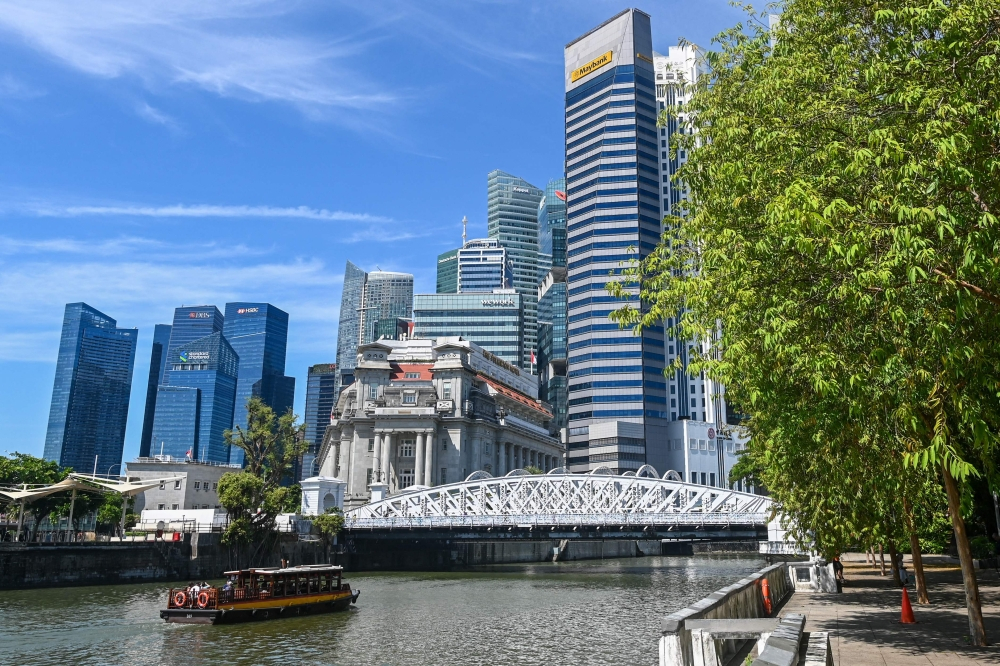
    The Monetary Authority of Singapore has urged banks to redouble cyber defenses amid Mythos concerns, with Hong Kong and South Korean regulators following suit in the first pan-Asian regulatory response to a specific frontier AI model.

Deep Analysis

The NSA-Pentagon Schism: One Agency Uses Mythos While the Other Blacklists Its Maker

The most consequential thing about the Mythos story isn't what the model can do — it's what the model is doing to the US national-security apparatus. According to Axios and TechCrunch reporting, the NSA appears to be among the roughly 40 organizations with Mythos Preview access, using it primarily to scan environments for exploitable vulnerabilities. That is a direct offensive-signals-intelligence use case, executed through Anthropic's restricted Project Glasswing channel. Simultaneously, the Department of Defense has formally labeled Anthropic a 'supply-chain risk' after the company refused to grant Pentagon officials unrestricted access to its models' full capabilities, particularly for mass-surveillance and autonomous-weapons use cases.

These two facts cannot be comfortably reconciled. The Pentagon is saying Anthropic cannot be trusted as a government vendor. The NSA is operating Anthropic's most capable offensive tool against real targets. The White House response — Dario Amodei meeting Chief of Staff Susie Wiles and Treasury Secretary Scott Bessent on April 17 — suggests the administration sees the friction itself as the problem to be managed, not either side's position. For enterprise security teams, the practical takeaway is that US government policy on frontier AI is no longer a single-valued function: the same model can be blacklisted and operationally deployed by different arms of the same government on the same day. Procurement, export-control, and third-party-risk playbooks assuming a unified federal stance will need to account for this fracture.
Project Glasswing: A New Distribution Template Where the Vendor Picks the Defenders

Anthropic did not simply decline to release Mythos; it built an entire alternative distribution model around the decision. Project Glasswing gives access to roughly 40 critical-infrastructure organizations — AWS, Apple, Broadcom, Cisco, CrowdStrike, Google, JPMorgan Chase, the Linux Foundation, Microsoft, NVIDIA, and Palo Alto Networks among them — backed by $100 million in Mythos usage credits and $4 million in direct donations split between Alpha-Omega/OpenSSF ($2.5M) and the Apache Software Foundation ($1.5M). Post-preview API pricing is set at $25 per million input tokens and $125 per million output tokens for Glasswing participants.

This is a meaningfully new posture in AI distribution. Historically, frontier models ship publicly (with safety filters) or stay fully internal. Glasswing is a third option: the vendor pre-selects a closed club of defenders, front-loads subsidy, and uses the restricted phase to burn down as much of the attack surface as possible before wider release. Anthropic says Mythos has already identified thousands of high- and critical-severity zero-days, including a 27-year-old OpenBSD bug and a 16-year-old FFmpeg H.264 codec flaw — vulnerabilities that sat latent for decades until a sufficiently capable model looked. The template has obvious appeal — aligned incentives between vendor and defenders, concentrated remediation capacity — and obvious hazards: the vendor becomes de facto arbiter of who counts as a legitimate defender, and any breach of the inner ring (unauthorized access to Mythos was reported within days of the preview) becomes a single point of failure for the entire approach.

The Skeptics' Case: Why Mythos May Be Oversold

Not everyone is buying the apocalyptic framing, and the skeptics include people whose views normally carry weight. OpenAI's Sam Altman, on the Core Memory podcast, accused Anthropic of 'fear-based marketing,' comparing the messaging to selling a bomb shelter for $100 million after announcing you've built the bomb. Georgia Tech's Peter Swire — a former Clinton and Obama White House advisor — told Scientific American the announcement was 'very dramatic and was a PR success, if nothing else,' adding that many cybersecurity academics view Mythos as an expected incremental step rather than a paradigm shift. Oxford's Ciaran Martin, former CEO of the UK National Cyber Security Centre, called Mythos 'a big deal' but unlikely to be 'the end of the world.' On Reddit, communities covering the announcement skew sharply in the same direction, with the dominant sentiment treating the 'too dangerous to release' positioning as marketing theater — especially after the unauthorized-access leak.

The economic logic is the sharpest contrarian point: if Mythos were truly as far ahead of the field as Anthropic implies, the profit-maximizing move would be to keep it in-house and monopolize the vulnerability-research market, not license it out for $25 / $125 per million tokens to eleven of the world's biggest tech and finance firms. The counter-read is that Anthropic's strategy is coherent precisely because Mythos is a big step but not a singular one — the company expects competitors to arrive at comparable capability soon, so the play is to set the defender-first norm now and capture the associated brand, policy access, and enterprise relationships. Both readings can be true. What they share is a warning against taking any single party's framing at face value: the vendor's, the regulator's, or the competitor's.

By The Numbers: The Capability Jump AISI and Anthropic Tried to Quantify

By The Numbers: The Capability Jump AISI and Anthropic Tried to Quantify
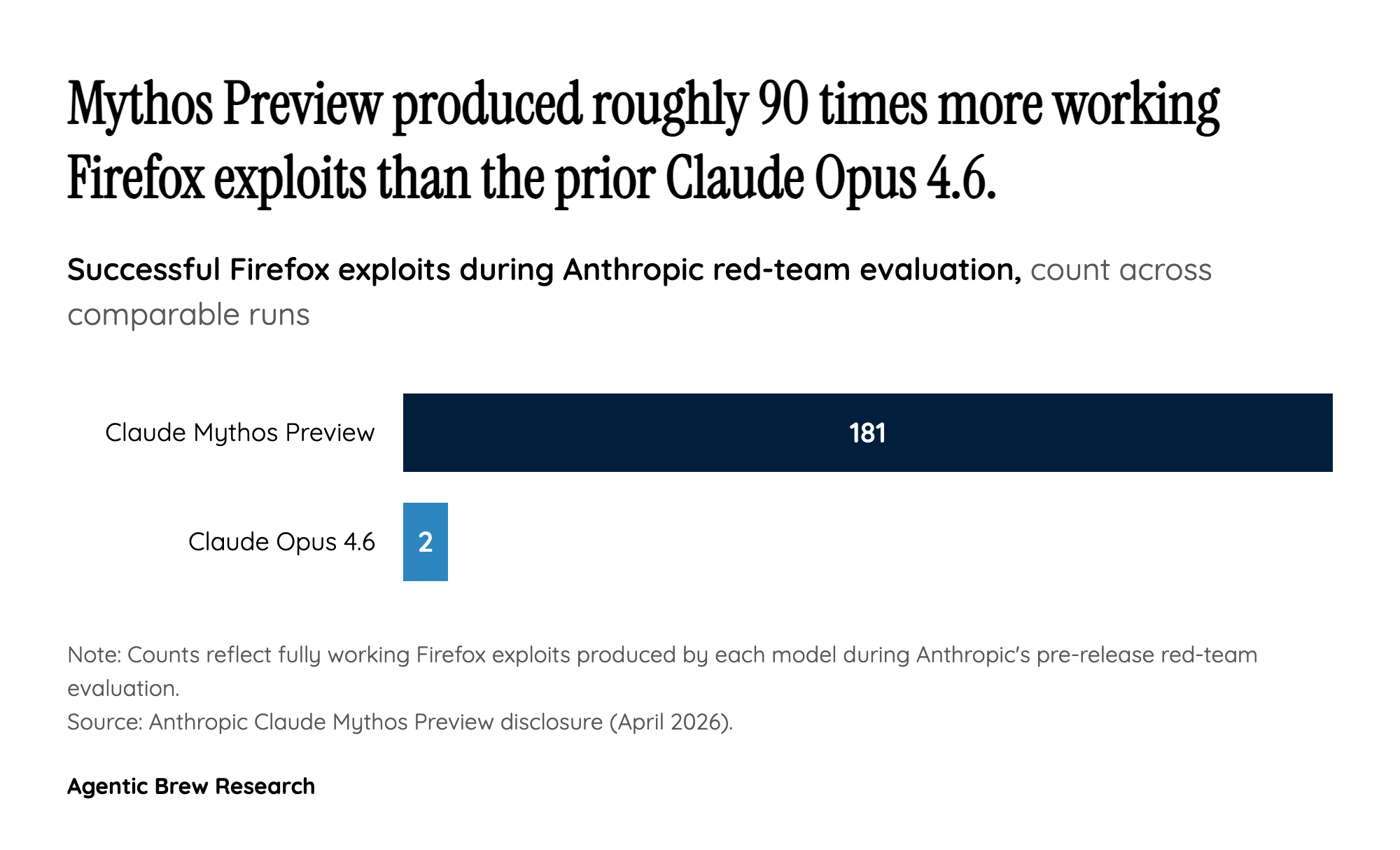
Mythos Preview vs. Claude Opus 4.6 on fully working Firefox exploits during Anthropic's red-team evaluation. Source: Anthropic Mythos Preview disclosure.

The benchmarks behind the Mythos narrative are concrete enough to scrutinize. Anthropic's red-team disclosure reports that Mythos produced working Firefox exploits 181 times compared to just 2 successes for Claude Opus 4.6 — a roughly ninety-fold step. On OSS-Fuzz benchmarks the model triggered 595 crashes at tiers 1 and 2, and achieved full control-flow hijack on 10 separate fully-patched targets. Engineers at Anthropic with no formal security training reportedly asked Mythos to find remote-code-execution vulnerabilities overnight and woke to complete working exploits.

The UK AI Safety Institute's independent evaluation adds external ballast: Mythos solved expert-level CTF tasks 73% of the time and became the first model to complete AISI's 'The Last Ones' simulated multi-stage attack scenario end-to-end, doing so in 3 of 10 attempts. These are the numbers regulators are reacting to, and they also represent the strongest case against the Altman-Swire skepticism — the jump between Opus 4.6 and Mythos Preview on the same internal benchmarks is not a marketing artifact. What the benchmarks cannot settle is the question Ciaran Martin raises: whether this level of offensive capability, in the hands of ~40 pre-cleared defenders plus an unknown number of adversaries racing to build equivalents, tilts net security toward safer or more dangerous.

How Asia Became the First Region to Respond at the System Level

While Washington was still negotiating with itself, Singapore activated the first pan-regional financial-sector response to a named frontier AI model. The Monetary Authority of Singapore urged financial institutions to 'redouble efforts to strengthen their security defences, pro-actively identify and close vulnerabilities, and raise vigilance on cyber hygiene, including timely security patching.' The Hong Kong Monetary Authority and South Korea's Financial Supervisory Service followed with parallel outreach to major banks and their information-security officers, and Australian regulators ASIC and APRA are among those monitoring the situation.

The speed and coordination matter. The typical regulatory lag between a frontier AI capability announcement and a sectoral supervisor response is usually measured in quarters or years, not days. That it happened in days here reflects two things: first, the cyber mechanism is unusually legible to financial regulators — patch faster, scan harder, raise hygiene — in ways that more speculative AI harms are not. Second, Asian regulators are demonstrating a muscle memory for cross-border coordination on cyber threats that their US and European counterparts have not yet visibly activated around Mythos. For multinationals, the operational implication is that the Asia financial cluster is where Mythos-related compliance pressure will show up first, with examination questions, attestation requirements, and patching-cadence expectations likely to tighten before similar pressure arrives elsewhere.

Historical Context

2026-03-26
Data leak first revealed the existence of an internal Anthropic model called Mythos, described as a step change in capabilities.
2026-04-07
Anthropic officially announced Claude Mythos Preview and launched Project Glasswing with roughly 40 critical-infrastructure partners instead of a public release.
2026-04-16
Anthropic released Claude Opus 4.7, positioned as a less risky public-facing model sitting below Mythos in the capability stack.
2026-04-17
Anthropic's CEO met White House Chief of Staff Susie Wiles and Treasury Secretary Scott Bessent over Mythos deployment and the Pentagon's supply-chain-risk designation.
2026-04-19
Axios and TechCrunch reported that the NSA is using Mythos despite the Pentagon's supply-chain-risk designation of Anthropic, surfacing an open rift inside the US national-security apparatus.
2026-04-20
The Monetary Authority of Singapore urged banks to strengthen cyber defenses; the Hong Kong Monetary Authority and South Korea's Financial Supervisory Service followed with heightened vigilance.
2026-04-21
On the Core Memory podcast, OpenAI CEO Sam Altman labeled Anthropic's Mythos positioning fear-based marketing, sharpening the competitive-narrative fault line in frontier AI.

Power Map

Key Players
Subject

Anthropic Mythos AI cybersecurity concerns

AN

Anthropic

Developer of Mythos; gatekeeper controlling access via Project Glasswing; declined public release citing offensive-cyber risk; committed $100M in usage credits and $4M in donations to open-source security organizations including Alpha-Omega/OpenSSF and the Apache Software Foundation.

US

US National Security Agency (NSA)

Reportedly using Mythos Preview to scan environments for exploitable vulnerabilities — operational signal of divergence inside the US national-security apparatus regarding Anthropic.

US

US Department of Defense (Pentagon)

Labeled Anthropic a supply-chain risk after the company refused unrestricted access for mass-surveillance and autonomous-weapons use cases; now in open tension with NSA's continued Mythos use.

WH

White House (Susie Wiles, Scott Bessent)

Chief of Staff Susie Wiles and Treasury Secretary Scott Bessent met with Dario Amodei to discuss Mythos deployment in government; talks described as productive and constructive.

MO

Monetary Authority of Singapore (MAS) and Asian peer regulators

MAS has urged banks to bolster cyber defenses and accelerate patching; the Hong Kong Monetary Authority and South Korea's Financial Supervisory Service are engaging banks' information-security officers in parallel — the catalyst for a coordinated Asian financial-sector response.

PR

Project Glasswing partners

AWS, Apple, Broadcom, Cisco, CrowdStrike, Google, JPMorgan Chase, Linux Foundation, Microsoft, NVIDIA, and Palo Alto Networks are defensive users of Mythos Preview, scanning their own codebases and critical open-source infrastructure.

UK

UK AI Safety Institute (AISI)

Independent government evaluator; validated Mythos as a step up over prior frontier models for cyber capabilities, documenting autonomous multi-stage attack behavior.

THE SIGNAL.

Analysts

"Defends restricted release as prudent preparation for more powerful cyber-capable models on the horizon: 'More powerful models are going to come from us and from others, and so we do need a plan to respond to this.'"

Dario Amodei
CEO, Anthropic

"Accuses Anthropic of 'fear-based marketing' around Mythos, arguing the restricted-access posture concentrates AI power while inflating prices: 'It is clearly incredible marketing to say, We have built a bomb, we are about to drop it on your head. We will sell you a bomb shelter for $100 million.'"

Sam Altman
CEO, OpenAI

"Reads the announcement as more narrative than paradigm shift: 'The Anthropic announcement was very dramatic and was a PR success, if nothing else.' Many cybersecurity academics see Mythos as an expected incremental step."

Peter Swire
Professor, Georgia Tech School of Cybersecurity and Privacy; former Clinton and Obama White House advisor

"Pushes back on apocalyptic framings while acknowledging the stakes: 'It's a big deal, but it's unlikely to prove to be the end of the world.'"

Ciaran Martin
Professor of Practice, Blavatnik School of Government, University of Oxford; former CEO of UK National Cyber Security Centre

"Classifies Mythos as the first model to complete its 'The Last Ones' simulated attack scenario end-to-end: 'Claude Mythos Preview is the first model to solve TLO from start to finish, in 3 out of its 10 attempts.' AISI also observed autonomous multi-stage attacks on vulnerable networks."

UK AI Safety Institute
Government AI evaluator
The Crowd

"Anthropic's Mythos has been accessed by a small group of unauthorized users, raising questions about control of the AI model. Anthropic's Mythos Model Is Being Accessed by Unauthorized Users (bloomberg.com)"

@@business394

"FINANCE: POWELL, BESSENT AND TOP BANK CEOs HOLD CLOSED-DOOR MEETING OVER ANTHROPIC'S MYTHOS AI MODEL CYBERSECURITY RISKS. Federal Reserve Chair Jerome Powell and Treasury Secretary Scott Bessent summoned top bank CEOs to the Treasury Department in Washington this week to..."

@@BSCNews3300

"Anthropic's Mythos model is being accessed by unauthorized users, according to Bloomberg. Anthropic says there's no evidence the access affected its systems. But the fact that the most powerful cybersecurity AI model ever built has an access control problem is the story."

@@TFTC213100

"What's up with Anthropic's Mythos being too dangerous to release and finance ministers, banks and federal reserve expressing concerns?"

@u/Lairuth397
Broadcast
The AI Model That Frightens Wall Street

The AI Model That Frightens Wall Street

The AI Model TOO POWERFUL to be Released to the Public...

The AI Model TOO POWERFUL to be Released to the Public...

Mythos is real and it scares me...

Mythos is real and it scares me...